




false
Category
Author
Search for Articles
Trending Keywords
Category
Author
Search
Category
Author
Search
Editor's Pick
Savings and Investment

[Guide to Savings Insurance Choices] Life stage determines the policy best suited to you

2026-07-03 5min read

According to Swiss Re Institute’s latest sigma No 2/2025 report, Hong Kong’s life insurance penetration rate reached 15.7% in 2024, ranking first in the world for the second consecutive year. Per capita premiums also amounted to as much as US$8,624¹, making it arguably the city with the most insurance coverage in the world, where almost everyone has a policy in hand. However, 10Life took a closer look at the composition of new business premiums and found that in 2024, policy premiums for newly written non-investment-linked business totalled HK$195.7 billion, of which participating business accounted for 89.4% of the related new policy premiums² — meaning nearly 90% of new premiums were highly concentrated in participating savings-type products.

This market structure led 10Life to question: does being first in the world by premium volume truly reflect that the public has put proper protection planning in place? Or are most people simply following the crowd and blindly flocking into the same type of products? 

What psychological factors lie behind the illusion of the “perfect policy”? 

You often hear people say: “When you’re a child, you make choices; I want everything.” This popular internet phrase perfectly captures the mentality many people have when buying insurance: wanting a bit of everything. To meet this demand, many insurers package participating savings policies as all-round solutions that appear to do it all — offering stable returns, flexibility and protection, and even the ability to pass wealth on. In short, they use the idea of being able to advance or retreat as needed to precisely tap into people’s “I want it all” mindset.

Many insurance agents today promote “perfect products” that can meet a wide range of needs. But different life stages naturally call for different financial priorities. No single insurance plan, however ideal it may seem, can simultaneously satisfy the needs of employees, parents, entrepreneurs and retirees. Buying a product that does not match your own life stage simply by following the crowd may, at best, tie up your funds and cause you to miss opportunities; at worst, it could derail your entire retirement plan. Rather than imagining that one policy can protect you for life, it is better to learn to make the right decisions at the right time. 

“The Perfect Policy” delays retirement by seven years 

Mr Chan, who is now 50, regards a participating savings policy he bought with colleagues 10 years ago as the decision he regrets most to this day. When he was 40, he saw colleagues around him buying one participating savings policy after another and was tempted himself. Introduced by a friend, an insurance agent described the plan as a “one-size-fits-all” solution: it could be used to save for his children’s education fund, build up his own retirement reserve, and even be passed on to the next generation. It sounded as though one policy could solve every problem. So he signed up for a long-term participating savings plan with an 8-year premium payment period, fully expecting his money to grow steadily and compound over time.

Ten years on, both of Mr Chan’s children have been admitted to universities in the UK, where annual tuition and living expenses can easily reach HK$400,000. When he opened the policy and planned to make a withdrawal for an emergency, he was shocked to face a harsh reality: after holding the plan for 10 years, he was still not in the black; cashing out early would not only mean taking a loss on his principal, but would also interrupt the compounding effect of the money, leaving the actual return lower than the figure projected in the original proposal and causing Mr Chan to be badly off his estimates. In the end, Mr Chan could only reluctantly apply for an education loan with a relatively high interest rate to meet the urgent expenses. What had originally been planned as retirement at 60 has now been delayed by a full seven years, due to the additional debt and the large sum of savings being locked inside the policy and unavailable for use. The man who once believed that one policy could solve all his problems now deeply regrets it.

In fact, there are costs behind every savings insurance policy, and insurers find it difficult to design a perfect product that is “profitable in the short term and profitable in the long term”. Mr Chan’s experience is by no means an isolated case. The so-called “perfect policy” is usually intended to generate higher cash value over the long term, and the underlying investments are often higher-risk assets, so the returns in the first 10 years may not be impressive. Ultimately, the issue has never been with the product itself. Participating savings plans do have their value; the key is whether you have chosen the right one.  

There is more than one answer at different stages of life 

Buying insurance is not like buying clothes. A one-size-fits-all T-shirt can be worn by anyone, but an insurance plan is difficult to suit every stage of life. Each life stage comes with its own wealth planning challenge: working adults need disciplined savings; after starting a family, they may look for flexible withdrawals for children’s education funds; in retirement, they seek stable cash flow and medical protection; and some may even plan for intergenerational wealth transfer. Different challenges require different solutions and answers.

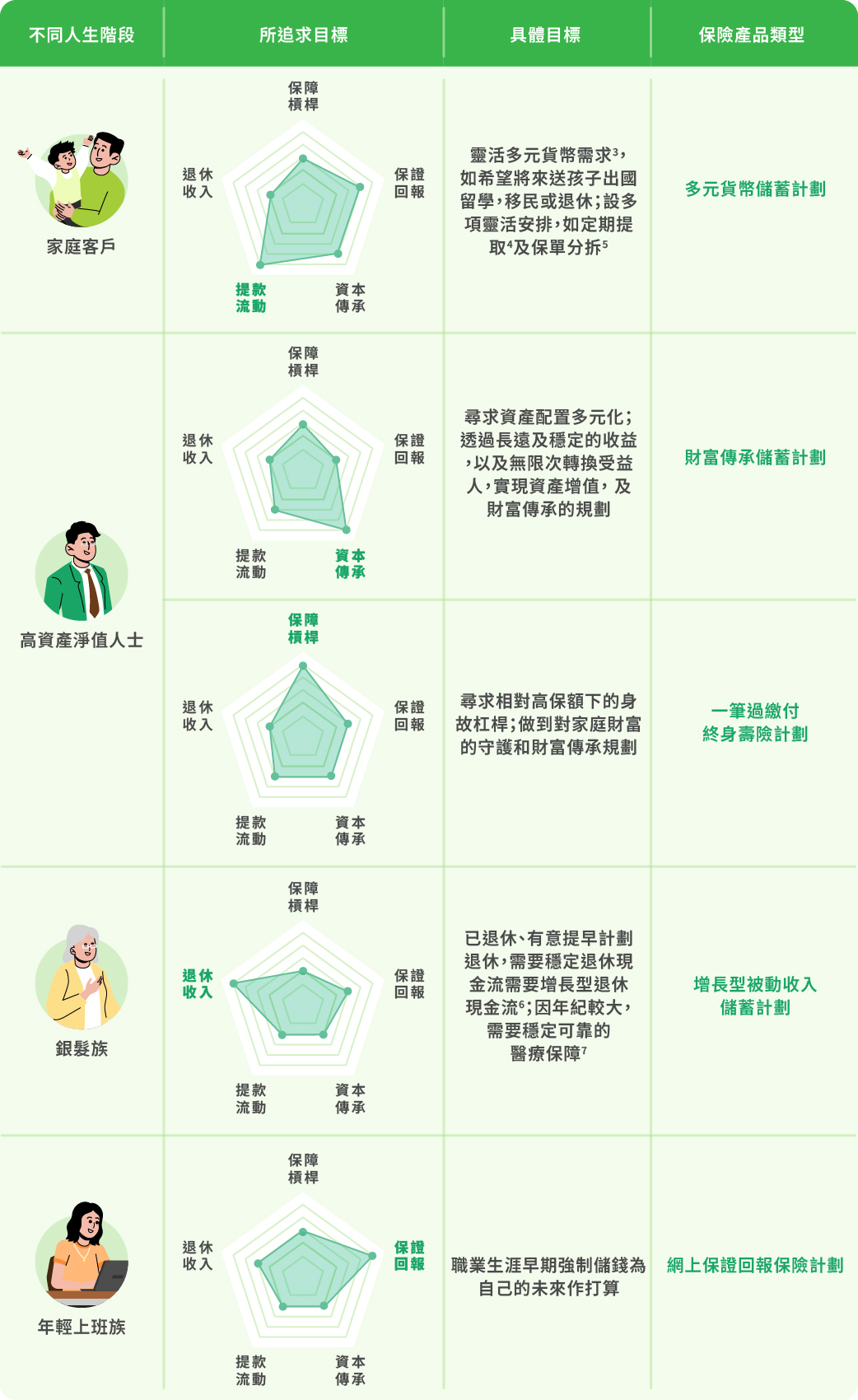
10Life has noticed that insurers in the market have already begun to address this challenge with more precise product design. For example, Hang Seng’s life insurance product range does not position itself as an all-in-one “one-stop” solution. Instead, it is arranged according to different stages across the life spectrum, covering the various phases from “starting a family” to “retirement”, and aligning with three layers of objectives: “for yourself, for your family, and for retirement”. The five products each serve a distinct purpose, aiming to respond to the different needs at different life stages. 10Life has summarised the key needs at different life stages, using the corresponding products of Hang Seng Insurance Company Limited (“Hang Seng Insurance”) as examples, and set them out in the table below. 

Note: The above product types are for reference only. The relevant products are subject to those offered by Hang Seng Insurance from time to time, including but not limited to the “Easy Income” Deferred Annuity Plan (100% Guaranteed), “Income Prosper” Guaranteed Whole Life Insurance Plan, “Love and Hang Seng” Multi-Currency Life Insurance Plan 2, “Love and Legacy” Life Insurance Plan (Prestige) (Legacy Savings Plan), “Esteemed Life” Life Insurance Plan (Whole Life Insurance Plan), and “Income Link” Life Insurance Plan (Growth Passive Income Savings Plan).

A proposal is a promise; the implementation rate is what truly fulfils it 

Choosing the right plan and matching it to your life stage is only the first step. Another equally crucial question is: will the attractive projected returns shown in the proposal ultimately be realised? The returns of participating policies are made up of two parts: “guaranteed” and “non-guaranteed”. The latter includes annual dividends and terminal dividends, and the amount paid depends entirely on the insurer’s investment performance and dividend policy. Among these, terminal dividends make up a very high proportion of the total return, but they are also the most volatile, and it often takes ten years or even twenty years before the true picture becomes clear.

How can you tell whether an insurer will live up to its promise? The answer lies in the “Fulfilment Ratio”, namely the percentage of the actual amount paid out relative to the amount projected in the proposal. A fulfilment ratio of 100% or above means the company has delivered on that year’s projection. When choosing a participating policy, rather than being drawn in by forecast figures, it is better to check the historical fulfilment ratio for “guarantee”.

【分紅實現率2025】一文比較保險公司的分紅實現率

Having said all that, every solution and product involves trade-offs. When planning, consumers should still start from their actual financial needs and life stage, and carefully assess the product’s coverage, flexibility and claims terms in order to find a long-term solution that truly suits them. There is no standard answer in insurance; the one that fits best at this moment is the best choice. 

Learn more: hangseng.com/lifeinsurance 

----------------------------------------------------------------------------------------------
The above life insurance plan information is provided by Hang Seng Insurance. Please refer to the relevant product brochure for details. Subject to terms and conditions. Please note the relevant product risks and credit risk. 

For full details of the terms, conditions, risks and exclusions of the following plans, please refer to the relevant product brochure:
“eIncome Pro” Deferred Annuity Plan (100% Guaranteed):Click here
“eCouponPower” Fully Guaranteed Life Insurance Plan:Click here
“Family Power 2” Multi-Currency Life Insurance Plan 2:Click here
“Legend Power Supreme” Life Insurance Plan:Click here
“Phoenix Life” Life Insurance Plan:Click here
“Income Power” Life Insurance Plan:Click here

Notes:

1 Source: Swiss Re Institute’s “sigma No. 2/2025” report, covering global insurance market data for 2024, including Hong Kong’s total premium volume of USD 74.468 billion (the world’s 16th largest insurance market), a life insurance penetration rate of 15.7% and per capita premiums of USD 8,624. Full report: https://legismap.com.br/phocadownload/sigma_2_2025.pdf
2 Source: The Hong Kong Insurance Authority’s 2024 statistics. The policy premium of new long-term business issued in 2024 was HKD 195.719 billion, of which participating business accounted for 89.4% of the relevant new policy premium.
3 Hang Seng Insurance has the absolute right and discretion in relation to any application to exercise the Currency Conversion Option to: (i) decide whether to accept any application to exercise the Currency Conversion Option; and (ii) impose any requirements or conditions when accepting an application; and, subject to applicable laws and regulations, if a currency is discontinued by the issuing country or region when applying for the Currency Conversion Option, that currency will no longer be available for selection. Hang Seng Insurance will issue a written notice and the amended policy schedule and explanatory document to the policyholder once any Currency Conversion Option takes effect, showing that the converted currency has been changed to the policy currency.
4 Any application for the Regular Withdrawal Option must satisfy the following two requirements: (i) the minimum amount by which the policy amount is reduced each time; and (ii) the minimum policy amount after exercising the Regular Withdrawal Option. These two minimum amount requirements are determined by Hang Seng Insurance from time to time at its absolute discretion. You may use the form specified by Hang Seng Insurance to submit a written request to us to designate or change the Regular Withdrawal Beneficiary. The exercise of the Regular Withdrawal Option, and the designation or change of the Regular Withdrawal Beneficiary, may only be made while the policyholder, the Regular Withdrawal Beneficiary and the insured are all alive. Hang Seng Insurance will issue a written notice and the amended policy schedule to the policyholder when the Regular Withdrawal Option takes effect. If Hang Seng Insurance receives a request to exercise the Currency Conversion Option, Policy Split Option, Policy Value Management Benefit or partial surrender, or when the policy ownership is transferred, instructions to exercise the Regular Withdrawal Option under the policy will be suspended and the existing designated Regular Withdrawal Beneficiary will be automatically revoked. After the transfer of ownership, Currency Conversion Option, Policy Split Option, Policy Value Management Benefit or partial surrender takes effect, if you wish to exercise the Regular Withdrawal Option, you must submit a new application in writing to Hang Seng Insurance.
5 Hang Seng Insurance has the absolute right and discretion in relation to any application to exercise the Policy Split Option to: (i) decide whether to accept any application to exercise the Policy Split Option; and (ii) impose any requirements or conditions when accepting an application. You may, when applying for the Policy Split Option, also apply for the transfer of policy ownership, the Currency Conversion Option or a change of insured in respect of the split policy, subject to the policy terms. All supplementary benefits attached to the basic plan (if still in force) will be transferred to the split policy. Exercising the Policy Split Option may affect supplementary benefits; please refer to the supplementary benefit terms. Hang Seng Insurance will issue a written notice to the existing policyholder and the policyholder of the split policy, and will issue to the policyholder of the split policy the amended policy schedule, policy terms, supplementary benefit terms (if any), any policy endorsement and explanatory document for the split policy. Any existing selected death benefit payment option, any existing designated beneficiary, contingent policyholder, policy trustee, contingent insured, Regular Withdrawal Beneficiary and Family Protector Benefit Beneficiary, as well as the designated percentage of the Family Protector Benefit, will not be automatically transferred to the split policy.
6 Monthly income may be distributed on each month-end from the end of the 25th month until the benefit end date of the basic plan, provided that the policy remains in force and all premiums due up to the relevant month-end have been fully paid. The amount of monthly income is non-guaranteed and not fixed, and is determined by us at our sole discretion on each month-end. The projected non-guaranteed monthly income rate (% p.a.) for the relevant policy year is calculated as the projected non-guaranteed monthly income distributed in that relevant policy completion year divided by the total standard premium, where the total standard premium is equal to the single premium paid at application or, for annual premium payment, the annual premium amount multiplied by the number of completed policy years (i.e. up to the day before each relevant policy year, subject to the premium payment term). This calculation method applies whether premiums are paid monthly or annually, and is calculated based on Hang Seng Insurance’s current assumptions for investment return and bonus interest rate, and may vary depending on factors such as payment term, policy currency and the use of monthly income. The projected increasing trend of the non-guaranteed monthly income rate is also non-guaranteed; the actual trend of the non-guaranteed monthly income rate may remain flat, decline or fluctuate. If the policy is partially surrendered or after the payment of the Mental Incapacity Benefit – Super Benefit, monthly income will be reduced proportionately. In certain circumstances, the non-guaranteed amount may be zero.
7 The Medical Advance Benefit takes effect from the later of: (i) the premium payment end date; (ii) the second policy anniversary; (iii) one year after the effective date of the latest policy reinstatement; or (iv) one year after the effective date of the latest change of insured. During the period when the Medical Advance Benefit is in force and before the insured reaches age 90, if the insured: (i) is first diagnosed by a registered doctor with cancer, heart disease or stroke; or (ii) is hospitalised for 25 consecutive days or more due to bodily injury, illness, disease or indisposition, and a registered doctor certifies that such hospitalisation is medically necessary (whichever is earlier), Hang Seng Insurance will pay the Medical Advance Benefit upon receipt of satisfactory proof and approval by Hang Seng Insurance. Hang Seng Insurance will pay the Medical Advance Benefit as a lump sum in cash, in an amount equal to the total projected monthly income for the advance benefit period as at the claim approval date of the Medical Advance Benefit. Any indebtedness will be deducted from the amount payable when the Medical Advance Benefit is paid. After payment of the Medical Advance Benefit, monthly income will be suspended during the advance benefit period and will resume after the advance benefit period ends, except where that day is the benefit end date of the basic plan. The Medical Advance Benefit is payable only once during the term of this policy, provided that the insured is still alive on the claim approval date of the Medical Advance Benefit. If a specified deduction event occurs during the deduction period after the Medical Advance Benefit has been paid, the deducted portion of the Medical Advance Benefit paid will be deducted from the benefits payable under the basic plan or supplementary benefits. If the policy is cancelled or lapses, Hang Seng Insurance reserves the right to claim back the deducted portion of the Medical Advance Benefit paid from you. Hang Seng Insurance will not adjust the amount of the Medical Advance Benefit paid for subsequent changes in the monthly income amount during the advance benefit period as at the claim approval date of the Medical Advance Benefit. For the definition of the Medical Advance Benefit and other details, please refer to the relevant policy terms.

Disclosure of Information
This article is for information sharing and reference only, and does not constitute sales advice. The above product information is provided by Hang Seng Insurance, and the policy terms shall prevail for details. 10Life is not authorised as an insurance intermediary of Hang Seng Insurance and will not carry out any regulated activity specified under the Insurance Ordinance (Cap. 41).
If the policyholder surrenders the policy at any time after the cooling-off period has expired, the surrender value may be less than the total premiums paid. The expected surrender value may be referred to in the plan summary. 
The benefits and/or returns stated in this promotional material are not guaranteed and are for illustration purposes only. The actual benefits and/or returns in the future may be lower or higher than those currently stated. The policyholder is subject to the credit risk of Hang Seng Insurance. 
If the policyholder terminates this plan and/or surrenders the policy in the early years, the amount retrieved may be far less than the premiums paid. All surrender details are subject to the relevant policy terms. 

This English version of this article has been generated by machine translation powered by AI. It is provided solely for reference purposes. In the event of any discrepancy or inconsistency between this translation and the original Chinese version, the Chinese version shall prevail.

10Life Logo
10Life Editorial Team

Our team of professional content researchers focussing on insurance

10Life Logo
10Life Editorial Team

Our team of professional content researchers focussing on insurance

Disclaimer

10Life Product Comparison and 10Life Insurance Ratings are developed by 10Life Financial Limited, an authorised insurance broker company licensed with the Insurance Authority under License Number FB1526. 10Life Product Comparison and 10Life Insurance Ratings are developed for generic customer segments using mathematical calculations based on product information, facts and data, and are not influenced by any partnerships with or fees received from insurance companies. Any information on 10Life Platform ("10Life Information"), including but not limited to Product Comparison, Product Ratings, Blog Articles are intended for general education purpose and reference only. None of the 10Life Information is intended, nor should they be considered or relied upon, as regulated advice, insurance, financial, investment or professional advice, recommendation, approval, endorsement, invitation or solicitation in respect of any insurance, financial or investment products. 10Life Information does not take into account your individual needs. Reading 10Life Information should not be considered as conducting a suitability assessment, and is not sufficient to form the basis of any decisions to purchase any insurance products. You should rely on information authorised by insurance companies, carry out your own research and/or seek independent advice from licensed intermediaries before purchasing any insurance products or making any insurance decisions. While reasonable effort is used when collecting, validating and updating 10Life Information from various channels, none of 10Life Group and its subsidiaries, affiliates, agents, directors, officers and employees will be responsible for any liability, claim or loss arising from or associated with you using 10Life Information. No warranty, representation or guarantee is given by 10Life Group and its subsidiaries on the accuracy, completeness and timeliness of the information. If you have any questions on 10Life Product Comparison and 10Life Insurance Ratings, please email us at enquiries@10life.com

Whatsapp icon
Whatsapp icon
WeChat icon
WeChat icon
Enquiry icon Close icon
Back To Top
Whatsapp icon
Whatsapp icon
WhatsApp