









10Life Financial Limited
Enquiries: enquiries@10life.com
Hotline: (852) 3705 1599
Address: 16/F Greatmany Centre, 109-115 Queen’s Road East, Wan Chai, Hong Kong


How much should you save for an education fund to be enough? First, understand overseas study costs
Make early use of financial planning tools to help your children save for studying overseas


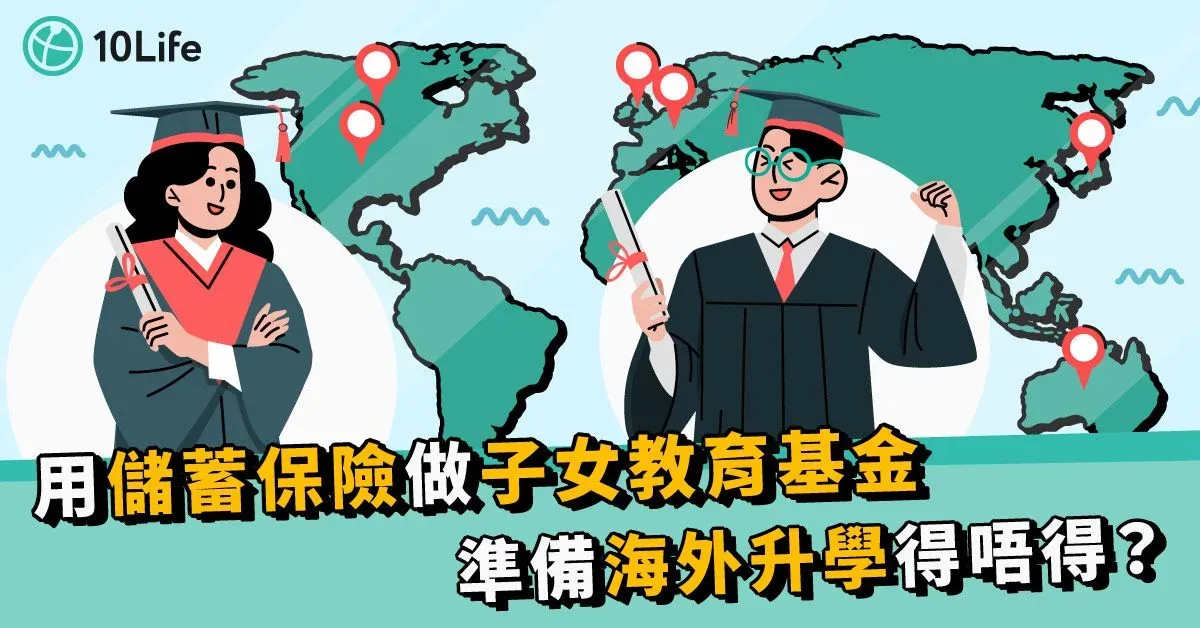
When children go overseas to study, it not only broadens their horizons, but also widens their perspective. That said, it is well known that overseas education is expensive. If you can start preparing an education fund for the next generation early, you can ease future financial pressure. There are many tools available on the market for saving towards future overseas study expenses. Generally speaking, the earlier you take out a policy, the longer the accumulation period and the higher the return. But how much does it actually cost to study abroad? How much are the expenses for overseas study? When should you start preparing an education fund? How much should you save before it is enough? This time, we will explain each of these points one by one.
How much should you save for an education fund to be enough? First, understand overseas study costs
If you want your children to study abroad, the first task when setting up an education fund is to establish a savings target, and understanding the cost of overseas study is a crucial step. Readers may first refer to Table 1. Some organisations have surveyed the education expenses for studying overseas. Popular destinations for Hong Kong students, such as the United States, Australia, Canada and the United Kingdom, are all relatively expensive. Taking the United States as an example, the total annual education-related cost per student is US$35,097 (approximately HK$274,000). Over a four-year undergraduate course in the US, the total cost amounts to US$140,388 (approximately HK$1.095 million). When accommodation and meals locally are added, this is also a considerable sum. Therefore, if parents want to send their children to study abroad, they may need to prepare their finances well in advance.
| Destination | Total education-related expenses (USD) | Tuition fees (USD) | Other education expenses (USD) |
| United States | $35,097 | $31,855 | $3,241 |
| New Zealand | $24,645 | $22,869 | $1,776 |
| Australia | $21,589 | $18,271 | $3,317 |
| Canada | $19,117 | $16,553 | $2,563 |
| Hong Kong | $17,166 | $14,299 | $2,867 |
| United Kingdom | $16,872 | $14,757 | $2,115 |
| Singapore | $16,156 | $12,434 | $3,722 |
| Israel | $13,225 | $11,191 | $2,034 |
| Japan | $8,096 | $5,148 | $2,947 |
| Chile | $8,026 | $7,107 | $919 |
| Notes: 1. Source: Wise; research report compiled in April 2023 (reprinted by Hong Kong Economic Times) 2. The above expenses do not include living costs such as food and accommodation for students 3. Ranked by total education-related expenses (highest to lowest) 4. Rounded to the nearest whole number | |||
Make early use of financial planning tools to help your children save for studying overseas
The earlier parents start saving, the more they can not only build a habit, but also let their assets compound and grow in value. According to the Rule of 72, dividing 72 by the annual rate of return gives an estimate of how long it will take for the principal to double. For example, a product with an annual return of 7.2% would take 10 years for the principal to increase by 100%, whereas a product with an annual return of 6% would take 12 years.
There are many tools available for building an education fund for the next generation. Table 2 compares five common financial tools, including education fund insurance, guaranteed income savings life insurance (Coupon Plan), long-term savings insurance, investment-linked life insurance plans (investment-linked insurance, ILAS), and monthly stock investment plans. When planning an education fund, many people focus on guaranteed returns. However, among the five products, only education fund insurance, guaranteed income savings life insurance (Coupon Plan), and long-term savings insurance offer guaranteed returns, and unless the policy is surrendered early, they generally do not lose the principal, making them more suitable for those with a lower risk tolerance.
As for investors seeking higher returns, investment-linked insurance or monthly stock investment plans may be considered. However, higher returns come with higher risk; if investments perform poorly, it may not be worth the while and could end with a loss of capital.
Of course, parents need not put all their eggs in one basket; they may consider adopting a mixed strategy to diversify risk.
| Education Fund Insurance | Guaranteed Income Savings Life Insurance (Coupon Plan) | Long-term Savings Insurance | Investment-Linked Life Insurance Plan (ILAS) | Monthly Stock Investment | |
| Guaranteed return | ✓ | ✓ | ✓ | X | X |
| Risk of losing money | Generally not, unless the policy is surrendered early | Generally not, unless the policy is surrendered early | Generally not, unless the policy is surrendered early | Possible | Possible |
| Potential return | Low | Low | Low to medium, depending on the product features | Low to high, depending on the fund category selected | High |
| Method of paying returns | |||||
| Lump-sum payment | ✓ | ✓ | ✓ | ✓ | ✓ |
| Fixed instalment payment | ✓ | ✓ | May pay dividends (some products) | May pay dividends (some funds) | May pay dividends |
| Note: The above table considers only the general product features. | |||||

Long-term savings insurance not only preserves capital, but also offers guaranteed returns, so it is a popular choice among many parents. However, it should be noted that long-term savings insurance products vary considerably in nature: some place greater emphasis on guaranteed returns, while others focus on non-guaranteed returns. Users may choose suitable products according to their risk tolerance and financial planning needs.
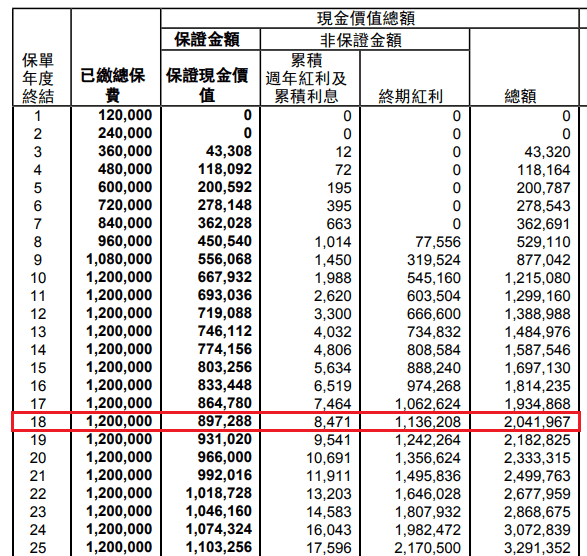
Taking Mr Chan, aged 35, as an example, he plans ahead to set up an education fund for his newborn daughter and chooses long-term savings insurance as a savings tool. As shown in Table 3, Mr Chan contributes a total of HK$120,000 per year for a 10-year premium payment period, making a total contribution of HK$1.2 million. In policy year 18 (highlighted in red in Table 3), the policy’s total cash value is HK$2.04 million, equivalent to 170% of the total premiums paid.
However, it must be noted that if the policyholder surrenders the policy early due to an unforeseen need, the surrender value may be lower than the premiums paid. Therefore, before purchasing a policy, it is advisable to pay attention to your own financial reserves to avoid being forced into an early policy lapse.
Assuming the insured is a 35-year-old non-smoking male, with total annual premiums of HK$120,000 and a 10-year premium payment period
In summary, the earlier an education fund is arranged, the better. However, there are many financial tools to choose from, and they involve a fair amount of specialised knowledge. If you would like to know more, please feel free to call or WhatsApp 37051599 to enquire with our 10Life insurance advisers.
Note: Information is current as of 1 January 2025.
This English version of this article has been generated by machine translation powered by AI. It is provided solely for reference purposes. In the event of any discrepancy or inconsistency between this translation and the original Chinese version, the Chinese version shall prevail.
Our team of professional content researchers focussing on insurance
Our team of professional content researchers focussing on insurance
10Life Product Comparison and 10Life Insurance Ratings are developed by 10Life Financial Limited, an authorised insurance broker company licensed with the Insurance Authority under License Number FB1526. 10Life Product Comparison and 10Life Insurance Ratings are developed for generic customer segments using mathematical calculations based on product information, facts and data, and are not influenced by any partnerships with or fees received from insurance companies. Any information on 10Life Platform ("10Life Information"), including but not limited to Product Comparison, Product Ratings, Blog Articles are intended for general education purpose and reference only. None of the 10Life Information is intended, nor should they be considered or relied upon, as regulated advice, insurance, financial, investment or professional advice, recommendation, approval, endorsement, invitation or solicitation in respect of any insurance, financial or investment products. 10Life Information does not take into account your individual needs. Reading 10Life Information should not be considered as conducting a suitability assessment, and is not sufficient to form the basis of any decisions to purchase any insurance products. You should rely on information authorised by insurance companies, carry out your own research and/or seek independent advice from licensed intermediaries before purchasing any insurance products or making any insurance decisions. While reasonable effort is used when collecting, validating and updating 10Life Information from various channels, none of 10Life Group and its subsidiaries, affiliates, agents, directors, officers and employees will be responsible for any liability, claim or loss arising from or associated with you using 10Life Information. No warranty, representation or guarantee is given by 10Life Group and its subsidiaries on the accuracy, completeness and timeliness of the information. If you have any questions on 10Life Product Comparison and 10Life Insurance Ratings, please email us at enquiries@10life.com




 Talk to 10Life on WeChat
