


false
Category
Author
Search for Articles
Trending Keywords
Category
Author
Search
Category
Author
Search
Critical Illness

【Critical Illness Insurance Comparison】With the same premium, compensation varies by over 50%! Which critical illness plan offers the best value?

2021-04-18 6min read
Comparing-Whole-Life-CI-Insurance-Over-50-percent-coverage-difference-for-the-same-price-Which-CI-plan-gives-you-the-best-value-for-money-kv.png
As a consumer, everyone naturally wants to pay a low price for high-quality experiences, akin to enjoying the taste of roast goose at a bargain. This principle applies not only to dining but is even more critical when purchasing critical illness insurance. However, critical illness insurance products from different insurers can vary significantly, making it challenging to assess their cost-effectiveness. In this analysis, 10Life evaluates the key coverage aspects of lifelong critical illness insurance, including protection for major critical illnesses such as cancer, heart disease, and stroke, as well as multiple claims coverage and early-stage critical illness benefits. We compare the compensation amounts under the same premium across various scenarios to determine which plan offers the best value for money. This article will review popular lifelong critical illness insurance plans in the market, including AIA友邦加裕智倍保3, AXA Hong Kong and Macau愛護同行危疾保障(加強版), FTLife富通 「守護168」危疾保障計劃 (加強版), Manulife宏利活耀人生危疾保2 (加強版), and Prudential英國保誠危疾加護保III.
 
When purchasing critical illness insurance, policyholders must select a coverage amount. Depending on the severity of the diagnosed critical illness, compensation is paid as a specified percentage (%) of the coverage amount. Generally, compensation for major critical illnesses is 100% of the coverage amount, while early-stage critical illnesses offer a lower percentage. To facilitate a fair comparison, let’s consider a uniform scenario: a 35-year-old non-smoking male purchasing lifelong critical illness insurance with a 20-year (or closest) premium payment term, paying an annual premium of HKD 10,000 (Hong Kong Dollars, hereinafter the same). We calculate the compensation amounts across multiple scenarios for these products (Note 1).
 
First Critical Illness Claim is Crucial: Compensation Can Differ by Over 50%

 
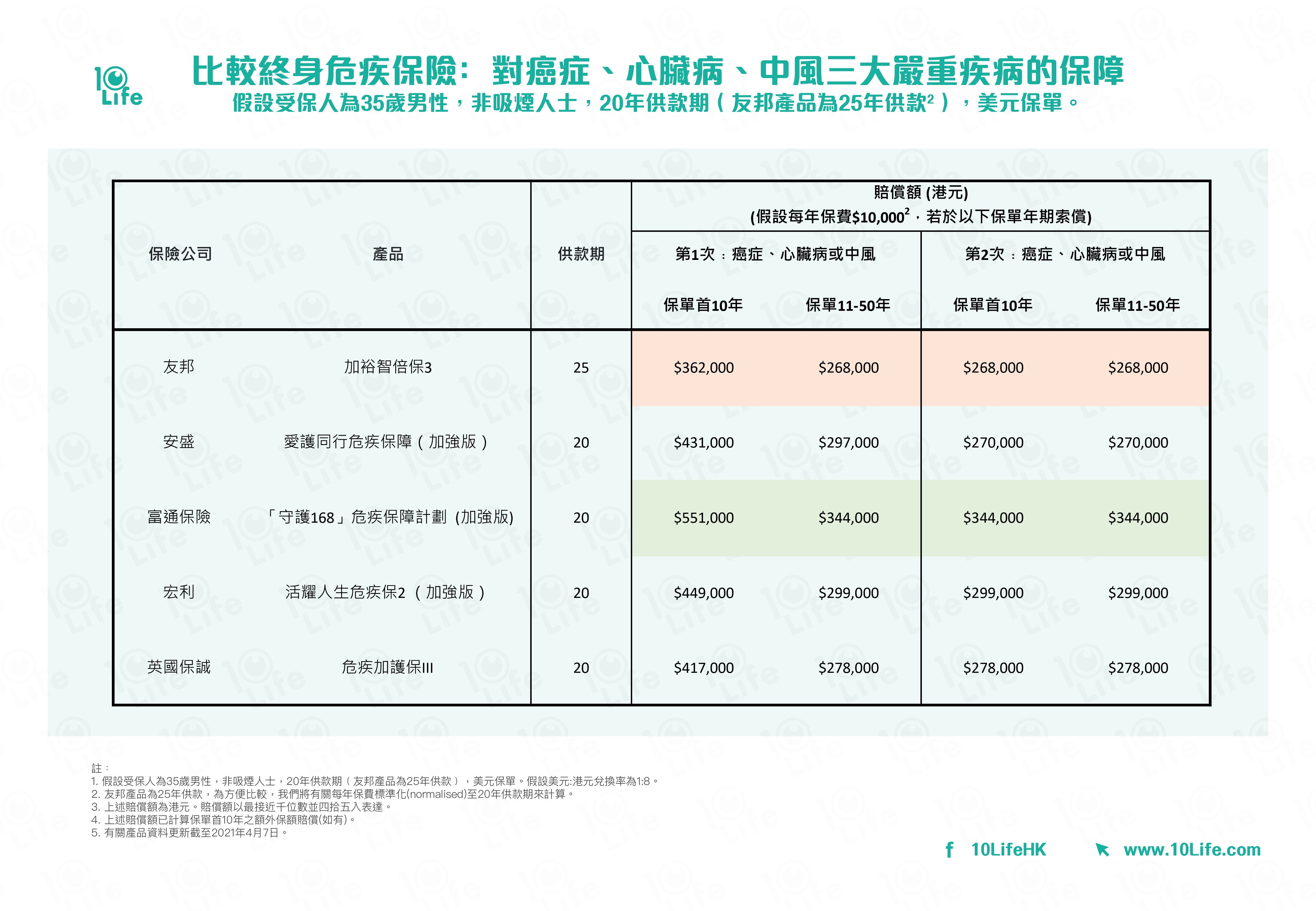
Cancer, heart disease, and stroke account for over 90% of critical illness insurance claims across insurers, making compensation for these three major critical illnesses particularly important. Notably, the compensation for the first major critical illness diagnosis deserves special attention. As shown in Chart 1, the highest compensation is offered by the FTLife plan. If the insured is diagnosed with a major critical illness within the first 10 policy years, the compensation amount is HKD 551,000, compared to HKD 362,000 under the AIA plan—a difference of 52.2%. Many lifelong critical illness products include additional early-year compensation, meaning that if the insured is diagnosed with a major critical illness within the first 10 years, the payout exceeds 100% of the coverage amount, significantly higher than claims made later in the policy term.
 
Chart 1


Lifelong critical illness insurance is a long-term product, and for younger policyholders facing a long life ahead, multiple claims coverage is essential. Therefore, we also compared the compensation for a second major critical illness (cancer, heart disease, or stroke). The highest compensation again comes from the FTLife plan, reaching HKD 344,000.
 
Increased Compensation for Specified Early-Stage Critical Illnesses: Few Products Restore Coverage to 100% After Early Claims

 
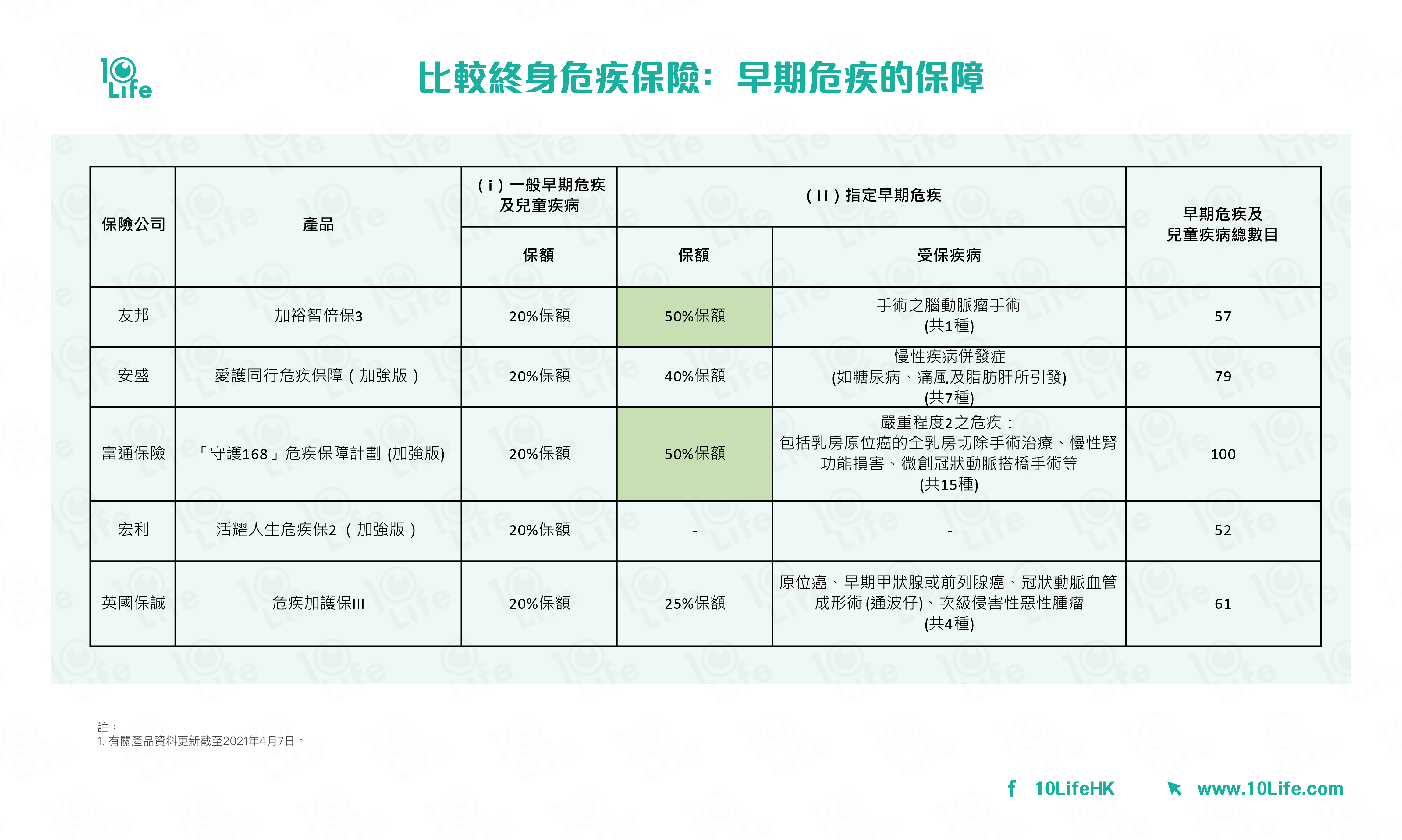
With growing public awareness of health and regular medical check-ups, many illnesses are diagnosed at an early stage before worsening, increasing the importance of early-stage critical illness coverage. Early-stage critical illnesses generally refer to non-severe conditions that can be managed or even cured with timely treatment. Treatment costs for these are typically lower than for major critical illnesses, so lifelong critical illness insurance usually compensates around 20% of the coverage amount for most early-stage conditions.
 
However, some insurers have increased compensation for certain specified early-stage critical illnesses. For instance, the FTLife plan offers 50% of the coverage amount for 15 early-stage critical illnesses, including cirrhosis caused by hepatitis, chronic kidney impairment, and minimally invasive coronary artery bypass surgery. Meanwhile, the Prudential plan enhances coverage to 25% of the coverage amount for four common early-stage conditions, such as carcinoma in situ and angioplasty.
 
Chart 2


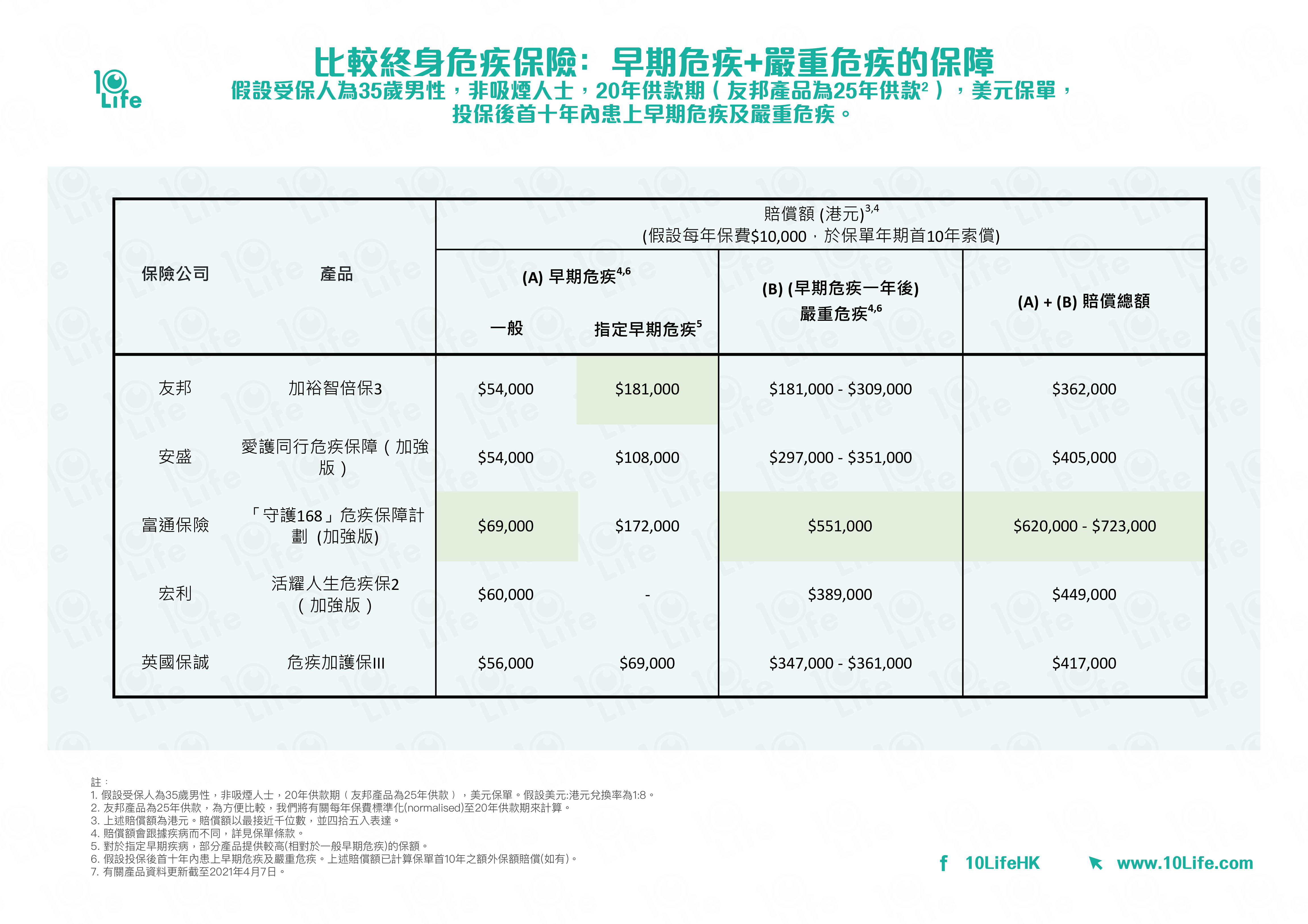
Continuing the above assumption with an annual premium of HKD 10,000, Chart 3 shows that for general early-stage critical illnesses, compensation ranges from approximately HKD 54,000 (AIA and AXA Hong Kong and Macau plans) to HKD 69,000 (FTLife plan). For specified critical illnesses, compensation is further increased, with AIA offering HKD 181,000 and FTLife providing HKD 172,000.
 
The early-stage critical illness coverage in the AIA, AXA Hong Kong and Macau, Manulife, and Prudential plans operates as an “advance” payment. For example, if an AIA policyholder first claims for a specified early-stage critical illness (HKD 181,000) and later claims for a major critical illness, the compensation for the latter is adjusted downward (also HKD 181,000). The total compensation for both claims combined amounts to HKD 362,000 (i.e., 100% coverage amount + early additional protection).
 
In contrast, the early-stage critical illness coverage under the FTLife plan does not affect the major critical illness coverage. Even if the policyholder claims for an early-stage critical illness first, the coverage for a subsequent major critical illness claim can still be restored to 100% of the coverage amount. The total compensation for both claims can reach HKD 620,000 to HKD 723,000 (i.e., 20% or 50% coverage amount + 100% coverage amount + early additional protection). To qualify for this, the claims for early-stage and major critical illnesses must be at least one year apart (Note 2).
 
Chart 3


Expanding the Safety Net: Coverage for Unknown Critical Illnesses

 
Traditionally, critical illness insurance covers specified conditions and compensates based on defined criteria, often excluding unknown diseases. To address this gap, some insurers have introduced coverage beyond specified critical illnesses, providing protection for new diseases that severely impact health.
 
Take COVID-19 as an example. Due to its recent emergence and varying severity—ranging from critical cases to asymptomatic ones—it is not covered as a critical illness under most insurance plans. However, for severe conditions caused by COVID-19, certain critical illness plans include innovative coverage that may offer compensation of 20% of the coverage amount.
 
The AIA plan provides compensation for severe infectious diseases. If the insured is admitted to an intensive care unit (ICU) for three or more consecutive days due to a disease classified as a Public Health Emergency of International Concern by the World Health Organization (WHO), they are eligible for compensation.
 
Similarly, the Manulife and Prudential plans offer ICU coverage, though not limited to severe infectious diseases.
 
The FTLife plan compensates based on major organ impairment, regardless of the cause. For instance, compensation is provided if lung function is impaired to a certain degree. Other covered organs include the heart, liver, and kidneys.
Premium Waiver After Critical Illness Diagnosis
 
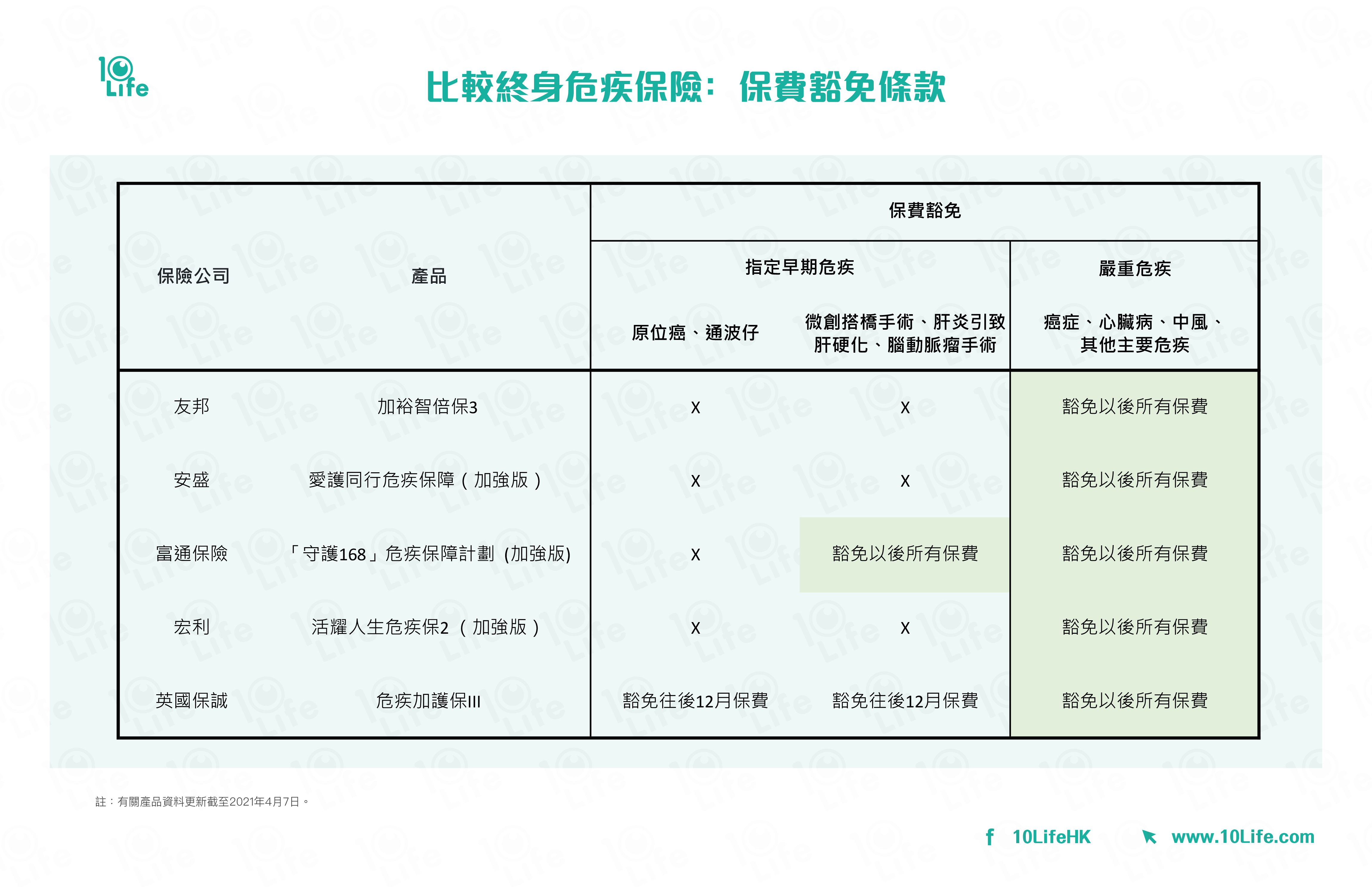
Most lifelong critical illness insurance plans in the market include a premium waiver clause. If diagnosed with a major critical illness, future premiums are waived, easing the financial burden on the policyholder. Some insurers have extended premium waivers to specified non-severe conditions, as detailed in Chart 4:
 
Chart 4


  • The Prudential plan offers a 12-month premium waiver for early-stage illnesses, allowing the policyholder to focus on recovery.
  • The FTLife plan provides a lifelong premium waiver for 15 early-stage critical illnesses, including minimally invasive bypass surgery and cirrhosis caused by hepatitis, while the policyholder continues to receive lifelong critical illness protection.
Guaranteed Cash-Back Period Differs by 28 Years
 
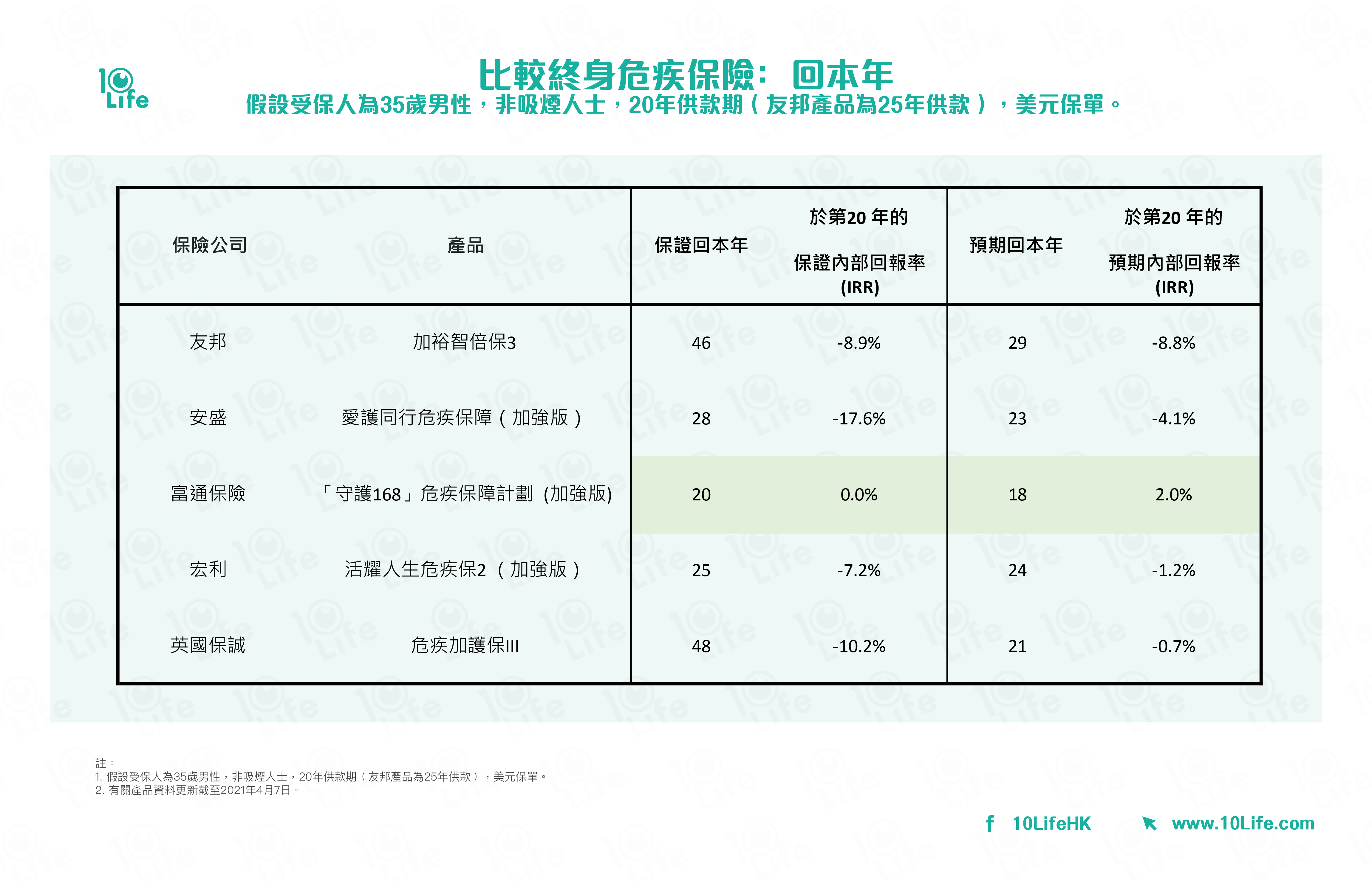
A key feature of lifelong critical illness insurance is “coverage for illness, savings if healthy.” The savings aspect refers to the option for policyholders, if no claims are made, to withdraw the premiums paid at or after the guaranteed cash-back period, thereby terminating the policy. As shown in Chart 5, for products with a 20-year (or closest) premium payment term, the guaranteed cash-back period varies significantly. The FTLife plan offers a guaranteed cash-back period of just 20 years, while the Prudential plan extends to 48 years—a difference of 28 years.
 
If the product achieves non-guaranteed dividends, the expected cash-back period could be significantly shorter. However, non-guaranteed components are influenced by the insurer’s investment performance, dividend policies, and macroeconomic factors, making them unpredictable. Moreover, since critical illness insurance primarily focuses on health protection, policyholders should not place excessive emphasis on non-guaranteed returns.
 
Chart 5


This article focuses on the key aspects of lifelong critical illness insurance. Due to space constraints, not all coverage details are covered. For a deeper comparison of insurance products, you can visit the 10Life ‘Product Decoder’ for more information or consult licensed advisors instantly on the 10Life website.
 
Notes:


  1. The calculation of compensation amounts includes additional early-year compensation within the first ten policy years.
  2. If the policyholder has already received compensation or is entitled to survival benefits for critical illnesses or childhood diseases of severity levels 1 and 2, and subsequently passes away or is diagnosed with a severity level 3 critical illness within 1 year or before the policy anniversary at age 70, the coverage can be restored up to 100% of the coverage amount. Refer to the policy terms for details.
  3. The currency in this article is Hong Kong Dollars.
  4. The information above is provided by 10Life for reference only and does not constitute a sales proposal. The data is updated as of 7 April 2021. 

This English version of this article has been generated by machine translation powered by AI. It is provided solely for reference purposes. In the event of any discrepancy or inconsistency between this translation and the original Chinese version, the Chinese version shall prevail.

Last updated: 9 Apr 2026

10Life Logo
10Life Editorial Team

Our team of professional content researchers focussing on insurance

10Life Logo
10Life Editorial Team

Our team of professional content researchers focussing on insurance

Disclaimer

10Life Product Comparison and 10Life Insurance Ratings are developed by 10Life Financial Limited, an authorised insurance broker company licensed with the Insurance Authority under License Number FB1526. 10Life Product Comparison and 10Life Insurance Ratings are developed for generic customer segments using mathematical calculations based on product information, facts and data, and are not influenced by any partnerships with or fees received from insurance companies. Any information on 10Life Platform ("10Life Information"), including but not limited to Product Comparison, Product Ratings, Blog Articles are intended for general education purpose and reference only. None of the 10Life Information is intended, nor should they be considered or relied upon, as regulated advice, insurance, financial, investment or professional advice, recommendation, approval, endorsement, invitation or solicitation in respect of any insurance, financial or investment products. 10Life Information does not take into account your individual needs. Reading 10Life Information should not be considered as conducting a suitability assessment, and is not sufficient to form the basis of any decisions to purchase any insurance products. You should rely on information authorised by insurance companies, carry out your own research and/or seek independent advice from licensed intermediaries before purchasing any insurance products or making any insurance decisions. While reasonable effort is used when collecting, validating and updating 10Life Information from various channels, none of 10Life Group and its subsidiaries, affiliates, agents, directors, officers and employees will be responsible for any liability, claim or loss arising from or associated with you using 10Life Information. No warranty, representation or guarantee is given by 10Life Group and its subsidiaries on the accuracy, completeness and timeliness of the information. If you have any questions on 10Life Product Comparison and 10Life Insurance Ratings, please email us at enquiries@10life.com

Whatsapp icon
Whatsapp icon
WeChat icon
WeChat icon
Enquiry icon Close icon
Back To Top
Whatsapp icon
Whatsapp icon
WhatsApp