


false
Category
Author
Search for Articles
Trending Keywords
Category
Author
Search
Category
Author
Search
危疾保險
編輯推介

Comparing the flagship critical illness insurance plans from AIA, Manulife, and Prudential: Analyse critical illness coverage and new features.

2020-10-11 6min read
Comparing-new-generation-flagship-Critical-Illness-Insurance-from-AIA-Manulife-Prudential-coverage-and-new-features-kv.png
The ongoing COVID-19 pandemic has heightened everyone's focus on health protection. Among the new generation of critical illness insurance plans launched this year, in addition to covering major critical illnesses such as cancer, heart disease, and stroke, insurance companies have also enhanced protection for policyholders in areas such as ongoing cancer treatment, severe infectious diseases, and post-illness life. This article will analyse the coverage, features, and returns of the flagship lifetime critical illness insurance plans from AIA, Manulife, and Prudential.
 
Comparison of Critical Illness Compensation for Three Popular Plans
 
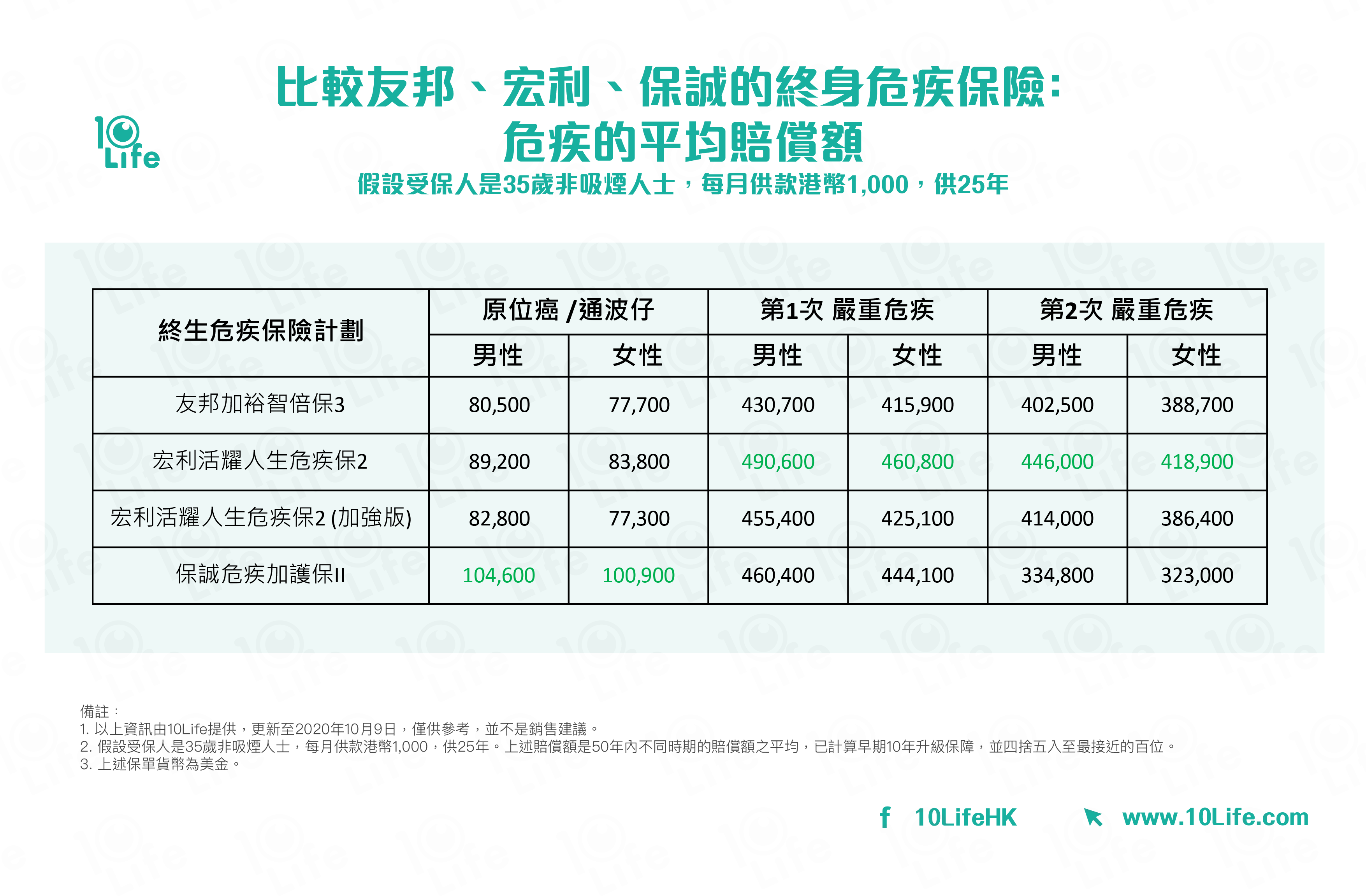
Critical illness insurance provides a lump-sum payout when the policyholder is diagnosed with a specified illness as defined in the policy. The payout amount depends on the severity of the illness; severe cases may receive 100% of the basic sum assured, while early-stage critical illnesses, such as carcinoma in situ or angioplasty, may receive approximately 20 to 25% of the basic sum assured. Assuming the policyholder is a 35-year-old non-smoker, paying a monthly premium of HKD 1,000 for 25 years, the average payout amounts for specified illnesses under AIA Premier Elite Max 3, Manulife Vivid Life Critical Illness 2 (available in two versions), and Prudential Crisis Cover Protector II are as follows (see Note 2):
 
Chart 1: Comparison of Lifetime Critical Illness Insurance from AIA, Manulife, and Prudential: Average Payout for Critical Illnesses


As shown in Chart 1, under the same premium, Prudential Crisis Cover Protector II offers higher payouts for early-stage critical illnesses, while Manulife Vivid Life Critical Illness 2 leads in payouts for the first and second severe critical illnesses. Additionally, premium rates for critical illness insurance differ by gender, with females generally paying slightly higher premiums. If a policyholder claims for the first severe critical illness, they are exempt from paying future premiums.
 
In-Depth Comparison of Single and Multiple Critical Illness Coverage from AIA, Manulife, and Prudential (Male)
In-Depth Comparison of Single and Multiple Critical Illness Coverage from AIA, Manulife, and Prudential (Female)
 
Cumulative Payouts for Ongoing Cancer Treatment: Considering Treatment Duration
 
In the previous generation of multiple-claim critical illness plans, even if cancer persisted after the initial claim, policyholders had to wait for a period of 3 years or more before making a second claim. However, the new generation of critical illness plans includes coverage for ongoing cancer treatment. Even during the waiting period (1 year after the first claim), as long as the policyholder is actively receiving cancer treatment, they can receive additional payouts. Active cancer treatment typically includes surgery, radiotherapy, chemotherapy, or targeted therapy, but excludes hormone therapy. Although cancer is a serious illness, it is not necessarily incurable; however, the prolonged treatment can be costly. Thus, ongoing cancer treatment coverage can alleviate the financial burden on policyholders during treatment.
 
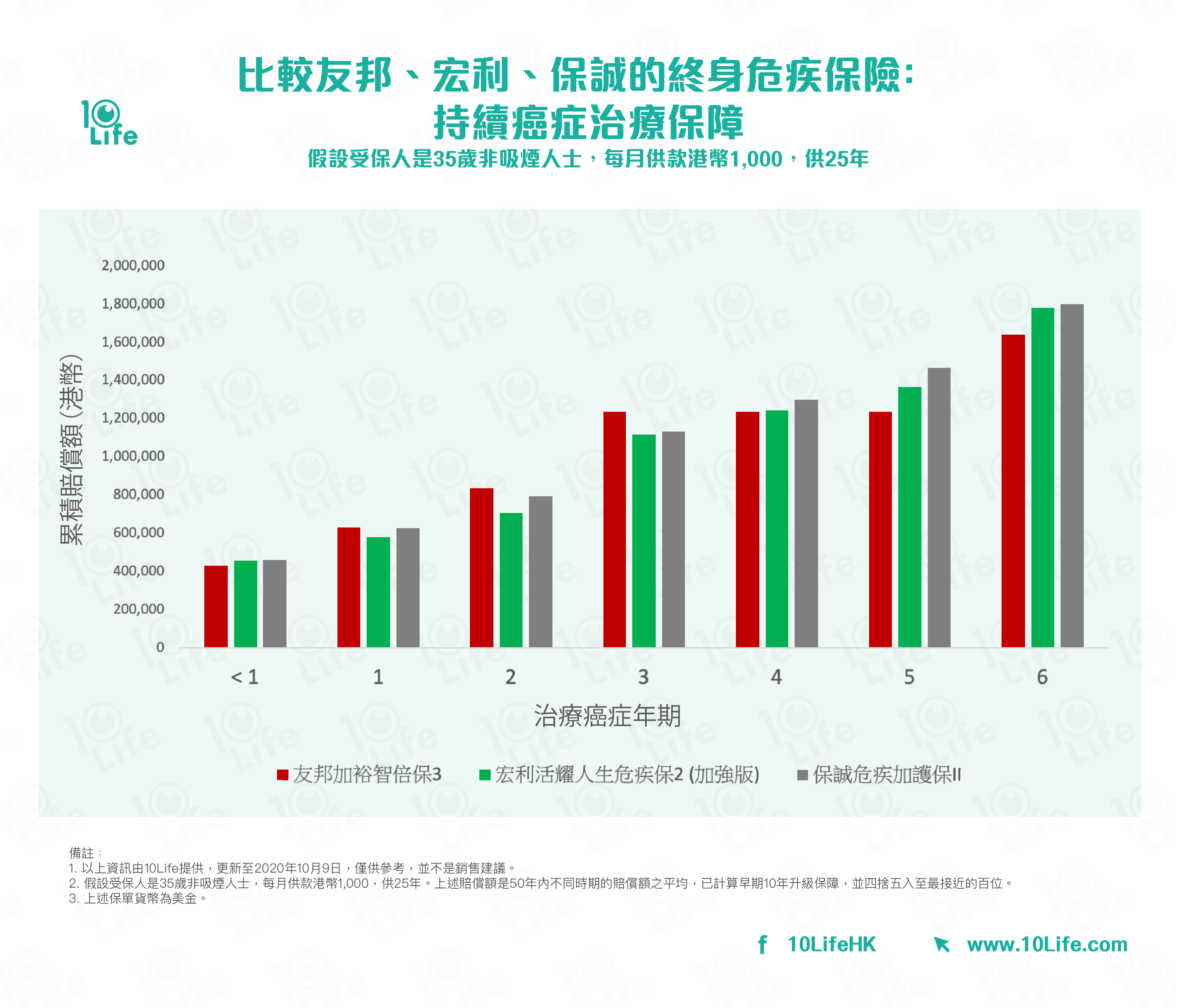
When reviewing the ongoing cancer treatment coverage of a product, key aspects to note include the payout amount, payout method (lump sum or monthly), and the number of payouts. We have used cancer cases with varying treatment durations, up to six years, to explain the coverage provided by AIA, Manulife (Enhanced Version), and Prudential. Below are the cumulative payout amounts at different stages (assuming a 35-year-old non-smoking male, paying a monthly premium of HKD 1,000 for 25 years).
 
Chart 2: Comparison of Lifetime Critical Illness Insurance from AIA, Manulife, and Prudential: Ongoing Cancer Treatment Coverage


Upon cancer diagnosis, the policyholder receives the first cancer payout. Among the plans mentioned, Prudential and Manulife (Enhanced Version) offer slightly higher payouts.
If the policyholder continues active treatment 1 and 2 years later, they can receive ongoing cancer treatment coverage each year. At this point, AIA offers a higher cumulative payout, but its ongoing cancer treatment coverage concludes.
After 3 years (post-waiting period), policyholders with persistent cancer can claim the second cancer payout, and AIA’s cumulative payout remains higher.
After 4 and 5 years, eligible policyholders under Prudential and Manulife (Enhanced Version) can again receive ongoing cancer treatment coverage. However, AIA does not offer this benefit, so its cumulative payout remains unchanged.
After 6 years (post-waiting period), policyholders with persistent cancer can claim the third cancer payout. At this stage, Prudential and Manulife (Enhanced Version) offer significantly higher cumulative payouts.
Subsequently, if the policyholder develops another critical illness, such as heart disease or stroke, only policyholders under Manulife and Prudential can receive severe illness payouts again, with Manulife paying 100% of the sum assured and Prudential paying 80%. AIA, however, offers no further payouts.
 
As shown in the chart above, when comparing cumulative payout amounts, the advantage depends on the year in which cancer treatment ends. The critical illness plans from AIA, Manulife (Enhanced Version), and Prudential each have their strengths.
 
Coverage for Severe Infectious Diseases and Even Unknown Severe Illnesses
 
With the outbreak of COVID-19, insurance companies have sought to extend critical illness insurance coverage to severe conditions caused by infectious diseases. For policyholders of AIA Premier Elite Max 3, if diagnosed with a disease declared by the WHO as a Public Health Emergency of International Concern and requiring admission to an intensive care unit (ICU) for 3 or more consecutive days, they can receive a payout of 20% of the basic sum assured. For example, COVID-19 is classified as a Public Health Emergency of International Concern by the WHO.
 
As for Manulife Vivid Life Critical Illness 2, if the policyholder unfortunately requires ICU admission for 3 or more consecutive days, whether for a listed or unlisted illness in the policy, they can receive a payout of 20% of the basic sum assured. This broader coverage extends beyond infectious diseases to illnesses outside the policy’s defined scope.
 
New Coverage Extends to Post-Illness Life
 
Critical illness insurance often introduces new features, and one worth mentioning is the Life Protection Benefit under Manulife Vivid Life Critical Illness 2. If the policyholder has claimed for their first severe critical illness and is unable to independently perform two or more “Activities of Daily Living” (including bathing, dressing, mobility, transferring, toileting, and eating) for 180 consecutive days or more, requiring assistance from others, they can claim an additional 100% of the basic sum assured from the insurance company. For conditions such as stroke or certain cancer treatments, post-illness life can be significantly impacted, and this coverage may prove beneficial.
 
Manulife Offers Faster Break-Even Year with Guaranteed Fixed Premiums
 
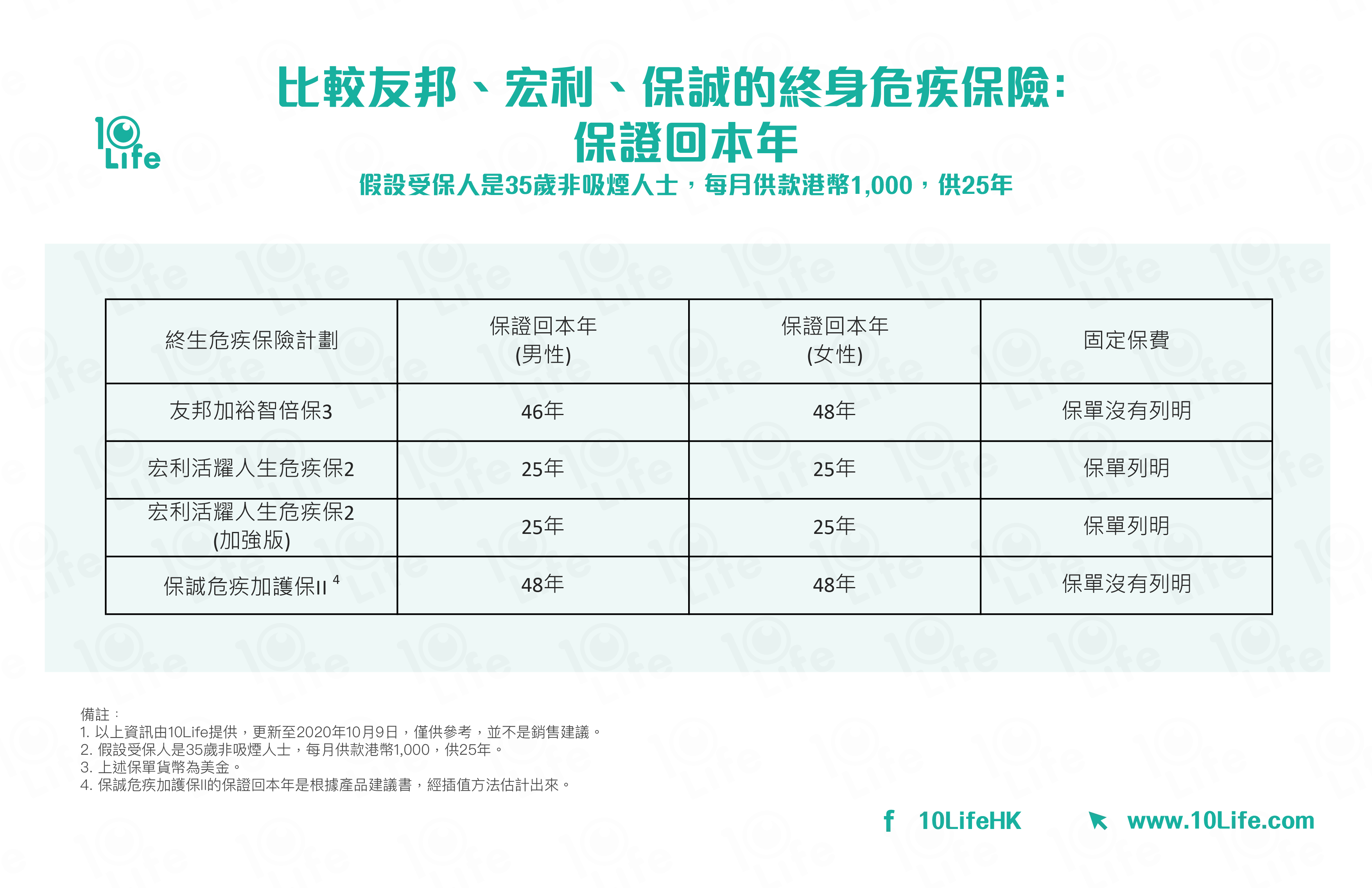
Another feature of lifetime critical illness insurance is its dual purpose: coverage for illness and savings if no claims are made. If the policyholder fortunately does not make a claim, they are guaranteed to recover their premiums, though the break-even year varies across plans. In the case of the three products mentioned, Manulife Vivid Life Critical Illness 2 offers the fastest guaranteed break-even year. In principle, upon completing the full 25-year premium payment period, policyholders can surrender the policy and immediately recover their premiums. However, for AIA Premier Elite Max 3 and Prudential Crisis Cover Protector II, the guaranteed break-even year exceeds 45 years. Of course, the primary purpose of critical illness insurance is protection, and surrendering the policy means losing coverage. Nevertheless, a shorter break-even year offers policyholders greater flexibility.
 
Chart 3: Comparison of Lifetime Critical Illness Insurance from AIA, Manulife, and Prudential: Guaranteed Break-Even Year


Regarding premiums, many customers are concerned about whether lifetime critical illness insurance premiums might increase. Insurance advisors often assure clients that premiums for lifetime critical illness insurance do not increase, citing industry practice. However, very few policies explicitly state fixed premiums in black and white within the contract, and Manulife Vivid Life Critical Illness 2 is among the few that do. Consider this: if claims for a particular plan far exceed expectations, placing pressure on the insurance company’s profitability, can they truly refrain from increasing premiums based solely on industry practice? If one company raises premiums, a domino effect could occur, with others following suit. Without a contractual guarantee, who can prevent this? Ultimately, verbal assurances are no substitute for policy guarantees, and we hope more insurance companies will explicitly state fixed premiums in the future.
 
In-Depth Comparison of Guaranteed Returns from AIA, Manulife, and Prudential (Male)
In-Depth Comparison of Guaranteed Returns from AIA, Manulife, and Prudential (Female)
 
10Life has compared multiple lifetime critical illness insurance plans. For more details, visit 10Life’s 《Product Decoder》.
 
Notes:


  1. The above information is provided by 10Life, updated as of 9 October 2020, and is for reference only. It does not constitute sales advice.
  2. Assumes the policyholder is a 35-year-old non-smoker, paying a monthly premium of HKD 1,000 for 25 years, with the policy currency in USD. Payout amounts are the average over different periods within 50 years, factoring in enhanced coverage for the first 10 years, and rounded to the nearest hundred.

This English version of this article has been generated by machine translation powered by AI. It is provided solely for reference purposes. In the event of any discrepancy or inconsistency between this translation and the original Chinese version, the Chinese version shall prevail.

10Life 編輯團隊

團隊成員由一群資料搜集員組成,主力保險相關資訊研究。

10Life 編輯團隊

團隊成員由一群資料搜集員組成,主力保險相關資訊研究。

Disclaimer

10Life 产品比较和 10Life 保险评分由获保监局授权持牌保险经纪公司 10Life Financial Limited(保监局牌照号码为FB1526)营运。10Life 产品比较和 10Life 保险评分是根据产品数据、事实陈述以及数据,并以一般消费者作为对象,从而作出数学运算,并不受与保险公司任何形式之合作或所获得之费用所影响。

10Life平台上之任何信息(「10Life信息」),包括但不限于产品比较、产品评分、网志文章等,旨在向香港特别行政区(「香港」)境内人士发布,所有信息及服务对象为于身处香港境内人士,仅供一般教育及参考用途。10Life信息无意,也不应被视为对任何保险、金融或投资产品进行受监管建议或专业建议、推荐、批准、认可、邀请或招揽。10Life信息并没有考虑阁下之个人需要,阅览有关数据也不应被视为正在进行个人合适性评估,且不足以构成任何购买保险产品决定的依据。购买任何保险产品或进行有关保险决定前,阁下应以保险公司提供的数据为准,自行进行研究,及/或寻求持牌保险中介人的独立及专业意见。10Life信息是以最大努力从不同渠道收集、验证、更新而成。10Life集团及其附属公司、关连人士、代理、董事、职员、员工将不会就有关资料引致的责任、索偿或损失负上任何责任,也概不保证或担保有关资料之准确性、完整性和适时性。

所显示保费数据尚未包括保险业监管局收取的保费征费,并均四舍五入至港元个位数。

如阁下对 10Life 产品比较和 10Life 保险评分有任何意见,欢迎电邮至 enquiries@10life.com

Whatsapp icon
Whatsapp icon
WeChat icon
WeChat icon
Enquiry icon Close icon
Back To Top
Whatsapp icon
Whatsapp icon
WhatsApp