





10Life Financial Limited
Enquiries: enquiries@10life.com
Hotline: (852) 3705 1599
Address: 16/F Greatmany Centre, 109-115 Queen’s Road East, Wan Chai, Hong Kong



Are you dissatisfied with low fixed deposit interest rates, yet worried about your average investment acumen and lack of time to keep up with market trends, risking losses in stocks? Many clients seek investment options that offer both offensive and defensive potential. Among these, savings insurance provides guaranteed returns and potential bonuses without the need for active investment management, making it suitable for both investment novices and busy professionals to build wealth over the long term. This time, 10Life compares three flagship savings insurance products in the market—AIA's "Capital Assured Plus" (referred to as AIA Capital Assured), Manulife's Wealth Builder Legacy Protection Plan 2 (referred to as Manulife Wealth Builder 2), and Prudential's Premier "Elite" Savings Protection Plan II (referred to as Prudential Elite II). These products share a similar positioning as relatively aggressive savings insurance plans, aiming to deliver comparatively substantial potential returns for policyholders.
Step 1: Compare Returns and Cash Value After the Accumulation Period – Expected and Guaranteed IRR of the Three Products are Close
It’s essential to first understand the accumulation period of savings insurance before analysing returns at maturity. The returns of savings insurance are measured by the Internal Rate of Return (IRR). IRR can be understood as the annualised return rate of the product, divided into guaranteed IRR and expected IRR, with the latter including non-guaranteed returns.
The guaranteed and expected returns of savings insurance reflect its positioning. Generally, conservative plans offer better guaranteed IRR but have limited return potential. In contrast, aggressive plans often invest more in equities, offering higher potential expected returns but with limited guaranteed components.
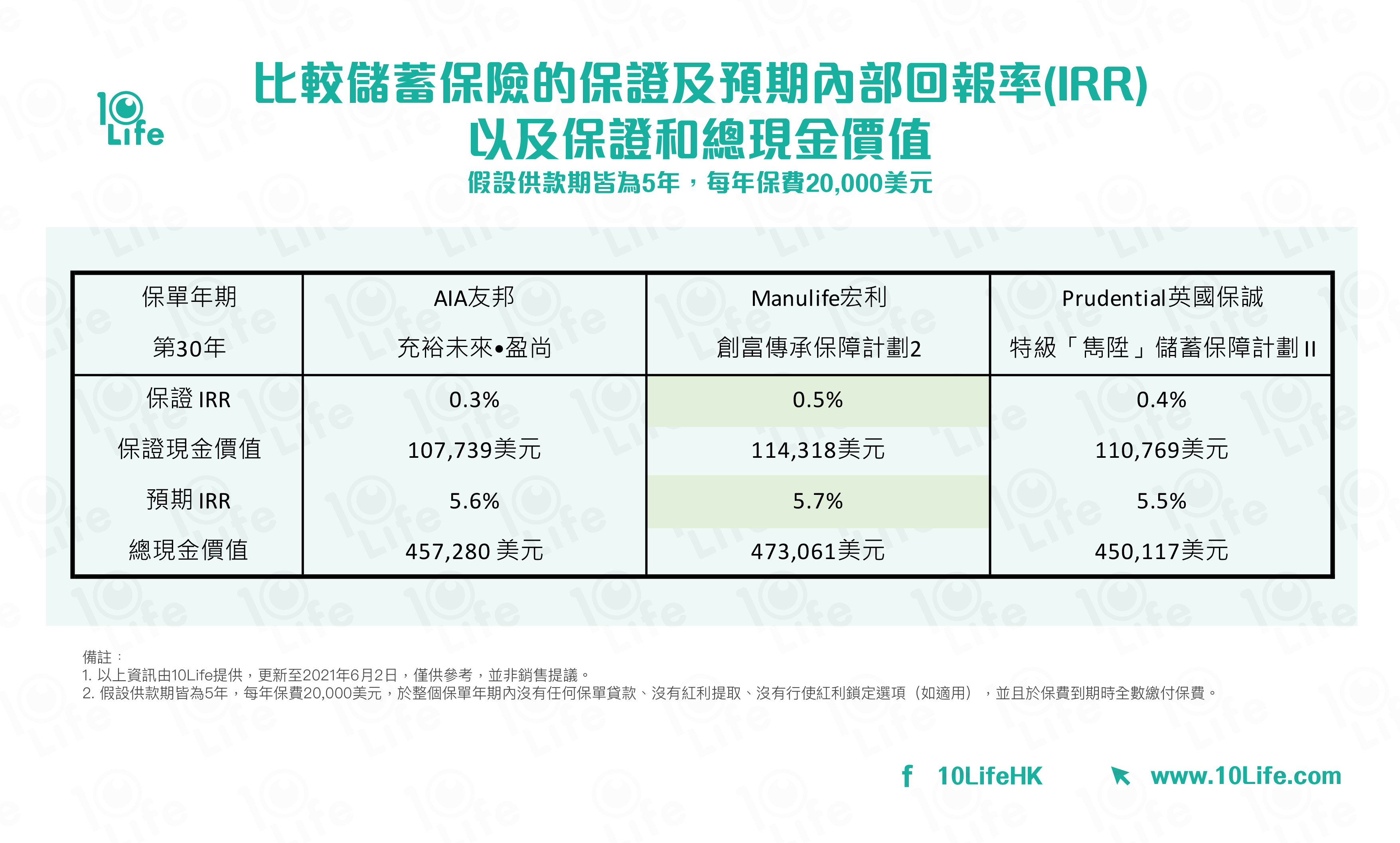
We selected products with a 5-year premium payment period and an annual premium of USD 20,000, assuming a 30-year accumulation period (Note 1), and calculated the IRR over 30 years. As shown in Chart 1, the 30-year expected and guaranteed IRR of the three products are close, with expected IRR ranging from 5.5% to 5.7%. Due to their relatively aggressive nature, the 30-year guaranteed IRR ranges only from 0.3% to 0.5%. Among them, Manulife Wealth Builder 2 slightly outperforms in both expected and guaranteed IRR.
Chart 1
Step 2: Understand the Risk Factors of Bonus Fluctuations – Identify More "Guaranteed" Elements in Potential Returns
The potential return rate of the above aggressive savings insurance exceeds 5%, which is quite attractive in a low-interest environment, allowing even the less proactive to accumulate wealth over time. However, expected returns include non-guaranteed components. Are there other indicators to help assess risks and ensure a defensive position?
2.1 Non-Guaranteed Bonus Components: Prudential Elite II Has a Higher Proportion of Reversionary Bonus
Non-guaranteed bonuses come in different forms, such as reversionary bonus (also known as annual bonus) and special bonus (also known as terminal bonus):
Reversionary Bonus: Typically announced annually, once declared, the face value is guaranteed to be paid and accumulates within the policy.
Special Bonus: Paid as a lump sum upon policy surrender, the amount varies depending on when the policyholder surrenders, based on investment returns and market conditions at that time. It does not accumulate within the policy.
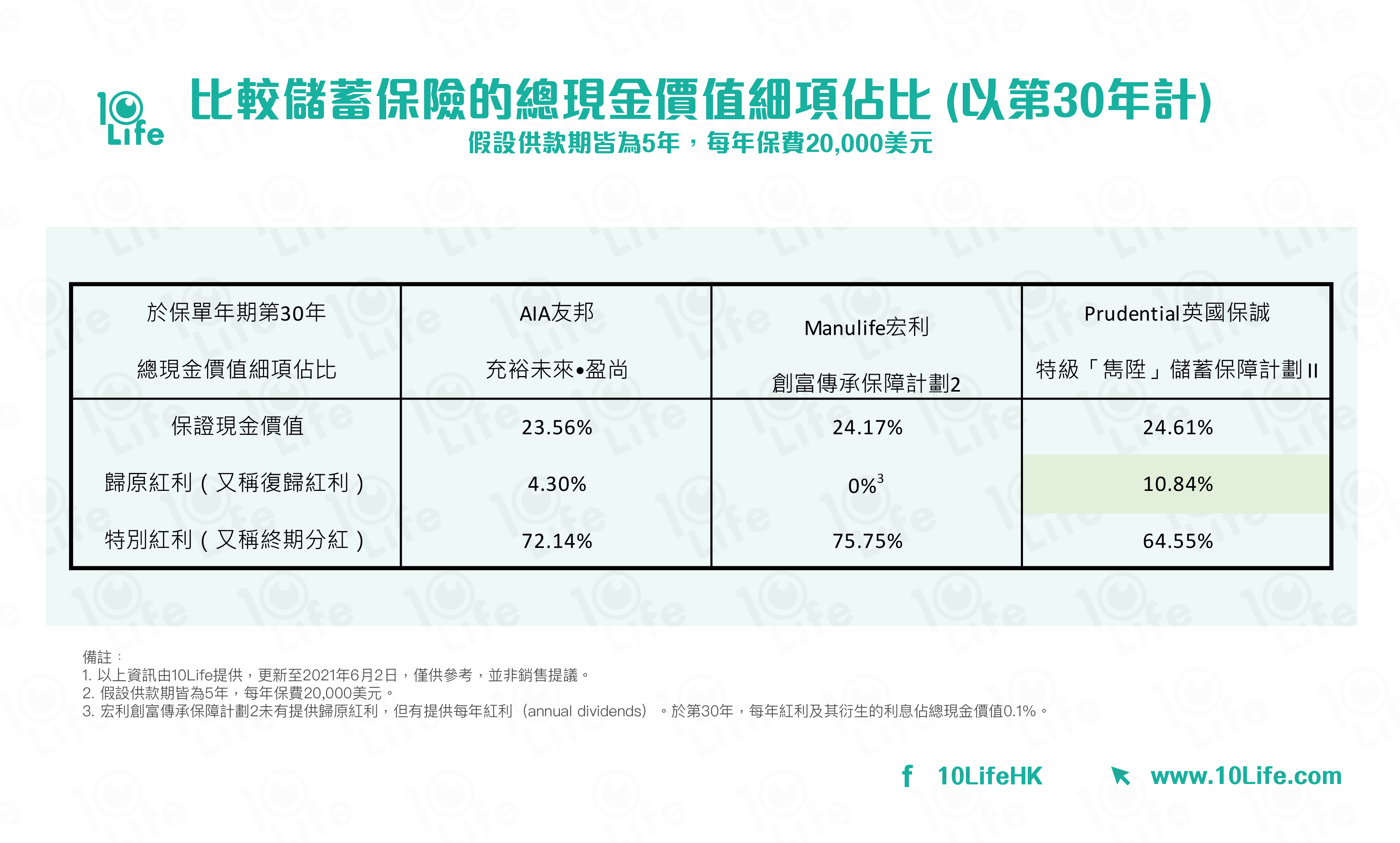
Since the face value of a reversionary bonus is guaranteed upon announcement, a higher reversionary bonus means lower volatility in non-guaranteed bonuses, which is more beneficial for policyholders. Policyholders can request to withdraw the cash value of accumulated reversionary bonuses to meet financial needs when necessary. Chart 2 shows that Prudential Elite II has the highest proportion of reversionary bonus, accounting for 10.84% (based on the total cash value over 30 years).
Chart 2
2.2 Returns Under Pessimistic Scenarios: Prudential Elite II and Manulife Wealth Builder 2 Expected IRR Still Exceed 4%
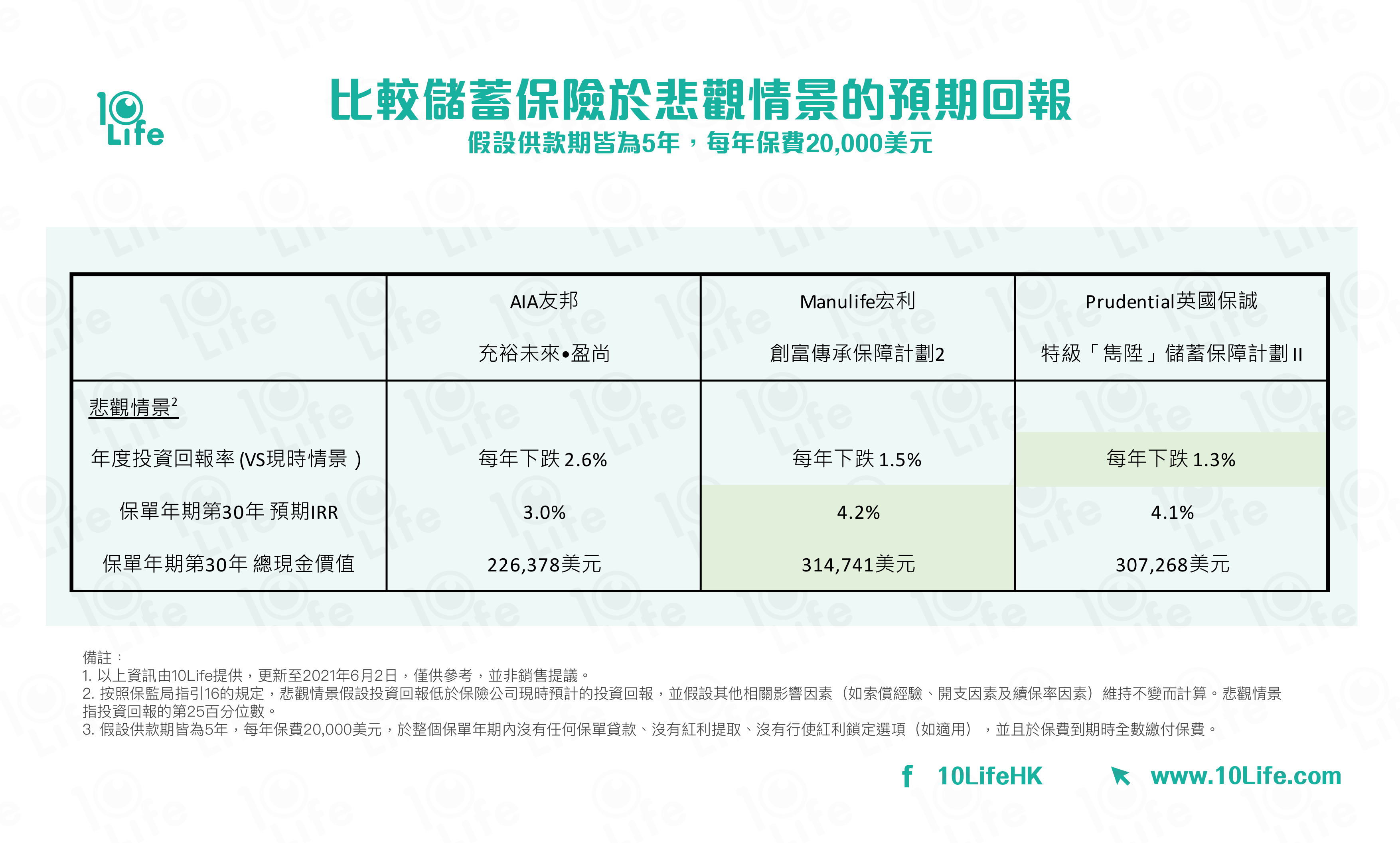
Besides the "currently projected" returns, you can also refer to the "pessimistic scenario" (Note 2) in the sales illustration documents to gauge the product’s risk volatility. The "pessimistic scenario" is calculated based on the 25th percentile of the "currently projected" investment return, assuming other relevant factors (such as claims experience, expenses, and persistency rates) remain unchanged. Chart 3 shows that under the "pessimistic scenario," Prudential Elite II experiences the smallest decline in annual investment return rate, at only 1.3%, while Manulife Wealth Builder 2 slightly leads with a 30-year expected IRR of 4.2%.
Chart 3
2.3 Target Asset Allocation: AIA Capital Assured and Manulife Wealth Builder 2 Have More High-Risk Assets
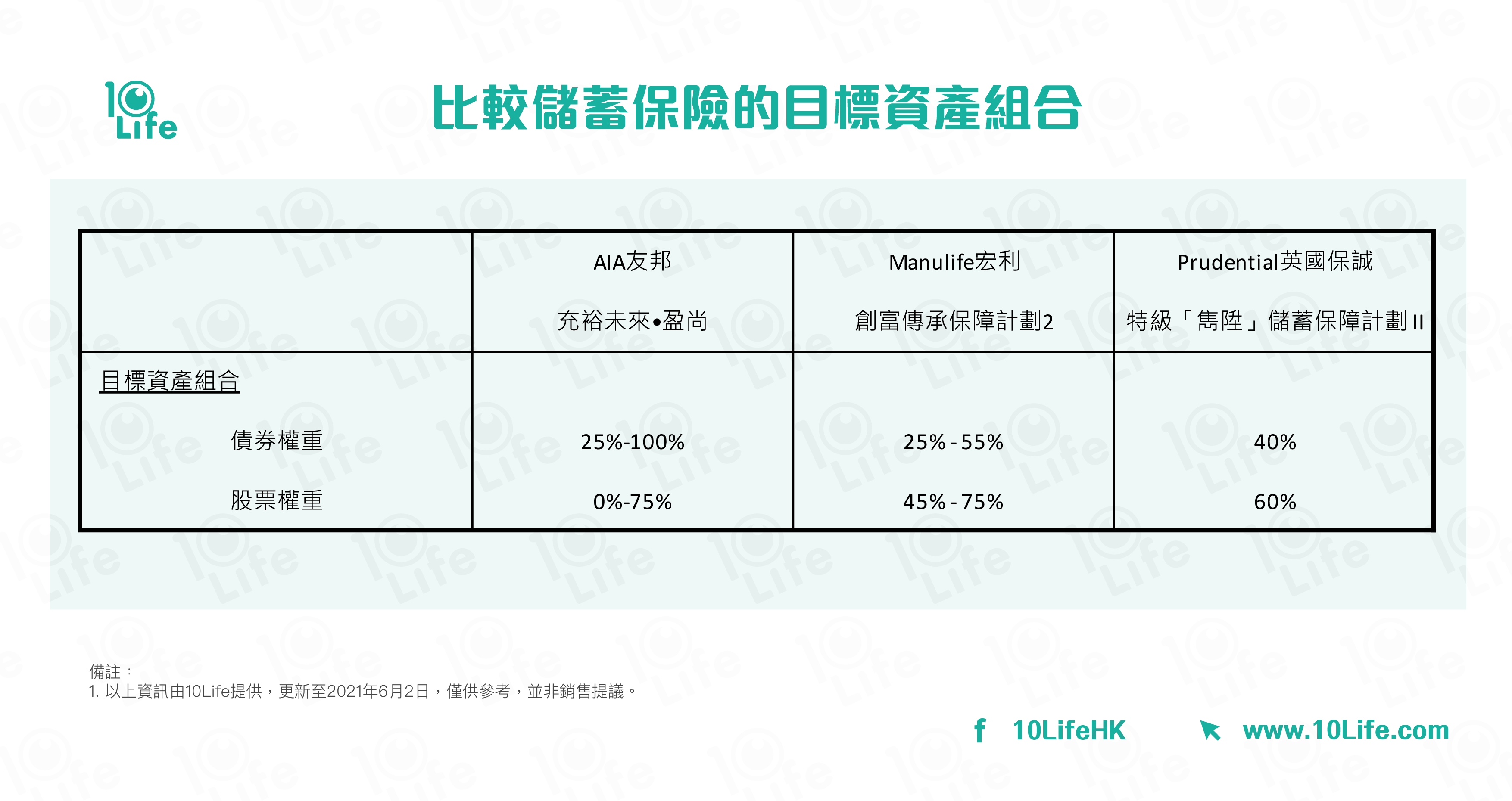
Insurance companies are required to disclose the target asset allocation by asset class for savings insurance, i.e., the proportion of equities, bonds, and other fixed-income instruments. The more assets allocated to equities, the higher the volatility in investment returns. In the most aggressive scenarios, AIA Capital Assured and Manulife Wealth Builder 2 can invest up to 75% of funds in equities, while Prudential Elite II invests a maximum of 60% in equities.
Chart 4
2.4 Bonus Policy: Prudential Elite II Offers Higher Transparency
Bonus policy refers to how insurance companies distribute investment gains to policyholders and company shareholders. Prudential Elite II explicitly states its bonus policy, allocating at least 90% of distributable profits to policyholders, whereas AIA and Manulife do not specify the profit proportion for policyholders in their bonus policies (Note 3). In other words, Prudential Elite II’s bonus policy is clearer and more transparent.
Step 3: Compare Historical Bonus Performance – But Short Disclosure Periods May Not Reflect Long-Term Bonus Performance
When discussing bonus performance, the bonus fulfilment ratio is a commonly used indicator. Many sales agents in the market highlight that their company’s bonus fulfilment ratio can reach 100% or even higher. Does a 100% bonus fulfilment ratio indicate that long-term bonus performance matches expectations? The so-called bonus fulfilment ratio is calculated by dividing the actual non-guaranteed bonuses paid by the average amount stated in the benefit illustration.
The three products discussed in this article are of a newer generation and lack bonus fulfilment ratio data. We can only refer to data from the previous generation of similar products. However, 10Life has identified two major limitations with bonus fulfilment ratios.
Limitation 1 – Disclosure Period Too Short: According to Guideline 16 issued by the Insurance Authority, since 2017, insurance companies must disclose the bonus fulfilment ratio for dividend-paying savings insurance for at least the past 5 years (if available). However, since the guideline’s implementation, the disclosure period for many products in the market remains short. For example, AIA Capital Assured, being a recently launched plan, currently has only 4 years of data. Comparing the total cash value in the 4th year versus the 30th year, the former accounts for less than 10% of the latter. Manulife’s previous generation plan currently has no bonus fulfilment ratio data available. As for Prudential Elite, 10 years of bonus fulfilment ratio data have been disclosed, with bonuses accounting for nearly 25% (compared to the 30th year).
Even if the bonus fulfilment ratio is high, a short data period offers limited reference value for savings insurance spanning decades. Over longer periods, as the proportion of bonuses increases, achieving a high bonus fulfilment ratio becomes increasingly challenging.
[Visit AIA, Manulife, and Prudential websites for bonus fulfilment ratio data]
Limitation 2 – Proportion of Individual Bonuses May Be Too Small: Currently, insurance companies can disclose bonus fulfilment ratios for individual bonus types separately. For instance, in AIA Capital Assured’s 4-year data, although the reversionary bonus has a 100% fulfilment ratio, it accounts for only 4.3% of the total cash value (based on 30 years, see Chart 2). This may not reflect the overall fulfilment of non-guaranteed returns.
Continuous disclosure of bonus fulfilment ratios helps policyholders understand the return performance of long-term dividend-paying savings insurance, but interpreting this data is not straightforward. In fact, rather than disclosing data for individual bonus types separately, disclosing the fulfilment ratio of total cash value (including the sum of all guaranteed and non-guaranteed returns) would be more meaningful. Prudential is among the few insurers in the market that disclose the total cash value fulfilment ratio.
Undoubtedly, transparency in information is the trend, and we hope that insurance companies will strive to exceed the minimum requirements set by regulators when disclosing information. For example, disclosing bonus fulfilment ratios over longer periods or even the actual IRR of savings insurance would help policyholders better understand the historical return performance of similar products.
If you wish to compare savings insurance in-depth, you can visit the "Product Decoder" on the 10Life website or consult licensed advisors on the site.
Notes:
This English version of this article has been generated by machine translation powered by AI. It is provided solely for reference purposes. In the event of any discrepancy or inconsistency between this translation and the original Chinese version, the Chinese version shall prevail.

Our team of professional content researchers focussing on insurance
Our team of professional content researchers focussing on insurance
10Life Product Comparison and 10Life Insurance Ratings are developed by 10Life Financial Limited, an authorised insurance broker company licensed with the Insurance Authority under License Number FB1526. 10Life Product Comparison and 10Life Insurance Ratings are developed for generic customer segments using mathematical calculations based on product information, facts and data, and are not influenced by any partnerships with or fees received from insurance companies. Any information on 10Life Platform ("10Life Information"), including but not limited to Product Comparison, Product Ratings, Blog Articles are intended for general education purpose and reference only. None of the 10Life Information is intended, nor should they be considered or relied upon, as regulated advice, insurance, financial, investment or professional advice, recommendation, approval, endorsement, invitation or solicitation in respect of any insurance, financial or investment products. 10Life Information does not take into account your individual needs. Reading 10Life Information should not be considered as conducting a suitability assessment, and is not sufficient to form the basis of any decisions to purchase any insurance products. You should rely on information authorised by insurance companies, carry out your own research and/or seek independent advice from licensed intermediaries before purchasing any insurance products or making any insurance decisions. While reasonable effort is used when collecting, validating and updating 10Life Information from various channels, none of 10Life Group and its subsidiaries, affiliates, agents, directors, officers and employees will be responsible for any liability, claim or loss arising from or associated with you using 10Life Information. No warranty, representation or guarantee is given by 10Life Group and its subsidiaries on the accuracy, completeness and timeliness of the information. If you have any questions on 10Life Product Comparison and 10Life Insurance Ratings, please email us at enquiries@10life.com




 Talk to 10Life on WeChat