









10Life Financial Limited
Enquiries: enquiries@10life.com
Hotline: (852) 3705 1599
Address: 16/F Greatmany Centre, 109-115 Queen’s Road East, Wan Chai, Hong Kong



Whole Life Savings Insurance: Long-term Wealth Growth with Both Growth and Protection
Tax-deductible annuities: Suitable for retirement and savings, with tax incentives enhancing returns
Universal life insurance: Higher entry threshold
Investment-linked life insurance plan: Policyholders need to have a certain level of investment knowledge. Investment losses may result in a loss of principal.


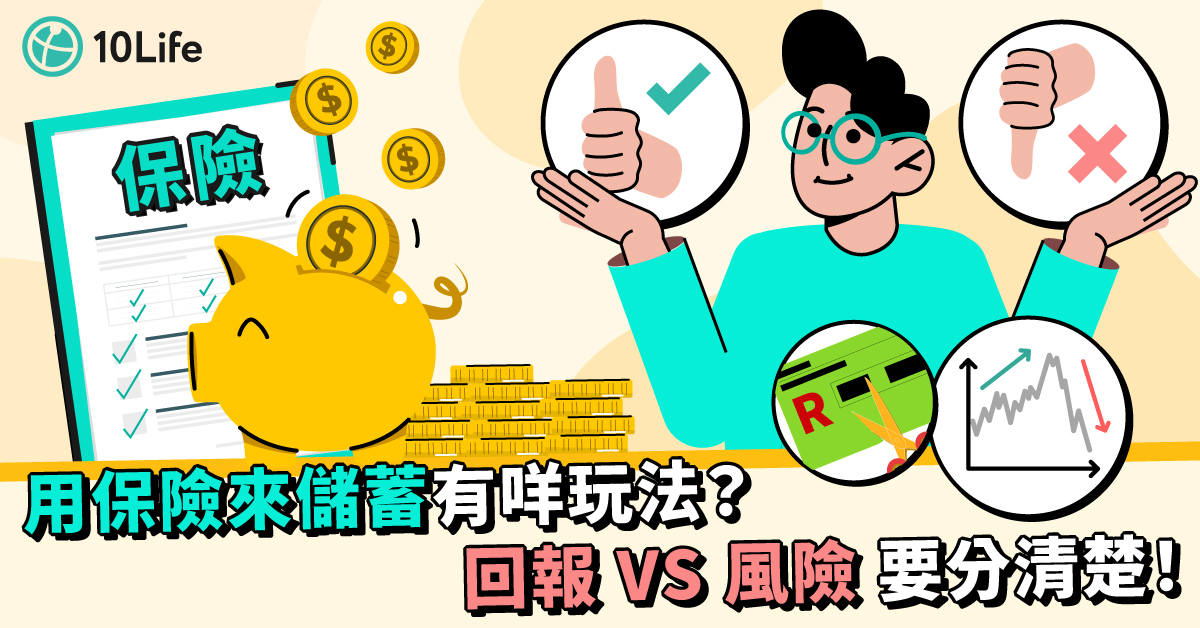
There is a wide range of insurance products designed for saving money. Common examples include savings insurance (which can be further divided into short-term and whole-of-life plans), tax-deductible annuities (officially known as “Qualifying Deferred Annuity Policies”, QDAP), investment-linked assurance schemes (commonly referred to as “ILAS”), and universal life insurance. However, many consumers find these insurance products confusing, or take out policies because of their high returns, only to lose money when surrendering them early. What are the differences between these products? What must you know before taking out a policy? In the following article, 10Life will examine the characteristics of these products one by one, including their returns, uses and potential risks.
| Short-Term Savings Insurance | Whole-of-Life Savings Insurance (Savings-Focused) | Tax-Deductible Annuity (QDAP) | Universal Life Insurance | Investment-Linked Assurance Scheme (ILAS) | |
| Premium Payment Term | 1 to 3 years1 | 1 to several years1 | 5 to 10 years1 | 1 to several years1 | Single premium to several years |
| Premium Amount | Fixed | Fixed | Fixed | Fixed or variable (depending on the product) | Fixed or variable (depending on the product) |
| Guaranteed Returns | ✓ | ✓ | ✓ | Some products2 | X |
| Tax Deduction Benefits | X | X | ✓ | X | X |
Savings / Investment Term | |||||
| Short Term (less than 10 years) | ✓ | X | X | Some products | X |
| Medium Term (10 to 19 years) | X | X | ✓ | ✓ | ✓ |
| Long Term (20 years or more) | X | ✓ | ✓ | ✓ | ✓ |
Return Distribution Method | |||||
| Lump-Sum Distribution | ✓ | ✓ | Some products3 | ✓ | ✓ |
| Fixed Instalment Distribution | X | May pay dividends (some products) | ✓ | X | May pay dividends (some funds) |
| Notes: 1. Some products offer a prepayment option for premiums. 2. Some products offer a guaranteed minimum payout rate (but only for specified terms). 3. Some products offer a flexible option allowing policyholders to choose to receive the annuity as a lump sum. 4. The table above considers general product features only. 5. The above information is for reference only and does not constitute investment advice. | |||||
Whole Life Savings Insurance: Long-term Wealth Growth with Both Growth and Protection
Whole-of-life savings insurance can be used for long-term savings, helping you prepare for retirement, your children’s education and achieving your dreams (such as starting a business or travelling around the world). The product offers guaranteed and projected returns, and the policy term can extend to the policyholder’s entire lifetime. Policyholders must select a premium payment term (ranging from 1 to 25 years) and pay fixed premiums during this period. You should understand your target term and the IRR (internal rate of return) when the policy reaches that target term. For example, if Mr Chan plans to fund his child’s overseas education in 20 years, he can compare the 20-year IRR of different whole-of-life savings insurance products. As whole-of-life savings insurance requires time to build up value, policyholders may incur a loss if they surrender the policy in its early years.
It is worth noting that savings insurance products in the market have different positioning, with varying returns and risks:
If you would like to compare whole-of-life savings insurance products, visit the 10Life website’s <《Product Decoder》>:
Tax-deductible annuities: Suitable for retirement and savings, with tax incentives enhancing returns
Universal life insurance: Higher entry threshold
Universal life insurance has a relatively high entry threshold, and policyholders are generally required to pay a large premium in a lump sum, so it is aimed at wealthier individuals. Some products offer a minimum guaranteed payout rate for a specified period. Policyholders can use premium financing to borrow at a low interest rate (lower than the guaranteed payout rate of universal life insurance) to pay the large premium. As long as borrowing costs remain low, policyholders can profit from the interest-rate spread. However, if borrowing rates rise and the insurer's payout rate fails to keep pace, losses may result.
Investment-linked life insurance plan: Policyholders need to have a certain level of investment knowledge. Investment losses may result in a loss of principal.
An investment-linked assurance scheme (known as an investment-linked assurance scheme or ILAS) allows policyholders to make “fund investments” through insurance. ILAS is a long-term investment. Returns are linked to the performance of the selected funds and are not guaranteed, while the life cover is at least 105% of the account value. Insurance companies typically offer a range of funds for policyholders to choose from. These funds cover different regions (such as developed countries and emerging markets), countries (such as the US and China), or industries (such as finance and technology), enabling policyholders to invest in markets and industries outside Hong Kong through ILAS.
Charges should be taken into consideration when investing in funds. In addition to the charges imposed by the funds themselves, insurance companies also levy fees, known as additional charges. You may compare the fees charged by ILAS, banks and online fund trading platforms. ILAS generally does not charge switching fees, which benefits policyholders who frequently buy and sell funds.
Returns from ILAS are linked to the performance of the selected funds. During a rising market, returns can be substantial; however, investment losses may result in a loss of principal. Even if a fund has delivered impressive returns in the past, this does not mean it will perform well in the future. It is also worth noting that, unless insurance intermediaries hold a licence from the Securities and Futures Commission (SFC), they are not legally permitted to provide advice on fund selection. Policyholders therefore need to have a certain level of investment knowledge.
Further reading:
【Savings Insurance】Understand the types of bonuses to avoid miscalculating your finances when withdrawing money mid-term
【Financial Planning Methods 2025】What constitutes an ideal investment portfolio?
The above products also provide life cover, but the amount of compensation varies depending on the product and is therefore not discussed in detail here. This article provides a brief comparison of the various insurance products that can be used for savings. Put simply, returns are proportional to risk. When you hope to achieve higher returns, you should also understand your ability to bear risk. When someone promotes a product offering high returns with low risk, you should be particularly cautious and understand the product concerned. You are welcome to compare insurance plans through 10Life《Insurance Decoder》.
Last updated: 20 August 2025
This English version of this article has been generated by machine translation powered by AI. It is provided solely for reference purposes. In the event of any discrepancy or inconsistency between this translation and the original Chinese version, the Chinese version shall prevail.
Our team of professional content researchers focussing on insurance
Our team of professional content researchers focussing on insurance
10Life Product Comparison and 10Life Insurance Ratings are developed by 10Life Financial Limited, an authorised insurance broker company licensed with the Insurance Authority under License Number FB1526. 10Life Product Comparison and 10Life Insurance Ratings are developed for generic customer segments using mathematical calculations based on product information, facts and data, and are not influenced by any partnerships with or fees received from insurance companies. Any information on 10Life Platform ("10Life Information"), including but not limited to Product Comparison, Product Ratings, Blog Articles are intended for general education purpose and reference only. None of the 10Life Information is intended, nor should they be considered or relied upon, as regulated advice, insurance, financial, investment or professional advice, recommendation, approval, endorsement, invitation or solicitation in respect of any insurance, financial or investment products. 10Life Information does not take into account your individual needs. Reading 10Life Information should not be considered as conducting a suitability assessment, and is not sufficient to form the basis of any decisions to purchase any insurance products. You should rely on information authorised by insurance companies, carry out your own research and/or seek independent advice from licensed intermediaries before purchasing any insurance products or making any insurance decisions. While reasonable effort is used when collecting, validating and updating 10Life Information from various channels, none of 10Life Group and its subsidiaries, affiliates, agents, directors, officers and employees will be responsible for any liability, claim or loss arising from or associated with you using 10Life Information. No warranty, representation or guarantee is given by 10Life Group and its subsidiaries on the accuracy, completeness and timeliness of the information. If you have any questions on 10Life Product Comparison and 10Life Insurance Ratings, please email us at enquiries@10life.com




 Talk to 10Life on WeChat
