


false
Category
Author
Search for Articles
Trending Keywords
Category
Author
Search
Category
Author
Search
Critical Illness

【Unlimited Claims vs Unlimited Diseases】 A Showdown of "Unlimited" Critical Illness Insurance: Why Such a Huge Difference in Compensation?

2021-05-18 6min read
Unlimited-Claims-vs-Unlimited-Diseases-Comparing-coverage-on-unlimited-critical-illness-insurance-kv.png
Is "Unlimited" Invincible? The risks of the future are hard to predict, and if insurance can offer "unlimited" protection, it is certainly very appealing. But what does "unlimited" actually mean? In the market, there are not many critical illness insurance products with an "unlimited" concept. Currently, only AIA's 唯一摯保–全面保障 (hereinafter referred to as AIA 唯一摯保), Generali Hong Kong's 加愛無限保 (hereinafter referred to as Generali 加愛), and 跨越無限保 (hereinafter referred to as Generali 跨越) fall into this category. Although these products are marketed as "unlimited," there are differences among them. Generali 跨越 is a lifelong critical illness insurance, while AIA 唯一摯保 and Generali 加愛 both have specified renewal periods without a savings component, classifying them as term critical illness insurance. This article will focus on comparing the latter two.
 
AIA 唯一摯保’s Payout for Three Major Critical Illnesses Is Unpredictable and Depends on Severity

 
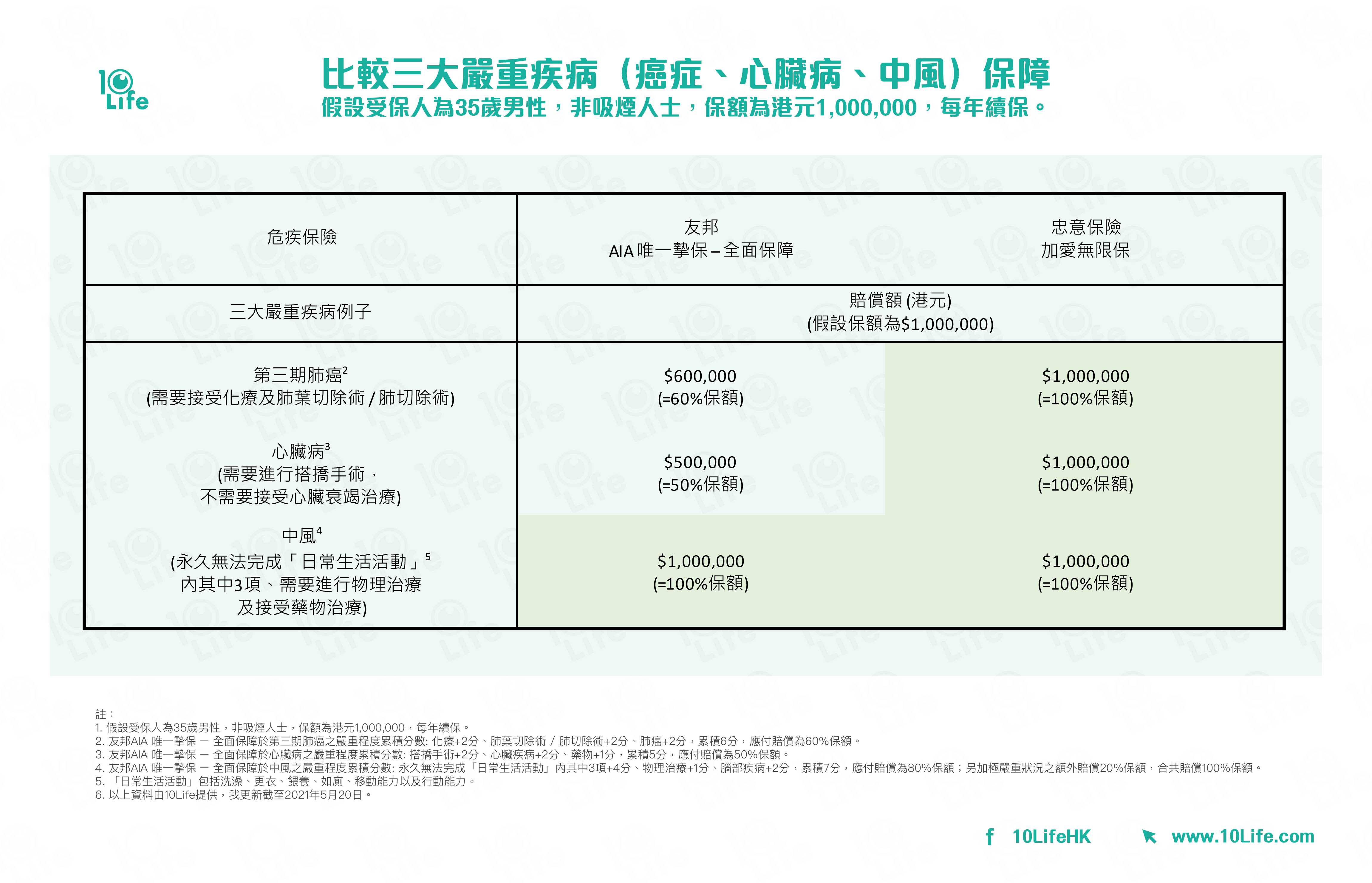
Customers are generally most concerned about the three major critical illnesses—cancer, heart disease, and stroke—which account for approximately 90% of critical illness insurance claims. Therefore, we first compare the payouts for these three illnesses. Assuming a sum insured of HKD 1 million (Note 1), Chart 1 illustrates the severity levels of the diseases.
 
Chart 1
Comparison of Coverage for Three Major Critical Illnesses (Cancer, Heart Disease, Stroke)
 
 
AIA 唯一摯保 promotes "Unlimited Types of Illnesses" coverage, with payouts determined by the severity of the insured’s condition. In the above case, AIA 唯一摯保 is estimated to pay HKD 600,000 for stage III lung cancer, HKD 500,000 for a heart attack (requiring bypass surgery), and HKD 1 million for a stroke (Note 2). Why is there such a significant difference in payouts for equally serious critical illnesses? This is because the plan calculates payouts based on the medical process and severity level (Note 3), with single payouts ranging from 10% to 160% of the sum insured. Therefore, even for serious critical illnesses, a full 100% payout of the sum insured is not guaranteed. If the case becomes more severe—for example, cancer progresses to stage IV or heart condition worsens to heart failure—the payout may increase. However, the insured must understand these complex conditions and calculations to estimate the payout amount.
 
In contrast, Generali 加愛 classifies cancer, heart attack, and stroke as serious critical illnesses, with the insured receiving a payout of HKD 1 million. Once the insured is diagnosed with a covered critical illness, they receive 100% of the sum insured as compensation, without the need to further "escalate" the severity for calculation purposes. Thus, the insured only needs to understand the definition of covered illnesses to more easily predict the payout amount. Including the three major critical illnesses, Generali 加愛 lists 69 illnesses as serious critical illnesses, each eligible for a 100% payout of the sum insured.
 
<Compare Term Critical Illness Insurance>
 
 
Generali 加愛 Offers Unlimited Payouts for Three Major Critical Illnesses, with Easier-to-Predict Compensation

 
In recent years, the survival rate of critical illness patients has improved. After being diagnosed with a critical illness for the first time, it becomes difficult for patients to obtain new insurance coverage. Over a long lifetime, there is also the risk of facing critical illness again, which is why many customers prioritise multiple protection in critical illness insurance.
 
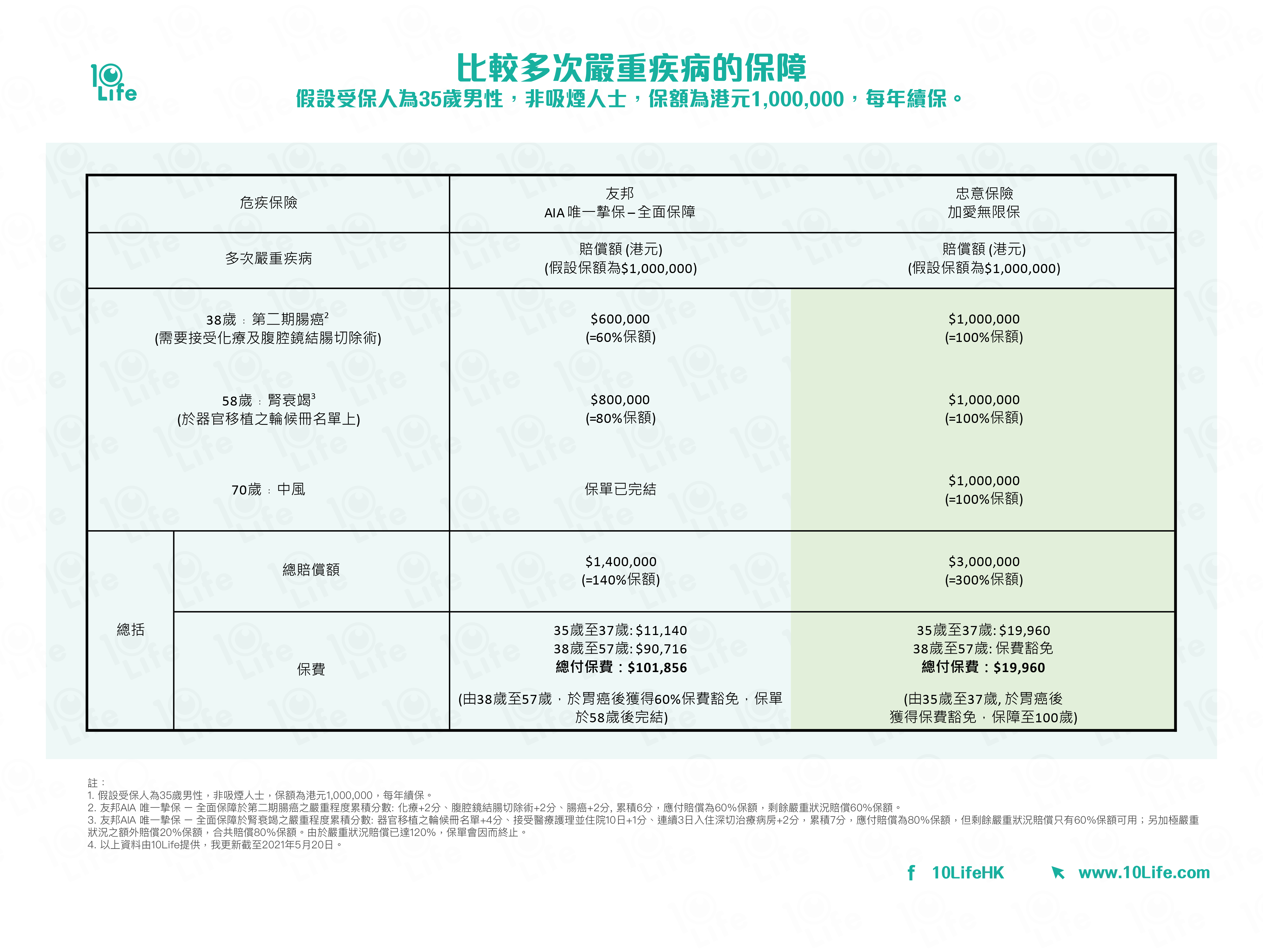
Let’s illustrate with a case study: Assume the policyholder is a 35-year-old non-smoking male with a sum insured of HKD 1 million. At age 38, he is diagnosed with stage II colorectal cancer; at age 58, he is diagnosed with kidney failure; and at age 70, he unfortunately suffers a stroke. See Chart 2.
 
For Generali 加愛, after the waiting period (Note 4), each diagnosis of a covered critical illness results in a payout of HKD 1 million. Therefore, for the three serious critical illnesses, the total payout amounts to HKD 3 million. Most term critical illness insurance products in the market only offer a single payout, but Generali 加愛 uniquely provides "Unlimited Payouts" for cancer, heart disease, and stroke. Even for other serious critical illnesses, Generali 加愛 offers at least one payout, with each payout at 100% of the sum insured.
 
Although AIA 唯一摯保 does not limit the types of illnesses, payouts are constrained by severity levels, meaning it may not always provide a 100% payout of the sum insured. In the example, stage II colorectal cancer is estimated to result in a payout of HKD 600,000, and kidney failure is estimated at HKD 800,000, with a total payout of HKD 1.4 million (i.e., 140% of the sum insured) for the two claims (Note 2). After these two claims, if the payout for severe conditions reaches 120% of the sum insured, the policy will terminate (Note 5), meaning any subsequent stroke will not be compensated.
 
Chart 2
Comparison of Coverage for Multiple Serious Illnesses
 
<Compare Term Critical Illness Insurance>
 
 
Premium Waiver After Critical Illness? Comparing Waiver Details

 
Continuing with the example in Chart 2, why is there a significant difference in the premiums paid by the insured? Generali 加愛 offers a premium waiver mechanism. In the example, the insured only pays premiums for 3 years (approximately HKD 20,000). Upon diagnosis of a serious illness, future premiums are waived, and the insured continues to enjoy lifelong coverage. Generally speaking, premium waiver clauses are rare in term critical illness insurance. Among similar products, Generali 加愛 uniquely provides premium waivers for all serious critical illnesses until the end of the coverage period (age 100).
 
In fact, AIA 唯一摯保 also offers a premium waiver, but it requires meeting strict conditions to fully waive future premiums (Note 6), and the coverage period is limited to age 85. In the Chart 2 example, when the insured claims for stage II colorectal cancer (60% of the sum insured), since the payout is less than 100% of the sum insured, only a partial premium waiver is granted, meaning 60% of subsequent premiums are waived. However, between the first and second claims, the insured still needs to pay approximately HKD 90,000 in premiums over 20 years.
 
Compensation for Unknown Illnesses Still Depends on Severity

 
For common critical illness cases, Generali 加愛, which compensates based on covered critical illnesses, offers relatively predictable payout amounts, with unlimited payouts for the three major critical illnesses. On the other hand, for AIA 唯一摯保, which compensates based on severity, consumers need to understand the plan’s definitions of severe, very severe, and extremely severe conditions to calculate the payout amount. Of course, the selling point of AIA 唯一摯保 is its coverage of unlimited types of illnesses, including unknown illnesses. For example, in the case of COVID-19, if an insured under AIA 唯一摯保 is hospitalised for 10 or more consecutive days and spends 3 or more consecutive days in the ICU due to COVID-19, they can receive a payout of 50% of the sum insured (Notes 2, 7). However, if the insured is only hospitalised without meeting these conditions, no compensation will be provided. As for Generali 加愛, if COVID-19 results in lung function loss to a specified degree, such as a permanent and irreversible decline (Note 8), a payout of 100% of the sum insured will be made.
 
Like Generali 加愛, Generali 跨越, mentioned at the beginning of the article, also offers unlimited payouts for the three major critical illnesses. However, the latter is a lifelong critical illness insurance. After the insured completes premium payments within the selected period, they can enjoy lifelong coverage, including a premium waiver after the first serious critical illness claim. Since we cannot predict whether a critical illness will occur early or late in life, if it occurs later, the premiums for lifelong critical illness insurance may already be fully paid, yet the insured still enjoys lifelong coverage. Imagine if parents purchase insurance for their children; even though the likelihood of a critical illness in the short term is low, the premiums are also lower due to the reduced risk. By the time the premium payments are completed, the child will likely be an adult, enjoying lifelong coverage with unlimited payouts. This is the advantage of lifelong critical illness insurance.
 
10Life provides separate comparisons of term and lifelong critical illness insurance. For more details, please visit the 《Product Decoder》.
 
Notes:


  1. The currency in this article is Hong Kong Dollars (HKD).
  2. In this article, when calculating payouts for AIA 唯一摯保, 10Life has assumed the required medical processes for the cases and interpreted the relevant policy terms to estimate the payout amounts for the above cases. These estimated payout amounts are for reference only and have not been verified with the relevant insurance company.
  3. AIA 唯一摯保: The 4x3 payout scoring table considers four medical processes (surgery, treatment, severe hospitalisation, disability) and corresponding three severity levels. Since the plan does not specify particular illnesses, it theoretically covers unlimited types of illnesses as long as the specified severe conditions are met.
  4. For Generali 加愛, a 3-year waiting period applies to the same cancer, whether it recurs, spreads, or persists. However, the waiting period for a new cancer or other illnesses is 1 year.
  5. AIA 唯一摯保: The total payout limit for the entire policy is 160% of the sum insured, comprising payouts for severe conditions (120% of the sum insured) and additional payouts for extremely severe conditions (40% of the sum insured). However, once the payout for severe conditions reaches 120% of the sum insured, the policy terminates.
  6. AIA 唯一摯保: Premiums are waived if the payout for severe conditions reaches 100% of the sum insured, or if the additional payout for extremely severe conditions reaches 40% of the sum insured.
  7. AIA 唯一摯保: For COVID-19 severity scoring, points are accumulated as follows: hospitalisation for 10 or more days (+1 point), 3 consecutive days in ICU (+2 points), meeting severe hospitalisation criteria with 2 factors (+2 points). With a total of 5 points, the payout is 50% of the sum insured.
  8. Any lung disease causing permanent and irreversible decline in lung function, requiring long-term oxygen therapy for hypoxemia, and with a Forced Expiratory Volume in 1 second (FEV1) test result consistently equal to or less than 1 litre under appropriate medical treatment for at least three (3) months. The diagnosis must be confirmed by a registered specialist in respiratory medicine. If the diagnosed lung disease does not meet the definitions of other serious illnesses related to the lungs, the policy will provide coverage based on lung function impairment.
  9. The above information is provided by 10Life for reference only and does not constitute a sales proposal. The information is updated as of 20 May 2021.

This English version of this article has been generated by machine translation powered by AI. It is provided solely for reference purposes. In the event of any discrepancy or inconsistency between this translation and the original Chinese version, the Chinese version shall prevail.

Last updated: 9 Apr 2026

10Life Logo
10Life Editorial Team

Our team of professional content researchers focussing on insurance

10Life Logo
10Life Editorial Team

Our team of professional content researchers focussing on insurance

Disclaimer

10Life Product Comparison and 10Life Insurance Ratings are developed by 10Life Financial Limited, an authorised insurance broker company licensed with the Insurance Authority under License Number FB1526. 10Life Product Comparison and 10Life Insurance Ratings are developed for generic customer segments using mathematical calculations based on product information, facts and data, and are not influenced by any partnerships with or fees received from insurance companies. Any information on 10Life Platform ("10Life Information"), including but not limited to Product Comparison, Product Ratings, Blog Articles are intended for general education purpose and reference only. None of the 10Life Information is intended, nor should they be considered or relied upon, as regulated advice, insurance, financial, investment or professional advice, recommendation, approval, endorsement, invitation or solicitation in respect of any insurance, financial or investment products. 10Life Information does not take into account your individual needs. Reading 10Life Information should not be considered as conducting a suitability assessment, and is not sufficient to form the basis of any decisions to purchase any insurance products. You should rely on information authorised by insurance companies, carry out your own research and/or seek independent advice from licensed intermediaries before purchasing any insurance products or making any insurance decisions. While reasonable effort is used when collecting, validating and updating 10Life Information from various channels, none of 10Life Group and its subsidiaries, affiliates, agents, directors, officers and employees will be responsible for any liability, claim or loss arising from or associated with you using 10Life Information. No warranty, representation or guarantee is given by 10Life Group and its subsidiaries on the accuracy, completeness and timeliness of the information. If you have any questions on 10Life Product Comparison and 10Life Insurance Ratings, please email us at enquiries@10life.com

Whatsapp icon
Whatsapp icon
WeChat icon
WeChat icon
Enquiry icon Close icon
Back To Top
Whatsapp icon
Whatsapp icon
WhatsApp