


false
Category
Author
Search for Articles
Trending Keywords
Category
Author
Search
Category
Author
Search
VHIS
Medical
Editor's Pick

Voluntary Health Insurance: Innovative Compensation Mechanism - Does Public Health Insurance Rival High-End Coverage? (Comparing Voluntary Health Insurance Flexi Plans (General Ward))

2020-11-18 8min read
Innovative-Benefit-Limit-Basis-in-VHIS-Mass-Market-Medical-Comparing-VHIS-Ward-Flexi-Plans-kv.png
Under the impact of COVID-19, various industries have been severely affected, and many employees are tightening their belts. When it comes to medical protection, how can consumers not do more research to secure better coverage with a limited budget? Over the past decade, insurance companies have been promoting high-end medical insurance plans that offer full coverage, which provide greater peace of mind to policyholders compared to traditional medical insurance plans with itemised limits. However, the premiums for high-end medical plans without a deductible (i.e., excess) are not low, unless consumers opt for plans with a deductible to share the risk with the insurer, thereby reducing the required premium. This year, some insurance companies have introduced full coverage elements into Voluntary Health Insurance Scheme (VHIS) Flexi Plans (Standard Ward), offering competitive premiums and more comprehensive protection.

 
Innovations in Compensation Mechanisms for VHIS Standard Ward Plans
 
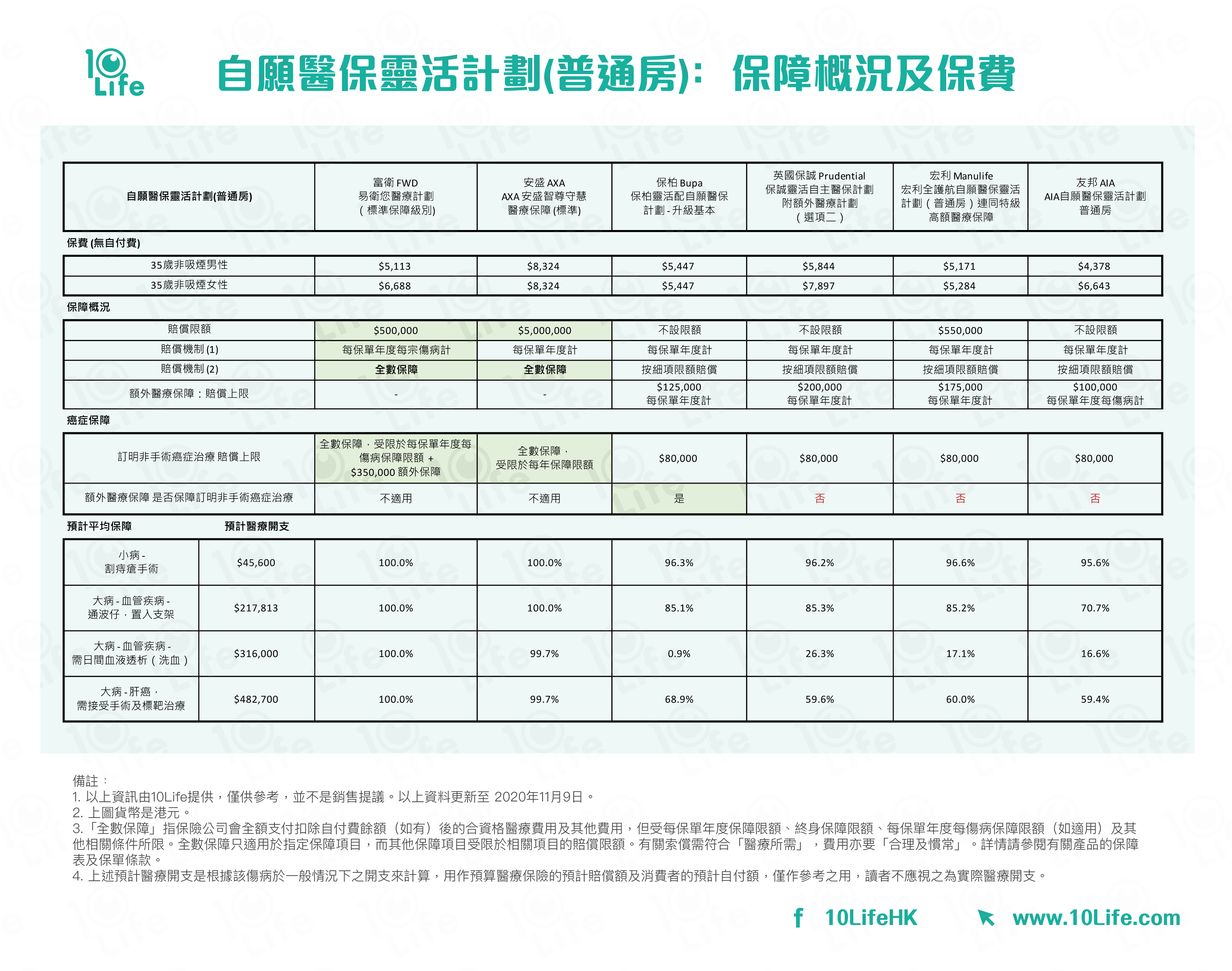
VHIS Flexi Plans (Standard Ward) are generally positioned as mass-market medical insurance, with most products offering compensation based on itemised limits. This means that compensation limits are set for individual coverage items such as hospitalisation fees, surgical fees, and miscellaneous expenses, creating numerous constraints on claims. 10Life calculates the expected medical coverage for multiple illness cases within the same policy year for medical insurance. Chart 1 shows that, for minor conditions like haemorrhoid surgery, the compared Standard Ward plans with itemised limits provide over 95% coverage. However, for serious illnesses, the coverage is clearly insufficient. For instance, some products only cover around 60%-69% of liver cancer treatment requiring surgery and targeted therapy, and just 1%-26% for haemodialysis.
 
To alleviate customer concerns about claims, some insurance companies have introduced full coverage (see Note 3) into VHIS Flexi Plans (Standard Ward). These plans are primarily subject to per policy year coverage limits, lifetime coverage limits, per policy year per illness coverage limits (if applicable), and/or other relevant conditions. Regardless of the severity of the illness, 10Life’s expected medical coverage rate is close to 100%. If a consumer opts for AXA Hong Kong and Macau’s plan without a deductible (see Chart 1), the annual premium would exceed HKD 8,000 (for a 35-year-old non-smoker).
 
Recently, FWD launched a VHIS plan - vCare Medical Plan (Standard Coverage Level: F00051-01-000-01) (“FWD vCare”), which features a more innovative and unique compensation mechanism. It calculates coverage per illness per policy year (see Note 4) for each coverage item, with a total coverage limit of HKD 500,000 per illness per policy year. Within this limit, it provides full coverage for most hospitalisation and surgical expenses, with no annual or lifetime coverage limits. According to 10Life’s rating, the expected coverage rate for both minor and serious illnesses reaches 100%. Compared to typical VHIS plans that only compensate based on itemised limits, the full coverage combined with a per policy year per illness compensation mechanism enhances protection, especially for clients who need to be hospitalised multiple times in a year due to different illnesses. For a 35-year-old non-smoking male client, the annual premium is just over HKD 5,000.
 
VHIS Flexi Plan (Standard Ward): Coverage Overview and Premiums
 
 
Taking liver cancer requiring surgery and targeted therapy as an example, FWD vCare’s expected coverage rate reaches 100%. This is because, in addition to the total coverage limit of HKD 500,000 per illness per policy year, the product offers an additional coverage limit of HKD 350,000 per policy year per illness for prescribed non-surgical cancer treatments (see Note 6 and Note 7). Combined, the total compensation limit can reach up to HKD 850,000 per policy year per illness. Moreover, the product covers outpatient expenses for 3 visits before admission and 20 visits after discharge (see Note 8).
 
In contrast, the expected coverage rate for AIA’s Flexi Plan, Prudential’s Flexi Plan, and Manulife’s Global Care Flexi Plan, which compensate based on itemised limits, is only around 60%. This is because (1) the compensation limit for prescribed non-surgical cancer treatments is only HKD 80,000, and (2) although these products offer Supplementary Major Medical (SMM) coverage to compensate for some expenses exceeding itemised limits, SMM does not apply to prescribed non-surgical cancer treatments. Therefore, in this example, the annual compensation limit for targeted therapy is restricted to the HKD 80,000 provided under basic coverage.

 
Full Coverage and Per Policy Year Per Illness Compensation Mechanism Enhances Protection for Multiple Illnesses in a Year
 
The above discussion assumes the expected coverage rate for a single hospitalisation due to an illness within the same policy year. However, in reality, it is impossible to predict how long an illness will last or how many illnesses one might suffer in a policy year. Therefore, we will analyse different compensation mechanisms using more severe cases.
 
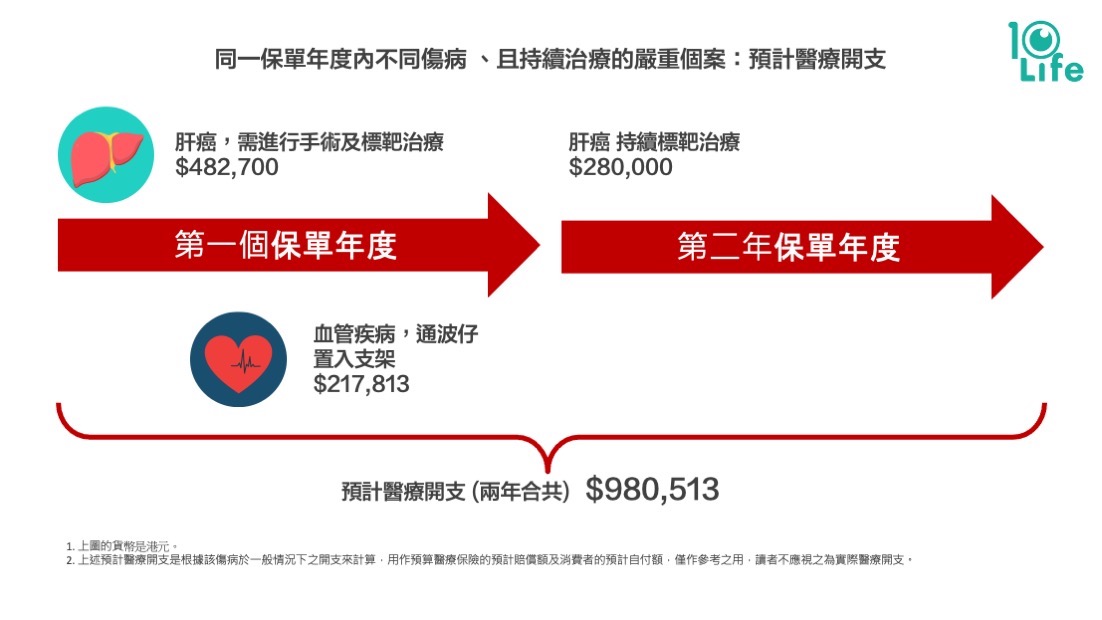
Severe Cases with Different Illnesses in the Same Policy Year and Ongoing Treatment: Expected Medical Expenses
 
 
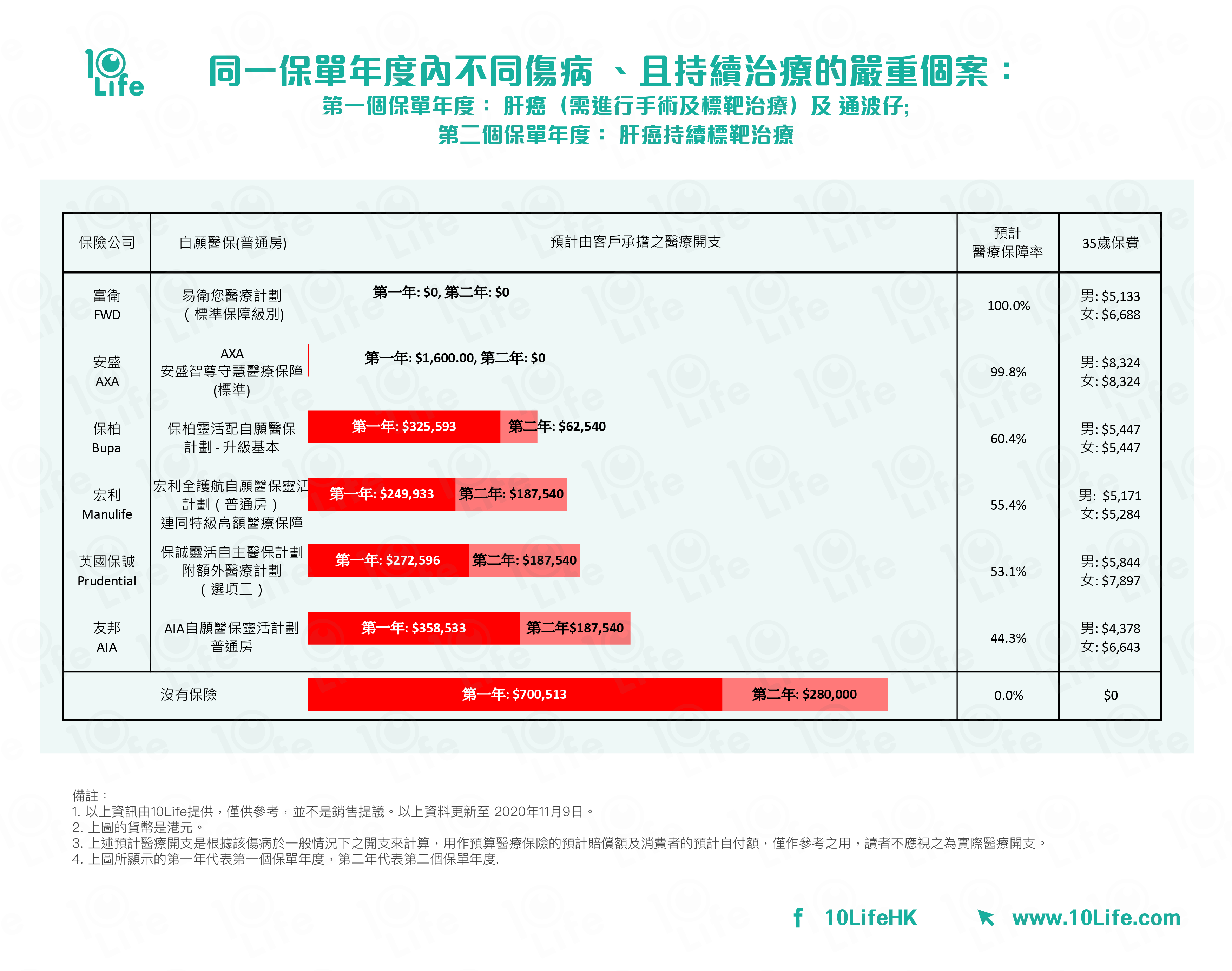
In the first policy year, if liver cancer and angioplasty occur in the same year, products with full coverage demonstrate a significant advantage in terms of protection. Among them, FWD vCare, which offers full coverage per illness per policy year, achieves an expected coverage rate of 100%. The compensation limit for the first illness (liver cancer) is HKD 500,000, and for another illness (vascular disease) claimed in the same policy year, the compensation limit is recalculated anew.
 
Compared to scenarios where two illnesses occur in different policy years, when they occur in the same policy year, the expected coverage rate for products with itemised limits may be even lower, with clients expected to bear medical expenses ranging from HKD 250,000 to HKD 360,000. This is because each itemised limit restricts claims, and even if expenses exceeding these limits can be covered by SMM, clients must note that SMM has its own limit and they must first bear 20% of the eligible medical expenses under SMM (see Note 9).
 
In the second policy year, if targeted therapy for liver cancer continues, FWD vCare’s total coverage limit per illness per policy year and the additional coverage limit for prescribed non-surgical cancer treatments reset to HKD 500,000 and HKD 350,000 per illness per policy year, respectively, resulting in an expected compensation rate of 100%. Another plan offering full coverage with an annual limit reset (AXA Hong Kong and Macau’s Smart Medicare) also shows a high expected coverage rate.
 
For other products with itemised limits, even though the limits reset in the new policy year, the expected coverage rate for the second policy year remains clearly insufficient, with clients expected to bear medical expenses ranging from HKD 60,000 to HKD 190,000. The inadequate compensation is due to the limit for prescribed non-surgical cancer treatments being only HKD 80,000, and for some products, SMM does not cover prescribed non-surgical cancer treatments.
 
Severe Cases with Different Illnesses in the Same Policy Year and Ongoing Treatment: First Policy Year: Liver Cancer (Requiring Surgery and Targeted Therapy) and Angioplasty; Second Policy Year: Ongoing Targeted Therapy for Liver Cancer
 
 
Beyond Tax Savings: Upgraded Coverage Terms for VHIS
 
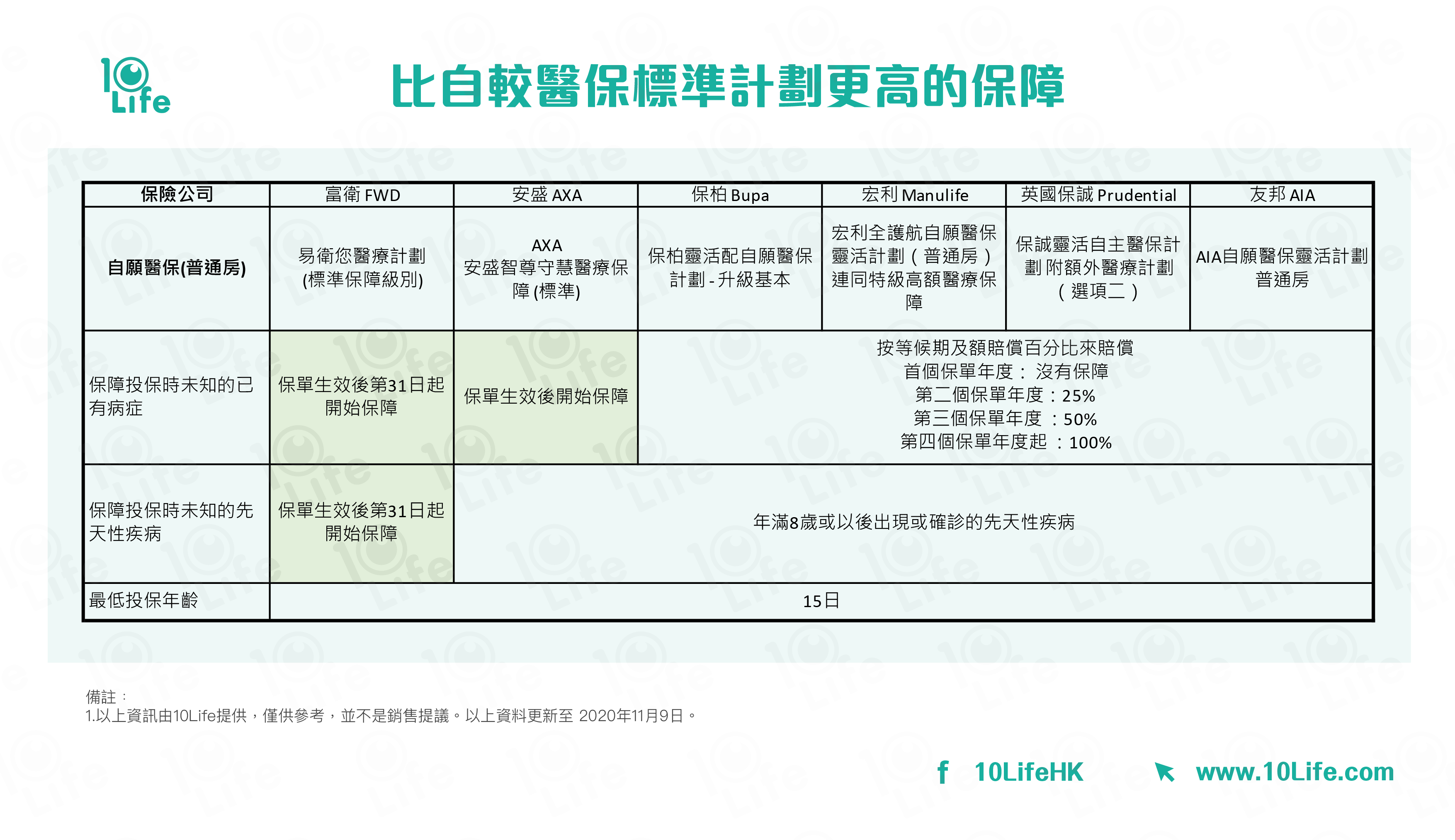
In addition to tax deductions and standardised basic terms, VHIS allows insurance companies to enhance coverage in Flexi Plans. One notable feature is the coverage for pre-existing conditions unknown at the time of application, though the compensation ratio depends on the waiting period. Typically, plans reach 100% compensation only by the fourth policy year. However, AXA Hong Kong and Macau’s Smart Medicare offers full compensation from the policy’s effective date, with no waiting period.
 
Additionally, the Food and Health Bureau mandates that VHIS must cover congenital conditions diagnosed or manifesting after the age of 8. However, FWD vCare provides coverage for pre-existing conditions and congenital conditions unknown at the time of application from the 31st day after the policy becomes effective. A paediatric professor has noted that over 90% of congenital conditions manifest before the age of 1, and conditions like haemophilia and leukaemia often appear before the age of 8 (see Note 10). If a client insures a healthy infant at 15 days old (the earliest insurable age), the infant could gain this coverage as early as around two months after birth; even if a congenital condition is later diagnosed, a claim can be made.
 
Higher Coverage Compared to Standard VHIS Plans
 
 
This article discusses VHIS Standard Ward Plans. For clients looking to upgrade their ward level, Semi-Private Ward Plans are also an option. However, for readers considering long-term insurance, future premiums should also be taken into account. Generally, as age increases and the cost of medical services rises, medical insurance premiums will increase annually. In old age, the premiums for Standard Ward Plans are relatively more affordable.
 
[ Compare VHIS Semi-Private Ward Plans, Adults ]
[ Compare VHIS Standard Ward Plans, Adults ]
[ Compare VHIS Semi-Private Ward Plans, Children ]
[ Compare VHIS Standard Ward Plans, Children ]
 
Lastly, we remind everyone to understand whether a product meets their needs and financial capacity before purchasing. You can visit 10Life to compare various VHIS plans in the market and analyse their coverage.
 
Notes:


  1. The above product information does not include the complete terms of the policy (full terms are contained in the policy documents) and is subject to the terms and conditions of the relevant plan. For details on the above product features, coverage benefits, terms, exclusions, and key product risks, please refer to the relevant plan’s website, product brochure, and policy terms.
  2. The information above is provided by 10Life for reference only and aims to describe the key features of the product. It is not a sales proposal. Readers should not rely solely on this material to purchase insurance. The above information is updated as of 9 November 2020.
  3. “Full Coverage” means the insurance company will fully reimburse eligible medical expenses and other costs after deducting any deductible (if applicable), subject to per policy year coverage limits (if applicable), lifetime coverage limits (if applicable), per policy year per illness coverage limits (if applicable), and/or other relevant conditions. Full coverage applies only to specified coverage items, while other items are subject to the compensation limits of the relevant items. Claims must meet the requirement of “medical necessity,” and expenses must be “reasonable and customary.” For details, please refer to the coverage table and policy terms of the relevant product.
  4. For each hospitalisation or day surgery related to the same illness, the applicable coverage limit and/or total coverage limit per illness per policy year will be recalculated, provided that the hospitalisation or day surgery does not occur within a continuous 90-day period from the last date of a previous hospitalisation or day surgery for the same illness. When the insured is hospitalised or undergoes day surgery for more than one illness, all different illnesses involved in the same hospitalisation or day surgery will be subject to a single applicable coverage limit and/or total coverage limit per illness per policy year.
  5. The above expected medical expenses are calculated based on typical costs for the illness in general circumstances, used to estimate the expected compensation amount of medical insurance and the consumer’s expected out-of-pocket expenses (if any). These are for reference only, and readers should not consider them as actual medical expenses.
  6. Prescribed non-surgical cancer treatments include radiotherapy, chemotherapy, targeted therapy, immunotherapy, and hormonal therapy.
  7. This limit refers to the additional coverage limit for prescribed non-surgical cancer treatments and kidney dialysis.
  8. For pre-admission or post-discharge / pre- or post-day surgery outpatient care, FWD’s vCare Medical Plan (Standard Coverage Level) provides full coverage for up to 3 outpatient or emergency consultations before admission/day surgery and up to 20 follow-up outpatient visits within 90 days after discharge/day surgery. However, if the follow-up outpatient visits after discharge/day surgery are for physiotherapy or chiropractic treatment, a limit of HKD 600 per visit applies.
  9. The co-insurance for additional medical coverage (if any) mentioned in the product is 20%, calculated based on non-network medical services.
  10. Reference: HKET Topick, 22 February 2018, “Many Conditions Manifest Before Age 8, Difficult Coverage for Children with Congenital Conditions.”

This English version of this article has been generated by machine translation powered by AI. It is provided solely for reference purposes. In the event of any discrepancy or inconsistency between this translation and the original Chinese version, the Chinese version shall prevail.

Last updated: 9 Apr 2026

10Life Logo
10Life Editorial Team

Our team of professional content researchers focussing on insurance

10Life Logo
10Life Editorial Team

Our team of professional content researchers focussing on insurance

Disclaimer

10Life Product Comparison and 10Life Insurance Ratings are developed by 10Life Financial Limited, an authorised insurance broker company licensed with the Insurance Authority under License Number FB1526. 10Life Product Comparison and 10Life Insurance Ratings are developed for generic customer segments using mathematical calculations based on product information, facts and data, and are not influenced by any partnerships with or fees received from insurance companies. Any information on 10Life Platform ("10Life Information"), including but not limited to Product Comparison, Product Ratings, Blog Articles are intended for general education purpose and reference only. None of the 10Life Information is intended, nor should they be considered or relied upon, as regulated advice, insurance, financial, investment or professional advice, recommendation, approval, endorsement, invitation or solicitation in respect of any insurance, financial or investment products. 10Life Information does not take into account your individual needs. Reading 10Life Information should not be considered as conducting a suitability assessment, and is not sufficient to form the basis of any decisions to purchase any insurance products. You should rely on information authorised by insurance companies, carry out your own research and/or seek independent advice from licensed intermediaries before purchasing any insurance products or making any insurance decisions. While reasonable effort is used when collecting, validating and updating 10Life Information from various channels, none of 10Life Group and its subsidiaries, affiliates, agents, directors, officers and employees will be responsible for any liability, claim or loss arising from or associated with you using 10Life Information. No warranty, representation or guarantee is given by 10Life Group and its subsidiaries on the accuracy, completeness and timeliness of the information. If you have any questions on 10Life Product Comparison and 10Life Insurance Ratings, please email us at enquiries@10life.com

Whatsapp icon
Whatsapp icon
WeChat icon
WeChat icon
Enquiry icon Close icon
Back To Top
Whatsapp icon
Whatsapp icon
WhatsApp