


false
Category
Author
Search for Articles
Trending Keywords
Category
Author
Search
Category
Author
Search
Retirement and Annuity
Editor's Pick

【Unlimited QE】 Guaranteed returns on qualifying deferred annuities under pressure—act quickly to lock in high guaranteed returns?

2020-05-17 5min read
Unlimited-QE-Pressure-on-QDAP-returns-may-lead-to-a-rush-to-lock-in-high-guarantees-kv.png
To encourage the public to save for retirement, the Government introduced Qualifying Deferred Annuity Policies (QDAPs), under which policyholders are entitled to tax benefits. Since their introduction, QDAPs, commonly known as tax-deductible annuities, have proved very popular. Their premiums can be deducted for tax purposes, saving up to $10,200 in tax (see Note 1), effectively acting as a government subsidy and enhancing retirement returns. In addition, QDAPs are subject to specific requirements regarding guaranteed returns, helping to reduce the risks posed by market volatility to policyholders’ retirement planning. However, the global COVID-19 pandemic triggered turmoil in global stock markets. Governments around the world, deeply concerned about economic recession, rushed to introduce market rescue measures. The US Federal Reserve even launched “unlimited QE” to reduce borrowing costs. Interest rates offered by Hong Kong banks naturally fell in response, and even the guaranteed returns of tax-deductible deferred annuity policies came under pressure to be reduced.
 
US Treasury yields extremely low Insurers likely to cut guaranteed returns on QDAPs

 
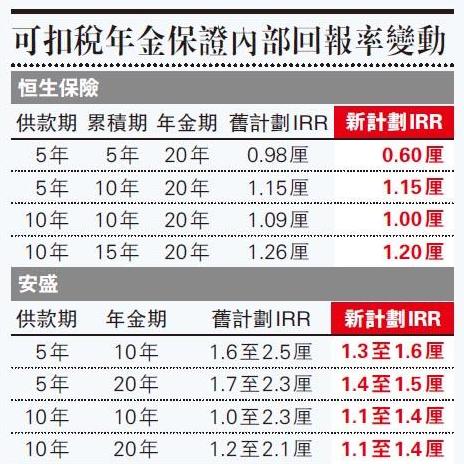
The US Federal Reserve’s unlimited quantitative easing and extensive money printing to rescue the market caused interest rates to fall sharply. The yield on 10-year US Treasury bonds fell from approximately 2.5% in April 2019 to around 0.7% in May this year. When an insurer launches a product offering a higher guaranteed return, it will invest more conservatively at the same time, with US Treasury bonds being an important benchmark. US Treasury yields are now at extremely low levels. Nevertheless, some QDAPs in the market still offer a Guaranteed Internal Rate of Return (Guaranteed IRR, or GIRR) significantly higher than US Treasury yields. Such a substantial disparity means that insurers’ profit margins are being squeezed considerably. For policyholders, QDAP guaranteed returns are binding under the contract: once an insurer has written them into the policy, it must deliver them, leaving no room for manoeuvre. The media previously reported (see Note 2) that the Guaranteed Internal Rate of Return on the new-generation Qualifying Deferred Annuity Policies offered by AXA, Hang Seng Insurance and others was already lower than that of their previous-generation plans.


(Image excerpted from Ming Pao)
 
 
Most policyholders take out QDAPs shortly before the tax season in order to enjoy the tax-saving benefits as soon as possible. The tax season has now passed, and enthusiasm for QDAPs has instantly waned. However, following COVID-19, unlimited QE has been launched and the US is accelerating its money printing. The world has changed. In the face of steadily declining US Treasury yields, how long can the guaranteed returns on QDAPs determined before the global COVID-19 pandemic continue to hold? Or will insurers successively reduce the guaranteed IRR on QDAPs, narrowing the gap between these products and US Treasury yields? If readers are interested in the higher guaranteed returns offered by QDAPs, they may not be able to wait until next year’s tax season to take out a policy. They should pay attention now to the performance of QDAP returns in the market and make more comparisons. It is worth noting that the guaranteed return received by a policyholder is the guaranteed IRR specified in the policy at the time of application. Even if the product’s guaranteed IRR is subsequently changed, the policyholder remains locked into the guaranteed IRR applicable when the policy was signed.
 
Tax-deductible annuities Guaranteed returns of 3% available over a minimum term of 15 years

 
This time, we set medium-term savings as the objective and assumed that the policyholder is a 45-year-old man who chooses a Qualifying Deferred Annuity Policy with a policy term (from the commencement of premium payments to the end of the annuity income period) of between 15 and 25 years. We compared the products’ Guaranteed Internal Rate of Return (IRR) when the policyholder reaches the age of 60. Under the basic requirements for QDAPs, the minimum premium payment period is five years, while the income period may begin as early as age 50 and last for 10 years. Therefore, the shortest policy term for a QDAP is 15 years. To cover more products, we have also included products with policy terms of up to 25 years in the comparison below.


The table above shows that the Guaranteed IRR at age 60 for the BOC Life Deferred Annuity Plan (Fixed Term), Generali Tax Saving Deferred Annuity and HKBEA “Smart Plus” Deferred Annuity ranges from 2.87% to 3.04%, clearly higher than that of other products in the market. The highest is the 3.04% offered by the BOC Life Deferred Annuity Plan (Fixed Term), subject to an annual premium requirement of US$15,000. If the premium is less than US$15,000, the policyholder can still receive a Guaranteed IRR of 2.95%. In addition, the Guaranteed IRR figures in the table do not take into account the impact of the tax benefits (see Note 1). If the tax benefits are included, the Guaranteed IRR of the above products could be further enhanced, depending on the policyholder’s tax band.
 
[Detailed comparison of the savings returns of Qualifying Deferred Annuity Policies]
 
In response to the widespread COVID-19 pandemic, members of the public have been following social-distancing measures, and the Insurance Authority introduced temporary facilitation measures (see Note 3). Until 30 June 2020, insurance advisers are permitted to sell Qualifying Deferred Annuity Policies without meeting clients in person. To ensure that the interests of policyholders and potential policyholders are not compromised, the Insurance Authority also requires clear disclosure of the relevant product information during the sales process and has extended the cooling-off period for policies to 30 days.
 
At the same time, the Insurance Authority has permitted certain Qualifying Deferred Annuity Policies to be sold virtually. As at the publication date (15 May 2020), only the BOC Life Deferred Annuity Plan (Fixed Term) and China Life Premium Deferred Annuity offered online applications in the market. BOC Hong Kong customers can complete the entire application process through the BOC Hong Kong mobile application. China Life applications can only be made through its website, but the annuity payment period for that product is from age 60 to 108, so it has not been included in the product comparison in this article. Applying for a deferred annuity online is certainly convenient for busy working people, but the sales process is regulated and clients need to read numerous terms and conditions, which may make the procedure seem somewhat cumbersome. Nevertheless, it is extremely important to understand the product thoroughly. Therefore, it should not be difficult to complete the process as long as you are a little patient.
 
Finally, 10Life would like to remind everyone that before taking out a QDAP, you should first understand the purpose of the policy and your ability to afford it. You should also understand the potential risks of QDAPs, such as losses from early surrender, liquidity risk, and changes in your personal financial or employment circumstances.
 
Notes:


  1. Taking out a Qualifying Deferred Annuity Policy may entitle you to tax benefits. The maximum deduction is annual premiums of $60,000. Based on the current highest tax rate of 17%, the maximum tax saving is $10,200 per year. Please refer to the relevant website for details.
  2. See Ming Pao, 20 April 2020: “Annuity Savings Insurance Returns Fall — Maximum Drop Nearly One Percentage Point; Analysis: Long-term Policies May Be Affected”.
  3. For details of the extension of the temporary facilitation measures by the Insurance Authority and the expansion of their scope, please refer to the relevant website. 

This English version of this article has been generated by machine translation powered by AI. It is provided solely for reference purposes. In the event of any discrepancy or inconsistency between this translation and the original Chinese version, the Chinese version shall prevail.
10Life Logo
10Life Editorial Team

Our team of professional content researchers focussing on insurance

10Life Logo
10Life Editorial Team

Our team of professional content researchers focussing on insurance

Disclaimer

10Life Product Comparison and 10Life Insurance Ratings are developed by 10Life Financial Limited, an authorised insurance broker company licensed with the Insurance Authority under License Number FB1526. 10Life Product Comparison and 10Life Insurance Ratings are developed for generic customer segments using mathematical calculations based on product information, facts and data, and are not influenced by any partnerships with or fees received from insurance companies. Any information on 10Life Platform ("10Life Information"), including but not limited to Product Comparison, Product Ratings, Blog Articles are intended for general education purpose and reference only. None of the 10Life Information is intended, nor should they be considered or relied upon, as regulated advice, insurance, financial, investment or professional advice, recommendation, approval, endorsement, invitation or solicitation in respect of any insurance, financial or investment products. 10Life Information does not take into account your individual needs. Reading 10Life Information should not be considered as conducting a suitability assessment, and is not sufficient to form the basis of any decisions to purchase any insurance products. You should rely on information authorised by insurance companies, carry out your own research and/or seek independent advice from licensed intermediaries before purchasing any insurance products or making any insurance decisions. While reasonable effort is used when collecting, validating and updating 10Life Information from various channels, none of 10Life Group and its subsidiaries, affiliates, agents, directors, officers and employees will be responsible for any liability, claim or loss arising from or associated with you using 10Life Information. No warranty, representation or guarantee is given by 10Life Group and its subsidiaries on the accuracy, completeness and timeliness of the information. If you have any questions on 10Life Product Comparison and 10Life Insurance Ratings, please email us at enquiries@10life.com

Whatsapp icon
Whatsapp icon
WeChat icon
WeChat icon
Enquiry icon Close icon
Back To Top
Whatsapp icon
Whatsapp icon
WhatsApp