









10Life Financial Limited
Enquiries: enquiries@10life.com
Hotline: (852) 3705 1599
Address: 16/F Greatmany Centre, 109-115 Queen’s Road East, Wan Chai, Hong Kong



Key points of children’s travel insurance:
Is a family Easter outing more enjoyable, but actually riskier?
5 Major Accident Risks When Travelling with Children (Often Overlooked by Parents)
What should you look out for when choosing children’s travel insurance? 5 key points
Children’s travel insurance ≠ standard travel insurance | 3 key differences
Easter Family Trip Insurance Checklist Before You Buy (Quick Version)
When travelling with children, the biggest concern is not accidents, but inadequate cover
Common Questions about Children's Travel Insurance


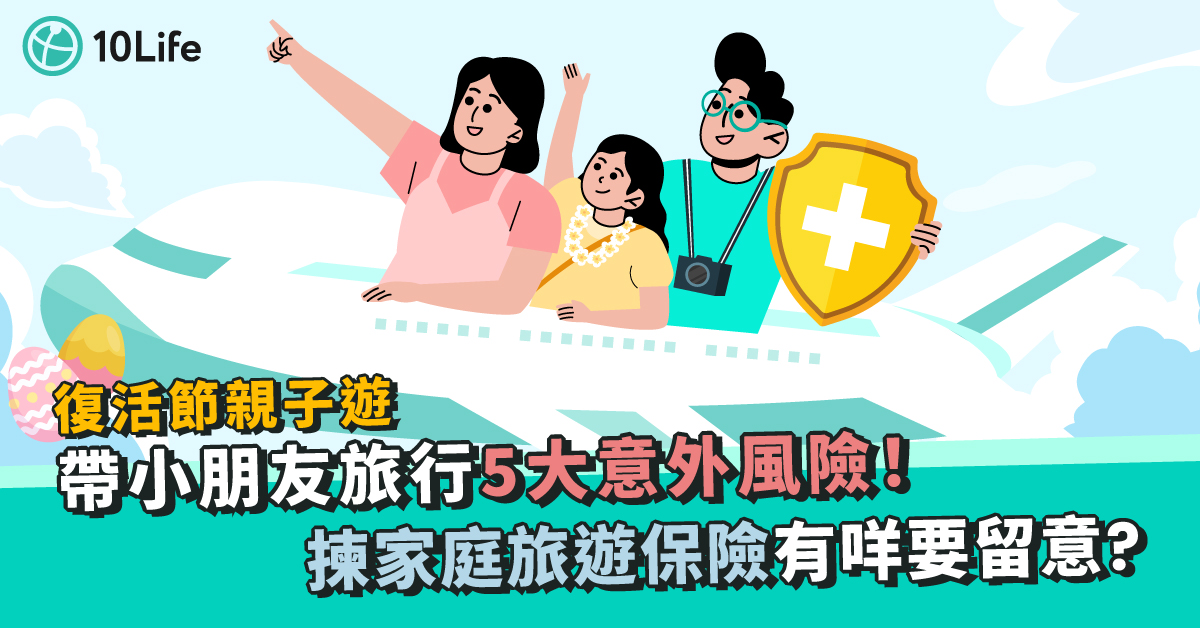
Children’s travel insurance differs significantly from standard adult insurance: the sum insured is usually lower, it must be purchased by a parent on the child’s behalf, and some plans do not cover children travelling alone (such as study tours). Simply “having insurance” does not necessarily mean the cover is sufficient; the key is whether the policy terms meet actual needs. This article analyses the five most common accident risks when travelling with children, and sets out the essential factors that should not be overlooked when choosing children’s travel insurance, helping parents make full preparations before departure.
Key points of children’s travel insurance:
Is a family Easter outing more enjoyable, but actually riskier?
Easter is a peak season for family travel, with short trips to Japan, Korea and Taiwan, and even long-haul journeys to Europe and the US, all proving popular with Hong Kong families. Itineraries are usually packed, with theme parks, outdoor activities, skiing and water sports all on the agenda. However, children are more likely than adults to encounter unexpected situations — whether they fall ill suddenly, are injured in an accident, or lose important belongings, it can quickly become more troublesome if anything goes wrong.
Many parents assume that “having insurance is enough”, but in reality there are important differences between children’s travel insurance terms and adult plans. The cover amount, scope of protection, and even whether a child can be insured separately are all matters that require careful consideration. Understanding the most common risks before departure and choosing suitable cover is the real key to peace of mind.
5 Major Accident Risks When Travelling with Children (Often Overlooked by Parents)
Children generally have weaker immunity, and with a sudden change in environment and diet, they are more likely to experience upset stomach, fever or other sudden discomfort.
Overseas medical expenses are generally higher, especially in Japan, Australia, Europe and the US. Should medical attention be required, the cost can be considerable.
Key points to note:
Children are highly active and naturally curious, so accidents are relatively difficult to avoid.
In theme parks, outdoor activities or skiing, sprains, collisions and even fractures are common. If the activity involves higher risk, some policies may not cover it automatically, and related costs may have to be borne by yourself.
Key points to note:
Children's health can change quickly, so it is not uncommon for them to develop a fever or feel unwell just before departure.
If the trip cannot proceed, costs such as flights, hotels and tickets may not be refundable, resulting in losses of several thousand to over ten thousand dollars. Please note that trip cancellation cover generally must be purchased before departure, and a medical certificate is required.
Key points to note:
During peak seasons such as Easter, flights are busier, and combined with weather factors, the risk of delays is higher.
If there is a flight delay or trip interruption, travelling with children will require additional accommodation and transport arrangements, and overall expenses will also increase.
Key points to note:
In crowded tourist attractions, children are more easily distracted, which also increases the risk of loss or theft.
If valuables such as mobile phones, iPads, cameras and passports are lost, this not only involves financial loss but may also affect the entire itinerary.
👉 Key points to note:
What should you look out for when choosing children’s travel insurance? 5 key points
When choosing travel insurance for children, rather than focusing solely on the premium, it is better to first understand whether the cover truly suits the needs of the trip. The following key points are the ones parents should pay the most attention to before taking out a policy.
Different insurers do not necessarily define “children” in the same way. Generally, a child must be at least 30 days old or 6 weeks old before they can be insured, while some plans place those aged 16–17 in a separate category. Before purchasing, you should first confirm the age classification and the relevant differences in cover.
Many policies appear to offer sufficient overall cover, but the actual claims limit for children may be lower than for adults.
Key items to compare:
Skiing, snorkelling or outdoor activities may not be automatically included in the cover. If the trip involves such activities, you should confirm whether they are covered or choose a plan that includes amateur sports cover
When a child has a sudden incident overseas, the ability to receive immediate assistance is very important. Please note the following:
If your child is joining a study tour or school exchange, a parent may not be travelling with them. Before purchasing, you should confirm whether minors travelling alone are accepted, or whether there are any additional terms or restrictions.
Children’s travel insurance ≠ standard travel insurance | 3 key differences
In fact, children’s travel insurance (for those under 18) differs significantly from standard travel insurance in terms of coverage design and policy terms, so it is well worth understanding the details before you set off.
Persons under 18 are usually not able to take out the policy in their own name; the application must be made by a parent or guardian. From arranging the policy and updating details to making claims later on, the entire process must be handled by a parent. Therefore, if a child has an accident overseas, the related claims process will also need to be followed up by a parent.
In most travel insurance plans, the maximum compensation for children is lower than that for adults, especially for items such as personal accident, death or permanent disability, where the cover is commonly around half that of an adult.
As for medical cover, although some plans offer the same limits as adults, many set lower maximums. Therefore, when comparing policies, you should not only look at the overall sum insured, but also read carefully the actual compensation arrangements under the terms applicable to minors.
If a child is travelling without a parent, such as on a study tour, exchange programme, or a trip with relatives or friends, it is important to check whether the cover remains valid. Some policies require the child to travel with a parent in order to be covered, while others impose restrictions on solo travel or require separate application. You should confirm the relevant terms before purchasing to avoid affecting the coverage.
If the whole family is travelling together, family travel insurance may be worth considering, as it is generally more convenient and the premium is relatively more cost-effective. However, please note that “children included” does not mean the cover is the same as for adults, particularly in respect of medical and accident benefits, where children’s limits may be lower. It is advisable to compare the policy terms carefully before purchase to ensure the cover is genuinely sufficient for your actual needs.
Easter Family Trip Insurance Checklist Before You Buy (Quick Version)
Before departure, why not take 1 minute to quickly check the following key points:
When travelling with children, the biggest concern is not accidents, but inadequate cover
Children face a higher risk when travelling overseas than adults — weaker immunity, strong curiosity, and belongings that are easily misplaced all create potential hazards. Family or children’s travel insurance may not provide sufficient cover, for example reduced children’s benefit limits, exclusion of certain activities, and separate restrictions for study tours… These details can only be identified by reading the policy terms carefully. We therefore remind everyone to pay close attention to the coverage terms and small print. Spend 20 minutes before departure comparing the terms and coverage of different plans to ensure you are fully prepared for your trip.
Common Questions about Children's Travel Insurance
Children generally have lower resistance and are at higher risk of sudden illness or accidents, while overseas medical expenses (especially in Japan, Australia, Europe and the United States) can be very expensive. Travel insurance can cover medical expenses, trip cancellation and personal belongings, giving parents greater peace of mind when travelling.
For some insurance plans, the cover amount for children (especially personal accident and death/disability benefits) is usually only 50% of the adult amount. Medical cover depends on the plan, and some plans offer the same medical cover as for adults. Before purchasing, be sure to read the terms carefully and confirm whether the cover amounts meet your needs.
Not necessarily. Family plans usually cover accompanying children, but insurers differ in their definition of “family” and the upper age limit for children. Some plans require children to travel with their parents to be insured, while solo travel may not be covered. You should confirm the details with the insurer before taking out the policy.
It is recommended to buy separate cover. Group insurance provided by schools or organisations usually has limited coverage and may not cover all medical expenses and personal belongings. Parents should purchase an additional personal travel insurance policy for their children, and confirm that the plan covers minors travelling alone.
Most insurers require infants to be at least 30 days or 6 weeks old before they can be included in the cover. Requirements may vary between insurers, so you should confirm the minimum age requirement for infants with the insurer before purchasing.
Children’s travel checklist key items include:
It is advisable to pack one day’s necessities in your hand luggage in case of baggage delays or unexpected situations.
Further reading: Which travel insurance is best? Experts teach you 10 essential details to look out for when choosing travel insurance
This English version of this article has been generated by machine translation powered by AI. It is provided solely for reference purposes. In the event of any discrepancy or inconsistency between this translation and the original Chinese version, the Chinese version shall prevail.
身為10Life編輯團隊的一員,主力研究各種保險產品比較、拆解保單條款及索償細節,並與10Life持牌顧問緊密合作,致力將複雜術語轉化為易明分析,讓大眾更了解各種保險產品。
身為10Life編輯團隊的一員,主力研究各種保險產品比較、拆解保單條款及索償細節,並與10Life持牌顧問緊密合作,致力將複雜術語轉化為易明分析,讓大眾更了解各種保險產品。
10Life Product Comparison and 10Life Insurance Ratings are developed by 10Life Financial Limited, an authorised insurance broker company licensed with the Insurance Authority under License Number FB1526. 10Life Product Comparison and 10Life Insurance Ratings are developed for generic customer segments using mathematical calculations based on product information, facts and data, and are not influenced by any partnerships with or fees received from insurance companies. Any information on 10Life Platform ("10Life Information"), including but not limited to Product Comparison, Product Ratings, Blog Articles are intended for general education purpose and reference only. None of the 10Life Information is intended, nor should they be considered or relied upon, as regulated advice, insurance, financial, investment or professional advice, recommendation, approval, endorsement, invitation or solicitation in respect of any insurance, financial or investment products. 10Life Information does not take into account your individual needs. Reading 10Life Information should not be considered as conducting a suitability assessment, and is not sufficient to form the basis of any decisions to purchase any insurance products. You should rely on information authorised by insurance companies, carry out your own research and/or seek independent advice from licensed intermediaries before purchasing any insurance products or making any insurance decisions. While reasonable effort is used when collecting, validating and updating 10Life Information from various channels, none of 10Life Group and its subsidiaries, affiliates, agents, directors, officers and employees will be responsible for any liability, claim or loss arising from or associated with you using 10Life Information. No warranty, representation or guarantee is given by 10Life Group and its subsidiaries on the accuracy, completeness and timeliness of the information. If you have any questions on 10Life Product Comparison and 10Life Insurance Ratings, please email us at enquiries@10life.com




 Talk to 10Life on WeChat
