









10Life Financial Limited
Enquiries: enquiries@10life.com
Hotline: (852) 3705 1599
Address: 16/F Greatmany Centre, 109-115 Queen’s Road East, Wan Chai, Hong Kong



What is the rebellious phase/adolescence?
What behaviours are exhibited during the rebellious phase?1
At what age does the rebellious phase usually occur?1
How to communicate with children going through their rebellious phase?2
Caring for children’s physical and emotional needs and supporting them through key stages of development


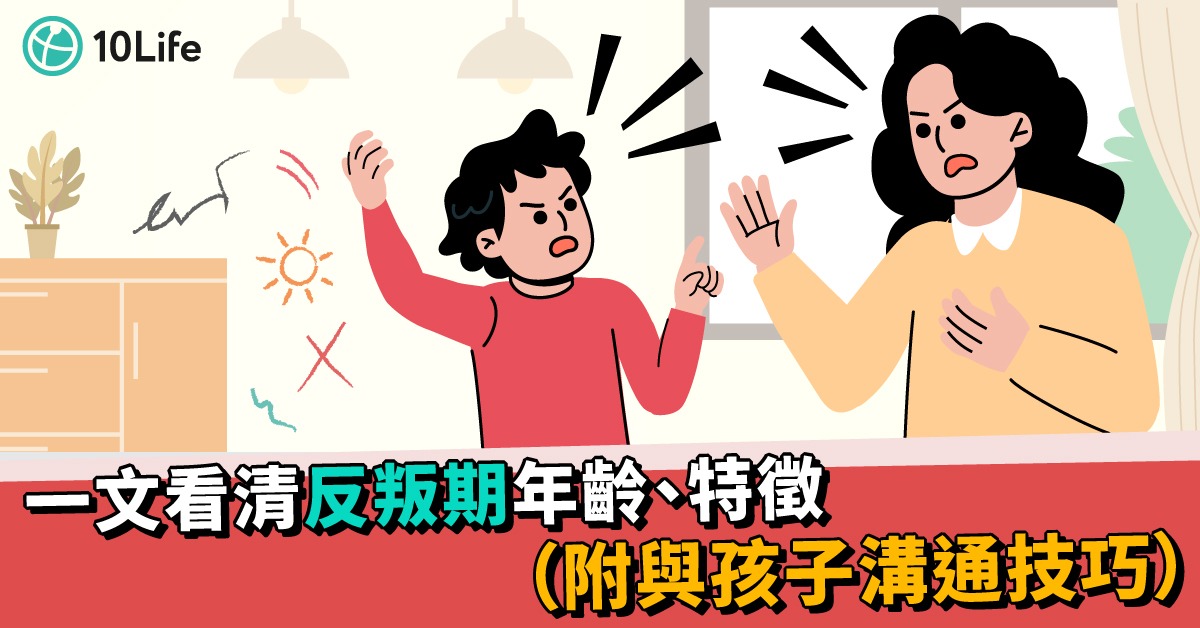
As parents, watching your little ones gradually move from being well-behaved, adorable angels into their rebellious phase can inevitably leave you feeling emotionally and physically exhausted. In fact, as children grow, they gradually become less dependent on their parents, begin to seek independence and express themselves, and may consequently display rebellious behaviour. If this is not handled appropriately, it could lead to parent–child conflicts. So, at what age does the rebellious phase usually occur? What are its characteristics? What should parents be aware of? This time, 10Life will share the characteristics of the rebellious phase with parents and teach you how to communicate with rebellious children, so that you can navigate this crucial stage of their development together.
What is the rebellious phase/adolescence?
Although the rebellious phase can be a source of frustration for many parents, it is in fact an inevitable stage of a child’s development. During this phase, children begin to explore their identity, become less dependent on their parents and develop a sense of self. However, as their minds are not yet fully mature, they may be unable to express their thoughts and inner conflicts clearly. They often express themselves impulsively or defiantly, leading to conflicts with their parents.
What behaviours are exhibited during the rebellious phase?1
Every child displays different behaviours during their rebellious phase. Generally speaking, the rebellious phase can be divided into 3 stages: the toddler rebellious phase, the childhood rebellious phase and the adolescent rebellious phase. However, every child displays different behaviours during their rebellious phase. Common rebellious behaviours include:
At what age does the rebellious phase usually occur?1
Children display rebellious behaviour at different ages. As mentioned above, the rebellious phase can be divided into 3 stages. By understanding the rebellious phase at each stage, parents can gain a deeper understanding of their children’s psychological development.
At this stage, children’s self-awareness gradually begins to develop. They long to express themselves and hope to gain more autonomy. However, due to their limited language skills, they often use rebellious behaviour to express their inner needs.
Common behaviours include:
At this stage, children become curious about the world around them and long for independence and autonomy. By imitating the adults around them, they learn their behaviour and ways of thinking, hoping to become “grown-ups” themselves.
Common behaviours include:
Upon entering adolescence, children actively explore their identity, develop an independent personality and long to break free from their parents’ constraints. They may question their parents’ opinions and even display rebellious behaviour. At the same time, children undergo psychological and physical changes and face greater pressure, such as academic pressure and the pursuit of peer acceptance, making them more emotionally sensitive.
Common behaviours include:
How to communicate with children going through their rebellious phase?2
Communicating with children going through their rebellious phase is undoubtedly a major challenge. Parents may wish to refer to the following communication techniques to build a close parent–child relationship:
When children behave inappropriately or in ways that are difficult to accept, reprimanding or belittling them too quickly can easily make them feel angry and lead them to rebel. Conversely, if parents can calmly express their genuine feelings, such as concern or disappointment, children may find it easier to develop empathy and take responsibility for their actions. For example, if your child comes home late at night, instead of reprimanding them immediately, try sharing your genuine feelings, such as unease and anxiety. This may help your child reflect on their behaviour.
Parents’ emotions directly affect their children’s emotions. When children are emotionally agitated, parents are advised to remain calm, steadily accept their children’s feelings and respond calmly. This can help soothe children’s emotions while creating a peaceful space in which they will be more willing to open up and share their inner world.
Children in their rebellious phase are going through a critical period of physical and psychological development. Their minds are filled with confusion and conflicting emotions, but as their thinking is not yet mature, they may express themselves in extreme ways. Parents can make a greater effort to understand their children’s inner world and maintain a good parent–child relationship through appropriate sharing and communication.
If a good habit of communication has not been established with children in daily life, they may often feel isolated and helpless when they encounter difficulties, and may not know how to express their feelings. Parents can proactively share more of their own life experiences, foster an atmosphere of family communication and care, and help children express their thoughts and feelings more courageously.
Caring for children’s physical and emotional needs and supporting them through key stages of development
Adolescence is an important turning point in a child’s physical and psychological development. In addition to paying attention to their children’s physical health, parents should also monitor their mental wellbeing at all times. Current Voluntary Health Insurance Scheme plans include psychiatric treatment in their coverage, providing children with more comprehensive protection. However, it is important to note that the coverage limits and scope vary between plans, so you should understand the relevant details clearly before taking out a policy. To make things more convenient for parents, 10Life has compared different Voluntary Health Insurance Scheme plans and introduced a rating system designed by actuaries. Alternatively, you can contact 10Life’s professional insurance advisers to help you compare insurance products fairly and find a suitable option.
Further reading:
【Insurance for Young Children】What medical insurance is best for kindergarten children?
【Children’s Insurance】Starting primary school: compare medical insurance premiums and coverage
Sources:
Last updated: 10 October 2024
This English version of this article has been generated by machine translation powered by AI. It is provided solely for reference purposes. In the event of any discrepancy or inconsistency between this translation and the original Chinese version, the Chinese version shall prevail.
Our team of professional content researchers focussing on insurance
Our team of professional content researchers focussing on insurance
10Life Product Comparison and 10Life Insurance Ratings are developed by 10Life Financial Limited, an authorised insurance broker company licensed with the Insurance Authority under License Number FB1526. 10Life Product Comparison and 10Life Insurance Ratings are developed for generic customer segments using mathematical calculations based on product information, facts and data, and are not influenced by any partnerships with or fees received from insurance companies. Any information on 10Life Platform ("10Life Information"), including but not limited to Product Comparison, Product Ratings, Blog Articles are intended for general education purpose and reference only. None of the 10Life Information is intended, nor should they be considered or relied upon, as regulated advice, insurance, financial, investment or professional advice, recommendation, approval, endorsement, invitation or solicitation in respect of any insurance, financial or investment products. 10Life Information does not take into account your individual needs. Reading 10Life Information should not be considered as conducting a suitability assessment, and is not sufficient to form the basis of any decisions to purchase any insurance products. You should rely on information authorised by insurance companies, carry out your own research and/or seek independent advice from licensed intermediaries before purchasing any insurance products or making any insurance decisions. While reasonable effort is used when collecting, validating and updating 10Life Information from various channels, none of 10Life Group and its subsidiaries, affiliates, agents, directors, officers and employees will be responsible for any liability, claim or loss arising from or associated with you using 10Life Information. No warranty, representation or guarantee is given by 10Life Group and its subsidiaries on the accuracy, completeness and timeliness of the information. If you have any questions on 10Life Product Comparison and 10Life Insurance Ratings, please email us at enquiries@10life.com




 Talk to 10Life on WeChat
