









10Life Financial Limited
Enquiries: enquiries@10life.com
Hotline: (852) 3705 1599
Address: 16/F Greatmany Centre, 109-115 Queen’s Road East, Wan Chai, Hong Kong



What is the Voluntary Health Insurance Scheme (VHIS)?
What are the "Standard Plan" and the "Flexible Plan"?
What are the features of the Voluntary Health Insurance Scheme "Standard Plan" products?
What is the difference between the Voluntary Health Insurance Scheme and traditional medical insurance? Voluntary Health Insurance Scheme vs Medical Insurance
Are the "standard plans" offered by each insurance company exactly the same?
Is Voluntary Health Insurance worth buying?
How much can be claimed under the Voluntary Health Insurance Scheme (VHIS) Standard Plan?
Should I buy Voluntary Health Insurance (VHIS) or traditional medical insurance?
Frequently Asked Questions


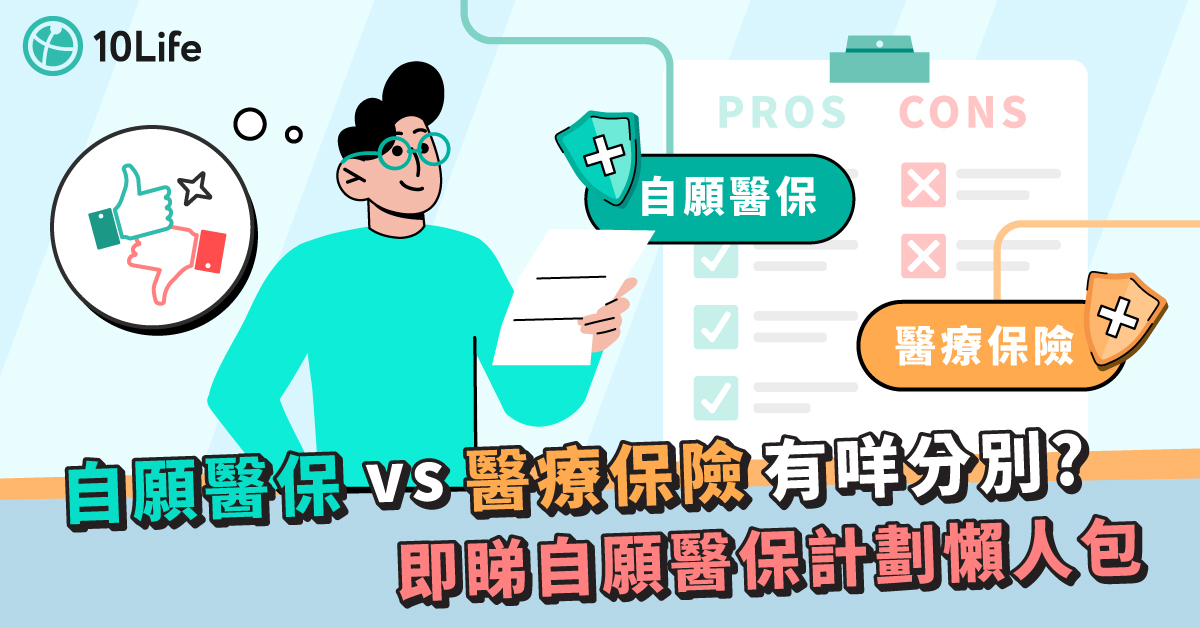
In Hong Kong, if one unfortunately becomes ill and is hospitalized, residents mainly have two choices: public healthcare and private healthcare. Public healthcare is inexpensive, but the public system has long waiting lists; unless it is very urgent, sometimes you have to wait several years for surgery, and if admitted when wards are overcrowded the inpatient environment may also be less than ideal. Some residents use private healthcare services hoping to receive treatment faster. However, private healthcare is more expensive, so many people take out medical insurance to share the costs of staying in private hospitals and ease the financial burden. The Hong Kong government's Voluntary Health Insurance Scheme (Voluntary Health Insurance Scheme, VHIS) has become an option many residents consider. What exactly does the Voluntary Health Insurance Scheme mean? How does VHIS differ from traditional individual medical insurance? How should one choose? This time, 10Life will explain the differences between the two in detail.
What is the Voluntary Health Insurance Scheme (VHIS)?
The government's "Voluntary Health Insurance Scheme (VHIS)" is a policy to coordinate the public and private healthcare systems. Under the scheme, if an insurer's medical insurance product meets the thresholds set by the government, it can be certified by the government and become a VHIS "certified product". The aim of VHIS is to encourage the public to use private healthcare services, which is expected to relieve pressure on public hospitals in the long term.
Because the Food and Health Bureau will set policy templates for VHIS "Standard Plans", the certified standard plans will have highly similar terms. When members of the public purchase a "certified product", it means they have obtained the minimum medical protection required by the government and may be eligible for tax concessions.
However, the government will not directly provide medical insurance to the public; VHIS premiums are determined by insurers themselves, and the public can choose whether to purchase and which company's product to buy.
What are the "Standard Plan" and the "Flexible Plan"?
Voluntary Health Insurance Scheme (VHIS)–certified products are divided into "Standard Plans" and "Flexible Plans". "Standard Plans" meet the government's minimum requirements for basic medical protection; "Flexible Plans" offer better protection than Standard Plans, such as higher coverage limits and a more diversified range of product options.
What are the features of the Voluntary Health Insurance Scheme "Standard Plan" products?
The insurance product must meet the government's requirements in the following aspects to be certified as an approved product under the Standard Plan:
Using the "ward and meals" benefit amount as an example, under the Standard Plan the policy's compensation limit must be at least HK$750 per day, and up to a maximum of 180 days per year. For details, please see the table below:
What is the difference between the Voluntary Health Insurance Scheme and traditional medical insurance? Voluntary Health Insurance Scheme vs Medical Insurance
The scope and terms of traditional medical insurance are determined by each insurance company, so coverage varies considerably between products. The Voluntary Health Insurance Scheme (VHIS), however, is regulated by the government; all products must meet minimum coverage standards set by the authority, making it easier for consumers to compare different plans. Traditional plans also tend to have lower transparency in terms and premiums, with large differences between plans that make direct comparison difficult. VHIS plans have standardized terms, with the minimum coverage of all products publicly listed and premiums available from insurance companies or government websites, making it easier for consumers to clearly understand the scope of coverage and terms.
Most traditional medical insurance policies have a lifetime benefit limit, meaning that once claims reach the limit the policy will no longer provide coverage. VHIS standard plans do not set a lifetime coverage limit; they only set an annual benefit limit that is recalculated each year and will not be reduced by past claims. However, some VHIS flexible plans may still impose limits, so you should read the terms carefully before purchasing.
The typical entry age for traditional medical insurance is between 15 days and 70 years old, while the usual renewal age ranges from 75 to 100. By comparison, VHIS has a wider entry age range — from 15 days after birth up to age 80 — and guarantees renewal up to age 100, so renewal eligibility is not affected by changes in health status.
One major feature of VHIS is tax deductibility: each insured person's premiums are eligible for a tax deduction of up to HK$8,000. Traditional medical insurance does not offer any tax benefits.
Generally, traditional medical insurance provides limited coverage for pre-existing conditions that were unknown at the time of application. VHIS, however, covers pre-existing conditions unknown before application and congenital conditions that only appear after age 8, with reimbursements of 25% and 50% in the second and third years respectively, and full 100% coverage from the fourth policy year onward. The interpretation of “unknown pre-existing conditions” has considerable room for variation — for details, click here.
Most traditional medical insurance does not cover psychiatric treatment, whereas VHIS standard plans provide at least HK$30,000 per year for inpatient psychiatric treatment. However, note that this benefit applies only to inpatient treatment costs and does not include psychiatric outpatient services or psychological counselling.
Are the "standard plans" offered by each insurance company exactly the same?
No. The Food and Health Bureau allows insurers to offer a small amount of customized additional cover.
In addition to the premium, insurers may also customize the coverage content of "other coverage items" for their "standard plan" products (capped at 10% of the actuarial value). Examples are as follows:
Is Voluntary Health Insurance worth buying?
According to Legislative Council documents, for the Voluntary Health Insurance Scheme (Standard Plan) launched in 2019, the estimated premiums (HKD) for each age group are as follows:
| Age | 2019 Estimated average at launch | Actual average (as at end-March 2021) |
| 0 to 4 years | $2,600 | $2,300 |
| 20 to 24 years | $2,000 | $1,800 |
| 40 to 44 years | $3,900 | $3,400 |
| 60 to 64 years | $9,800 | $7,400 |
| 80 to 84 years | $22,600 | $16,200 |
How much can be claimed under the Voluntary Health Insurance Scheme (VHIS) Standard Plan?
Based on the projected medical expenses of several common injury and illness cases, relative to the medical insurance coverage amounts, the Standard Plan under the Voluntary Health Insurance Scheme is expected to reimburse about 70% of costs for minor cases such as hospitalisation for fever or haemorrhoid surgery; but for more complex conditions like cancer or orthopaedic surgery, the estimated coverage rate is only around 30%, and consumers may need to pay tens of thousands or even over one hundred thousand in expenses.
For the projected coverage rates of medical insurance products currently on the market, please refer to 10Life's Insurance Decoder
Should I buy Voluntary Health Insurance (VHIS) or traditional medical insurance?
Whether it is Voluntary Health Insurance or traditional personal medical insurance, both can provide medical protection and help cover the insured person's medical expenses when admitted to private hospitals. Therefore, when choosing between Voluntary Health Insurance and traditional medical insurance, one should first assess their own coverage needs, carefully compare the terms and coverage of different insurance plans, and consider their financial capacity to ensure selecting the most suitable medical insurance plan.
Assuming the policyholder is a 30-year-old male, standard room, deductible $15,000–$23,000
| Overall Rating | Deductible | Coverage Area | First-year Premium | |
| 保泰人壽 | Bowtie 保泰粉紅自願醫保 | 9.0 | $20,000 | Global (excluding the United States) | $1,384 →Apply Now← |
| 富衛 | FWD 倍衛您醫療計劃 | 9.6 | $16,000 | Asia | $2,939 →Apply Now← |
| 滙豐保險 | HSBC Life 滙豐自願醫保靈活計劃銅級 | 9.3 | $16,000 | Greater China | $3,721 |
| Sun Life 永明 | Sun Life 永明港無憂醫療保 | 9.0 | $20,000 | Greater China | $3,722 |
| 保柏 | Bupa Bupa Hero 非凡自願醫保計劃 (倍精選) | 9.6 | $15,000 | Global (excluding the United States) | $3,855 |
| Notes: Sorted by product first-year premium (low to high) Product information last updated: 14 November 2025 | ||||
Frequently Asked Questions
Although the VHIS is government-certified, the plans are not available to everyone. There was initially a proposal for a "high-risk pool" to allow people with pre-existing conditions to obtain coverage, but this was ultimately abandoned. High‑risk individuals may still be refused by insurers. However, VHIS products are designed to cover persons from 15 days after birth up to 80 years of age, which is an improvement compared with some market products that only offer policies to those aged 18 or above, or under 60.
Some insurers allow customers at renewal to upgrade their existing policies to VHIS-certified products, or to adjust certain coverage items to meet VHIS requirements. If the policy meets the conversion conditions, re‑underwriting may not be necessary. But in some cases, the conversion process may still require re‑underwriting. Specifics vary by insurer, so it is recommended to check with the insurer directly.
Even with employer-provided medical insurance, coverage may be incomplete and gaps may remain; VHIS can help fill these gaps. Also, when changing jobs, a new employer's medical coverage may not begin for several months or even up to half a year, and after retirement the employer's plan will no longer provide coverage. VHIS guarantees renewal up to age 100, ensuring continuous medical protection. Therefore, even if you already have company medical insurance, it is still worth considering VHIS to make your coverage more comprehensive.
Although the government regulates insurers' operations, the financial stability of the insurer is also a factor to consider when purchasing medical insurance; even if an insurer is not in immediate financial distress, consumers should still consider its stability in the Hong Kong market.
Because medical insurance is renewed annually, if an insurer announces it is winding up, policyholders will have to move to another insurer. In that case, the new insurer will re‑underwrite the policyholders; if a customer's health condition has changed, the new policy may include additional exclusions or the insurer may decline to cover them.
Sources: VHIS pamphlet, Compliance rules for products under the VHIS (English) Annex II P36
Last updated: 5 March 2025
This English version of this article has been generated by machine translation powered by AI. It is provided solely for reference purposes. In the event of any discrepancy or inconsistency between this translation and the original Chinese version, the Chinese version shall prevail.
Our team of professional content researchers focussing on insurance
Our team of professional content researchers focussing on insurance
10Life Product Comparison and 10Life Insurance Ratings are developed by 10Life Financial Limited, an authorised insurance broker company licensed with the Insurance Authority under License Number FB1526. 10Life Product Comparison and 10Life Insurance Ratings are developed for generic customer segments using mathematical calculations based on product information, facts and data, and are not influenced by any partnerships with or fees received from insurance companies. Any information on 10Life Platform ("10Life Information"), including but not limited to Product Comparison, Product Ratings, Blog Articles are intended for general education purpose and reference only. None of the 10Life Information is intended, nor should they be considered or relied upon, as regulated advice, insurance, financial, investment or professional advice, recommendation, approval, endorsement, invitation or solicitation in respect of any insurance, financial or investment products. 10Life Information does not take into account your individual needs. Reading 10Life Information should not be considered as conducting a suitability assessment, and is not sufficient to form the basis of any decisions to purchase any insurance products. You should rely on information authorised by insurance companies, carry out your own research and/or seek independent advice from licensed intermediaries before purchasing any insurance products or making any insurance decisions. While reasonable effort is used when collecting, validating and updating 10Life Information from various channels, none of 10Life Group and its subsidiaries, affiliates, agents, directors, officers and employees will be responsible for any liability, claim or loss arising from or associated with you using 10Life Information. No warranty, representation or guarantee is given by 10Life Group and its subsidiaries on the accuracy, completeness and timeliness of the information. If you have any questions on 10Life Product Comparison and 10Life Insurance Ratings, please email us at enquiries@10life.com




 Talk to 10Life on WeChat
