false
Category
Author
Search for Articles
Trending Keywords
Category
Author
Search
Category
Author
Search
醫療保險
編輯推介

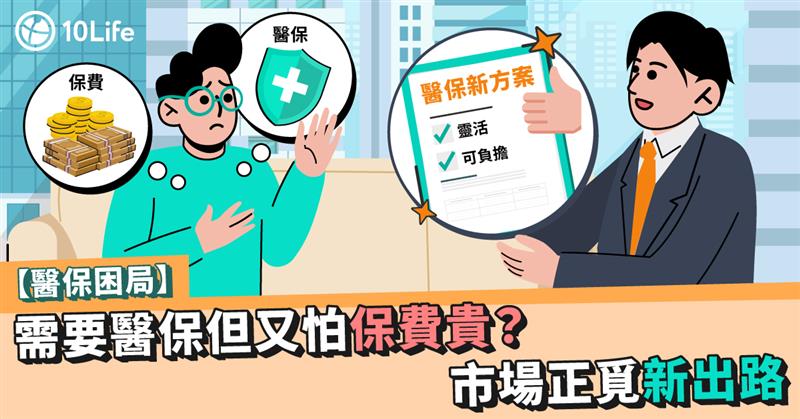
【Healthcare Insurance Dilemma】Need health insurance but worried about expensive premiums? The market is looking for new solutions

2025-11-19 5min read

Life is like a long marathon, and medical protection is the pair of running shoes that lets us keep a steady pace whether we hit gravel or mud. If we can, we all want to choose the top-tier, most protective name-brand shoes — just like the high-end medical insurance on the market.

To make those top-tier shoes last the whole race of a lifetime, the "maintenance fee" (premium) is not something everyone can afford. As the race goes on (as we age), our stamina (income) may gradually decline in the latter stages while premiums keep rising, and the cost of maintaining those shoes can quietly become a stumbling block on our path. If you have already reached the latter part of life, your steps have grown heavier and the pressure has risen, would you consider adjusting your strategy, traveling lighter, and finding medical protection that is both cost-effective and efficient so you can run farther and with greater peace of mind on the track? 

A look at the pros and cons and market gaps of mainstream medical coverage

Many medical insurance plans have long aimed for comprehensive coverage, hoping to fully cover private hospital medical expenses. But with high medical inflation, "there's no such thing as a free lunch" — behind high levels of coverage, customers must bear high premiums and the risk that the coverage may not be sustainable. 

Some people who haven’t purchased medical insurance still think they can rely entirely on public hospitals. Although public hospital inpatient fees are low, there are two major concerns: first, wait times for non-emergency imaging tests such as computed tomography (CT) and magnetic resonance imaging (MRI) can be months or even years long1, which may delay a patient’s critical treatment window or force them to pay out of pocket to have the tests done at private hospitals; second, many vital treatments—such as new targeted cancer drugs and vascular stents used in angioplasty—are not covered and must be paid for privately, often costing tens of thousands to hundreds of thousands of Hong Kong dollars2, potentially imposing a heavy financial burden on patients.

Mainstream medical insurance products on the market currently can reimburse treatment and medication expenses incurred at both public and private hospitals. One is high-end medical insurance, with both high coverage limits and high premiums; the other is traditional insurance that sets per-item compensation limits and has a limited overall sum insured. But under high medical inflation, premium increases for both will be equally staggering.

However, even if people can afford high premiums, they still have to pass "underwriting." Because middle-aged and elderly people, regardless of which plan they want to choose, may only find upon applying that their health condition no longer meets insurers' underwriting requirements, and are ultimately shut out from medical protection. 

Health insurance keeps innovating to offer the public solutions

Facing customer pain points such as medical inflation making premiums hard to sustain, coverage gaps in public healthcare, and difficulties for middle-aged and elderly people to obtain insurance, insurers need to find solutions. FWD recently launched a new medical insurance product "Renren Medical Insurance Plan"3 (hereinafter "Renren"), aiming to balance the contradiction between "comprehensive coverage" and "premium sustainability" through an innovative classification based on hospital type.

To address the needs of different customer groups, Renren offers three coverage levels, each positioned differently:

  • "Entry Level": This level is designed for the budget-conscious general public, with an annual benefit limit per policy year per injury/illness of up to HK$500,000. The product provides basic medical coverage for the insured, with simplified underwriting4, and premiums that are relatively more affordable. This level fully covers5 the insured's hospitalization and surgical costs in Hong Kong public hospitals. At the same time, the plan provides coverage, under a co-insurance6 model, for self-funded drugs and medical items in Hong Kong public hospitals, as well as specified imaging tests referred to private medical institutions due to long waiting times.
     
  • "Enhanced Level": Building on the Entry Level, this level further extends coverage to public and private hospitals in Mainland China and Macau to meet growing cross-border medical demand, with an annual benefit limit per policy year per injury/illness of up to HK$850,000.
     
  • "Premier Level": Building on the Enhanced Level, this level further expands the network to cover all public and private hospitals across Asia (including Hong Kong, Macau and Mainland China), with an annual benefit limit per policy year per injury/illness of up to HK$1,000,000. The Premier Level, through a co-insurance6 model, covers a range of medical expenses arising from hospitalization and surgeries at private hospitals in Asia, improving premium attractiveness to keep premiums reasonably affordable. Policyholders can also choose at any time to downgrade to other coverage levels without re-underwriting, flexibly meeting medical protection needs at different stages of life.

    In addition, as long as a child takes out the Premier Level, they can add optional coverage7 for their parents that is similar to the Entry coverage, and the parents do not need any health underwriting or to sign the application in person, specifically addressing the pain point of middle-aged and elderly groups who "didn't insure when young and are hard to insure when older." 

At the same time, Renren is supported by the FWD Care Greater Bay Area medical management team8, which provides end-to-end support and assistance to resolve difficulties clients may face when unfamiliar with the Mainland medical system. Renren also offers global inpatient or day surgery cash benefits to help alleviate everyday expense pressures. 

Health insurance premiums increase with age; when taking out a policy, pay attention to your long-term affordability.

RenRen Insurance balances coverage and premiums by using the features of "classification by hospital type" and the "co-insurance6 model". We attempted to observe the average premiums and their changes across different age groups, comparing a basket of market medical insurance products with RenRen Insurance's "Hui-ya tier" (see Table 1). Please note that Table 1 is a simple premium comparison intended to provide a reference for premium increases across different types of medical insurance products; the coverages and terms of each product differ, so consumers should take note.  

Table 1: Comparison of market medical insurance average annual premiums and Renren Insurance 「Huiya」 tier average annual premiums (annual payment)

(Assuming the insured is male, with a zero deductible, standard room level, Asia region, and no sub-limits on itemised benefits for the medical insurance. Table 1 is a simple premium comparison; the coverage and terms of each medical insurance product vary.) 

Actual ageMarket medical insurance average annual premium* (HKD)Renren Insurance "Huiya Level" average annual premium (HKD)
45-54$16,845$5,488
55-64$28,687$9,035
65-74$53,846$15,974
75-84$85,259$28,359
* The calculation of the market medical insurance average annual premium is based on 7 medical insurance plans, namely Blue Cross "Love Yourself" Voluntary Health Insurance Plan, Po Pak Home Interoperable Medical Protection Plan (Plan B), Bupa Hero Exceptional Voluntary Health Insurance Plan (Select), Cigna‑Cathay Superior Medical Insurance (Plan 1), Cigna Voluntary Health Insurance Series – Flexible Plan (Superior), FWD Be Well Medical Plan and Manulife "Jin Yue" Voluntary Health Insurance Flexible Plan (Smart Choice).
The above premium calculations are based on standard premiums and do not include any rider premiums, premium discounts or premium levies.
Premium information last updated: 19 November 2025 
 

From the table above, it can be seen that the average annual premium for market medical insurance rises sharply with age. At ages 45 to 54, the annual premium is about HK$16,845, which is still affordable for many families; but by ages 75 to 84, the premium has surged to about HK$85,259, clearly imposing a heavy burden on ordinary households. If medical inflation is taken into account, the future burden will be even heavier. By contrast, the average annual premium of Ren Ren Insurance’s "Huiya" tier at each age is only one-third of the average annual premium of market medical insurance.

The reason the "Huiya" tier was chosen for comparison is precisely because the comparison items above are similar to the selected market products, making them more comparable. Of course, these figures are intended to reveal industry trends and are for reference only, not a definitive judgment of the merits of each product. It is worth reflecting that, faced with medical inflation and an aging population, consumers who rely solely on "buying the most expensive" or "only using public hospitals" may not have a sustainable strategy. Innovative medical product designs—through "per-policy-year per-illness compensation mechanisms", "classification by hospital type", and a "co-insurance6 model"—offer another approach to balancing premiums and coverage, giving consumers a markedly different choice.

However, every plan involves trade-offs, and consumers still need to consider factors such as coverage scope, hospital network, claims mechanisms, and out-of-pocket ratios. When taking out insurance, one should consider personal actual medical needs and long-term financial capacity, and carefully review the specific coverages of the product to choose the long-term plan that best suits oneself.  

Notes:
1. Source: Hospital Authority, "Key Performance Indicator Report", March 2025.
2. Source: Now News, "300 public hospital patients pay over HK$400,000 a year for medication; Health Bureau studies capping mechanism for critical care treatment fees", 26 June 2024.
3. Source: One N All Medical Insurance Plan | FWD Hong Kong  
4. Only three simple health questions need to be answered at application (applicable to persons whose age next birthday is 1 to 65). For underwriting requirements, terms and conditions, please refer to the full underwriting questions.
5. "Full coverage" means there are no sub-limits and covers the actual amounts of eligible expenses and other charges, subject to the overall benefit limit per injury/illness per policy year. Full coverage is limited to reasonable and customary charges or expenses incurred for medically necessary medical services.
6. Co-insurance refers to the portion of eligible expenses that the policyholder must share at the specified rate. For the avoidance of doubt, co-insurance does not mean any shortfall the policyholder must pay where actual charges exceed the applicable limits under the relevant terms and coverage.
7. The Parents' Home Extra Protection option is an optional benefit selected by the policyholder when purchasing the One N All Medical Insurance Plan (coverage level: Huiya). Any amounts paid under the Parents' Home Extra Protection option will not be counted toward any applicable benefit limits under this plan and will not affect the insured person's entitlement to benefits and/or eligibility for a no-claim premium discount under this plan.
8. This service is provided by a third-party service provider and renewal is not guaranteed. The insurer will not be liable for the acts, negligence or omissions in relation to any medical consultation, advice, services or treatments they provide.
9. Last updated: 19 November 2025

The above product information does not include the full terms of the policy and is subject to the terms and conditions of the relevant plans. For details of the above product features, benefits and the full terms, exclusions and key product risks, please refer to the FWD website, the relevant product brochure and the policy wording. Customers must successfully pass a financial needs analysis to determine that the recommended insurance product meets their insurance needs.  

This English version of this article has been generated by machine translation powered by AI. It is provided solely for reference purposes. In the event of any discrepancy or inconsistency between this translation and the original Chinese version, the Chinese version shall prevail.

10Life 編輯團隊

團隊成員由一群資料搜集員組成,主力保險相關資訊研究。

10Life 編輯團隊

團隊成員由一群資料搜集員組成,主力保險相關資訊研究。

Disclaimer

10Life 产品比较和 10Life 保险评分由获保监局授权持牌保险经纪公司 10Life Financial Limited(保监局牌照号码为FB1526)营运。10Life 产品比较和 10Life 保险评分是根据产品数据、事实陈述以及数据,并以一般消费者作为对象,从而作出数学运算,并不受与保险公司任何形式之合作或所获得之费用所影响。

10Life平台上之任何信息(「10Life信息」),包括但不限于产品比较、产品评分、网志文章等,旨在向香港特别行政区(「香港」)境内人士发布,所有信息及服务对象为于身处香港境内人士,仅供一般教育及参考用途。10Life信息无意,也不应被视为对任何保险、金融或投资产品进行受监管建议或专业建议、推荐、批准、认可、邀请或招揽。10Life信息并没有考虑阁下之个人需要,阅览有关数据也不应被视为正在进行个人合适性评估,且不足以构成任何购买保险产品决定的依据。购买任何保险产品或进行有关保险决定前,阁下应以保险公司提供的数据为准,自行进行研究,及/或寻求持牌保险中介人的独立及专业意见。10Life信息是以最大努力从不同渠道收集、验证、更新而成。10Life集团及其附属公司、关连人士、代理、董事、职员、员工将不会就有关资料引致的责任、索偿或损失负上任何责任,也概不保证或担保有关资料之准确性、完整性和适时性。

所显示保费数据尚未包括保险业监管局收取的保费征费,并均四舍五入至港元个位数。

如阁下对 10Life 产品比较和 10Life 保险评分有任何意见,欢迎电邮至 enquiries@10life.com

Whatsapp icon
Whatsapp icon
WeChat icon
WeChat icon
Enquiry icon Close icon
Back To Top
Whatsapp icon
Whatsapp icon
WhatsApp