









10Life Financial Limited
Enquiries: enquiries@10life.com
Hotline: (852) 3705 1599
Address: 16/F Greatmany Centre, 109-115 Queen’s Road East, Wan Chai, Hong Kong



Public healthcare VS Private healthcare
Healthcare system challenges: aging population, staff shortages, rising healthcare costs
Practical advice: For non-urgent pain, go to private hospitals For emergencies, go to public hospitals
The government is promoting wider adoption of the Voluntary Health Insurance Scheme and reforms to public healthcare fees.
Protect yourself — buy health insurance early


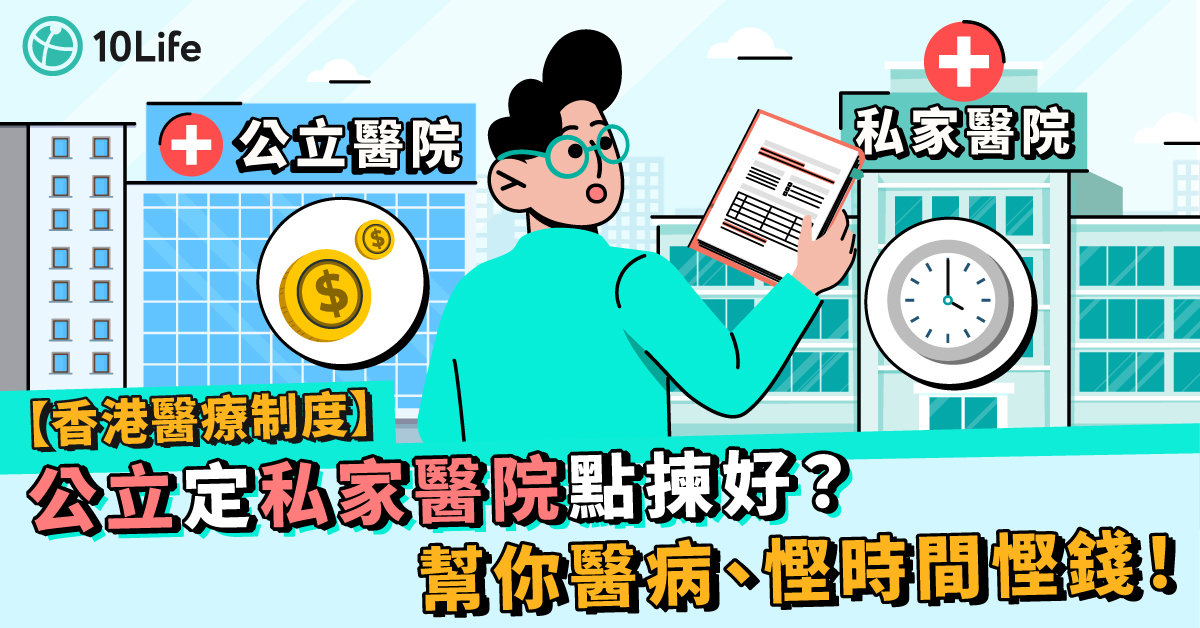
Health is the greatest wealth in life, and Hong Kong’s ability to be one of the regions with the highest life expectancy in the world1 owes much to its comprehensive healthcare system.
However, hit by population ageing and the growing prevalence of chronic diseases, public-sector waiting times have lengthened and private medical costs have risen, making access to care an increasingly pressing problem. How can the best balance be struck among "cost", "efficiency" and "quality of service"? This article will compare the strengths and weaknesses of public and private healthcare, the current state of waiting times, and the future direction of healthcare reform to help patients find the medical services best suited to them.
Public healthcare VS Private healthcare
Hong Kong's healthcare system is centered on the "dual public-private track" model, divided into public and private systems, each with clearly defined roles:
Government-led, "low fees, high coverage" medical services that cover 90% of inpatient care, but waiting times are long, imposing significant time costs on patients with chronic illnesses and their families.
Highly flexible and high-quality services suitable for urgent needs, but very expensive: minor surgeries can cost tens of thousands of HKD, and major surgeries can reach several hundred thousand HKD, making them unaffordable for ordinary families without relevant insurance coverage.
Public Healthcare | Private Healthcare | |
| Composition | 43 public hospitals under the Hospital Authority, 49 specialist outpatient clinics and 74 general outpatient clinics | 13 private hospitals (e.g., Hong Kong Sanatorium & Hospital, Hong Kong Adventist Hospital, Gleneagles Hospital, French Hospital, Baptist Hospital), private clinics |
| Scope of services | Emergency, specialist services, long-term inpatient care (covers about 90% of inpatient services in Hong Kong) | Emergency, specialist, outpatient, health check-ups, surgeries and other diversified services |
Cost | Relatively inexpensive | More expensive |
| Waiting time | Long | Short (Most private clinics and private hospitals offer same-day appointments and rapid scheduling for surgeries) |
| Service recipients | Hong Kong residents (Hong Kong ID card required) | No restriction, includes non-residents and tourists |
| Advantages | Low fees, protects lower-income citizens, major disease treatments are basically fully covered | Flexible and fast, high-end services, strong privacy |
| Note: 1. Information last updated: 6 May 2025 | ||
Healthcare system challenges: aging population, staff shortages, rising healthcare costs
Although Hong Kong's healthcare system is centered on a "dual-track" model, with public and private healthcare each playing a role and theoretically able to meet different citizens' needs, population aging and the increase in chronic disease patients have intensified the mismatch between supply and demand for medical resources, and system pressure continues to rise.
Hong Kong is one of the regions most severely affected by population aging worldwide. According to 2021 data2, the proportion of people aged 65 and over has exceeded 20%. The surge in chronic disease patients has greatly increased demand for medical services, further burdening the system.
As of 31 March 2024, Hong Kong had 16,459 doctors, i.e. only 2.16 doctors per 1,000 people3, significantly lower than the average level of OECD member countries, which have about 3.7 doctors per 1,000 people4.
Patients face waits of several years for specialist consultations and non-urgent surgeries at public hospitals, affecting timely treatment and even worsening conditions.
As medical technology and the costs of new drugs continue to climb, private healthcare fees have also kept rising, making them unaffordable for average families. At the same time, the public healthcare system's drug formulary has limitations, and some expensive medications must be purchased out of pocket by patients, further increasing financial pressure on the public.
Practical advice: For non-urgent pain, go to private hospitals For emergencies, go to public hospitals
When people get sick, many agonize over whether to use public healthcare or choose private healthcare. In fact, as long as you understand the characteristics of both, choosing isn’t difficult. Here are some practical suggestions:
Public healthcare is suitable for handling emergencies or complex critical patients, especially emergency treatment or situations that require specialist care and long-term rehabilitation. It provides cross-specialty collaborative services to ensure patients receive continuous and comprehensive medical support. At the same time, rare or high-risk conditions (such as organ transplants) are usually handled by public hospitals that offer specialized techniques and equipment, and the costs are generally more affordable, reducing financial pressure.
Private healthcare is suitable for minor to moderate conditions, medical procedures that can be planned in advance, or situations requiring rapid diagnosis and treatment. Waiting times are shorter, and it also offers flexible testing and treatment options. If a seriously ill patient has already purchased medical insurance (such as the Voluntary Health Insurance Scheme), they can transfer hundreds of thousands, or even over a million dollars in medical expenses to the insurance company, while enjoying faster services and avoiding the long waiting times of public healthcare.
Further reading: Compare VHIS plans
If a seriously ill patient does not have insurance, or their insurance coverage is limited, they can also consider a public-private collaboration model: first go to private medical services for tests and to manage the initial condition, then during the scheduling period connect to a public hospital specialist. This can help achieve the best treatment outcomes while reducing the financial burden. At the same time, make good use of the public system’s specialist and rehabilitation services to ensure long-term support.

The government is promoting wider adoption of the Voluntary Health Insurance Scheme and reforms to public healthcare fees.
In order to alleviate citizens' difficulties waiting for medical services, the government is actively introducing a number of reform measures to make public healthcare more efficient and private healthcare more affordable, helping citizens strike a balance between economic considerations and medical needs.
Continue to encourage citizens to purchase Voluntary Health Insurance to ease the pressure on public healthcare, and provide tax deductions for policyholders.
The Hospital Authority will implement the fee reform in January 20265, adjusting inpatient, accident and emergency (A&E) and outpatient fees, and introducing a co-payment model for non-emergency tests to guide resource use, with the aim of directing more resources to seriously ill patients.
The government promotes “one person, one family doctor”, using District Health Centres to screen and manage chronic diseases, reducing the burden on public healthcare.
Expand hospitals and increase facilities such as cataract surgery centres and community health centres to shorten waiting times, reform Hospital Authority management, and improve efficiency and service quality.
Advance medical innovation, accelerate new drug approvals, and promote biopharmaceutical development.
Implement Greater Bay Area medical integration, expand the scope of elderly medical vouchers, pilot cross-border ambulances, and promote sharing of Guangdong-Hong Kong resources.
Protect yourself — buy health insurance early
In fact, Hong Kong’s healthcare system “guarantees a floor but not excellence”: public healthcare provides basic coverage, while the private sector meets demand for efficiency. Want both? For elective minor or major cases you can choose private care; for emergencies, rely on public hospitals. You can also buy health insurance early to prepare for the future! However, there are many voluntary health insurance options and the professional details can be hard to understand. Want to learn more? Right away WhatsApp 10Life insurance consultant to quickly get your questions answered!
Further reading:
Out-of-pocket drug costs giving you a fright? Understand the public hospital drug formulary in one article
Notes:
1.LegCo: Opening remarks by the Secretary for Food and Health on the motion “Implementing and Promoting Healthcare Reform” (Chinese only): Hong Kong is one of the regions with the highest life expectancy in the world (2023 male life expectancy 82.8 years, female 88.2 years), and the infant mortality rate is as low as 1.5 per 1,000, among the lowest globally.
2. Hong Kong population estimates
3. LegCo question: Staffing and resources of public healthcare services
4.Global shortage of healthcare workers | Korea’s doctor ratio below the OECD average — market-driven talent tilts toward medical aesthetics
5. Hospital Authority pushes fee reform to streamline medical services and strengthen patient protection
Article last updated: 6 May 2025
This English version of this article has been generated by machine translation powered by AI. It is provided solely for reference purposes. In the event of any discrepancy or inconsistency between this translation and the original Chinese version, the Chinese version shall prevail.
身為10Life編輯團隊的一員,主力研究各種保險產品比較、拆解保單條款及索償細節,並與10Life持牌顧問緊密合作,致力將複雜術語轉化為易明分析,讓大眾更了解各種保險產品。
身為10Life編輯團隊的一員,主力研究各種保險產品比較、拆解保單條款及索償細節,並與10Life持牌顧問緊密合作,致力將複雜術語轉化為易明分析,讓大眾更了解各種保險產品。
10Life Product Comparison and 10Life Insurance Ratings are developed by 10Life Financial Limited, an authorised insurance broker company licensed with the Insurance Authority under License Number FB1526. 10Life Product Comparison and 10Life Insurance Ratings are developed for generic customer segments using mathematical calculations based on product information, facts and data, and are not influenced by any partnerships with or fees received from insurance companies. Any information on 10Life Platform ("10Life Information"), including but not limited to Product Comparison, Product Ratings, Blog Articles are intended for general education purpose and reference only. None of the 10Life Information is intended, nor should they be considered or relied upon, as regulated advice, insurance, financial, investment or professional advice, recommendation, approval, endorsement, invitation or solicitation in respect of any insurance, financial or investment products. 10Life Information does not take into account your individual needs. Reading 10Life Information should not be considered as conducting a suitability assessment, and is not sufficient to form the basis of any decisions to purchase any insurance products. You should rely on information authorised by insurance companies, carry out your own research and/or seek independent advice from licensed intermediaries before purchasing any insurance products or making any insurance decisions. While reasonable effort is used when collecting, validating and updating 10Life Information from various channels, none of 10Life Group and its subsidiaries, affiliates, agents, directors, officers and employees will be responsible for any liability, claim or loss arising from or associated with you using 10Life Information. No warranty, representation or guarantee is given by 10Life Group and its subsidiaries on the accuracy, completeness and timeliness of the information. If you have any questions on 10Life Product Comparison and 10Life Insurance Ratings, please email us at enquiries@10life.com




 Talk to 10Life on WeChat
