









10Life Financial Limited
Enquiries: enquiries@10life.com
Hotline: (852) 3705 1599
Address: 16/F Greatmany Centre, 109-115 Queen’s Road East, Wan Chai, Hong Kong



Key Rental Summary: What are the steps from viewing a property to signing the contract?
What should you pay attention to before and after viewing a property?
What terms should be confirmed before signing a tenancy agreement?
How much money do you need to prepare to rent a property? What does “two months’ deposit and one month’s rent in advance” mean?
How much is the rental commission? When does it need to be paid?
What is the purpose of stamping a tenancy agreement? What are the fees and deadline?
What is the difference between a periodic tenancy and a fixed-term tenancy? Can I terminate the tenancy early?
When is the tenancy deposit returned? How can you avoid having your deposit deducted when ending your tenancy?
Responsibility for Rental Property Repairs and Water Leaks: Is the Landlord or Tenant Responsible?
Do tenants need to buy Home protection insurance? What does it cover?
Key Considerations When Renting a Flat Checklist: Essential Reading from Viewing to Signing the Tenancy Agreement and Moving Out
Frequently Asked Questions About Renting a Property


When renting a property for the first time, there are many details to consider besides the rent and location. From viewing properties, signing the tenancy agreement, paying the deposit and agent’s commission, and stamping the tenancy agreement, to future repairs and arrangements for ending the tenancy, every stage may affect your rental expenses and rights as a tenant.
Exactly how much money do you need to prepare when renting a property? What does “two deposits and one month’s rent upfront” mean? When should you pay the rental agent’s commission? When will the rental deposit be returned? This time, 10Life, an insurance comparison platform, has compiled a practical Checklist of things to note when renting a property in Hong Kong to help you understand the entire rental process and reduce unnecessary expenses and tenancy disputes.
Key Rental Summary: What are the steps from viewing a property to signing the contract?
The process of renting a property in Hong Kong can generally be divided into the following six steps:
What should you pay attention to before and after viewing a property?
Many rental property photographs have been edited, and the actual property may differ from the description in the advertisement. Therefore, it is advisable to inspect the property in person and pay attention to the following:
If you identify any damage or areas requiring repair, confirm the arrangements with the landlord before signing the tenancy agreement and keep a written record.
What terms should be confirmed before signing a tenancy agreement?
Even where a verbal agreement has been reached with the landlord, important arrangements should still be clearly set out in the tenancy agreement, including:
Generally, the landlord and tenant may each retain a signed original copy of the tenancy agreement, and should keep the relevant payment receipts and records of written communications. In addition, some landlords may require tenants to provide proof of employment, payslips or proof of income in order to understand the tenant’s financial circumstances and ability to pay the rent.
How much money do you need to prepare to rent a property? What does “two months’ deposit and one month’s rent in advance” mean?
In Hong Kong, “two months’ deposit and one month’s rent upfront” is a common rental arrangement. When signing the tenancy agreement, tenants are required to pay a deposit equivalent to two months’ rent, as well as one month’s rent in advance.
“Two months’ deposit and one month’s rent upfront” is a common rental arrangement, but it is not a statutory standard applicable to all tenancy agreements. The actual amount must be agreed between both parties.
Assuming the monthly rent is HK$15,000, the tenant is required to pay two months’ deposit and one month’s rent upfront, and the property is rented through an agent with a commission of half a month’s rent:
The above amount does not include the tenancy agreement stamping fee, utility deposits, moving costs or other potential expenses. Therefore, using a property with monthly rent of HK$15,000 as an example, you may need to prepare more than HK$50,000 initially. Sufficient funds should be set aside before renting a property.
How much is the rental commission? When does it need to be paid?
There is no statutory standard rate for estate agent commissions on rental properties in Hong Kong. It is common in the market for the tenant and landlord to each pay half a month’s rent, but the actual amount is negotiable. For example, if the monthly rent is HK$15,000, half a month’s commission would be HK$7,500. Before signing the agreement, you should note the following:
The actual commission and payment timing are subject to the estate agency agreement.
Rental commissions are generally payable at the time specified in the estate agency agreement, such as upon signing the tenancy agreement or when the tenancy begins. Not all transactions require payment when the formal tenancy agreement is signed. Please note that if a binding tenancy agreement has been signed and both parties subsequently agree to cancel the transaction, commission may still be payable. Therefore, tenants should confirm the commission amount, payment timing and conditions for cancelling the transaction before signing the agreement.
In addition, if the tenancy cannot formally commence for reasons not attributable to the tenant’s fault, the issue of commission refunds must be handled in accordance with the applicable terms of the estate agency agreement.
What is the purpose of stamping a tenancy agreement? What are the fees and deadline?
“Stampling” refers to paying stamp duty on a tenancy agreement and obtaining the relevant stamp certificate. According to the Inland Revenue Department, a general tenancy agreement must be stamped within 30 days of signing; otherwise, a penalty may be imposed. An unstamped tenancy agreement generally cannot be admitted as evidence in civil proceedings and may also affect a tenant’s application for domestic rent tax deduction.
Stamp duty is calculated based on the tenancy period, rent and relevant terms of the agreement. For example, for a tenancy exceeding one year but not exceeding three years, stamp duty is generally calculated at 0.5% of the yearly or average yearly rent.
All parties to the tenancy agreement are responsible for the relevant stamp duty, but the landlord and tenant may agree on how to share the costs. Tenants can complete the process through the Inland Revenue Department’s e-Stamping service and retain the stamp certificate.
What is the difference between a periodic tenancy and a fixed-term tenancy? Can I terminate the tenancy early?
Residential tenancy agreements in Hong Kong commonly include “one year fixed term and one year flexible term”, but the actual arrangement is subject to the individual tenancy agreement.
For example, if the tenancy agreement states “one year fixed term and one year flexible term” and specifies a two-month notice period, this usually means that after completing the first year, the tenant may give notice to end the tenancy in accordance with the relevant terms, rather than being able to move out at any time and avoid liability for rent. In addition, if a tenant intends to sublet or underlet the premises (commonly known as “subletting a rented property”), they should first confirm whether this is permitted under the tenancy agreement. If subletting is prohibited, subletting without the landlord’s consent may constitute a breach of contract and could even result in termination of the tenancy agreement.
When is the tenancy deposit returned? How can you avoid having your deposit deducted when ending your tenancy?
A rental deposit is usually returned after the tenancy ends, the tenant has handed back the property and all related expenses have been settled. However, standard private residential tenancy agreements in Hong Kong generally do not provide a uniform deposit return period applicable to all circumstances, so the terms of the tenancy agreement should be followed.
To reduce disputes over the return of the deposit, it is recommended that you:
When moving in: Take photographs recording the condition of the walls, floors, furniture and appliances, and retain the check-in inventory.
During the tenancy: Notify the landlord as soon as possible if any damage is found, and retain records of repairs and communications.
Before moving out: Give the landlord advance notice as required by the tenancy agreement, and arrange cleaning and any repairs for which the tenant is responsible.
On the handover date: Inspect the property with the landlord, confirm the water, electricity and gas meter readings, return the keys, and confirm the deposit return arrangements in writing.
Ordinary wear and tear should not automatically be treated as damage caused by the tenant. However, liability for any actual deduction must still be determined with reference to the tenancy agreement, the evidence and the relevant law. If the landlord refuses to return the deposit, the tenant should first ask for an explanation of the reasons for the deductions and request the relevant supporting evidence. Where necessary, the tenant may consider pursuing recovery through appropriate legal proceedings.
Responsibility for Rental Property Repairs and Water Leaks: Is the Landlord or Tenant Responsible?
During a tenancy, disputes may arise from air-conditioning faults, leaking pipes or damaged appliances. Responsibility for repairs usually depends on the terms of the tenancy agreement, the cause of the damage and the relevant legal responsibilities, and cannot be categorically assigned to the landlord or tenant.
Who is responsible for repairing damaged air-conditioning units and household appliances?
Generally, the cause of the damage should first be considered:
When a problem is discovered, the tenant should notify the landlord in writing as soon as possible and retain photographs and repair records. Except in emergencies, the tenant should not arrange major repairs without consent and then request reimbursement from the landlord.
If water seepage occurs in the rented flat, first record the affected areas and the extent of the damage, and notify the landlord or building management office. If the seepage is suspected to originate from the flat above, further investigation is required to identify the source and clarify the relevant responsibilities. Where necessary, assistance may be sought from the Joint Office for Investigation of Water Seepage Complaints of the Food and Environmental Hygiene Department and the Buildings Department.
It should be noted that responsibility for building repairs is different from cover for losses involving personal belongings. For example, if water seepage damages the tenant's computer or clothing, the fact that the repair responsibility may involve another property owner does not necessarily mean that compensation for the damaged belongings will be provided.
Do tenants need to buy Home protection insurance? What does it cover?
Many tenants assume that since their landlord already has Home protection insurance, they do not need to take out additional cover themselves. However, a landlord’s policy may not cover the tenant’s personal belongings, nor does it mean that tenants are not liable for legal responsibilities arising from their own negligence.
When choosing Home protection insurance, tenants may wish to prioritise the following areas of cover:
The coverage limits, excesses and exclusions of different Home protection insurance plans may vary significantly, so premiums should not be the only basis for comparison. Want to compare the coverage and premium discounts offered by different insurance companies in one go? Use the 10Life Home protection insurance comparison platform now to conveniently compare major Home protection insurance plans in one place, receive objective analysis from professional actuaries and complete your online application!
Key Considerations When Renting a Flat Checklist: Essential Reading from Viewing to Signing the Tenancy Agreement and Moving Out
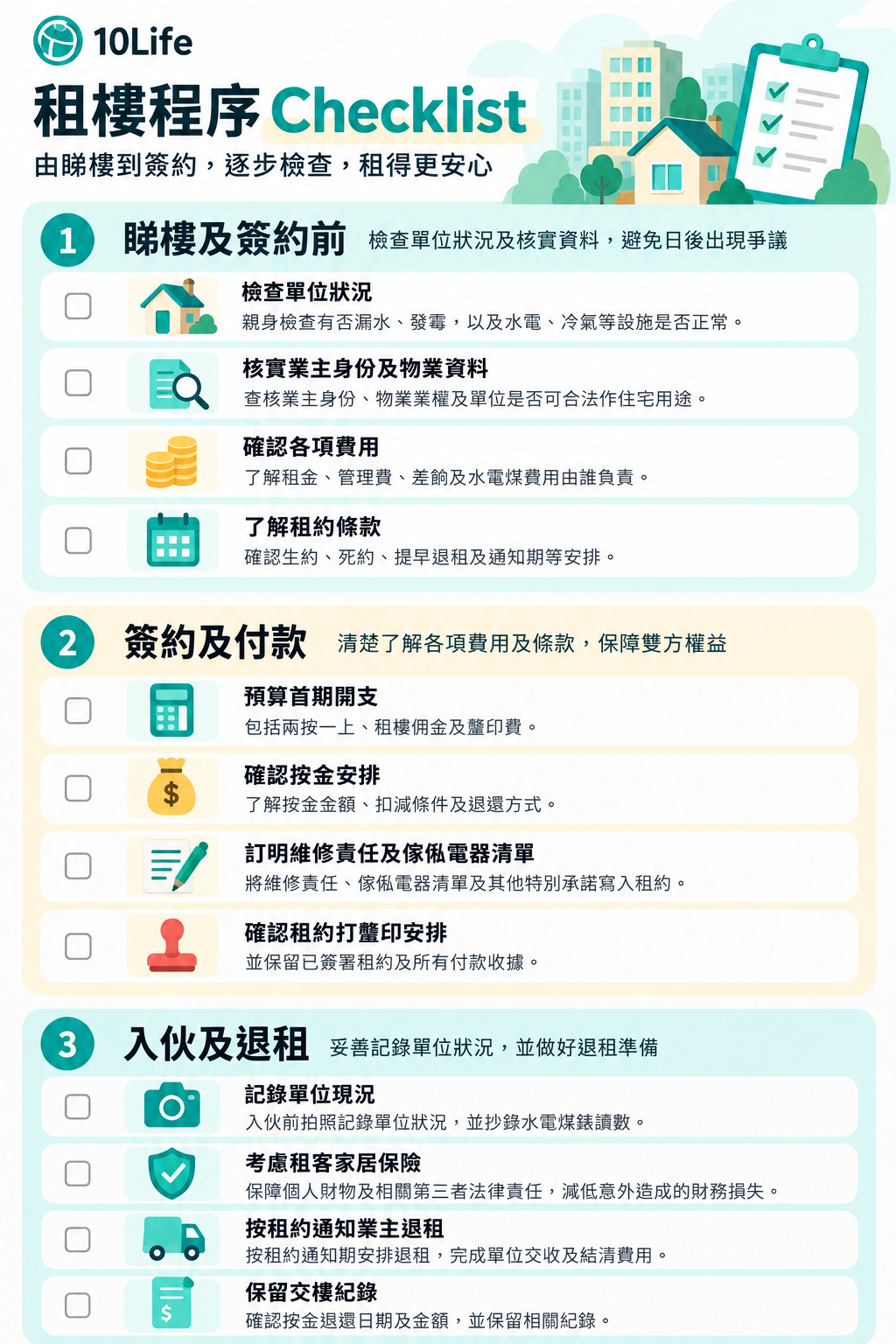
Frequently Asked Questions About Renting a Property
You generally need to set aside money for the deposit, first month’s rent, agency commission and stamp duty on the tenancy agreement. Under the “two months’ deposit and one month’s rent” arrangement, the deposit and first month’s rent alone amount to three months’ rent. You should also budget for moving expenses and utility deposits for water, electricity and gas.
If you rent through an estate agent, whether commission is payable and the amount involved will depend on the estate agency agreement. There is no statutory uniform commission rate in Hong Kong. Tenants may discuss the fees and arrangements for sharing them with the agent before signing the agreement.
Yes. Estate agency commissions in Hong Kong are not subject to a statutory fixed rate, and tenants may negotiate with the agent before signing the estate agency agreement. The actual fees should be based on the terms agreed by both parties.
The timing of commission payment is generally specified in the estate agency agreement, such as upon signing the tenancy agreement or when the tenancy commences. Tenants should confirm this before signing the agreement to avoid disputes later.
It is usually refunded after the tenancy ends, the property has been handed back and all payments have been settled. The actual timeframe will be governed by the tenancy agreement. It is advisable to confirm the refund date and conditions for deductions before signing the agreement.
A tenancy agreement generally must be stamped within 30 days of signing. Failure to stamp it may affect its admissibility as evidence in civil proceedings, as well as eligibility to apply for a deduction for residential rent.
You generally have to comply with the fixed tenancy term unless both parties agree to terminate it early, or another applicable arrangement is provided for in the tenancy agreement or by law. Otherwise, the tenant may be liable for breach of contract.
Tenants of private residential properties are generally not legally required to purchase Home protection insurance, but individual tenancy agreements may impose such a requirement. Tenants may consider whether insurance is necessary based on the value of their personal belongings and the risks associated with their legal liabilities.
This English version of this article has been generated by machine translation powered by AI. It is provided solely for reference purposes. In the event of any discrepancy or inconsistency between this translation and the original Chinese version, the Chinese version shall prevail.

10+ years in editing & copywriting. I love solving puzzles — now my goal is making insurance jargon simple. Let's decode policies and learn together.
10+ years in editing & copywriting. I love solving puzzles — now my goal is making insurance jargon simple. Let's decode policies and learn together.
10Life Product Comparison and 10Life Insurance Ratings are developed by 10Life Financial Limited, an authorised insurance broker company licensed with the Insurance Authority under License Number FB1526. 10Life Product Comparison and 10Life Insurance Ratings are developed for generic customer segments using mathematical calculations based on product information, facts and data, and are not influenced by any partnerships with or fees received from insurance companies. Any information on 10Life Platform ("10Life Information"), including but not limited to Product Comparison, Product Ratings, Blog Articles are intended for general education purpose and reference only. None of the 10Life Information is intended, nor should they be considered or relied upon, as regulated advice, insurance, financial, investment or professional advice, recommendation, approval, endorsement, invitation or solicitation in respect of any insurance, financial or investment products. 10Life Information does not take into account your individual needs. Reading 10Life Information should not be considered as conducting a suitability assessment, and is not sufficient to form the basis of any decisions to purchase any insurance products. You should rely on information authorised by insurance companies, carry out your own research and/or seek independent advice from licensed intermediaries before purchasing any insurance products or making any insurance decisions. While reasonable effort is used when collecting, validating and updating 10Life Information from various channels, none of 10Life Group and its subsidiaries, affiliates, agents, directors, officers and employees will be responsible for any liability, claim or loss arising from or associated with you using 10Life Information. No warranty, representation or guarantee is given by 10Life Group and its subsidiaries on the accuracy, completeness and timeliness of the information. If you have any questions on 10Life Product Comparison and 10Life Insurance Ratings, please email us at enquiries@10life.com




 Talk to 10Life on WeChat
