









10Life Financial Limited
Enquiries: enquiries@10life.com
Hotline: (852) 3705 1599
Address: 16/F Greatmany Centre, 109-115 Queen’s Road East, Wan Chai, Hong Kong



What is Autism Spectrum Disorder (ASD)?
Main Characteristics of Autism
Possible Causes of Autism
When will it be noticed? What are the early warning signs of autism?
How to evaluate? Can parents conduct a preliminary test themselves?
Treatment Methods for Autism
Does medical insurance cover the cost of autism treatment?


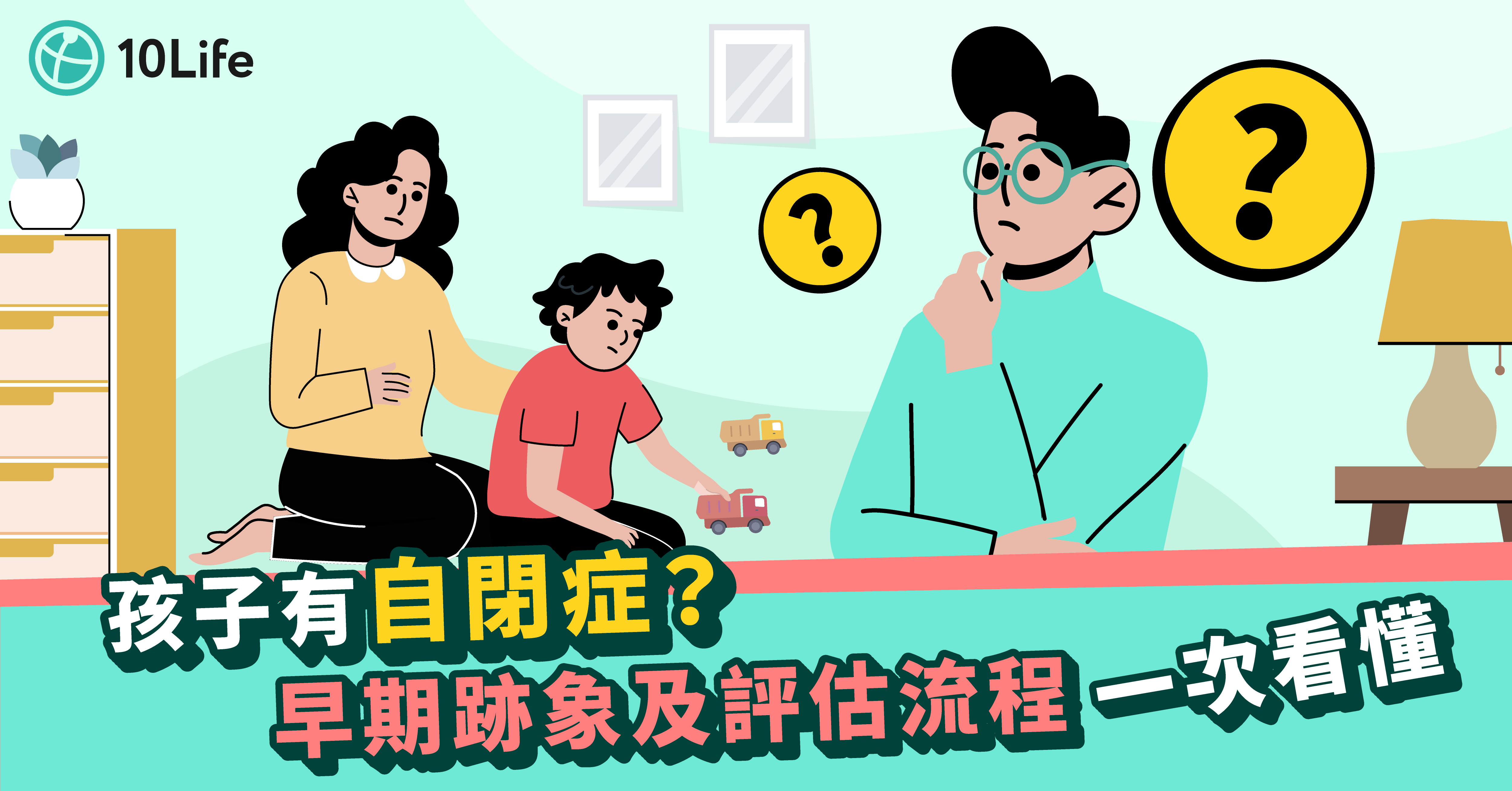
Many parents may notice during their children's growth that they seem "a bit slow" or particularly "shy" in terms of speech, expression, or social interaction. Are these behaviours simply due to personality differences, or could they be early signs of Autism Spectrum Disorder (ASD)? According to the World Health Organization (WHO), approximately 1 in every 100 children worldwide is diagnosed with autism, with a significantly higher diagnosis rate among boys compared to girls.
Early detection and intervention are crucial for improving a child’s communication and social skills. This article will provide a detailed breakdown of the classification, characteristics, causes, assessment, and treatment methods for autism, helping you grasp essential information to support your child’s developmental journey.
What is Autism Spectrum Disorder (ASD)?
Autism Spectrum Disorder (ASD) is a congenital neurodevelopmental disorder. It primarily affects an individual’s social interaction, communication skills, and behavioural patterns, with common characteristics including narrow interests and repetitive, rigid behaviours. Due to the wide variation in symptoms and severity among individuals, akin to a spectrum, it is referred to as a "spectrum" disorder.
Under the previous diagnostic criteria, autism was mainly categorised into the following types (now, in the latest edition of the *Diagnostic and Statistical Manual of Mental Disorders, Fifth Edition* (DSM-5), these categories have been unified under "Autism Spectrum Disorder"):
Symptoms typically become evident before the age of 3, including delayed language development, lack of eye contact, and limited interest in peers. It can be further subdivided into:
Language development is normal or even advanced, but there are significant difficulties in social understanding, non-verbal communication, and emotional expression. Individuals often exhibit intense focus on specific interests but pay little attention to others’ reactions or emotions.
The individual’s symptoms do not fully meet the diagnostic criteria for typical autism but still show evident difficulties in social interaction, language, or behaviour.
A rarer type of disorder. Children develop normally in early childhood (around age 2), but later (typically between ages 3 and 4), they experience significant regression in previously acquired skills, such as loss of language abilities, social skills, or self-care capabilities.
Main Characteristics of Autism
Children with autism spectrum disorder exhibit varying behaviours, but commonly face challenges in the following areas:
Possible Causes of Autism
The exact causes of autism are still not fully understood, but the medical community generally believes it results from a complex interaction of genetic and environmental factors:
According to the World Health Organization and numerous authoritative studies, there is no direct link between vaccination and autism.
When will it be noticed? What are the early warning signs of autism?
Some children may begin to show early signs within the first 6 months after birth, with the period between 12 to 24 months being a critical time for observation and identification. Parents are encouraged to pay close attention to the following:
If parents observe multiple of the above behaviours in their child, they should consult a paediatrician or visit a maternal and child health centre for an initial assessment as soon as possible. The American Academy of Pediatrics recommends that all children undergo routine autism screening at 18 and 24 months of age. Early intervention can significantly improve a child’s language development, social skills, and ability to adapt to daily life.
How to evaluate? Can parents conduct a preliminary test themselves?
Autism is not a physiological condition and cannot be diagnosed through blood tests or brain scans. Professional assessments are typically referred by paediatricians to the Child Assessment Centres (CAC) under the Department of Health, where a multidisciplinary team comprising clinical psychologists or child psychiatrists conducts the evaluation. The assessment process includes behavioural observation, standardised assessment tools, and in-depth interviews with parents and teachers to comprehensively determine if the child meets the diagnostic criteria for ASD.
Parents can use the following internationally recognised screening questionnaires for preliminary understanding, but it must be noted that screening tools are not diagnostic tools. A high score only indicates a higher risk, and professional assessment should be sought for confirmation.
A questionnaire completed by parents, consisting of 25 questions covering areas such as social interaction, communication, repetitive behaviours, and sensory responses, used for preliminary identification of autism risk in toddlers.[Click here to learn more or take the Q-CHAT test]
A brief screening questionnaire designed for children aged 4 to 11, consisting of 10 questions, completed by parents based on the child’s daily behaviour, to quickly assess whether the child exhibits traits associated with autism.[Click here to learn more or take the AQ-10 test]
Treatment Methods for Autism
Although autism cannot be "cured," continuous and appropriate early intervention can significantly enhance a child's communication, social, and adaptive life skills. Treatment plans are often personalised and developed by a multidisciplinary team (including speech therapists, occupational therapists, physiotherapists, etc.). Common effective methods include:
Does medical insurance cover the cost of autism treatment?
In Hong Kong, most standard medical insurance plans (especially hospitalisation insurance) offer very limited coverage for long-term training and treatments related to autism, such as behavioural therapy and speech therapy. The majority of these expenses must be borne by parents out of pocket. During underwriting, insurance companies may also decline coverage, increase premiums, or impose specific exclusions due to an autism diagnosis.
A small number of high-end medical insurance plans provide reimbursement for outpatient treatments related to psychiatry (including speech therapy, psychotherapy, etc.), but the premiums are relatively expensive. Additionally, these plans often come with waiting periods and annual compensation limits. Parents are advised to consult professional insurance advisors before purchasing a plan and to carefully compare the coverage scope, waiting periods, exclusions, and annual compensation limits of different plans to assess whether they meet their children's long-term needs.
If you need assistance in selecting a suitable plan, feel free to consult 10Life licensed insurance advisors for impartial and professional advice.
Further Reading:
10Life Research: Insurance Companies Denying Coverage for Children with Autism and ADHD May Involve Discrimination – Urgent Need for Stronger Regulations (with Latest 2025 Insurer Responses)
Denial of Coverage for Children with Autism and ADHD Not Isolated Cases – 10Life Receives Complaint Cases
[Autism] Three Key Characteristics to Identify Autism in Children – Are Limited Speech and Lack of Social Interaction Signs of Autism?
[ADHD] How to Distinguish Between Naughty Behaviour and ADHD in Children? A Comprehensive Guide to ADHD Characteristics, Causes, Assessment, and Treatment
Last Updated: 27 October 2025
This English version of this article has been generated by machine translation powered by AI. It is provided solely for reference purposes. In the event of any discrepancy or inconsistency between this translation and the original Chinese version, the Chinese version shall prevail.
Our team of professional content researchers focussing on insurance
Our team of professional content researchers focussing on insurance
10Life Product Comparison and 10Life Insurance Ratings are developed by 10Life Financial Limited, an authorised insurance broker company licensed with the Insurance Authority under License Number FB1526. 10Life Product Comparison and 10Life Insurance Ratings are developed for generic customer segments using mathematical calculations based on product information, facts and data, and are not influenced by any partnerships with or fees received from insurance companies. Any information on 10Life Platform ("10Life Information"), including but not limited to Product Comparison, Product Ratings, Blog Articles are intended for general education purpose and reference only. None of the 10Life Information is intended, nor should they be considered or relied upon, as regulated advice, insurance, financial, investment or professional advice, recommendation, approval, endorsement, invitation or solicitation in respect of any insurance, financial or investment products. 10Life Information does not take into account your individual needs. Reading 10Life Information should not be considered as conducting a suitability assessment, and is not sufficient to form the basis of any decisions to purchase any insurance products. You should rely on information authorised by insurance companies, carry out your own research and/or seek independent advice from licensed intermediaries before purchasing any insurance products or making any insurance decisions. While reasonable effort is used when collecting, validating and updating 10Life Information from various channels, none of 10Life Group and its subsidiaries, affiliates, agents, directors, officers and employees will be responsible for any liability, claim or loss arising from or associated with you using 10Life Information. No warranty, representation or guarantee is given by 10Life Group and its subsidiaries on the accuracy, completeness and timeliness of the information. If you have any questions on 10Life Product Comparison and 10Life Insurance Ratings, please email us at enquiries@10life.com



 Talk to 10Life on WeChat
