









10Life Financial Limited
Enquiries: enquiries@10life.com
Hotline: (852) 3705 1599
Address: 16/F Greatmany Centre, 109-115 Queen’s Road East, Wan Chai, Hong Kong



10Life In-depth Analysis: Six Travel Insurance Claim Rejection Pitfalls
Do not focus solely on the level of premiums; the details of the terms are equally important


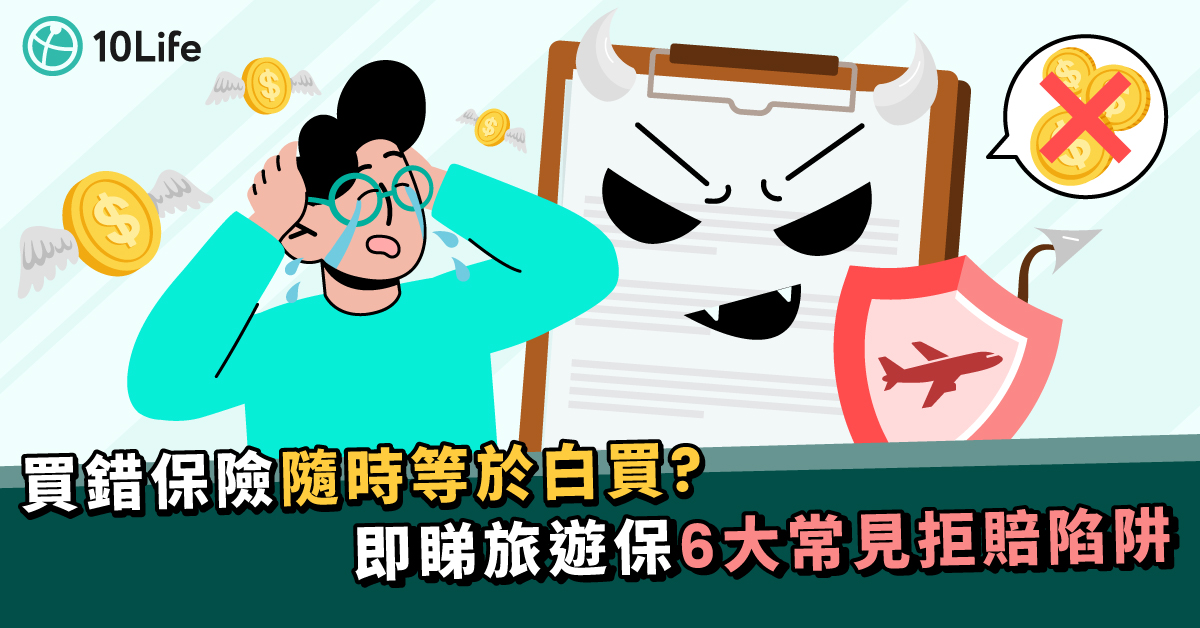
Consumers often think travel insurance is simple and does not require much scrutiny, only to discover when something goes wrong that the policy terms contain many grey areas. 10Life conducts an in-depth analysis of six common claim rejection pitfalls, helping the public to genuinely understand what they are buying before departure.

10Life In-depth Analysis: Six Travel Insurance Claim Rejection Pitfalls
Most travel insurance policies provide cover only on the basis of “pure leisure travel or business trips”. Itineraries for purposes such as study tours, volunteer services, and working holidays are usually not covered. Insurers generally determine this based on the overall itinerary’s “primary purpose”. Even if the traveller holds a tourist visa and the trip includes many leisure activities, a claim may still be rejected if the main arrangement is considered to be study.
10Life’s advice: For study tours or working holidays, you need to purchase specialist insurance, such as “overseas study insurance” or “working holiday insurance”. Do not assume standard travel insurance is sufficient. Before taking out a policy, you may proactively ask the insurer to confirm in writing whether the nature of your trip falls within the policy definition of cover.
The “trip cancellation” and “flight delay” cover under travel insurance generally only applies to force majeure events such as adverse weather, natural disasters or mechanical breakdown. If an airline cuts flights due to fuel prices or operational factors, this is a commercial decision and falls outside the scope of cover.
10Life recommendation: In the event of flight reductions, first check with the airline regarding refunds and free rebooking arrangements; when booking flights, you may wish to choose a flexible fare type to make changes to your itinerary easier later.
“Flight delay” may seem straightforward, but there are differences in the way it is calculated by different insurers, which directly affects whether a claim can be successfully made. Most insurers require a flight delay of 5 or 6 hours or more before “flight delay” cover becomes effective; where connecting flights are involved, delay times for each leg cannot be accumulated. Flight delays must also be caused by specified reasons (such as adverse weather, strikes, etc.) for the cover to be triggered.
10Life recommendation: Before taking out cover, verify how delays are calculated, especially for itineraries involving multiple flights or transit, and make sure you understand whether delays on each leg can trigger a claim independently.
Many consumers assume that once they purchase travel insurance, they can make a claim directly if they fall ill and are hospitalised during the trip. In fact, some travel policies contain a “claims co-ordination clause”, which requires the policyholder to first claim against other medical insurance policies (such as company medical insurance or VHIS). Travel insurance will only reimburse the portion not covered by those policies.
For example, if you are bitten by a mosquito on your trip and contract dengue fever that requires hospitalisation, even if you have travel insurance, you must first claim under your own medical insurance. Only the remaining medical expenses that have not been reimbursed can then be covered by the travel insurance. This not only makes the claims process more complicated, but may also cause you to miss the claims deadline if you are unaware of the terms or procedures.
10Life recommends: Before taking out insurance, carefully read the policy terms to understand whether a claims co-ordination arrangement is in place. If you also hold other medical insurance, it is advisable to check in advance with the relevant insurer about the claims procedure and the order of claims, so as not to affect the final payout.
Travel insurance policies generally classify “high-risk activities” as exclusions. Common excluded activities include: extreme sports (skydiving, bungee jumping, rock climbing), winter sports (skiing, or requiring separate add-on cover), water activities (scuba diving requires a licence), electric scooters or balance bikes, and competitive sports (marathons require separate specialist insurance).
Another grey area that is often overlooked is the distinction between “amateur” and “professional”. If a traveller receives any form of remuneration — including prize money, sponsorship fees or endorsement fees — the insurer may regard the activity as professional in nature and refuse the claim.
10Life recommends: If your itinerary involves any sport or physical activity, confirm before purchase whether the standard policy provides cover, and check whether additional cover is required.
Travel insurance generally excludes losses caused directly or indirectly by war. However, after reviewing major policies in the market, 10Life found that some products include “notwithstanding” policy clauses which, in certain circumstances, “override” the original war exclusion clause. The key factor is the “timing”, namely when a Red/Black Outbound Travel Alert is issued.
If the Hong Kong Government issues a Red or Black Outbound Travel Alert within seven days before departure or after departure, the special terms in some policies may still allow war-related losses to be covered. In other words, if your destination was still considered safe when you departed (i.e. there was no Red/Black alert), but war or civil unrest suddenly breaks out during your trip, you may still be covered.
There are also two important details you should know:
10Life recommends: if you are travelling to an area with an unstable political situation, you must carefully read the policy terms and the Outbound Travel Alert (OTA) level before taking out insurance, and do not guess. Once your itinerary is confirmed, take out insurance as soon as possible, and take a screenshot of the alert level on the day you buy the policy as important supporting evidence for any future claim. If you have any questions about the scope of cover, you should proactively seek written clarification from the insurer.
Do not focus solely on the level of premiums; the details of the terms are equally important
Many consumers, when taking out insurance, focus only on the premium level and overlook key details such as the definition of the scope of cover, exclusions and additional terms, significantly increasing the risk of a gap in coverage when an incident occurs.
This English version of this article has been generated by machine translation powered by AI. It is provided solely for reference purposes. In the event of any discrepancy or inconsistency between this translation and the original Chinese version, the Chinese version shall prevail.
Last updated: 18 Aug 2026

Our team of professional content researchers focussing on insurance
Our team of professional content researchers focussing on insurance
10Life Product Comparison and 10Life Insurance Ratings are developed by 10Life Financial Limited, an authorised insurance broker company licensed with the Insurance Authority under License Number FB1526. 10Life Product Comparison and 10Life Insurance Ratings are developed for generic customer segments using mathematical calculations based on product information, facts and data, and are not influenced by any partnerships with or fees received from insurance companies. Any information on 10Life Platform ("10Life Information"), including but not limited to Product Comparison, Product Ratings, Blog Articles are intended for general education purpose and reference only. None of the 10Life Information is intended, nor should they be considered or relied upon, as regulated advice, insurance, financial, investment or professional advice, recommendation, approval, endorsement, invitation or solicitation in respect of any insurance, financial or investment products. 10Life Information does not take into account your individual needs. Reading 10Life Information should not be considered as conducting a suitability assessment, and is not sufficient to form the basis of any decisions to purchase any insurance products. You should rely on information authorised by insurance companies, carry out your own research and/or seek independent advice from licensed intermediaries before purchasing any insurance products or making any insurance decisions. While reasonable effort is used when collecting, validating and updating 10Life Information from various channels, none of 10Life Group and its subsidiaries, affiliates, agents, directors, officers and employees will be responsible for any liability, claim or loss arising from or associated with you using 10Life Information. No warranty, representation or guarantee is given by 10Life Group and its subsidiaries on the accuracy, completeness and timeliness of the information. If you have any questions on 10Life Product Comparison and 10Life Insurance Ratings, please email us at enquiries@10life.com




 Talk to 10Life on WeChat
