









10Life Financial Limited
Enquiries: enquiries@10life.com
Hotline: (852) 3705 1599
Address: 16/F Greatmany Centre, 109-115 Queen’s Road East, Wan Chai, Hong Kong


What is motor insurance? Is it compulsory to buy it?
What is third-party liability insurance?
What is the difference between third-party liability insurance and comprehensive motor insurance?
What factors affect motor insurance premiums?
How do I compare car insurance?
Frequently Asked Questions


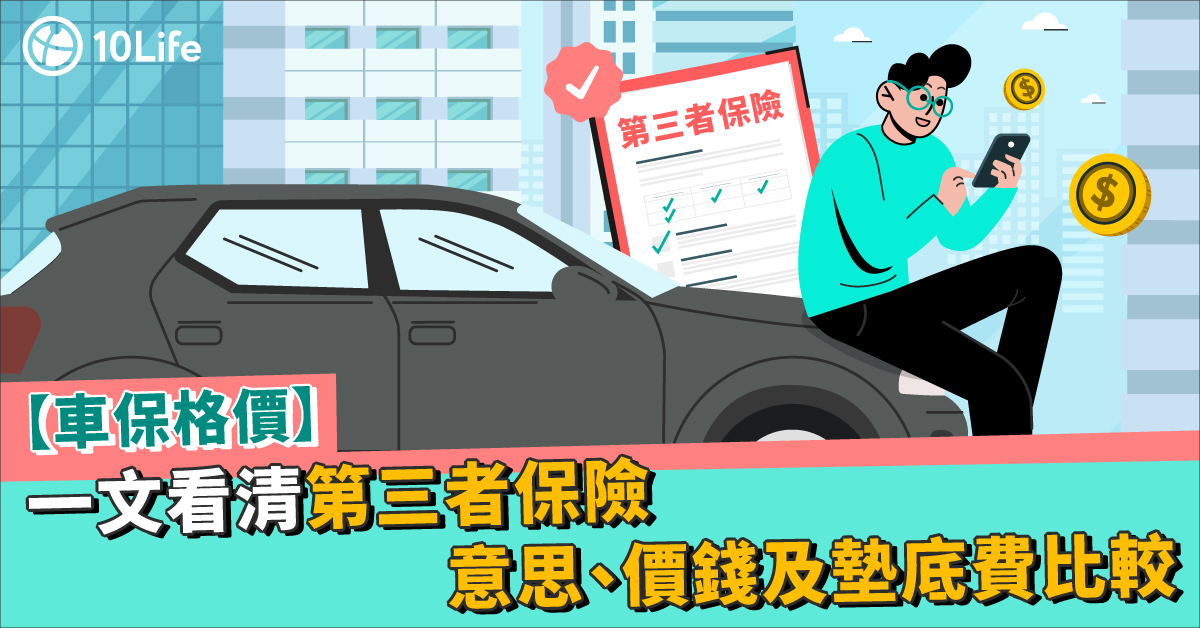
According to Hong Kong law, drivers are required to purchase motor insurance, which generally falls into third-party liability insurance and comprehensive insurance. However, for first-time car owners, motor insurance policy terms can be complicated, and the deductible involved can easily leave people confused. This time, 10Life will use real-life examples to explain the key points of motor insurance, so that everyone can clearly understand the difference between third-party liability insurance and comprehensive insurance, and choose the coverage that best suits their needs with ease.
What is motor insurance? Is it compulsory to buy it?
Motor insurance or vehicle insurance covers the financial losses that may be incurred by vehicle owners and third parties in a traffic accident, including vehicle repair costs, property damage and compensation for bodily injury or death. The scope of cover depends on the policy. Under the Motor Vehicles Insurance (Third Party Risks) Ordinance, anyone using a motor vehicle on a road in Hong Kong must purchase third-party liability insurance (third-party cover) for that vehicle; otherwise, it is unlawful and may attract a maximum penalty of HK$10,000 and imprisonment for 12 months.
What is third-party liability insurance?
Third Party Liability Insurance (abbreviated as “Third Party Cover”) is insurance that all vehicle owners are legally required to purchase when driving a car on the road. Its main purpose is to cover personal injury and property damage suffered by third parties as a result of an accident, such as passengers, pedestrians or other road users. If the vehicle owner does not purchase this insurance, it will be unlawful and they may face fines and imprisonment. However, the compensation under Third Party Cover does not include the driver’s own medical expenses or the repair costs for their own car. Therefore, if an accident occurs, the vehicle owner may have to bear the relevant costs themselves.
Third Party Insurance is tied to the car, not the person. When you lend your car to someone else, the insurance is lent along with it. If a traffic accident occurs, the vehicle owner is responsible for compensation or paying the excess. In addition, if the vehicle owner changes their car, they must notify the insurer, because the old policy may not apply to the new car. The insurer will determine the new premium based on the new car’s model, value and performance, and it may even be necessary to take out a new policy.
What is the difference between third-party liability insurance and comprehensive motor insurance?
The main difference between third-party liability insurance (third-party cover) and comprehensive motor insurance (comprehensive cover) lies in the scope of protection. Third-party cover primarily compensates for injuries to third parties and damage to property caused by an accident, such as pedestrians, passengers or other road users. However, third-party cover does not include the driver’s own injuries or damage to the vehicle. Therefore, if an accident occurs, the vehicle owner must pay for repair and medical expenses themselves. Because the coverage is more limited, third-party cover is usually cheaper.
Comprehensive cover offers broader protection than third-party cover. In addition to the coverage included under third-party cover, it also provides protection for the driver’s medical expenses and damage to the vehicle. Some comprehensive cover plans even include additional benefits such as theft and natural disaster protection. Due to the wider scope of coverage, the premium is usually higher than that of third-party cover. In simple terms, third-party cover protects “others”, while comprehensive cover protects “yourself and others”. Vehicle owners can choose a suitable insurance plan according to their needs.
What factors affect motor insurance premiums?
Motor insurance premiums are affected by a range of factors, including the vehicle model and value, the driver’s background, and the type of policy selected.
In terms of the vehicle model and value, newer, more valuable and higher-performance vehicles generally attract higher premiums. For example, the premium for sports cars or luxury cars is usually more expensive than that for ordinary vehicles, because these cars tend to be costlier to repair and involve greater risk.
Insurers also take into account factors such as the driver’s age, driving experience, occupation, claims history and traffic violation record when determining the premium. In general, younger drivers or those with limited driving experience face higher premiums, while drivers with a history of traffic violations or dangerous driving may have to pay an additional premium loading. In addition, certain occupations, such as construction workers, may also attract higher premiums because they frequently enter construction sites and therefore face a greater risk of accidents.
How do I compare car insurance?
For this analysis, 10Life used a relatively common family car, a 2018 Honda Stepwgn (engine capacity: 1,499 c.c.), as an example. The principal driver to be insured meets the following conditions:
Quotes were then obtained from different online platforms to compare third-party insurance prices in the market.
| Insurer | Premium (including the insurance levy) |
Third-party property excess | |||
| Driven by main driver | Driven by other drivers | ||||
| Drivers under 25 years old |
Driving licence held for less than 2 years |
Unnamed drivers | |||
| 立橋保險 | $944.8 →Insure now← |
$3,000 | $25,000 | $25,000 | $10,000 |
|
$1,575.2 |
$5,000 |
$10,000 |
$10,000 |
$10,000 |
|
| 大新保險 | $1,587.7 →Insure now← |
$10,000 | $10,000 | $10,000 | $10,000 |
| 中銀集團保險 | $1,958.9 →Insure now← |
$7,500 | $7,500 | $7,500 | $7,500 |
| $2,278.7 →Insure now← |
$9,000 |
$25,000 |
$25,000 |
N/A |
|
| $2,194 →Insure now← |
$9,000 |
$25,000 |
$25,000 |
N/A |
|
| The above products are listed by premium (low to high). Last updated on: 8 January 2025. |
|||||
Motor insurance includes a property excess, namely the “third-party insurance excess” that the policyholder has to bear when making a claim. This means that when the principal driver claims for property damage, the basic excess must first be borne; if an accident occurs while the car is lent to another person to drive, an additional property excess may arise depending on the other driver’s age and the length of time they have held a driving licence. For unnamed drivers not declared at the time of purchase, some insurers will also impose an additional charge.
Generally speaking, if the car owner is willing to accept a higher property excess, the premium will be lower, and vice versa. Therefore, when considering different motor insurance policies, car owners should not only compare premiums, but also carefully consider the property excess.
Taking the cheapest premium offered by Well Link Insurance as an example, the third-party property excess arising when driven by the principal driver is similar to that of products from other insurers, but there is a more noticeable difference when comparing the third-party property excess arising when driven by other drivers. When the car is lent to young drivers (i.e. drivers under 25) or inexperienced drivers (i.e. drivers who have held a driving licence for less than two years), the excess can be as high as HK$25,000, the same as Allianz’s plan, which is the highest among all the products. Car owners who may need to lend their car to young or inexperienced drivers should take note.
Furthermore, we also found that the same type of excess varies significantly across different plans. Take the property excess for young drivers and inexperienced drivers as an example: it can be as high as HK$25,000, compared with a low of HK$7,500, a difference of more than three times.
It is worth noting that the property excess can be accumulated, which further highlights the importance of the differences in excess amounts. Suppose a car insured by Well Link Insurance, as mentioned above, is lent to another person who then has a traffic accident, resulting in an actual claim of HK$100,000. If that driver is under 25 years old, has less than two years of driving experience, and is not named on the policy, then in respect of third-party property damage, the insured may have to bear a property excess of up to HK$63,000. Therefore, if a car is often lent to others, or shared by several family members, it is important to pay attention to the excess applicable when another person is driving at the time of purchase.
(Using a quotation from Well Link Insurance as an example)
| Driving driver | Excess | Cumulative excess (HK$) |
| Policyholder (i.e. principal driver) | Basic excess | $3,000 |
| The car is lent to elder sister (aged 30, 10 years’ driving experience) | Basic excess + unnamed driver excess | $13,000 |
| The car is lent to younger brother (aged 20, 1 year’s driving experience) | Basic excess + under-25 driver excess + less-than-2-years driving licence excess + unnamed driver excess | $63,000 |
Finally, not only do motor insurance premiums vary from one insurer to another, but the same motor insurance policy can also differ across online quotation platforms. In addition, where you buy motor insurance will also affect how claims are followed up in the future. If you purchase directly from the insurer, the insured person must contact the insurer directly to handle the claim; if you buy through an online quotation platform, the insurance broker can generally assist with follow-up.
When considering third-party insurance, prospective car owners should not only compare quotes from several providers before taking out a policy, but also pay close attention to the terms and details. For example, some third-party insurance plans may offer a lower premium but come with a much higher excess, while others may include items as optional cover. This helps avoid a situation where a small saving leads to a larger loss if an accident occurs.
Frequently Asked Questions
When purchasing third-party insurance, you need to prepare the following documents:
Yes. Insurance companies have the right to decline applications from certain drivers, mainly based on the following factors:
The no-claims discount (No Claim Discount, or NCD/NCB) is a premium discount offered by insurers to vehicle owners with no claims history. If the owner has not made any insurance claims for several years, the premium will gradually decrease in line with the number of claim-free years, up to a certain maximum discount.
Note: This article was last updated on 4 March 2025.
This English version of this article has been generated by machine translation powered by AI. It is provided solely for reference purposes. In the event of any discrepancy or inconsistency between this translation and the original Chinese version, the Chinese version shall prevail.
Our team of professional content researchers focussing on insurance
Our team of professional content researchers focussing on insurance
10Life Product Comparison and 10Life Insurance Ratings are developed by 10Life Financial Limited, an authorised insurance broker company licensed with the Insurance Authority under License Number FB1526. 10Life Product Comparison and 10Life Insurance Ratings are developed for generic customer segments using mathematical calculations based on product information, facts and data, and are not influenced by any partnerships with or fees received from insurance companies. Any information on 10Life Platform ("10Life Information"), including but not limited to Product Comparison, Product Ratings, Blog Articles are intended for general education purpose and reference only. None of the 10Life Information is intended, nor should they be considered or relied upon, as regulated advice, insurance, financial, investment or professional advice, recommendation, approval, endorsement, invitation or solicitation in respect of any insurance, financial or investment products. 10Life Information does not take into account your individual needs. Reading 10Life Information should not be considered as conducting a suitability assessment, and is not sufficient to form the basis of any decisions to purchase any insurance products. You should rely on information authorised by insurance companies, carry out your own research and/or seek independent advice from licensed intermediaries before purchasing any insurance products or making any insurance decisions. While reasonable effort is used when collecting, validating and updating 10Life Information from various channels, none of 10Life Group and its subsidiaries, affiliates, agents, directors, officers and employees will be responsible for any liability, claim or loss arising from or associated with you using 10Life Information. No warranty, representation or guarantee is given by 10Life Group and its subsidiaries on the accuracy, completeness and timeliness of the information. If you have any questions on 10Life Product Comparison and 10Life Insurance Ratings, please email us at enquiries@10life.com




 Talk to 10Life on WeChat
