









10Life Financial Limited
Enquiries: enquiries@10life.com
Hotline: (852) 3705 1599
Address: 16/F Greatmany Centre, 109-115 Queen’s Road East, Wan Chai, Hong Kong


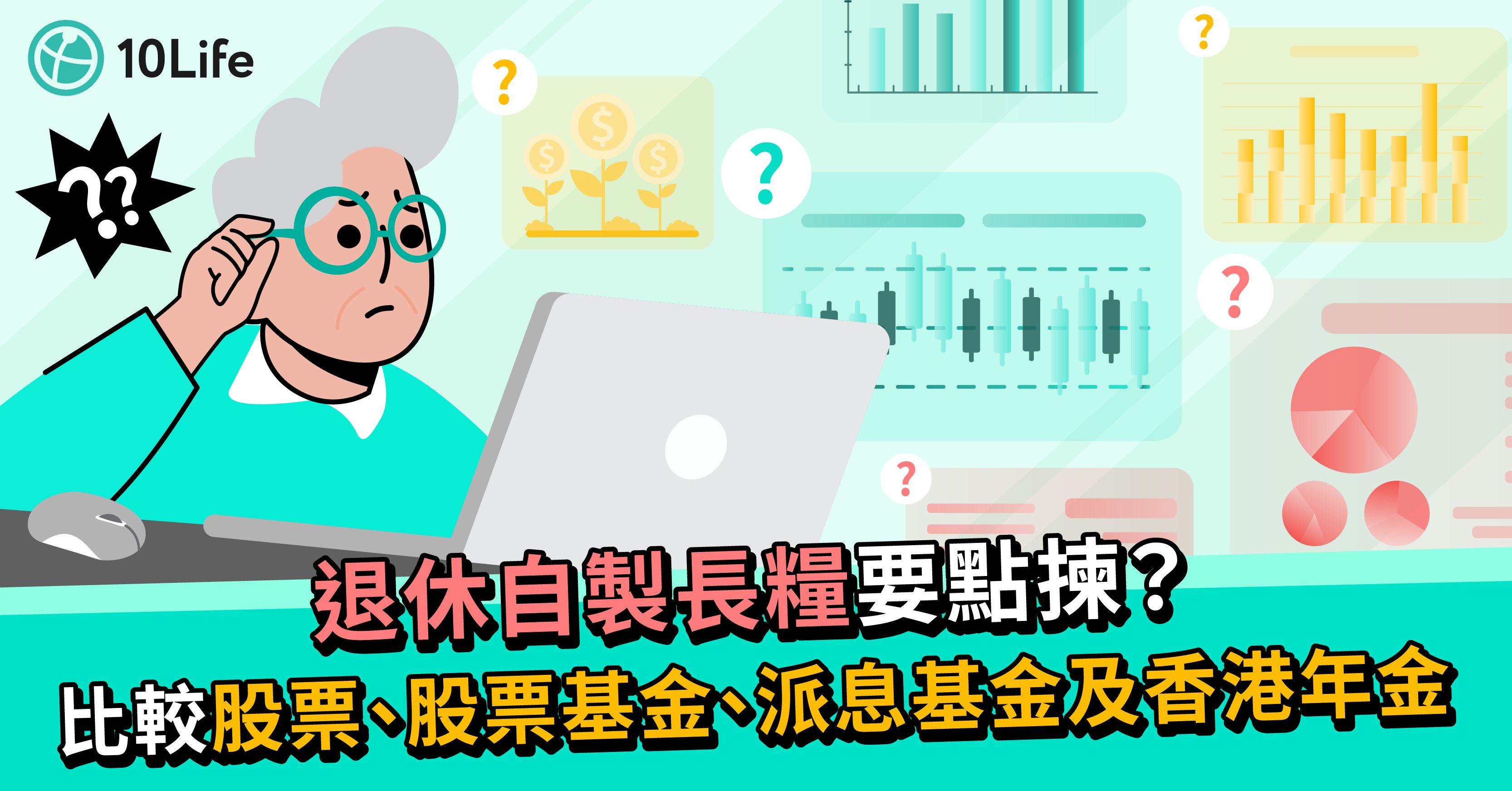
After working hard for most of their lives, many people hope to enjoy their retirement. However, relying solely on their retirement savings or MPF may not be sufficient to cover their everyday living expenses after retirement. “How can I create a steady stream of income after retirement?” is a major concern for retirees. The Hong Kong stock market has been sluggish in recent years, and retirees who have traditionally relied on dividends from blue-chip stocks to create a steady stream of income may find that their plans do not work out as intended. At this point, they may need to consider other financial products. 10Life compares stocks (HSBC), equity funds, income funds and the government-supported HKMC Annuity. By understanding the pros and cons of these different products, retirees can create a steady stream of income and enjoy their retirement with peace of mind.
10Life assumes that retirees invest HK$1 million of their savings in common retirement planning tools, such as blue-chip stocks (HSBC), the Tracker Fund of Hong Kong, which tracks the Hang Seng Index, Allianz Income and Growth Fund and HKMC Annuity, and compares their annual dividend payouts based on their performance over the past six years (November 2018 to November 2024).
The investor assumes an investment principal of HK$1 million, with the insured person under the HKMC Annuity being a 65-year-old man
| Financial instrument | Shares | Equity fund | Dividend-paying fund | Immediate annuity |
| HSBC | Tracker Fund of Hong Kong | Manulife智富Allianz收益及增長基金 | HKMC Annuity Plan (policyholder surrender) | |
| Date | Dividend income (per annum) | Annuity income (per annum) | ||
| 2018/11/15 | Purchase | Purchase | Purchase | Purchase |
| 2018/11/16- 2019/11/15 | 60,704 | 35,701 | 87,630 | 69,600 |
| 2019/11/16- 2020/11/15 | / | 28,791 | 82,499 | 69,600 |
| 2020/11/16- 2021/11/15 | 25,994 | 25,720 | 81,488 | 69,600 |
| 2021/11/16- 2022/11/15 | 32,189 | 24,568 | 80,713 | 69,600 |
| 2022/11/16- 2023/11/15 | 63,131 | 24,952 | 74,600 | 69,600 |
| 2023/11/16- 2024/11/15 | 97,335 | 29,559 | 65,061 | 69,600 |
| Future (per annum) | May rise or fall | May rise or fall | May rise or fall | 69,600 |
| Date | Net asset value | Policy value | ||
| 2018/11/15 | 1,000,000 | / | ||
| 2024/11/15 | 1,059,270 | 753,935 | 883,012 | 489,820 |
| Comparison of total returns of each asset | ||||
| Total return | +338,623 | -76,775 | +355,004 | / |
| Total return (%) | +34% | -8% | +36% | / |
| Note: 1. Total return = increase in net asset value (if any) + dividend income between 2018/11/15 and 2024/11/15 2. HSBC suspended dividend payments temporarily in 2020 Information updated to 15 November 2024 | ||||
In terms of dividend income from stocks, HSBC’s annual dividend payments ranged from HK$25,994 to HK$97,335 over the past six years. However, the stock suspended dividend payments in 2020, reminding investors that HSBC does not necessarily pay dividends to shareholders every year. As for equity funds, the Tracker Fund’s annual dividend payments ranged from HK$24,568 to HK$35,701. The Hang Seng Index has been weak over the past two years, and dividend payments have consequently been less favourable.
The Allianz Income and Growth Fund had the highest average annual dividend payments. Based on November 2019, it paid HK$87,630 over one year, while its dividend payment in 2024 was still HK$65,061. However, investors should note that its annual dividend payments have declined year-on-year over the past five years. Its future dividend trend is therefore worth monitoring. (Note: The income from the Allianz Income and Growth Fund mentioned in this article assumes that the investor purchased the fund through the fund market, rather than purchasing it through an investment-linked insurance policy.)
As for the government-backed HKMC Annuity, it pays annuity income monthly. Assuming a 65-year-old man takes out a policy, the total annual annuity income would be HK$69,600. As all payments from HKMC Annuity are guaranteed, the annuity will continue to pay as usual even if market conditions deteriorate further. However, readers should note that income from HKMC Annuity varies according to the policyholder’s age at application, gender and amount insured. For details, please visit the HKMC Annuity website.
As for stocks, equity funds and income funds, their annual income is based on the net asset value (NAV) and distribution rate, both of which are affected by market fluctuations and the policies of the issuing companies. Therefore, their distribution amounts fluctuate. Many retirees hope that stocks and funds can generate both capital gains and income; however, this certainly tests one’s long-term investment judgement.
As for funds, each fund has a different distribution strategy. Some reinvest their earnings or distribute them as income, while some funds may pay distributions from capital. This may cause the net asset value per unit to fall immediately and reduce the fund capital available for future investment. Among income funds, Allianz income and growth fund is a prominent example of the latter; in simple terms, it can “return capital”.
Speaking of returning capital, many people believe that HKMC Annuity also returns capital. How does it differ from an income fund? Undoubtedly, as the policyholder of HKMC Annuity receives annuity income, the cash value of the policy will gradually decrease. So, apart from consuming their own capital, what else does the policyholder receive? This relates to the purpose of HKMC Annuity: hedging longevity risk. Consider this: a 65-year-old man who takes out HKMC Annuity with a premium of HK$1 million will, according to the contract, have received the entire principal after approximately 14 years. However, HKMC Annuity provides lifelong protection, meaning that even if the policyholder lives to 120, they can still receive a stable annual annuity income of HK$69,600. As for stocks, equity funds and income funds, we cannot calculate their long-term share prices or net asset values, so the future income of their holders remains uncertain.
When considering retirement planning, it is also important to assess the liquidity of each financial instrument. For HKMC Annuity, if the insured surrenders the policy early before reaching the break-even point, or withdraws part of the cash, the insured may incur a loss unless the latter relates to medical and dental expenses (the amount withdrawn/retrieved is less than the premiums paid minus the annuity payments received). As for stocks, equity funds and income funds, their liquidity is relatively high, but whether the selling price is high or low depends on the prevailing market conditions and the net asset value of the relevant assets.
| Financial tools | Stocks | Equity funds | Dividend-paying funds | Immediate annuity |
| Assets | HSBC | 盈富基金 | Manulife智富Allianz收益及增長基金 | HKMC Annuity |
| Income volatility | High | High | Medium | Low |
| Potential for asset appreciation | Yes | Yes | Yes | No |
| Guaranteed lifetime income | No | No | No | Yes |
| Note: Data updated to 15 November 2024 | ||||
In summary, the above financial tools each serve a different purpose. HKMC Annuity’s key advantage is that it provides a stable income for life, but the funds are not highly liquid and cannot appreciate in value. In contrast, the dividends and net asset values of stocks, equity funds and income funds are more volatile and can rise or fall, but they cannot hedge against longevity risk. How should you choose when planning your retirement finances?
Retirees should first consider the level of risk they can tolerate, distinguish between the functions of different financial tools, and formulate a balanced investment portfolio rather than putting all their eggs in one basket. HKMC Annuity provides stable payouts unaffected by market conditions and involves relatively low risk, making it worthy of consideration by retirees. However, when market conditions are favourable and faced with inflationary pressure, you may be reluctant to rely solely on the fixed income from HKMC Annuity. Therefore, you may consider adding other investment tools to your retirement portfolio according to your risk tolerance, but be mindful of the potential risks.
Compare immediate annuities: mainly for retirees or those approaching retirement
Compare qualifying deferred annuities (tax-deductible savings): mainly for working people
Compare qualifying deferred annuities (tax-deductible retirement): mainly for working people
Note: This article was last updated on 15 November 2024.

This English version of this article has been generated by machine translation powered by AI. It is provided solely for reference purposes. In the event of any discrepancy or inconsistency between this translation and the original Chinese version, the Chinese version shall prevail.
Our team of professional content researchers focussing on insurance
Our team of professional content researchers focussing on insurance
10Life Product Comparison and 10Life Insurance Ratings are developed by 10Life Financial Limited, an authorised insurance broker company licensed with the Insurance Authority under License Number FB1526. 10Life Product Comparison and 10Life Insurance Ratings are developed for generic customer segments using mathematical calculations based on product information, facts and data, and are not influenced by any partnerships with or fees received from insurance companies. Any information on 10Life Platform ("10Life Information"), including but not limited to Product Comparison, Product Ratings, Blog Articles are intended for general education purpose and reference only. None of the 10Life Information is intended, nor should they be considered or relied upon, as regulated advice, insurance, financial, investment or professional advice, recommendation, approval, endorsement, invitation or solicitation in respect of any insurance, financial or investment products. 10Life Information does not take into account your individual needs. Reading 10Life Information should not be considered as conducting a suitability assessment, and is not sufficient to form the basis of any decisions to purchase any insurance products. You should rely on information authorised by insurance companies, carry out your own research and/or seek independent advice from licensed intermediaries before purchasing any insurance products or making any insurance decisions. While reasonable effort is used when collecting, validating and updating 10Life Information from various channels, none of 10Life Group and its subsidiaries, affiliates, agents, directors, officers and employees will be responsible for any liability, claim or loss arising from or associated with you using 10Life Information. No warranty, representation or guarantee is given by 10Life Group and its subsidiaries on the accuracy, completeness and timeliness of the information. If you have any questions on 10Life Product Comparison and 10Life Insurance Ratings, please email us at enquiries@10life.com




 Talk to 10Life on WeChat
