





10Life Financial Limited
Enquiries: enquiries@10life.com
Hotline: (852) 3705 1599
Address: 16/F Greatmany Centre, 109-115 Queen’s Road East, Wan Chai, Hong Kong



Many consumers rushed to take out qualifying deferred annuity policies (QDAPs) before the tax season in order to enjoy tax benefits. After the tax season, people may no longer be as eager to purchase annuities. However, in view of the COVID-19 pandemic, Hong Kong people have been strictly observing social-distancing measures, causing insurance sales to suffer a significant blow. QDAPs are one of the few products exempt from financial needs analysis and allow insurance intermediaries to complete sales without meeting clients in person. As a result, tax-deductible annuities remain a key focus of insurers’ sales this quarter. A policy is only recognised as a qualifying deferred annuity policy if it meets the requirements of the Insurance Authority. However, even if a QDAP is certified by the Authority, this does not necessarily mean that it offers high returns or is suitable for you. When comparing products, you still need to remain vigilant to avoid falling into the traps of deferred annuities.
QDAPs must comply with the Insurance Authority’s guidelines (see Note 1) for their premiums to be tax-deductible. These guidelines ensure that the products are deferred annuities, enabling policyholders to save money and receive annuity income for at least 10 years after the age of 50. In terms of disclosure, unlike ordinary whole-of-life savings insurance, which generally does not disclose the internal rate of return and instead focuses on the expected total return, QDAPs are required to disclose the internal rate of return (IRR):
The purpose of the above guidelines is to disclose the returns of QDAPs, making it easier for customers to assess them. However, from a consumer’s perspective, a careful review of the product brochures of major insurers reveals that comparing QDAPs remains extremely difficult, with pitfalls everywhere…
Blind spot 1: Insurers use different formats — no standardised format for qualifying deferred annuity policies
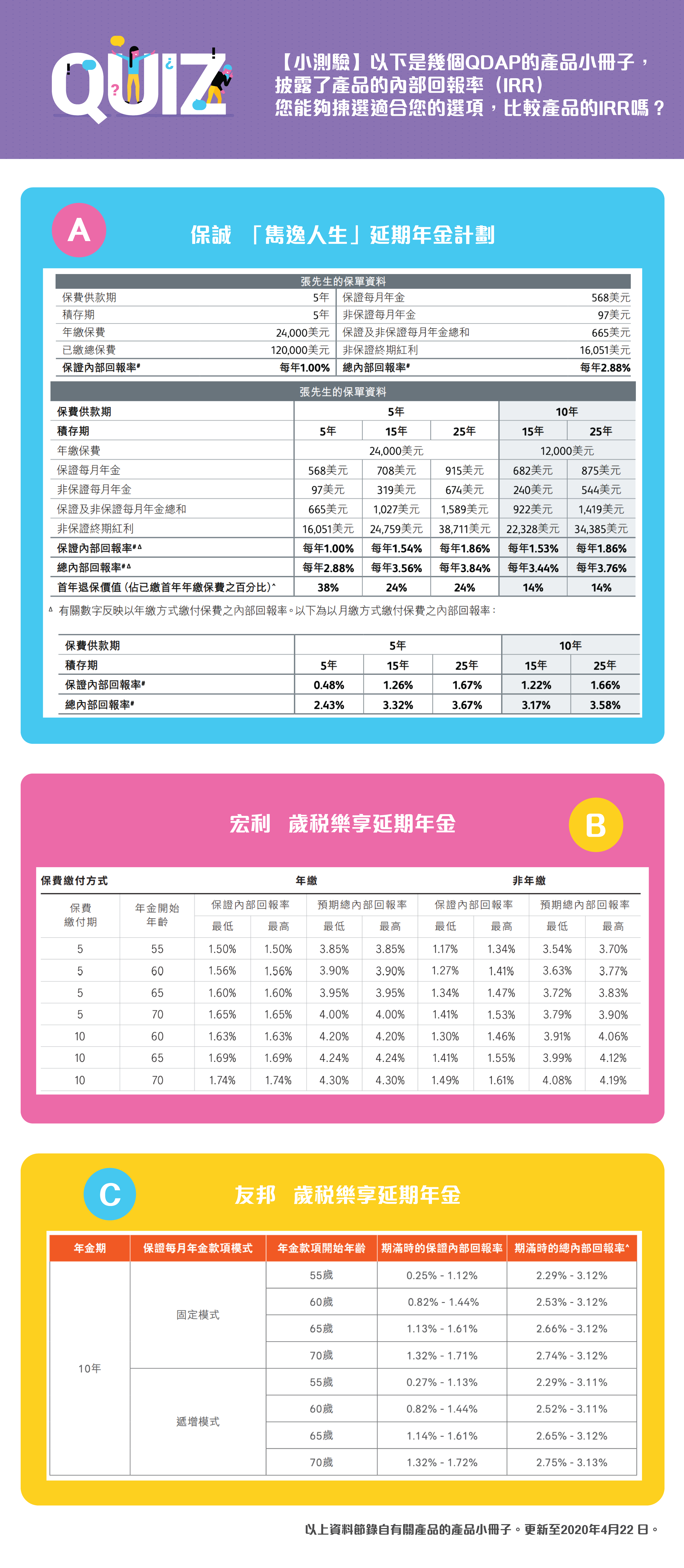
Although the Insurance Authority requires insurers to disclose the IRR at policy maturity of a QDAP based on the example of a 45-year-old non-smoking man, it has not prescribed a standard format or terminology. Insurers therefore present the IRRs of different options in their own ways.
Blind spot 2: Falling into the IRR myth — is a high IRR a guaranteed win?
IRR is an important indicator of the returns of a deferred annuity. Many consumers believe that they only need to select the option with the highest IRR shown in the product brochure. But is there really no problem with simply choosing the highest figure? Referring to the chart above, let us look at the highest (max) and lowest (min) IRRs among the guaranteed IRR ranges of the respective products:
The highest and lowest guaranteed IRRs disclosed in the product brochures of the following products
Assume that the policyholder is a 45-year-old non-smoking male. The policy currency is US dollars.
| Qualifying deferred annuity policy | PRURetirement Deferred Annuity Plan | Manulife – ManuLeisure | AIA – ManuLeisure |
| Highest (Max) guaranteed IRR | 1.86% | 1.74% | 1.72% |
| Lowest (Min) guaranteed IRR | 0.48% | 1.17% | 0.25% |
| Highest guaranteed IRR and its cash flow | |||
| Highest (Max) guaranteed IRR | 1.86% | 1.74% | 1.72% |
| Premium payment mode | Annual | Annual | Not specified in the table |
| Premium payment period (years) | 5 | 10 | 5 |
| Age at commencement of annuity payments | 70 | 70 | 70 |
| Income period (years) | 20 | 15 | 10 |
| Income mode | Fixed | Fixed | Increasing |
| Total policy term (years) | 45 | 40 | 35 |
| Lowest guaranteed IRR and its cash flow | |||
| Lowest (Min) guaranteed IRR | 0.48% | 1.17% | 0.25% |
| Premium payment mode | Monthly | Non-annual | Not specified in the table |
| Premium payment period (years) | 5 | 5 | 5 |
| Age at commencement of annuity payments | 50 | 55 | 55 |
| Income period (years) | 20 | 30 | 10 |
| Income mode | Fixed | Fixed | Fixed |
| Total policy term | 25 | 40 | 20 |
The above information is extracted from the product brochures of the relevant products. Updated on 22 April 2020.
Among the highest (Max) guaranteed IRRs of the above QDAPs, Prudential’s 1.86% ranks first, followed by Manulife’s 1.74% and AIA’s 1.72%. At first glance, Prudential’s 1.86% is the highest of the three. Its premium payment period is five years, annuity payments begin at age 70 and continue for 20 years, and its total policy term is 45 years, giving it the longest accumulation period.
Looking at the lowest (Min) guaranteed IRRs, AIA’s 0.25% is the lowest of the three. However, the premium payment period for this product is five years, annuity payments begin at age 55 and continue for 10 years, and the total policy term is only 20 years — shorter than Prudential’s 25 years and Manulife’s 40 years.
Some people believe that selecting the highest IRR guarantees a win. The biggest misconception is that these figures actually represent different cash flows for each product, including different payment amounts, accumulation periods and income periods. Do these cash flows suit your needs? For example, among the products above, Manulife’s income period necessarily ends when the policyholder reaches age 85, while AIA’s payments must stop after 10 years.
Generally speaking, when comparing options within the same product, an option with a shorter payment period or annual payments, a longer accumulation period, or a later income commencement date tends to have a higher IRR. However, a high IRR does not mean that the option is suitable for you. Going back to basics, consumers should choose the cash flow that best suits their needs.
Three steps for QDAP policyholders to protect themselves
Many deferred annuity products on the market are highly complex and offer multiple options, such as payment periods, income periods (fixed or increasing) and payment modes (annual, monthly, quarterly, etc.). How can policyholders protect themselves and identify the blind spots of QDAPs?
This article focuses only on common blind spots concerning QDAPs, and the examples are for illustrative purposes only. To compare more products, visit 10Life’s Product Decoder. We attempt to compare QDAPs with the cash flows that most closely match the purposes of savings and retirement respectively.
[Compare qualifying deferred annuity policies for savings purposes]
[Compare qualifying deferred annuity policies for retirement purposes]
Notes:
This English version of this article has been generated by machine translation powered by AI. It is provided solely for reference purposes. In the event of any discrepancy or inconsistency between this translation and the original Chinese version, the Chinese version shall prevail.

Our team of professional content researchers focussing on insurance
Our team of professional content researchers focussing on insurance
10Life Product Comparison and 10Life Insurance Ratings are developed by 10Life Financial Limited, an authorised insurance broker company licensed with the Insurance Authority under License Number FB1526. 10Life Product Comparison and 10Life Insurance Ratings are developed for generic customer segments using mathematical calculations based on product information, facts and data, and are not influenced by any partnerships with or fees received from insurance companies. Any information on 10Life Platform ("10Life Information"), including but not limited to Product Comparison, Product Ratings, Blog Articles are intended for general education purpose and reference only. None of the 10Life Information is intended, nor should they be considered or relied upon, as regulated advice, insurance, financial, investment or professional advice, recommendation, approval, endorsement, invitation or solicitation in respect of any insurance, financial or investment products. 10Life Information does not take into account your individual needs. Reading 10Life Information should not be considered as conducting a suitability assessment, and is not sufficient to form the basis of any decisions to purchase any insurance products. You should rely on information authorised by insurance companies, carry out your own research and/or seek independent advice from licensed intermediaries before purchasing any insurance products or making any insurance decisions. While reasonable effort is used when collecting, validating and updating 10Life Information from various channels, none of 10Life Group and its subsidiaries, affiliates, agents, directors, officers and employees will be responsible for any liability, claim or loss arising from or associated with you using 10Life Information. No warranty, representation or guarantee is given by 10Life Group and its subsidiaries on the accuracy, completeness and timeliness of the information. If you have any questions on 10Life Product Comparison and 10Life Insurance Ratings, please email us at enquiries@10life.com




 Talk to 10Life on WeChat