









10Life Financial Limited
Enquiries: enquiries@10life.com
Hotline: (852) 3705 1599
Address: 16/F Greatmany Centre, 109-115 Queen’s Road East, Wan Chai, Hong Kong



What is the definition of critical illness insurance? Why do you need to buy critical illness insurance?
Is critical illness insurance useful?
What does critical illness insurance cover?
What is the difference between critical illness insurance and medical insurance?
Who needs critical illness insurance?
Things to note before buying critical illness insurance
Which insurer is good for critical illness insurance?


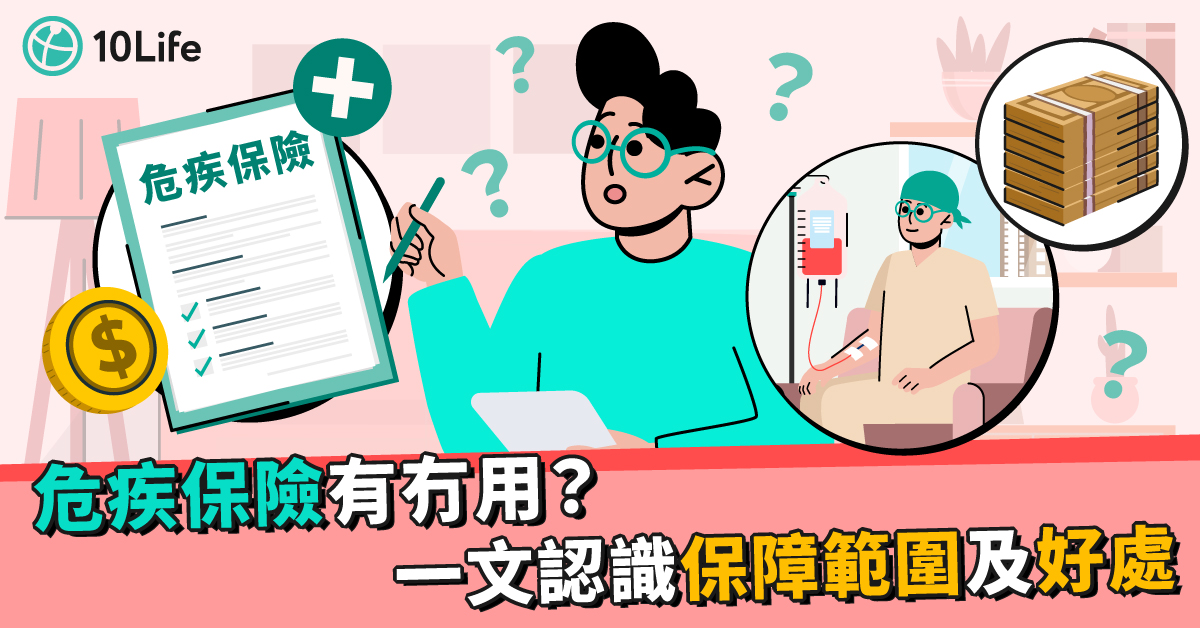
Many people understand the importance of medical insurance, but even if you already have it, do you still need to purchase additional critical illness insurance? What exactly does critical illness insurance cover? Why buy it? In fact, critical illness insurance and medical insurance do not serve the same functions, and critical illness insurance can protect against risks that medical insurance does not cover. In this article, 10Life will explain in detail the definition and scope of coverage of critical illness insurance, as well as how it differs from medical insurance, to help everyone understand their true needs.
What is the definition of critical illness insurance? Why do you need to buy critical illness insurance?
Critical illness insurance is a type of insurance product specifically aimed at major illnesses; its purpose is to provide financial support to the insured during the period of illness, easing the financial burden on them and their family.
When the insured is diagnosed with a serious disease covered by the plan, the insurer will provide a lump-sum cash benefit. The insured can use this money flexibly—for example, to pay medical expenses, cover living costs, or make up for lost income resulting from being unable to work during illness and treatment.
Critical illness insurance can be divided into term critical illness insurance and whole-life critical illness insurance:
Term critical illness insurance, also called "pure" critical illness insurance or "consumption-type" critical illness insurance, does not include any savings component. The coverage period can be 1 year, 5 years, 10 years, or 20 years, depending on the insurer. Most term plans only provide a one-time payout, and the policy will terminate once a claim has been paid. However, in recent years some insurers have started offering term plans that allow multiple claims or even unlimited claims.
Whole-life critical illness insurance, also known as "savings-type" critical illness insurance, not only provides critical illness coverage but also includes a savings function, such as cash value and surrender value. Premiums are generally higher; the insured only needs to pay premiums for a specified period for the policy to provide lifelong coverage. Some plans go further by offering multiple or even unlimited critical illness payouts, providing more comprehensive protection.
Item | Whole Life Critical Illness Insurance | Term Critical Illness Insurance |
| Premiums | Higher, with savings feature | Lower, pure protection |
| Premium Payment Period | Fixed payment term; premiums do not increase with age | Renewable annually; premiums generally increase with age |
| Coverage Period | Usually for life or up to age 100 | Typically 1, 5, 10, or 15 years |
| Cash Value | Yes | No |
| Policy Features | Has savings component; lifetime coverage | Pure critical illness protection |
| Surrender Value | May receive cash value upon surrender | Generally no surrender value |
Is critical illness insurance useful?
Many people think that having medical insurance is enough to cover all expenses when they fall ill. But in fact, when facing serious illnesses such as cancer, stroke, or heart disease, relying on medical insurance alone may not be sufficient. These illnesses not only require long-term treatment, but patients are also more likely to be too weak to work normally and lose income. Together with hospital stays, surgeries, rehabilitation therapy, and even the cost of hiring caregivers to assist with daily care, these expenses can greatly increase financial pressure on the family.
Even if medical insurance can reimburse part of the treatment costs, the additional living expenses and the loss of income are often the hardest parts to bear. At this time, critical illness insurance can play a crucial role. Critical illness insurance can provide an immediate lump-sum cash payout, allowing the insured to use it flexibly and not have to worry about the impact of interrupted income. It is not only protection for the patient but also support for the family, helping them maintain basic living standards during difficult times and focus on treatment and recovery.
What does critical illness insurance cover?
Critical illness insurance typically covers common serious diseases, such as cancer, stroke, heart disease, kidney failure, major organ transplants, and major conditions like multiple sclerosis. Some plans also include early-stage critical illnesses or carcinoma in situ. However, different policies define critical illness differently, so you should understand the relevant details when buying a policy.
Regarding the payout method, critical illness insurance is usually a lump-sum cash payout, mainly divided into "single payout" and "multiple payout" types. "Single payout" means that once the insured is diagnosed with a critical illness and receives a payment, the policy will terminate; "multiple payout" allows for further claims if the illness recurs or the insured develops another covered disease, with the number of payouts and maximum amounts depending on the policy terms.
As for choosing the sum insured, it is generally recommended to use two to three times your annual income as a reference, ensuring you have sufficient funds to cover medical expenses and daily living costs during illness. On the market, critical illness cover amounts typically range from hundreds of thousands to several millions, and applicants can choose according to their personal financial situation and protection needs.
What is the difference between critical illness insurance and medical insurance?
Medical insurance and critical illness insurance serve very different purposes. Medical insurance is a reimbursement-type policy, mainly used to cover reasonable medical expenses actually incurred for hospitalization, tests, surgeries, and the like, helping the insured reduce the financial burden of treatment.
Critical illness insurance, on the other hand, targets specified serious illnesses such as cancer, stroke, or heart disease. Once diagnosed, a lump-sum cash benefit is paid. This amount is unrestricted in use — it can cover medical bills, support living expenses, and help cope with financial pressure from work stoppage or lost income, allowing patients to pursue treatment with greater peace of mind.
Although premiums for both tend to rise with age, their coverage and functions differ. In short, medical insurance is used to pay medical costs, while critical illness insurance provides flexible financial support; they do not replace each other but are complementary.
Who needs critical illness insurance?
In fact, anyone can develop a serious illness, so regardless of age or background, it’s worth considering critical illness insurance. For a family’s breadwinner, if they become ill and cannot work, an interruption in income will affect family life; for mortgage payers, losing their income may mean they cannot pay the mortgage; as for retirees, because they have no fixed income, falling ill may mean having to dip into savings. But with critical illness insurance, you can receive a lump-sum payment to help cover everyday expenses.
As for young people, don’t assume that being healthy means you don’t need coverage — critical illnesses have been trending younger in recent years. According to government data, new cancer cases among 20- to 44-year-olds rose by 14% between 2010 and 2019, so the risk is still present. In addition, premiums are lower and it’s easier to get accepted when you insure at a younger age, so the earlier you prepare, the more comprehensive your protection will be.
Things to note before buying critical illness insurance
Each critical illness insurance policy covers different types of illnesses, definitions, and benefits. The most common critical illnesses include cancer, stroke, and heart disease, but some policies cover more conditions or include protection for early-stage illnesses (such as carcinoma in situ, early heart disease) and specific procedures (such as angioplasty).
Some plans also offer multiple-claim features. However, note that each policy has different disease definitions and diagnostic criteria, and there may be restrictions on claiming again for the "same organ." You should read the terms carefully before buying to understand the covered illnesses, claim conditions, and exclusions.
Also, more covered illnesses are not necessarily better — it is more important to choose a product that covers conditions relevant to your actual needs. At the same time, pay attention to the coverage amount, which is often more crucial than the number of illnesses, because after understanding the coverage, whether you can receive sufficient compensation is the key.
Everyone's required sum insured for critical illness insurance differs, but the key is to ensure you can maintain basic living expenses if your income is interrupted while ill. It's generally recommended to start with 2 to 3 times your annual salary, then adjust according to your actual expenses, mortgage obligations, and family responsibilities. For example, if you are the family's main breadwinner, have a mortgage, or need to care for children, you should consider a higher sum insured to cope with potential financial pressure.
Term critical illness insurance has a shorter coverage period, usually 1 to 20 years, and is suitable for those with limited budgets or who only need short-term protection. Whole-life critical illness insurance provides longer-term coverage; some plans even cover you for life or up to age 100, and most include a savings component, making them suitable for those who want both protection and financial planning.
Most critical illness policies have a waiting period (for example 60 or 90 days), during which claims won't be paid even if diagnosed. Additionally, some policies have a survival period clause, meaning you must survive for a specified number of days after diagnosis (usually between 14 and 30 days) to receive benefits. If you die within the survival period, you may not be eligible for the critical illness payout. These clauses affect actual protection, so pay special attention before purchasing.
Some critical illness plans offer "multiple claims," but they come with restrictions — for example, each claim may need to be separated by a certain interval (such as a year or more), or subsequent claims may only cover different diseases or different organs. Some policies also cap the amount per claim (for example only paying 25% or 30% of the original benefit), so even if called "multiple payouts" the actual coverage is limited. Make sure to check the related details.
Critical illness insurance can be divided into term critical illness insurance, which is pure protection, and whole-life critical illness insurance, which includes a savings element. Whole-life critical illness insurance usually has a cash value, allowing you to withdraw part of the amount if you surrender the policy, but premiums are correspondingly higher. If you only need basic protection, consider term critical illness insurance with lower premiums and no savings function. Choose the product that suits your needs.
Which insurer is good for critical illness insurance?
There are many critical illness insurance options on the market—how should you choose? As Hong Kong’s insurance comparison platform, 10Life has introduced an actuary-designed rating system to compare different insurance products fairly, allowing consumers to choose the policy that best suits them. Check 10Life’s whole-life critical illness insurance and term critical illness insurance comparisons now to learn more.
Further reading:
What is the waiting period for critical illness insurance? Important points to note when buying critical illness insurance
[Senior medical insurance] Can a 60-year-old be insured? What should be noted when applying?
[Critical Illness Insurance Comparison 2025] Which whole-life critical illness plan is best? 5-star insurance key revealed
References:
1. Insurance Authority. Role of critical illness insurance
2. Investor and Financial Education Council. Critical illness insurance
Last updated: 11 June 2025

This English version of this article has been generated by machine translation powered by AI. It is provided solely for reference purposes. In the event of any discrepancy or inconsistency between this translation and the original Chinese version, the Chinese version shall prevail.
Our team of professional content researchers focussing on insurance
Our team of professional content researchers focussing on insurance
10Life Product Comparison and 10Life Insurance Ratings are developed by 10Life Financial Limited, an authorised insurance broker company licensed with the Insurance Authority under License Number FB1526. 10Life Product Comparison and 10Life Insurance Ratings are developed for generic customer segments using mathematical calculations based on product information, facts and data, and are not influenced by any partnerships with or fees received from insurance companies. Any information on 10Life Platform ("10Life Information"), including but not limited to Product Comparison, Product Ratings, Blog Articles are intended for general education purpose and reference only. None of the 10Life Information is intended, nor should they be considered or relied upon, as regulated advice, insurance, financial, investment or professional advice, recommendation, approval, endorsement, invitation or solicitation in respect of any insurance, financial or investment products. 10Life Information does not take into account your individual needs. Reading 10Life Information should not be considered as conducting a suitability assessment, and is not sufficient to form the basis of any decisions to purchase any insurance products. You should rely on information authorised by insurance companies, carry out your own research and/or seek independent advice from licensed intermediaries before purchasing any insurance products or making any insurance decisions. While reasonable effort is used when collecting, validating and updating 10Life Information from various channels, none of 10Life Group and its subsidiaries, affiliates, agents, directors, officers and employees will be responsible for any liability, claim or loss arising from or associated with you using 10Life Information. No warranty, representation or guarantee is given by 10Life Group and its subsidiaries on the accuracy, completeness and timeliness of the information. If you have any questions on 10Life Product Comparison and 10Life Insurance Ratings, please email us at enquiries@10life.com




 Talk to 10Life on WeChat
