









10Life Financial Limited
Enquiries: enquiries@10life.com
Hotline: (852) 3705 1599
Address: 16/F Greatmany Centre, 109-115 Queen’s Road East, Wan Chai, Hong Kong


Opening an Account for Children: The First Step in Financial Education
What documents are required for a child to open an account? Overview of the account opening procedures
At what age can you open a bank account for a child? Age requirements at a glance
Children’s Savings Account Interest Rate Comparison 2026: The Limitations of Bank Savings
Is it better to put lucky money into a bank account or buy insurance? What are the advantages of savings insurance?
Want to know which savings plan is most suitable for your child?
Summary
Frequently Asked Questions


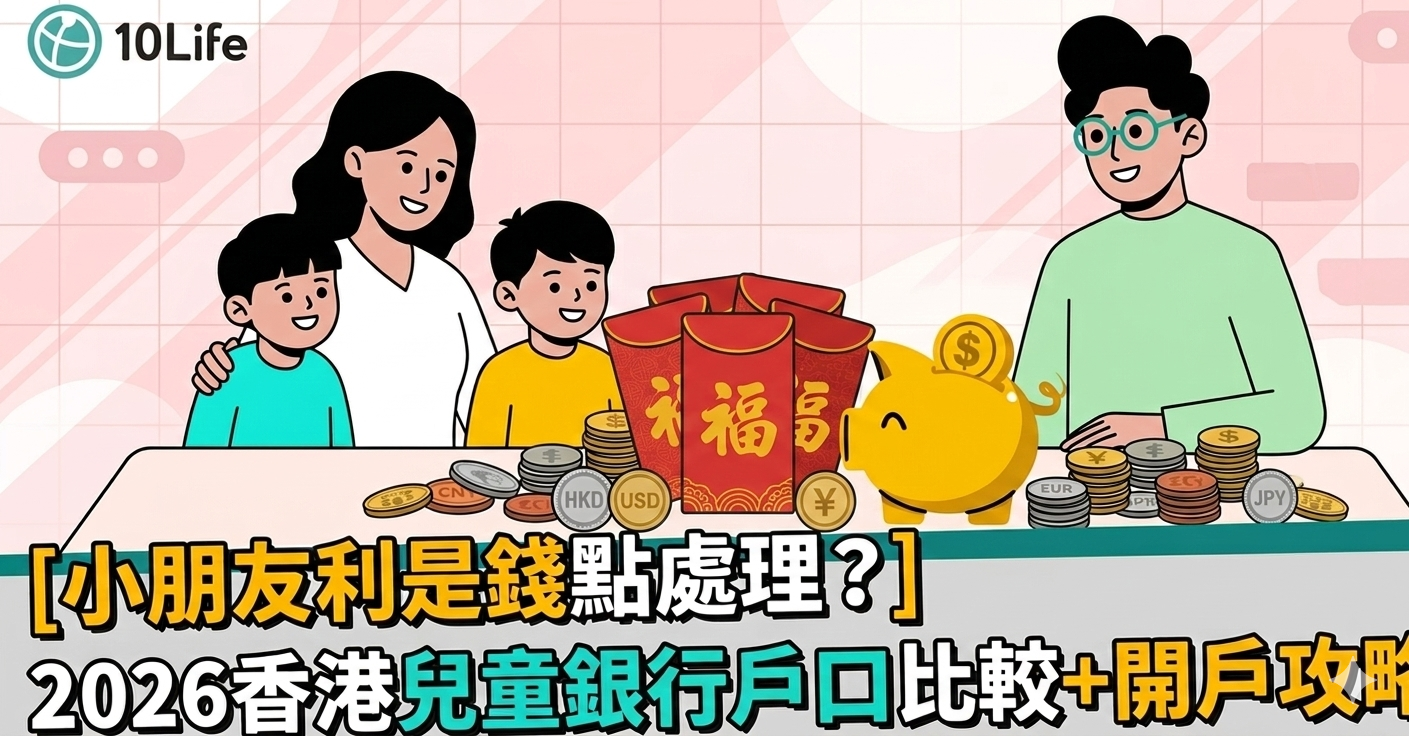
It is that time of year again to open red packets, and children may receive several thousand dollars in lai see money each year. Faced with this New Year income, many parents’ first reaction is to open a bank account for their children to safely put away the lai see money. However, there are many children’s accounts available on the market, with differing application requirements. Is it really worth opening one? Which children’s account is the best? Aside from bank savings, are there better ways to manage money? This time, we will analyse them one by one.
Opening an Account for Children: The First Step in Financial Education
Most major banks in Hong Kong offer children’s bank accounts, which parents can open jointly in the capacity of guardians. The account-opening threshold for children is low, and most accounts either charge no monthly fee or require only a very low minimum balance. For children who are developing money management skills, having a children’s bank account of their own can help build the following financial awareness:
From the perspective of financial education, opening a bank account for children is a recommended approach.
What documents are required for a child to open an account? Overview of the account opening procedures
Many parents are unsure about which documents are required to open a bank account for a child. In general, the documents needed to open a children’s bank account for your child are as follows:
Child’s documents:
Parent/guardian’s documents:
Notes:
At what age can you open a bank account for a child? Age requirements at a glance
Many parents will likely want to know at what age a child can open an account. In fact, most banks in Hong Kong do not impose a strict minimum age for opening an account, and even newborns can have an account opened on their behalf by their parents. However, the account opening arrangements, account functions and level of autonomy vary at different age stages. Below are the age restrictions of the major banks.
| Bank | Account Name | Suitable Age | Minimum Opening Deposit | Key Features | Offers / Functions |
|
中銀香港 |
Kiddie Sky 儲蓄賬戶 |
0–10 years old |
HK$500 |
No minimum balance requirement; child passbook provided; demand deposit interest rate of up to around 2% |
- Demand deposit interest rate of up to 2% |
|
中銀香港 |
自在理財 |
11–17 years old |
HK$500 |
An account exclusively for teenagers, with a debit card option to help build financial habits |
Enjoy the above offers as well (subject to specified conditions) |
|
滙豐銀行 |
HSBC for Teens |
Under 18 |
No minimum opening deposit |
No fees or minimum balance requirement; manage spending and transfers via the HSBC HK App |
- Check account balance |
|
渣打銀行 |
My Dream Account |
Under 18 |
No minimum opening deposit |
Disney-themed ATM card provided (different designs available by age) ; supports local and overseas cash withdrawals and transfers |
- Check account balance |
| 恒生銀行 | Family+戶口 | Under 18 | Generally no minimum opening deposit | Savings accounts in HKD and foreign currencies; comes with a debit card and online banking services | - HKD and foreign currency savings accounts - Debit card and EPS service - Online banking services - e-Statements - 24-hour automated telephone banking |
| 大新銀行 | Doraemon / Thomas & Friends™ 兒童儲蓄戶口 | Under 18 | No minimum opening deposit | Cartoon-themed passbook or deposit card | - Doraemon-themed monthly statement and deposit card - Thomas & Friends™ passbook and deposit card |
| 東亞銀行 | 理財小博士 | Under 18 | HK$10 | No minimum balance requirement; certain promotions offer cash rewards | For parents with Supreme Private Banking / Supreme Banking accounts: Deposit over HK$50,000, reward up to HK$400 Deposit HK$10,000–HK$50,000, reward HK$200 For parents with Supreme Gold Banking accounts / BEA GOAL accounts: Deposit over HK$50,000, reward up to HK$200 Deposit HK$10,000–HK$50,000, reward HK$100 |
| 創興銀行 | i-kid 儲蓄戶口 | Under 17 | HK$100 | No minimum balance requirement | Eligible to join a children’s life insurance plan |
| Source: official websites of the banks and Hong Kong Economic Journal (2026). All information is subject to the banks’ announcements. | |||||
Based on arrangements across various banks, children’s accounts in Hong Kong generally use 11 years old as an important dividing line:
Children’s Savings Account Interest Rate Comparison 2026: The Limitations of Bank Savings
Opening a bank account for children is a good start to financial education. However, if parents hope to accumulate a larger amount of wealth through savings, there are clear limitations to relying solely on a children’s bank account.
The interest rates on children’s savings accounts offered by traditional banks in Hong Kong are generally low. Although some banks do offer limited-time promotions, such as the BOC Hong Kong Kiddie Sky Savings Account, which may offer an annual interest rate of up to 2% on HKD current savings deposits during the promotion period, such offers are usually temporary in nature and are not long-term fixed rates. When making a choice, parents should carefully distinguish whether the promotional rate is part of a long-term arrangement, so as to avoid unrealistic expectations about long-term returns.
| Instrument | Annual return rate (reference | Estimated total amount after 15 years |
| Bank children’s account (general) | Approximately 0.5%–1% | Approximately HK$77,000 – HK$80,500 |
| Bank children’s account (higher interest rate) | Approximately 2% | Approximately HK$86,500 |
| The above figures are for reference only; actual returns depend on the product terms and market conditions. | ||
As shown in the above calculations, even when using a bank account with relatively higher market interest rates, the accumulated amount after 15 years remains limited. If the savings goal is to build a children’s education fund, cover overseas university fees, or help with a child’s property deposit, the gap will be even more significant.
Using a four-year university course in the UK or Australia as an example, including living expenses, the total cost can exceed HK$2 million. The low interest growth of bank deposits is clearly unable to meet the needs of such long-term financial goals.
Children’s bank accounts are suitable for financial education and short-term savings, but if you hope to build a larger education fund or property fund for your child, you will need to consider financial tools with higher return potential.
Is it better to put lucky money into a bank account or buy insurance? What are the advantages of savings insurance?
The greatest advantage of bank deposits is high liquidity and flexibility, allowing you to use the funds at any time. However, if the goal is to save for your children’s future education fund, or for a home purchase plan in ten years’ time, savings insurance may have the edge.
1. Guaranteed vs non-guaranteed returns
The returns of savings insurance are generally divided into two parts:
Guaranteed returns: the minimum return promised by the insurer, as stated in the policy terms, and not affected by market fluctuations
Non-guaranteed returns: mainly come from the insurer’s investment performance and bonus payouts. These may be higher than guaranteed returns, but are not assured
In accordance with regulatory requirements, insurers set out the projected returns under three scenarios — basic, optimistic and pessimistic — in the Benefit Illustration. The most commonly used “basic scenario” is generally calculated based on the current expected investment return level, and can be used as a benchmark for reference.
2. Long-term compounding effect
One of the key advantages of savings insurance is long-term compound accumulation. The longer the holding period, the more apparent the growth effect usually becomes.
If parents start planning when their children are young, after 15 to 20 years of accumulation, the growth potential may be higher than that of ordinary bank savings. However, please note: savings insurance requires a long holding period. If the policy is surrendered early, returns may be affected and you may even incur a loss. Before taking out the policy, you must carefully calculate the future liquidity arrangements for your funds.
3. Transferable insured person, enabling wealth inheritance
Some savings insurance policies offer an option to change the insured person or a policy continuation (legacy) feature. For example, parents may later change the insured person to their child, allowing the policy assets to be passed on to the next generation. For families looking to plan their assets over the long term, such design offers greater flexibility, making the policy a tool for intergenerational wealth planning.
4. Life protection at the same time
Unlike bank deposits, savings insurance includes life protection. If the insured person unfortunately passes away during the policy term, the insurer will pay a death benefit to the beneficiary, providing an additional layer of financial protection for the family.
Want to know which savings plan is most suitable for your child?
If you would like to know how to choose the right savings insurance, please feel free to call us or WhatsApp 37051599 to enquire with our 10Life insurance advisers.
Summary
Opening a bank account for a child is indeed a good start to financial education. However, if the goal is longer-term financial planning, such as an education fund or future home ownership, the returns from bank savings may be limited.
The advantage of savings insurance lies in its return potential and long-term compounding effect, with growth generally being more noticeable. That said, please note that these products are less liquid and the terms are relatively complex. Before taking out a policy, you should carefully assess your family’s financial situation and risk tolerance.
In fact, the two are not an either-or choice and can complement each other — bank deposits handle day-to-day liquidity, whilst savings insurance caters for long-term goals. The most important thing is to understand the characteristics of different tools, then make appropriate plans based on your child’s age, savings objectives and your family’s financial situation.
If you would like an objective comparison of the return ratings and policy term analysis of major savings insurance products in the Hong Kong market, please refer to 10Life Savings Insurance Comparison and Ratings.
Frequently Asked Questions
Age requirements vary by bank. Some banks, such as BOC Hong Kong Kiddie Sky, accept applications for newborns (aged 0), while others set the limit at under 18. For details, please refer to the comparison table above and the official announcements of each bank.
Generally, you will need the child’s birth certificate or identity card, the parent’s identity card, and proof of address dated within the past 3 months. Children under 12 usually need to be accompanied by a parent to visit the bank in person, although some banks also offer online account-opening services.
Yes, but the savings rates on children’s savings accounts at traditional banks in Hong Kong are generally low. Some banks offer limited-time promotional rates, such as BOC Hong Kong offering up to 2% during the promotion period. Parents should check whether the offer is long-term in nature.
It depends on your goal. If the aim is to develop good money management habits, a bank account is a good starting point. If the goal is long-term wealth accumulation, such as an education fund or a property deposit, savings insurance may offer higher potential returns, but with lower liquidity. You should fully understand the terms before making a decision. If you would like to know how to choose savings insurance, please feel free to call or WhatsApp 37051599 to enquire with our 10Life insurance advisers.
A children’s bank account is mainly for everyday savings and financial education; it offers high liquidity but lower returns. An education fund, usually structured as a savings insurance plan, is designed for long-term goals, with a longer premium payment term and potentially higher returns, but early surrender may result in losses. The two are not mutually exclusive and can be used together according to the family’s financial goals.
This English version of this article has been generated by machine translation powered by AI. It is provided solely for reference purposes. In the event of any discrepancy or inconsistency between this translation and the original Chinese version, the Chinese version shall prevail.
Our team of professional content researchers focussing on insurance
Our team of professional content researchers focussing on insurance
10Life Product Comparison and 10Life Insurance Ratings are developed by 10Life Financial Limited, an authorised insurance broker company licensed with the Insurance Authority under License Number FB1526. 10Life Product Comparison and 10Life Insurance Ratings are developed for generic customer segments using mathematical calculations based on product information, facts and data, and are not influenced by any partnerships with or fees received from insurance companies. Any information on 10Life Platform ("10Life Information"), including but not limited to Product Comparison, Product Ratings, Blog Articles are intended for general education purpose and reference only. None of the 10Life Information is intended, nor should they be considered or relied upon, as regulated advice, insurance, financial, investment or professional advice, recommendation, approval, endorsement, invitation or solicitation in respect of any insurance, financial or investment products. 10Life Information does not take into account your individual needs. Reading 10Life Information should not be considered as conducting a suitability assessment, and is not sufficient to form the basis of any decisions to purchase any insurance products. You should rely on information authorised by insurance companies, carry out your own research and/or seek independent advice from licensed intermediaries before purchasing any insurance products or making any insurance decisions. While reasonable effort is used when collecting, validating and updating 10Life Information from various channels, none of 10Life Group and its subsidiaries, affiliates, agents, directors, officers and employees will be responsible for any liability, claim or loss arising from or associated with you using 10Life Information. No warranty, representation or guarantee is given by 10Life Group and its subsidiaries on the accuracy, completeness and timeliness of the information. If you have any questions on 10Life Product Comparison and 10Life Insurance Ratings, please email us at enquiries@10life.com




 Talk to 10Life on WeChat
