








10Life Financial Limited
Enquiries: enquiries@10life.com
Hotline: (852) 3705 1599
Address: 16/F Greatmany Centre, 109-115 Queen’s Road East, Wan Chai, Hong Kong



Three major causes of myopia in children
What impact does worsening myopia in children have on vision?
Can children’s myopia improve after it worsens, and is recovery possible?
4 Major Myopia Control Methods


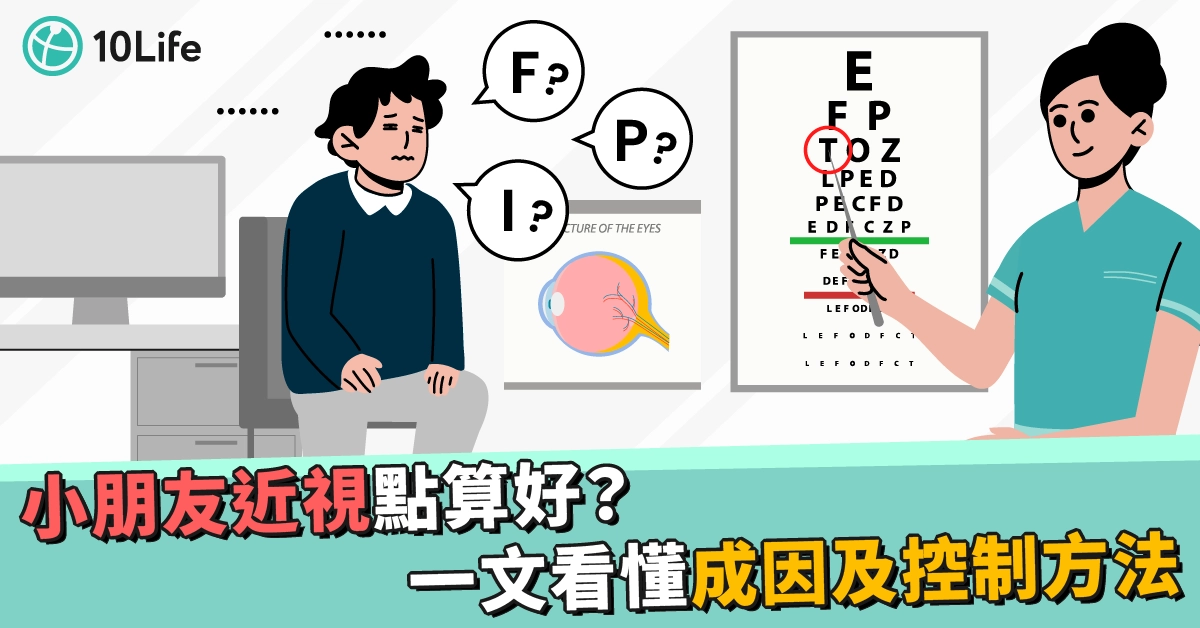
As electronic devices have become increasingly prevalent, more and more children have developed myopia in recent years and need to wear glasses. According to data from the Department of Health in Hong Kong, about 18% of 6-year-old children are affected by myopia, and by the age of 12, this proportion rises sharply to about 62%, meaning that more than half of children become bespectacled. Although myopia is very common, this situation still worries many parents. In view of this, 10Life will explain the causes of myopia in children and provide four control methods for reference.
Three major causes of myopia in children
Medical professionals have found that myopia has a certain degree of heredity. A child’s eyeball length is influenced by genetics, and eyeball length is closely related to the severity of myopia. Findings from a population screening programme show that the more severe the parents’ myopia, the greater the likelihood that their children will develop myopia, with the risk rate reaching as high as 11.89 times. In addition, a study in Australia also found that parents’ degree of myopia affects the risk of their children developing myopia. Compared with children whose parents do not have myopia, the risk of myopia is approximately 6 times, 10 times and 22 times higher for children with at least one parent who has mild, moderate or severe myopia respectively.
Prolonged close-range activities, such as reading books at close distance, may affect eyesight. In addition, poor eye-use habits may also lead to refractive errors, meaning that unaided vision does not meet normal standards. According to an Australian study, children who read at close range (less than 30 cm) are 2.5 times more likely to develop myopia than children who read at a distance of 30 cm or more.
Electronic devices have become essential in daily life, and children are gaining access to smartphones, tablets and similar devices at younger and younger ages. Prolonged and excessive use of these devices, especially at close range, can cause eye discomfort such as eye pain, dry eyes, headaches, blurred vision and even double vision, as well as other eye- and vision-related problems. It may also lead to myopia.
What impact does worsening myopia in children have on vision?
High myopia is closely associated with eye diseases. According to some studies, people with high myopia are also more likely than the general population to develop macular disease, cataracts and glaucoma. In addition, 20% to 30% of retinal detachment cases are caused by high myopia. Parents should therefore not overlook this issue and should take effective measures promptly to prevent children’s myopia from worsening.
Can children’s myopia improve after it worsens, and is recovery possible?
Children’s myopia is caused by the eyeball being too long from front to back, which prevents light from focusing on the retina to form a clear image. The focal point of distant objects can only be projected in front of the retina, resulting in a blurred image. Once a child’s myopia worsens, it is generally not possible to fully restore vision to a non-myopic state, but certain measures can be taken to help control further progression of myopia.
4 Major Myopia Control Methods
Many parents want to know how to control the rate at which myopia worsens in children. Below are four myopia control methods that parents can discuss with a doctor or optometrist to determine which is most suitable for their child.
Optical myopia control lenses use advanced scientific principles and a specific optical design to correct vision and control the progression of myopia. These lenses consist of two main areas: a central zone for vision correction, ensuring clear central vision for the wearer; and a peripheral zone with a myopic defocus area. After light passes through this area, it creates a myopic defocus effect on the retina, effectively slowing myopia progression. Optical myopia control lenses are worn in the same way as ordinary myopia glasses. Children simply wear them as they normally would, and can effectively slow the progression of myopia.
Orthokeratology contact lenses, also known as “OK lenses”, are a special type of contact lens. Through the pressure of the lenses, they reshape the curvature of the cornea and adjust the refractive power, thereby slowing myopia progression. These OK lenses only need to be worn during sleep, and clear vision can be achieved during the day without wearing them, making them suitable for active children. However, it is worth noting that once wearing them is stopped, the myopia prescription may return to its original state. Therefore, long-term wear is necessary to achieve the corrective effect.
Technology is advancing rapidly, and there are now contact lenses suitable for children that can both correct vision and control the progression of myopia. For example, MiSight® daily disposable contact lenses use the breakthrough ActivControl® Technology. They are the world’s only soft contact lenses certified by the US FDA, and have been proven to effectively slow myopia progression when used from the age of 8 to 12. Studies have shown that they can reduce the rate of myopia progression by around 50%, and most children do not need to wear glasses with a higher prescription at their next annual eye examination.
Atropine eye drops are one of the common methods used to control myopia in children. They only need to be used daily to effectively slow myopia progression. However, high-concentration atropine has certain side effects, such as dilated pupils, causing children to be sensitive to light and experience blurred near vision, so it may not be suitable for children. In recent years, studies have shown that low-concentration atropine (0.01% and 0.05%) can also effectively control myopia, with milder side effects, making it safe for children to use. According to research published in the Journal of the American Medical Association, low-concentration atropine at 0.05% can reduce myopia progression by as much as 67%.
In addition, aside from the methods above, the most direct and effective approach is to encourage children to spend more time outdoors. Why not take them hiking in the countryside or to the seaside to enjoy some sunshine at the weekend, allowing their eyes to relax a little?
Besides myopia, children inevitably encounter other illnesses during their growth. Want to provide better protection for your child? You may wish to refer to 10Life’s articles on children’s insurance, preschool children’s insurance premiums and coverage, or use the Product Decoder to compare different insurance plans at a preliminary stage.
Source: Department of Health Student Health Service, Department of Health publication, Hong Kong Ophthalmological Society, Report of the “Consultative Group on the Impact of Internet and Electronic Screen Products on Health”, Hong Kong Association of Private Practice Optometrists, CooperVision. MiSight®, Hima Eye Centre
This English version of this article has been generated by machine translation powered by AI. It is provided solely for reference purposes. In the event of any discrepancy or inconsistency between this translation and the original Chinese version, the Chinese version shall prevail.
Our team of professional content researchers focussing on insurance
Our team of professional content researchers focussing on insurance
10Life Product Comparison and 10Life Insurance Ratings are developed by 10Life Financial Limited, an authorised insurance broker company licensed with the Insurance Authority under License Number FB1526. 10Life Product Comparison and 10Life Insurance Ratings are developed for generic customer segments using mathematical calculations based on product information, facts and data, and are not influenced by any partnerships with or fees received from insurance companies. Any information on 10Life Platform ("10Life Information"), including but not limited to Product Comparison, Product Ratings, Blog Articles are intended for general education purpose and reference only. None of the 10Life Information is intended, nor should they be considered or relied upon, as regulated advice, insurance, financial, investment or professional advice, recommendation, approval, endorsement, invitation or solicitation in respect of any insurance, financial or investment products. 10Life Information does not take into account your individual needs. Reading 10Life Information should not be considered as conducting a suitability assessment, and is not sufficient to form the basis of any decisions to purchase any insurance products. You should rely on information authorised by insurance companies, carry out your own research and/or seek independent advice from licensed intermediaries before purchasing any insurance products or making any insurance decisions. While reasonable effort is used when collecting, validating and updating 10Life Information from various channels, none of 10Life Group and its subsidiaries, affiliates, agents, directors, officers and employees will be responsible for any liability, claim or loss arising from or associated with you using 10Life Information. No warranty, representation or guarantee is given by 10Life Group and its subsidiaries on the accuracy, completeness and timeliness of the information. If you have any questions on 10Life Product Comparison and 10Life Insurance Ratings, please email us at enquiries@10life.com




 Talk to 10Life on WeChat
