false
Category
Author
Search for Articles
Trending Keywords
Category
Author
Search
Category
Author
Search
儲蓄與投資
編輯推介

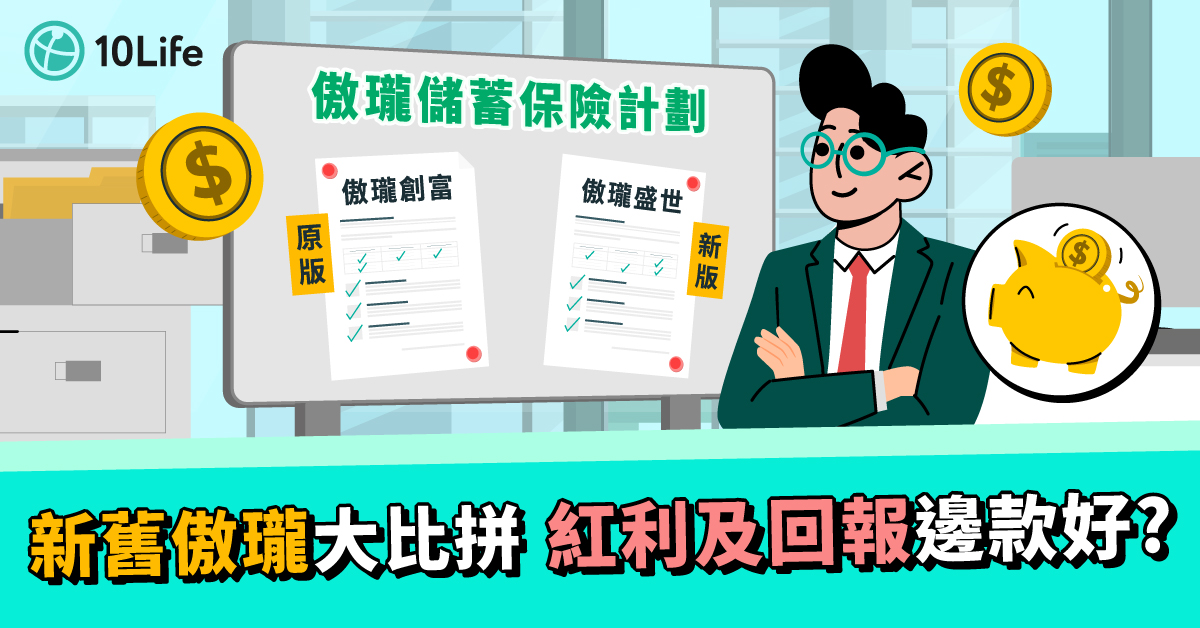
[New vs. Old Aolong] Aolong Prosperity VS Aolong Wealth Creation — Understand the dividends and returns of both in one article

2025-09-04 5min read
新舊傲瓏大比拼

After the Insurance Authority introduced illustrative interest rate caps of 6.5%/6% from July, China Life immediately shifted strategy and launched 傲瓏盛世, a name very similar to its flagship savings insurance product 傲瓏創富. The company describes the new product as an optimized upgrade, but 10Life found that 傲瓏創富 and 傲瓏盛世 have very different product positioning and dividend distribution, so they are suitable for different situations. This article will compare the new and old 傲瓏.

The bonus structure is very different

Aolong Wealth Creation is a hard-to-find savings insurance plan on the market that pays out annual bonuses, also known as the AD Plan. An annual bonus refers to the dividend the insurer distributes and pays to the policyholder each year in cash. Generally, once paid the amount will not change. Policyholders may, according to the policy terms, choose to withdraw these bonuses or leave them with the insurer to continue earning interest. Therefore, annual bonuses are relatively liquid; even if a policyholder withdraws the bonus, it will not affect the policy’s guaranteed cash value. Although annual bonuses are non-guaranteed and can be affected by factors such as the insurer’s investment performance and management, once an annual bonus is announced its amount will not change, making policyholders’ returns relatively “stable” and more predictable. This is also one of the main selling points of the AD Plan, and many clients use Aolong Wealth Creation to generate mid-term cash flow.

Old Aolong: annual bonus payout     New Aolong: terminal bonus payout

As for the newly launched 傲瓏盛世, its bonus structure is primarily based on terminal bonuses, with reversionary bonuses paid annually. Compared with anniversary bonuses, reversionary bonuses and terminal bonuses have lower "stability" and "predictability." The insurer will list the terminal bonus in the annual statement, but the final amount may be adjusted depending on the insurer's investment performance and operating expenses, and can rise or fall. Therefore, policyholders will only know the actual amount of the terminal bonus when the policy ends, such as on death or surrender.

It is worth noting that if a policyholder wishes to withdraw funds from the policy each year and the relevant bonus amounts are insufficient to cover the withdrawals, or if a partial surrender is required, only then can the balance be withdrawn from the guaranteed cash value. Such actions will reduce the overall value of the policy, the accumulated amount will shrink, and the final returns may be affected. Therefore, 傲瓏盛世 is more suitable for long-term wealth accumulation
 

Further reading: 【儲蓄保險】認清紅利種類 避免中途拎錢失預算 

Old Aolong's guaranteed cash value is a clear winner

After understanding the fundamental differences in bonus structure between the old and new Aolong products, what people are most concerned about is how the returns actually differ. As mentioned earlier, Aolong Chuangfu is very popular—policyholders take it out to make mid-term withdrawals to generate cash flow. If someone bought Aolong Shengshi for the same purpose, what would the effect be? Suppose a policyholder pays $100,000 over two years and, starting in year 5, withdraws $5,000 a year; compare the cash values obtainable on surrender in year 10, year 20 and year 30 for the two products.

Table 1: Comparison of Returns of New and Old Aolong Products
Assuming an insured amount of USD 100,000, a 2-year premium payment period, and annual withdrawals of approximately USD 5,000 from year 5

Item

Year

Aolong Prosperity (New)1

Aolong Wealth Creation (Old)

Cumulative WithdrawalsYear 10$25,000$25,000
 Year 20$75,000$75,000
 Year 30$125,000$125,000
Guaranteed Cash ValueYear 10$73,212 $79,771
 Year 20$70,029 $100,294 
 Year 30$57,746$100,887 
Non-guaranteed BonusesYear 10$38,804$32,242 
 Year 20$104,654 $57,213 
 Year 30$244,140 $137,571 
Total Expected Cash ValueYear 10$112,016 $112,013
 Year 20$174,683$157,507 
 Year 30$301,887$238,458
Note:
1.Withdrawal amounts may vary slightly due to rounding

From Table 1, it can be seen that under mid-term withdrawals the old Aolong decisively outperforms the new Aolong in guaranteed cash value. Even if approximately $5,000 is withdrawn each year starting in year 3, the old Aolong’s guaranteed cash value still increases over time. By contrast, the new Aolong’s guaranteed cash value decreases over time; by year 30, its guaranteed cash value is only $57,746, more than 40% lower than the old Aolong. The new Aolong operates such that when the policy’s dividend amount is insufficient to cover the policyholder’s withdrawals, a partial surrender is required, which also explains why the guaranteed cash value of the new Aolong product continues to shrink.  

The new Aolong's non-guaranteed bonuses are decoupled from the old Aolong

However, looking at the non-guaranteed bonus portion, the new Aolong far outperforms the old Aolong, and the gap widens substantially over time. In the 10th year, the two are still relatively close in non-guaranteed bonuses, differing by about 20%, but later the new Aolong's non-guaranteed bonuses grow faster and are clearly higher than the old Aolong. By the 20th year, the new Aolong's non-guaranteed bonuses have reached US$104,654, over 80% higher than the old Aolong.

In fact, if policyholders do not withdraw funds and let the bonuses continue to accumulate and earn interest, the new Aolong's returns would likely be even more substantial, making it suitable for policyholders seeking the maximum potential returns or those who wish to use savings insurance to pass on wealth.

Why are cash dividend plans becoming increasingly scarce?

Although AD Plans usually provide higher guaranteed cash values and more stable dividends, their potential returns are correspondingly conservative. In a market that prioritizes high expected returns, insurers have mostly shifted to promoting terminal bonus plans, and AD Plans have become increasingly rare. However, a few AD Plans remain available in the market; if you'd like to learn more, feel free to contact 10Life professional advisors.

Further reading:
【Personal Finance Guide】Comparison of Popular Savings Insurance with Short Premium Payment Terms 
【Savings Insurance】Breaking Down the Sales Talk in Savings Insurance to Reveal the True Returns 

Last updated: September 4, 2025
 

This English version of this article has been generated by machine translation powered by AI. It is provided solely for reference purposes. In the event of any discrepancy or inconsistency between this translation and the original Chinese version, the Chinese version shall prevail.

10Life 編輯團隊

團隊成員由一群資料搜集員組成,主力保險相關資訊研究。

10Life 編輯團隊

團隊成員由一群資料搜集員組成,主力保險相關資訊研究。

Disclaimer

10Life 产品比较和 10Life 保险评分由获保监局授权持牌保险经纪公司 10Life Financial Limited(保监局牌照号码为FB1526)营运。10Life 产品比较和 10Life 保险评分是根据产品数据、事实陈述以及数据,并以一般消费者作为对象,从而作出数学运算,并不受与保险公司任何形式之合作或所获得之费用所影响。

10Life平台上之任何信息(「10Life信息」),包括但不限于产品比较、产品评分、网志文章等,旨在向香港特别行政区(「香港」)境内人士发布,所有信息及服务对象为于身处香港境内人士,仅供一般教育及参考用途。10Life信息无意,也不应被视为对任何保险、金融或投资产品进行受监管建议或专业建议、推荐、批准、认可、邀请或招揽。10Life信息并没有考虑阁下之个人需要,阅览有关数据也不应被视为正在进行个人合适性评估,且不足以构成任何购买保险产品决定的依据。购买任何保险产品或进行有关保险决定前,阁下应以保险公司提供的数据为准,自行进行研究,及/或寻求持牌保险中介人的独立及专业意见。10Life信息是以最大努力从不同渠道收集、验证、更新而成。10Life集团及其附属公司、关连人士、代理、董事、职员、员工将不会就有关资料引致的责任、索偿或损失负上任何责任,也概不保证或担保有关资料之准确性、完整性和适时性。

所显示保费数据尚未包括保险业监管局收取的保费征费,并均四舍五入至港元个位数。

如阁下对 10Life 产品比较和 10Life 保险评分有任何意见,欢迎电邮至 enquiries@10life.com

Whatsapp icon
Whatsapp icon
WeChat icon
WeChat icon
Enquiry icon Close icon
Back To Top
Whatsapp icon
Whatsapp icon
WhatsApp