









10Life Financial Limited
Enquiries: enquiries@10life.com
Hotline: (852) 3705 1599
Address: 16/F Greatmany Centre, 109-115 Queen’s Road East, Wan Chai, Hong Kong


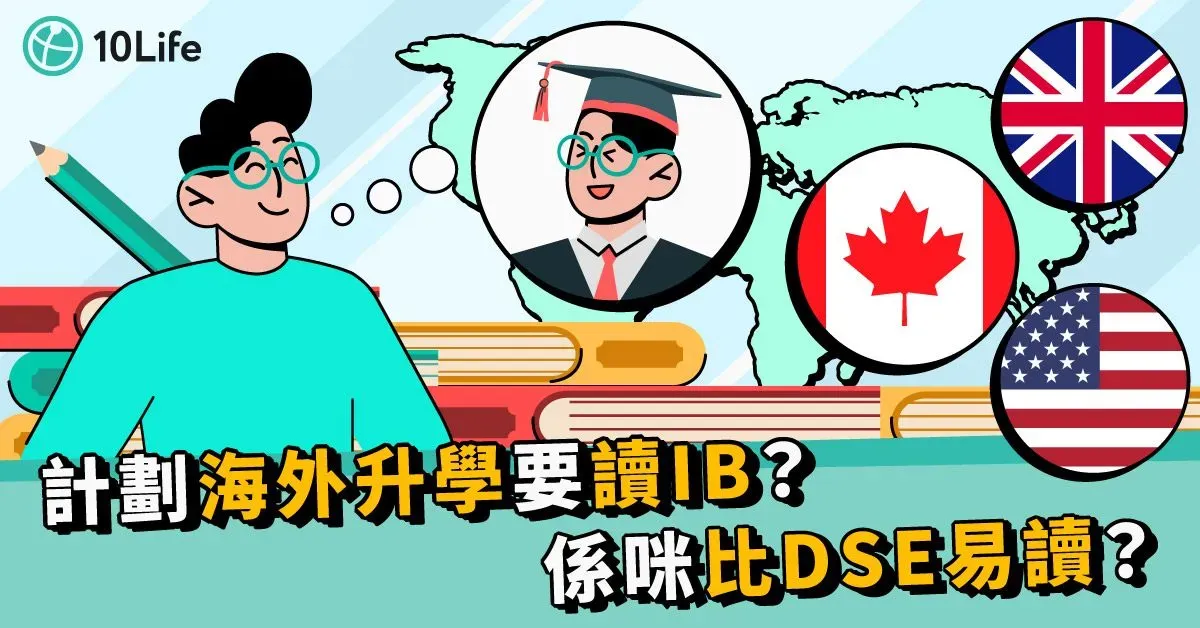
During the annual results season, in addition to DSE top scorers, news reports also often feature IB top scorers, referring to students who have achieved outstanding results under another education system. IB enjoys a high level of international recognition and has become increasingly popular among parents and students in Hong Kong in recent years. Apart from international schools, some Direct Subsidy Scheme and private schools also offer the IB International Baccalaureate programme. So, what are the features of the IB programme? How should subjects be chosen? What are the benefits of studying IB? And how does it differ from DSE, IGCSE and the Canadian education system?
The full name of the IB curriculum is The International Baccalaureate, which has a history of over 50 years. It is currently offered by more than 5,000 schools in over 150 countries or regions. The IB International Baccalaureate curriculum is divided into four categories, including the primary level (IB Primary Years Programme, PYP), middle level (IB Middle Years Programme, MYP), pre-university level (IB Diploma Programme, IBDP), and IB Career-related programme (CP).
A comprehensive education consultant pointed out that the biggest difference between IB and DSE is the learning approach. DSE is relatively more academically focused, and students need to do a large amount of practice and drill past exam papers when preparing for examinations. IB is also not easy to pass, but the curriculum places more emphasis on training students’ way of thinking, encouraging them to discuss freely and express their opinions.
The IB Diploma Programme is highly recognised internationally. More than 5,000 universities in over 100 countries and regions worldwide accept IB results as part of their admissions assessment, including universities in popular overseas study destinations such as the UK, the US and Canada. As such, the IB programme is particularly suitable for students who intend to pursue further studies overseas. If their results meet the required standard, they can progress directly to an undergraduate degree; otherwise, they may first take a pathway course, such as a Foundation Course or International Year One.
Parents and students may worry that choosing IB means they can only progress to overseas universities. In fact, this is not necessarily the case. If they ultimately decide to study in Hong Kong, IB students can still apply to local universities via the Non-JUPAS route. However, they should be mentally prepared, as competition is more intense than through the JUPAS route.
IBDP is a two-year pre-university programme designed for students aged 16 to 19, with subject choices mainly divided into compulsory and elective components. The three compulsory core subjects include:
| Theory of Knowledge (Theory of Knowledge) | Learn the fundamentals of knowledge and analysis, and complete an oral presentation as well as a 1,600-word essay |
| Extended Essay (Extended Essay) | Students need to choose a topic of interest for in-depth research and write an essay of approximately 4,000 words |
| Creativity, Action and Service (Creativity, Action, Service) | Participate in different types of practical learning, including group activities, to help students understand themselves and develop their strengths |
In addition, the IBDP curriculum requires students to choose one subject from each of the six subject groups, covering the following areas:
| Language and literature studies (Studies in language and literature) | Studying literary works to learn independent thinking and critical thinking |
| Language acquisition (Language acquisition) | Learning a language with which one has little familiarity or no familiarity at all |
| Individuals and societies (Individuals and societies) | Subjects related to the humanities and social sciences, such as philosophy, economics, business administration, geography and history |
| Sciences (Sciences) | Physics, chemistry, biology, computer science, sports and health science, etc. |
| Mathematics (Mathematics) | Mathematical studies, computer science, etc. |
| The arts (The arts) | Visual arts, film, music, dance and theatre arts, etc. |
The assessment method of the IBDP comprises public examinations and internal assessment, with public examinations held globally every May and November. Each elective subject is graded on a scale of 1 to 7, with a maximum total score of 42. If students achieve outstanding results in the compulsory subjects “Theory of Knowledge” and “Extended Essay”, they may receive up to 3 Bonus Points. Therefore, the maximum overall IBDP score is 45, which is what we commonly refer to as an “IB top scorer”. The passing score is 24.
Please note that if a student does not complete the requirements of the “Creativity, Activity, Service” subject, they will not be awarded the IBDP certificate, regardless of how well they perform in other subjects.
According to data from the International Baccalaureate Organization (IBO), as of September 2023, there were 59 schools in Hong Kong offering IB programmes, including at secondary, primary and pre-university levels. International schools such as Chinese International School, Yew Chung International School, King George V School and South Island School under the English Schools Foundation (ESF), as well as Direct Subsidy Scheme schools such as Diocesan Boys' School and St Paul's Co-educational College, all offer IB programmes at different levels. Please refer to each school’s announcement for details.
Some international schools and DSS schools offer a wider range of curriculum options. For example, IGCSE and IAL are part of the British curriculum and are secondary school examination and advanced-level programmes designed for overseas students; they are equivalent qualifications to GCSE and A-Level studied by local students. International schools and DSS schools that offer the British curriculum include Harrow International School, Diocesan Girls’ School and St Paul’s College.
In addition, some international schools offer curricula from other countries according to the background of their sponsoring bodies. For example, the Canadian International School of Hong Kong (DSC) offers the Ontario Secondary School Diploma (OSSD) programme; the French International School, German Swiss International School (German Section) and the American School, meanwhile, offer French (DNC, BAC), German (DIA) and American (AP) programmes respectively.
The admission age and primary/secondary school year structure vary slightly between different curricula. Below is a summary of information on some of these curricula, to give interested parents and students a basic overview.
| Age | Hong Kong local curriculum (DSE) | IB International Baccalaureate Programme | UK curriculum (IGCSE, IAL) | US and Canadian curricula |
| 5 | IB Primary Years Programme(PYP) | Primary school(Year 1 to Year 6) | ||
| 6 | Primary school(Primary 1 to Primary 6) | Primary school(Grade 1 to Grade 5) | ||
| 7 | ||||
| 8 | ||||
| 9 | ||||
| 10 | ||||
| 11 | IB Middle Years Programme(MYP) | Secondary school(Year 7 to Year 11) | Secondary school(Grade 6 to Grade 12) | |
| 12 | Secondary school(Secondary 1 to Secondary 6) | |||
| 13 | ||||
| 14 | ||||
| 15 | ||||
| 16 | IB Diploma Programme(IBDP) | Sixth form(Year 12 to Year 13) | ||
| 17 | ||||
| Source: website of the admissions centre and schools offering the relevant curricula | ||||
The International Baccalaureate (IB) programme is only offered by international schools, Direct Subsidy Scheme schools and private schools. Tuition fees are much higher than those of local subsidised schools, so preparing an education fund early through a savings plan can help ease future financial pressure. 10Life previously compared the potential returns and risks of common insurance plans used to set up an education fund. Parents who are interested can read the article for a basic understanding, or WhatsApp 3705 1599 to enquire with 10Life’s insurance consultants.
This English version of this article has been generated by machine translation powered by AI. It is provided solely for reference purposes. In the event of any discrepancy or inconsistency between this translation and the original Chinese version, the Chinese version shall prevail.
Our team of professional content researchers focussing on insurance
Our team of professional content researchers focussing on insurance
10Life Product Comparison and 10Life Insurance Ratings are developed by 10Life Financial Limited, an authorised insurance broker company licensed with the Insurance Authority under License Number FB1526. 10Life Product Comparison and 10Life Insurance Ratings are developed for generic customer segments using mathematical calculations based on product information, facts and data, and are not influenced by any partnerships with or fees received from insurance companies. Any information on 10Life Platform ("10Life Information"), including but not limited to Product Comparison, Product Ratings, Blog Articles are intended for general education purpose and reference only. None of the 10Life Information is intended, nor should they be considered or relied upon, as regulated advice, insurance, financial, investment or professional advice, recommendation, approval, endorsement, invitation or solicitation in respect of any insurance, financial or investment products. 10Life Information does not take into account your individual needs. Reading 10Life Information should not be considered as conducting a suitability assessment, and is not sufficient to form the basis of any decisions to purchase any insurance products. You should rely on information authorised by insurance companies, carry out your own research and/or seek independent advice from licensed intermediaries before purchasing any insurance products or making any insurance decisions. While reasonable effort is used when collecting, validating and updating 10Life Information from various channels, none of 10Life Group and its subsidiaries, affiliates, agents, directors, officers and employees will be responsible for any liability, claim or loss arising from or associated with you using 10Life Information. No warranty, representation or guarantee is given by 10Life Group and its subsidiaries on the accuracy, completeness and timeliness of the information. If you have any questions on 10Life Product Comparison and 10Life Insurance Ratings, please email us at enquiries@10life.com



 Talk to 10Life on WeChat
