









10Life Financial Limited
Enquiries: enquiries@10life.com
Hotline: (852) 3705 1599
Address: 16/F Greatmany Centre, 109-115 Queen’s Road East, Wan Chai, Hong Kong





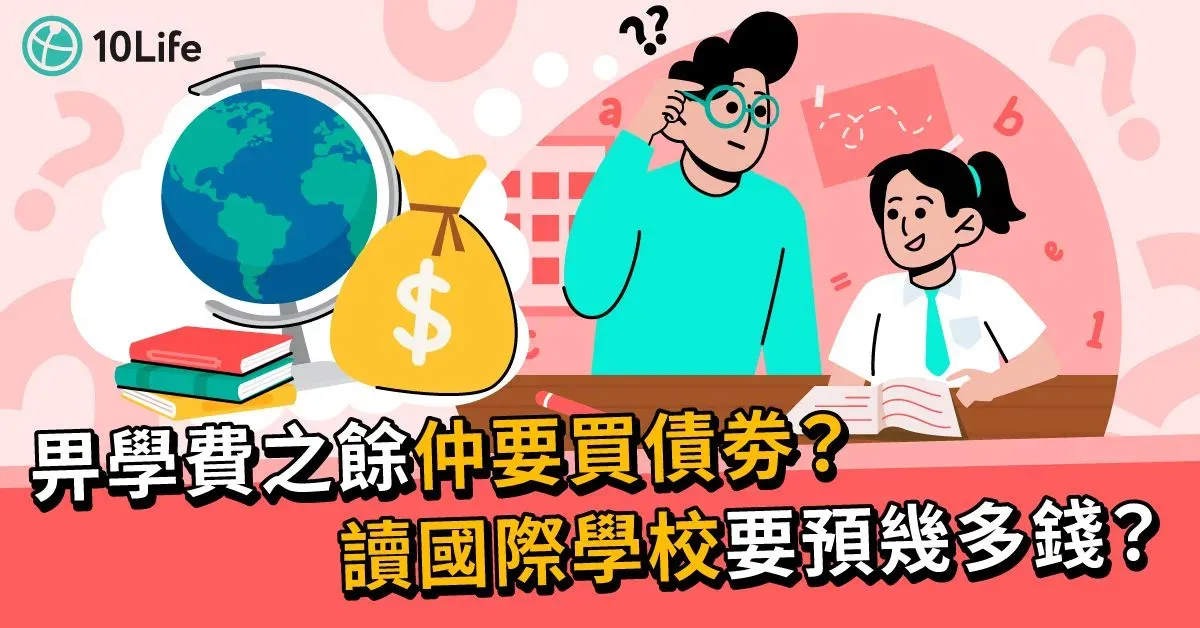
Places at international schools in Hong Kong have always been in short supply, especially for parents who intend to send their children overseas for further studies. If they are financially able, many will try to arrange for their children to attend an international school in Hong Kong. In addition to helping them adapt early to an English-speaking environment and a foreign style of learning, some international schools also offer a “through-train” path all the way to secondary school graduation.
Parents who are just beginning to explore information on international schools may not know where to start. Beyond referring to international school rankings, what else should they pay attention to? How large is the difference in fees between the most expensive school in Hong Kong, Chinese International School, and the relatively more affordable Christian Alliance International School? What exactly are international school debentures? 10Life has compiled the tuition fees and debenture categories of some popular international schools for interested parents’ reference.
According to Education Bureau data, Hong Kong’s international schools are primarily set up for the children of expatriate families. However, many international schools will accept applications from local students. For example, the English Schools Foundation (ESF), the largest international school group in Hong Kong, has had more than 30% of its students from local families in recent years.
The medium of instruction at international schools is generally English only or bilingual, and their curriculum also differs from that of local secondary schools. Students at international schools generally do not sit the Hong Kong Diploma of Secondary Education (DSE), but instead study the International Baccalaureate (IB) programme. Some schools also offer curriculum options such as those from the UK (IGCSE, A-Level), the US (AP), France and Germany, depending on the background of the sponsoring body.
In addition, international schools do not take part in the central allocation system, and admissions arrangements vary. In general, applications begin in September or October of the year before entry. Schools under the English Schools Foundation (ESF), such as South Island School and King George V School, conduct central admissions for K1, Year 1 and Year 7. Some international schools also accept applications throughout the year, depending on the availability of places. Parents and students interested in applying should pay attention to announcements from their preferred schools to avoid missing the application period.
There is no official ranking for international schools, but many education websites compile approximate rankings based on various indicators such as previous years’ public examination results and progression to further education.
In addition to comparing the rankings and teaching quality of international schools, parents should also note that tuition fees can vary greatly. Once you decide to send your child to an international school, you should be prepared for a minimum commitment of 12 or 13 years for primary and secondary education. If your child starts from kindergarten, the financial burden will be even greater, so you must assess the family’s financial situation when choosing a school.
The table below sets out the tuition fees of some of the more popular international schools, to give parents a general idea.
| School | Primary school tuition fees | Secondary school tuition fees |
| Chinese International School (CIS) Chinese International School (CIS) | HK$258,000 | HK$305,000 to HK$310,000 |
| Hong Kong Academy of the Chinese Christian and Missionary Alliance (ISF) | HK$221,000 | HK$257,000 to HK$279,000 |
| Yew Chung International School Yew Chung International School (YCIS) | HK$251,000 | HK$246,000 to HK$252,000 |
| Hong Kong International School Hong Kong International School (HKIS) | HK$211,000 | HK$218,000 to HK$242,000 |
| Singapore International School Singapore International School (Hong Kong) | HK$150,000 | HK$193,000 to HK$236,000 |
| German Swiss International School German Swiss International School (GSIS) | HK$183,000 | HK$218,000 to HK$231,000 |
| Canadian International School Canadian International School (CDNIS) | HK$174,000 to HK$185,000 | HK$197,000 to HK$227,000 |
| Harrow International School Hong Kong Harrow International School Hong Kong | HK$186,000 | HK$212,000 to HK$221,000 |
| Christian Alliance International School Christian Alliance International School (CAIS) | HK$143,000 to HK$172,000 | HK$186,000 to HK$215,000 |
| French International School French International School (FIS) | HK$143,000 | HK$180,000 to HK$207,000 |
| American International School American International School (AIS) | HK$142,000 to HK$153,000 | HK$153,000 to HK$168,000 |
| English Schools Foundation English Schools Foundation (ESF) | HK$126,000 | HK$145,000 to HK$167,000 |
| Korean International School Korean International School (KIS) | HK$114,000 | HK$127,000 |
| Notes: 1. The above table shows the annual tuition fees for the 2023/24 academic year, sourced from the schools listed above on 7 September 2023. 2. Rounded to the nearest thousand. 3. Owing to differences in school structure, some schools’ primary sections run from Year 1 to Year 5 or 6; secondary sections run from Year 6 or 7 to Year 12 or 13. Please refer to each school’s website for details. 4. There is currently no official ranking for international schools. The table above lists selected schools in descending order of secondary school tuition fees only, and does not reflect school rankings. It also does not include all international schools in Hong Kong. 5. In addition to tuition fees, some schools charge other fees, such as a capital levy, or require parents to purchase a debenture. Please refer to each school’s website for details. Source: The international schools listed above | ||
In addition to basic tuition fees, many parents will have heard that some international schools require parents to purchase a school debenture, nomination rights, or pay a capital levy. These charges, under different names, can simply be understood as international schools’ financing schemes. Most international schools are privately operated and do not receive government funding, so they need to raise funds for building school facilities or developing new curricula.
| Debenture (debenture) | Nomination rights (nomination rights) | Capital levy (capital levy) |
| These are divided into personal debentures and corporate debentures, and can be exchanged for the opportunity to secure priority admission or to recommend a student for admission. These debentures range from several hundred thousand to over a million dollars. Some elite schools, such as Chinese International School, no longer issue new debentures, and they can only be bought on the secondary market; at their peak, the resale price even exceeded HK$10 million. Some international schools also require parents to purchase a debenture, which will only be refunded when the student graduates or withdraws, and no interest will be paid. | Purchase is restricted to parents, and each nomination right may nominate only one child for priority admission. | There are two types: one is a one-off payment upon a new student’s enrolment, and the other is an annual payment of several tens of thousands of dollars. |
However, parents should note that buying a debenture does not mean securing a place. Even if the price of an international school debenture is high, there is still a chance of not being admitted.
The price of a debenture, the timing of when it must be purchased, and arrangements for resale or refund vary from one international school to another, so parents should do their research carefully before choosing to apply to an international school. Of course, there are also international schools that do not require the purchase of a debenture, such as the Korean International School and the American International School. Parents can choose a suitable school based on their family’s financial situation.
Whether a child is studying at an international school in Hong Kong or heading overseas for further education in future, the costs involved are substantial. Preparing an education fund early through a savings plan can help ease future financial pressure. 10Life recently compared the potential returns and risks of common insurance plans used to set up an education fund. Parents who would like to learn more may contact a 10Life insurance consultant via WhatsApp at 3705 1599.
Source: Education Bureau, various international schools, media reports
This English version of this article has been generated by machine translation powered by AI. It is provided solely for reference purposes. In the event of any discrepancy or inconsistency between this translation and the original Chinese version, the Chinese version shall prevail.
Our team of professional content researchers focussing on insurance
Our team of professional content researchers focussing on insurance
10Life Product Comparison and 10Life Insurance Ratings are developed by 10Life Financial Limited, an authorised insurance broker company licensed with the Insurance Authority under License Number FB1526. 10Life Product Comparison and 10Life Insurance Ratings are developed for generic customer segments using mathematical calculations based on product information, facts and data, and are not influenced by any partnerships with or fees received from insurance companies. Any information on 10Life Platform ("10Life Information"), including but not limited to Product Comparison, Product Ratings, Blog Articles are intended for general education purpose and reference only. None of the 10Life Information is intended, nor should they be considered or relied upon, as regulated advice, insurance, financial, investment or professional advice, recommendation, approval, endorsement, invitation or solicitation in respect of any insurance, financial or investment products. 10Life Information does not take into account your individual needs. Reading 10Life Information should not be considered as conducting a suitability assessment, and is not sufficient to form the basis of any decisions to purchase any insurance products. You should rely on information authorised by insurance companies, carry out your own research and/or seek independent advice from licensed intermediaries before purchasing any insurance products or making any insurance decisions. While reasonable effort is used when collecting, validating and updating 10Life Information from various channels, none of 10Life Group and its subsidiaries, affiliates, agents, directors, officers and employees will be responsible for any liability, claim or loss arising from or associated with you using 10Life Information. No warranty, representation or guarantee is given by 10Life Group and its subsidiaries on the accuracy, completeness and timeliness of the information. If you have any questions on 10Life Product Comparison and 10Life Insurance Ratings, please email us at enquiries@10life.com



 Talk to 10Life on WeChat
