









10Life Financial Limited
Enquiries: enquiries@10life.com
Hotline: (852) 3705 1599
Address: 16/F Greatmany Centre, 109-115 Queen’s Road East, Wan Chai, Hong Kong


What is roseola?
How long does roseola take to get better? Which parts of the body does it appear on? Are there any complications?
What causes roseola infection?
Is roseola contagious?
How can roseola be prevented?
What is the treatment for roseola?
Other Common Questions About Roseola


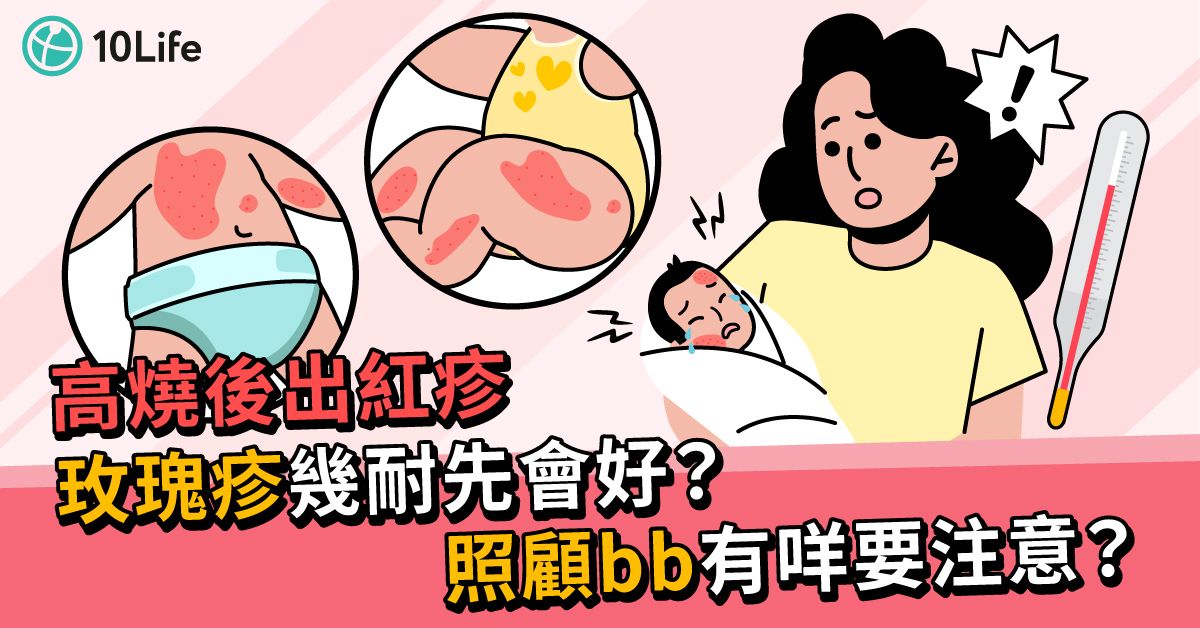
One of the most worrying things after becoming a parent is, without doubt, a baby developing a high fever. Although fever is a common symptom, if a baby has a high fever for several consecutive days and develops a rash after the fever subsides, it may be suffering from roseola, a common illness in infants and young children. So, which age group is most likely to catch roseola? What are the symptoms of roseola? How is it treated? How long does roseola take to recover? Is roseola contagious? And how should parents care for their child? 10Life has compiled information about roseola for parents’ reference.
What is roseola?
Roseola is a contagious childhood illness in Hong Kong, most commonly affecting children aged from 6 months to 2 years. At the onset of the illness, patients will develop a high fever, followed by a rash a few days later; however, it usually resolves on its own within a few days.
The incubation period for roseola ranges from 5 to 15 days. A paediatrician noted that the main symptom of roseola is a high fever of 39 to 40°C, which typically lasts for 3 to 5 days. Although there are many possible reasons why a baby may develop a high fever, if a rash appears on the body after the fever subsides, parents should be alert to the possibility that the baby may have roseola. In addition to fever, symptoms of roseola may also include mild diarrhoea, coughing, drooping eyelids or swollen eyelids. The paediatrician added that the high fever caused by roseola is different from influenza: in the former, the baby, despite the high fever, remains very energetic; by contrast, if infected with influenza, the baby will be lethargic.
Although the vast majority of roseola patients are young children, adults who have never been infected can still develop roseola, though symptoms in adults are generally not obvious.
How long does roseola take to get better? Which parts of the body does it appear on? Are there any complications?
The rash caused by roseola first appears on the trunk and neck, then spreads to the hands, feet and other areas. However, it is not usually itchy. After about 3 days, the rash will start to subside and generally does not require any specific treatment. If a doctor prescribes medication, it is mainly to relieve the baby’s fever and discomfort. Once the rash has completely disappeared, the child is considered recovered.
Seeing a baby develop a high fever and a rash can leave parents feeling at a loss, and may even prompt them to seek treatment in a rush. Below is a summary of some ways to help ease the baby’s discomfort:
✓ | X |
|
|
What causes roseola infection?
Roseola is a condition caused by a virus, most commonly human herpesvirus 6 (HHV-6), and in a smaller number of cases human herpesvirus 7 (HHV-7). Roseola is not affected by weather or season, so it can occur at any time.
Is roseola contagious?
The transmission of roseola is similar to that of the common cold, mainly through droplets, such as when sneezing or coughing. By the time a rash appears, the risk of contagion has already decreased. In addition, roseola infection is unrelated to weather or season, and it can occur at any time of the year.
How can roseola be prevented?
Ways to prevent roseola are similar to those for colds, with the main focus being on maintaining good personal and environmental hygiene. For example, wash hands after touching public facilities, clean and disinfect furniture and toys regularly, and keep indoor air well ventilated. Babies often touch their surroundings with their hands, making it easy for germs to take hold. Remember to help your baby wash their hands frequently before touching their eyes, mouth or nose, or after coughing or sneezing, and regularly clean your baby’s toys and furniture with diluted bleach to maintain a hygienic environment.
Roseola and measles can both cause fever and a rash in babies, but there are significant differences in their infectiousness and severity. Two simpler ways to tell them apart are to observe the shape of the rash and whether the fever subsides after the rash appears.
| Roseola | Measles | |
| Mode of transmission | Mainly spread through droplets | In addition to droplet transmission, it can also be spread through the air, making it highly contagious |
| Symptoms | There are no obvious symptoms at first, then a high fever of 39–40°C develops, followed by a red rash after the fever subsides | Early symptoms include fever, cough and runny nose; some patients develop white spots inside the mouth. A red rash appears 3 to 7 days after onset |
| Fever pattern | The fever subsides after the rash appears | The fever does not subside after the rash appears |
| Areas where the rash appears | Pinkish-red spots mainly appear on the chest, back and limbs | Patchy red rash, usually spreading from the face to the whole body; the rash is denser than roseola, making the body appear very red |
| Risk of complications | Lower | Higher, such as lung infection and encephalitis |
What is the treatment for roseola?
Roseola usually resolves naturally within a few days and does not require any specific treatment. However, if the baby develops a high fever, the doctor may prescribe antipyretic medication to help reduce the fever more quickly and prevent febrile convulsions.
Children often have weaker resistance and are more prone to illness, and may sometimes even require hospitalisation. Therefore, purchasing medical insurance can help them access suitable treatment more flexibly. If needed, you may refer to 10Life’s earlier article on comparing the premiums and out-of-pocket expenses of different VHIS plans for children, or take a preliminary look at 10Life’s Insurance Decoder.
Other Common Questions About Roseola
I’m sure many parents want to know whether a doctor is needed if a baby develops roseola. In fact, roseola usually clears up on its own and does not normally require special medical attention. However, parents should note that when a baby has a high fever, it may trigger a “febrile seizure”, causing the eyes to roll back and the limbs to twitch. In such cases, the baby should be taken to see a doctor immediately.
Although roseola is more common in young children, adults can also be infected. However, symptoms in adults are usually milder and less obvious.
In most cases, roseola does not cause itching or make the patient feel uncomfortable.
Note:
1. Source: Hong Kong Red Cross, media reports, Ot&P Healthcare
2. Last updated on: 27 August 2024.
This English version of this article has been generated by machine translation powered by AI. It is provided solely for reference purposes. In the event of any discrepancy or inconsistency between this translation and the original Chinese version, the Chinese version shall prevail.

Our team of professional content researchers focussing on insurance
Our team of professional content researchers focussing on insurance
10Life Product Comparison and 10Life Insurance Ratings are developed by 10Life Financial Limited, an authorised insurance broker company licensed with the Insurance Authority under License Number FB1526. 10Life Product Comparison and 10Life Insurance Ratings are developed for generic customer segments using mathematical calculations based on product information, facts and data, and are not influenced by any partnerships with or fees received from insurance companies. Any information on 10Life Platform ("10Life Information"), including but not limited to Product Comparison, Product Ratings, Blog Articles are intended for general education purpose and reference only. None of the 10Life Information is intended, nor should they be considered or relied upon, as regulated advice, insurance, financial, investment or professional advice, recommendation, approval, endorsement, invitation or solicitation in respect of any insurance, financial or investment products. 10Life Information does not take into account your individual needs. Reading 10Life Information should not be considered as conducting a suitability assessment, and is not sufficient to form the basis of any decisions to purchase any insurance products. You should rely on information authorised by insurance companies, carry out your own research and/or seek independent advice from licensed intermediaries before purchasing any insurance products or making any insurance decisions. While reasonable effort is used when collecting, validating and updating 10Life Information from various channels, none of 10Life Group and its subsidiaries, affiliates, agents, directors, officers and employees will be responsible for any liability, claim or loss arising from or associated with you using 10Life Information. No warranty, representation or guarantee is given by 10Life Group and its subsidiaries on the accuracy, completeness and timeliness of the information. If you have any questions on 10Life Product Comparison and 10Life Insurance Ratings, please email us at enquiries@10life.com




 Talk to 10Life on WeChat
