









10Life Financial Limited
Enquiries: enquiries@10life.com
Hotline: (852) 3705 1599
Address: 16/F Greatmany Centre, 109-115 Queen’s Road East, Wan Chai, Hong Kong



Silver Bond 2026 Basic Information
How is the interest on Silver Bonds calculated?
Silver Bond eligibility and application method
Silver Bond subscription offers: which bank or broker is the most cost-effective?
How many lots of Silver Bonds should you subscribe for? First, take a look at the historical allocation data
Can Silver Bond be redeemed early?
Not allotted the full amount, or not eligible for the Silver Bond? You may compare short-term savings insurance
Frequently Asked Questions


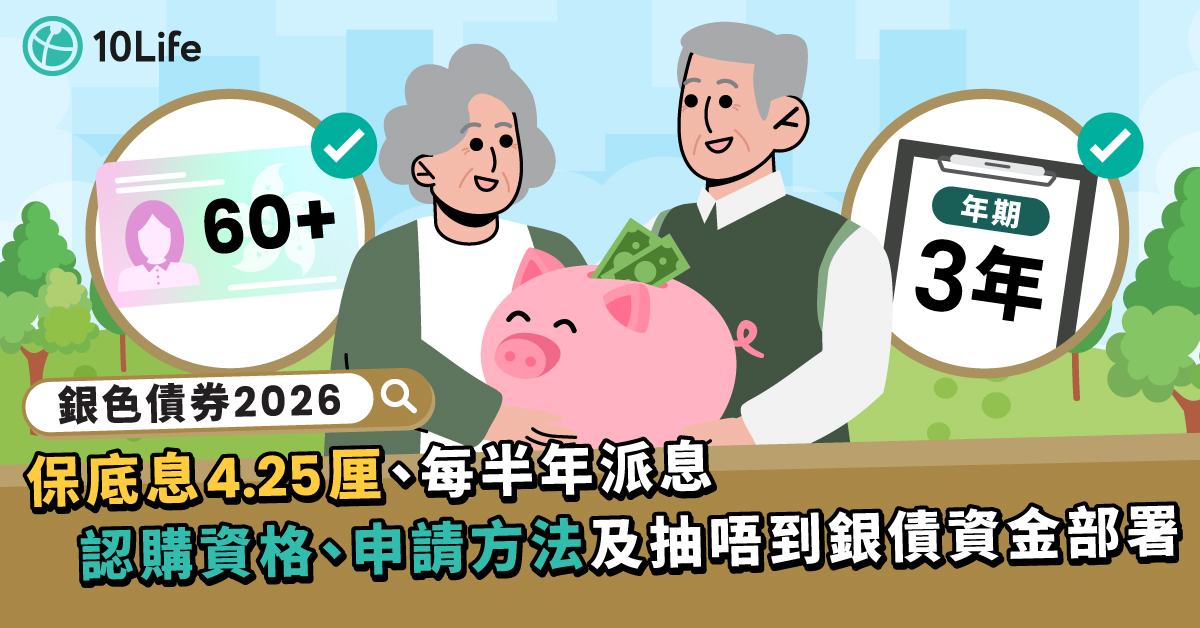
Silver Bond 2026 (11th batch of Silver Bonds) has been open for subscription since 21 August. The subscription period runs until 2:00 p.m. on 4 September, with allotment results to be announced on 11 September and formal issuance on 15 September. The guaranteed interest rate for this batch has been raised to 4.25%, the second highest on record, surpassed only by the 5% rate in 2023.
For those aged 60 or above who want stable interest income without bearing the volatility of the stock and fund markets, the Silver Bond, issued by the Hong Kong SAR Government, carries relatively low credit risk. It offers a guaranteed minimum interest rate, pays interest semi-annually, and can be redeemed early before maturity at principal plus accrued interest, making it quite attractive.
However, Silver Bonds are almost oversubscribed every year, so the number of lots applied for does not necessarily equal the number of lots allotted. This article summarises the basic information, subscription eligibility and application methods for Silver Bond 2026, the subscription offers from major banks and brokers, how many lots you should subscribe for, and how any remaining funds can be deployed if you are not allotted the full amount.
Silver Bond 2026 Basic Information
The 11th batch of Silver Bonds has a tenor of 3 years, with each lot valued at HKD 10,000. The interest rate is linked to local inflation, with a guaranteed rate of 4.25%; in other words, on each interest payment date, the inflation-linked rate will be compared with 4.25%, and the higher of the two will be used to calculate the actual interest. The inflation-linked rate is generally calculated based on the average year-on-year rate of increase in the Composite Consumer Price Index over the most recent 6 months.
The target issue size for this batch is HKD 50 billion, and the Government may increase it to a maximum of HKD 55 billion depending on subscription demand.
| Details of Silver Bond 2026 | |
| Issue | 11th batch of Silver Bonds |
| Guaranteed interest rate | 4.25% p.a. (the second highest on record) |
| Tenor | 3 years |
| Silver Bond interest payment | Interest paid every 6 months |
| Denomination per lot | HKD 10,000 |
| Issue size | HKD 50 billion, up to HKD 55 billion |
| Eligibility for Silver Bonds | Born in or before 1967 and holding a valid Hong Kong Identity Card |
| Subscription period for Silver Bonds | From 9:00 a.m. on 21 August 2026 to 2:00 p.m. on 4 September 2026 |
| Announcement of allotment results | 11 September 2026 |
| Issue date | 15 September 2026 |
| Maximum allotment per person | 100 lots, i.e. HKD 1 million |
| Early redemption | Yes, redeemable at principal plus accrued interest; no secondary market |
How is the interest on Silver Bonds calculated?
Silver Bonds pay interest every 6 months, with a guaranteed minimum annual interest rate of 4.25%. Taking an allocation of 10 lots, i.e. principal of HK$100,000, as an example:
| Estimated dividend amount based on an annual interest rate of 4.25% | |
| Interest every six months | Approximately HKD 2,125 |
| Annual interest | Approximately HKD 4,250 |
| Guaranteed interest over 3 years | Approximately HKD 12,750 |
| Principal repayment at maturity | HKD 100,000 |
By holding 10 lots of Silver Bonds to maturity, based on the guaranteed interest rate of 4.25%, you can receive approximately HK$12,750 in interest over three years; if the inflation-linked rate is higher than 4.25%, the actual coupon rate on the Silver Bonds may be even higher.
Silver Bond eligibility and application method
The eligibility criteria for Silver Bonds are persons born in 1967 or earlier who hold a valid Hong Kong Identity Card, namely Hong Kong residents aged 60 or above in 2026. Each eligible person may subscribe for a minimum of 1 lot, and a maximum of 100 lots per person may be subscribed and allotted, equivalent to HK$1 million.
Those eligible for Silver Bonds may submit an application through a placing bank or a designated securities broker. Before applying, it is advisable to confirm three things: whether a securities account needs to be opened, the institution’s internal deadline, and whether there are sufficient funds in the account (the full subscription amount must be frozen upon application, and any unsubscribed portion will be refunded).
It is worth noting that the Government’s subscription deadline may not be the same as the deadline of every institution. Some banks or brokers will stop accepting Silver Bond subscription applications earlier. Therefore, it is not advisable to leave it until the last day to complete the process.
Silver Bond subscription offers: which bank or broker is the most cost-effective?
There is no subscription threshold fee for Silver Bonds themselves, but banks and brokers may charge subscription handling fees, custody fees, interest collection fees, redemption fees and so on. In this batch, many institutions are offering “fee waiver” promotions, and some brokers are also providing lucky draws or dedicated counters for seniors. Below are the key promotional highlights from the major institutions:
| Institution | Fee waivers |
| Bright Smart Securities | 12 items waived in full (subscription fee, custody fee, platform fee, collection fee for interest, margin interest, early redemption and maturity redemption fees, stock transfer fee, dormant account fee, etc.) |
| Futu Securities | 9 items waived in full (application fee, subscription fee, custodian fee, collection fee for interest, early redemption and maturity redemption fees, stock transfer fee, dormant account fee) |
| BOCHK | 8 items waived in full, including waiver of the 0.15% subscription handling fee |
| Hang Seng Bank | 7 items waived in full (subscription fee, custodian fee, collection fee for interest, early redemption and maturity redemption fees, transfer-in and transfer-out fees), plus a lucky draw |
| Citibank | 7 items waived in full, including waiver of the 0.15% subscription handling fee |
| Industrial and Commercial Bank of China (Asia) | 7 items waived in full (subscription fee, collection fee for interest, early redemption and maturity redemption fees, deposit fee, custodian fee, stock transfer fee) |
| CCBA | 7 items waived in full (subscription fee, deposit fee, collection fee for interest, early redemption and maturity redemption fees, transfer-in and transfer-out fees) |
| CMB Wing Lung | 7 items waived in full (subscription fee, custodian fee, stock transfer fee, collection fee for interest, early redemption and maturity redemption fees) |
| OCBC Bank (Hong Kong) | 7 items waived in full (subscription fee, custodian fee, collection fee for interest, early redemption fee, stock transfer fee, maturity redemption fee) |
| Shanghai Commercial Bank | 7 items waived in full (subscription fee, custodian fee, collection fee for interest, transfer-in and transfer-out fees, early redemption and maturity redemption fees) |
| HSBC | 6 items waived in full (subscription fee, deposit fee, custodian fee, collection fee for interest, early redemption and maturity redemption fees) |
| Standard Chartered | 5 items waived in full (subscription fee, custodian fee, collection fee for interest, early redemption and maturity redemption fees) |
| Note: The information is compiled from public reports and is current as of 24 August 2026. Terms, applicable channels (branch / online / mobile app) and promotional periods may vary across institutions and may be subject to change at any time; some institutions (such as Fubon Bank, Bank of Communications Hong Kong, Bank of East Asia, Dah Sing Bank and uSMART Securities) have also launched similar offers, but the details should be confirmed directly with the relevant institution. Please refer to the latest announcements from the institutions before subscribing. | |
One point to note is that the extent to which charges are fully waived depends largely on how many fee items the institution has broken them down into. Among brokers’ “12 fee waivers” are charges such as dormant account fees, stock transfer fees and margin interest, most of which are fees that most Silver Bond subscribers would never encounter. A bank’s “7 fee waivers” already cover subscription fees, custodian fees, interest collection fees and redemption fees, in other words, all the charges you would face from start to finish when subscribing to Silver Bonds. In other words, “12 fee waivers” and “7 fee waivers” may not make any practical difference to the average subscriber.
Since the difference in fees is limited, the three things that are really worth comparing are: the institution’s internal cut-off time (some are earlier than the Government’s 4 September, 2pm deadline), how convenient the subscription channel is (whether you need to visit a branch in person, and whether there is a dedicated counter for seniors), and the speed of refund. In short, the faster the refund, the fewer days your funds remain idle while awaiting allocation.
How many lots of Silver Bonds should you subscribe for? First, take a look at the historical allocation data
The maximum allocation of 100 lots per person is only an upper limit, and does not mean that applying for 100 lots will guarantee an allocation of 100 lots. When Silver Bonds are oversubscribed, the final allocation will depend on the number of applicants, the total subscription amount and the allocation mechanism. Below are the guaranteed interest rates and the maximum number of lots ultimately allocated for Silver Bonds in previous years:
| Tranche | Issue year | Guaranteed interest rate | Final maximum allocation |
| Tranche 5 | 2020 | 3.5% | 14 lots |
| Tranche 6 | 2021 | 3.5% | 14 lots |
| Tranche 7 | 2022 | 4% | 21 lots |
| Tranche 8 | 2023 | 5% | 23 lots |
| Tranche 9 | 2024 | 4% | 24 lots |
| Tranche 10 | 2025 | 3.85% | 17 lots |
| Tranche 11 | 2026 | 4.25% | To be announced on 11 September |
Taking the 2025 Silver Bond as an example, applicants who subscribed for 16 lots or fewer were allocated in full, while those who subscribed for more than 16 lots were first allotted 16 lots; some people could obtain one additional lot only after a ballot, meaning a maximum of 17 lots. In that year, the number of applicants reached 372,000, a record high.
There are views in the market suggesting that this round should be subscribed for 20 to 30 lots, or even 30 to 50 lots, on the basis that one must “apply above the cap” in order not to be capped. The logic itself is sound, but there are two points worth noting.
First, most of these suggestions come from banks and brokers themselves. The institution publicly recommending “20 to 30 lots” in this round is BOC Hong Kong, while the one recommending “30 to 50 lots” is Bright Smart Securities. The larger the subscription amount, the greater the amount of funds parked with the institution and the higher the chance of account conversion; accordingly, these recommendations are not entirely neutral, and readers should make their own judgement.
Second, the full subscription amount must be frozen upon application, and it typically takes about three weeks from the application date to the refund. Subscribing for 30 lots means HK$300,000 must be frozen. If only 17 lots are ultimately allotted, the remaining HK$130,000 would be left idle for nearly a month, during which no interest will be generated. If 50 lots are subscribed, the idle amount would be as much as HK$330,000.
Can Silver Bond be redeemed early?
Yes. Silver Bonds do not have a secondary market, so they cannot be bought and sold on the market like shares. However, holders may apply to the Government for early redemption before maturity, with the redemption amount being the principal plus accrued interest, and there is no loss of principal due to changes in market interest rates. This is an important advantage of Silver Bonds over ordinary bonds and time deposits.
Please note that early redemption must be handled through the original subscribing institution, and individual institutions may impose processing time and handling fees (for this issue, most institutions have waived the early redemption fee). In addition, if the holder dies before maturity, the Silver Bonds may be transferred to the executor for handling in accordance with the law of inheritance.
Not allotted the full amount, or not eligible for the Silver Bond? You may compare short-term savings insurance
There are two restrictions on Silver Bonds: first, they are only available to people aged 60 or above; second, in the event of oversubscription, applicants may not be allocated the full amount. For those who are not eligible for Silver Bonds, have only been allocated a small amount, or do not wish to wait for the allotment results, short-term savings insurance may be considered as one of the comparison options.
The two products are different in nature, so it is not advisable to compare only the interest rate figures. The structural differences are as follows:
| Comparison Item | Silver Bond 2026 | Short-term Savings Insurance |
| Issuing / Underwriting Body | The Government of the Hong Kong Special Administrative Region | Insurance company |
| Nature of Returns | Guaranteed minimum annual interest rate of 4.25%, linked to inflation, whichever is higher | Depends on the product; generally centred on guaranteed returns, with some plans being fully guaranteed |
| Method of Return Calculation | Annual interest calculated on the principal, paid semi-annually | Usually expressed as total return at maturity or annualised internal rate of return (IRR); the definition should be checked carefully |
| Term | 3 years | Depends on the plan, usually 3 to 5 years |
| Eligibility | Hong Kong residents born in 1967 or earlier | Generally no minimum age limit (subject to the product’s underwriting requirements) |
| Lottery Required? | Yes; when oversubscribed, allocations are made according to the mechanism | No, but there may be a minimum premium or application threshold |
| Early Withdrawal | Can be redeemed early at principal plus accrued interest | If surrendered early, the cash value received may be less than the premiums paid |
In other words, the shortcoming of Silver Bonds is that you may or may not be allotted them, while the shortcoming of savings insurance is that surrendering too early will result in a loss. The former offers greater flexibility of funds, but the amount is not under your control; the latter has a fixed amount, but requires you to lock in the term. Which is more suitable depends on whether this money will genuinely not be needed over the next few years.
10Life, a one-stop insurance platform, is currently offering a limited-time promotion on short-term savings insurance. Some plans provide fully guaranteed returns, with guaranteed returns of up to 4.25% or more. If you are not allotted the full amount of Silver Bonds, or are not eligible to subscribe, you can compare the guaranteed returns, maturity values and limited-time offers of different plans to find a suitable way to deploy idle funds.
Find out more: Short-term savings insurance comparison
Saving insurance is not equivalent to bank deposits and is not protected by the Deposit Protection Scheme. Want to know which plan is more suitable for you? Message a 10Life insurance adviser on WhatsApp now to compare guaranteed returns, limited-time offers and maturity values of different short-term savings insurance plans for free.
Frequently Asked Questions
The Silver Bond has a term of 3 years and pays interest every 6 months; the effective annual interest rate is the higher of the inflation-linked rate or the guaranteed rate of 4.25%.
Members of the public born in 1967 or earlier and holding a valid Hong Kong Identity Card may subscribe, i.e. persons aged 60 or above in 2026.
The subscription period runs from 9:00am on 21 August 2026 to 2:00pm on 4 September 2026, although individual banks or brokers may set an earlier cut-off time.
The allocation results will be announced on 11 September 2026, and the bonds will be officially issued on 15 September. Any unsubscribed funds will be returned by the subscribing institution.
Only subscriptions exceeding the expected allocation cap will avoid being capped, but the full amount will need to be frozen for around three weeks during the subscription period. The decision should be based on the intended use of the funds and the opportunity cost, rather than simply aiming for the maximum number of lots.
Many institutions in this issuance have waived the main fees. It should be noted that the difference between “12 fee waivers” and “7 fee waivers” mainly lies in how the fee items are broken down. A bank’s seven full waivers already cover all the fees you would encounter when subscribing to Silver Bonds, so the practical difference is minimal. Instead, compare internal cut-off times, subscription channels and refund speed.
Yes. Silver Bonds do not have a secondary market, but holders may apply to the Government for early redemption. The amount is calculated based on the principal plus accrued interest, and the principal will not be affected by changes in market interest rates.
This English version of this article has been generated by machine translation powered by AI. It is provided solely for reference purposes. In the event of any discrepancy or inconsistency between this translation and the original Chinese version, the Chinese version shall prevail.
I’m delighted to be part of 10Life in building a one stop insurance platform.
10Life Product Comparison and 10Life Insurance Ratings are developed by 10Life Financial Limited, an authorised insurance broker company licensed with the Insurance Authority under License Number FB1526. 10Life Product Comparison and 10Life Insurance Ratings are developed for generic customer segments using mathematical calculations based on product information, facts and data, and are not influenced by any partnerships with or fees received from insurance companies. Any information on 10Life Platform ("10Life Information"), including but not limited to Product Comparison, Product Ratings, Blog Articles are intended for general education purpose and reference only. None of the 10Life Information is intended, nor should they be considered or relied upon, as regulated advice, insurance, financial, investment or professional advice, recommendation, approval, endorsement, invitation or solicitation in respect of any insurance, financial or investment products. 10Life Information does not take into account your individual needs. Reading 10Life Information should not be considered as conducting a suitability assessment, and is not sufficient to form the basis of any decisions to purchase any insurance products. You should rely on information authorised by insurance companies, carry out your own research and/or seek independent advice from licensed intermediaries before purchasing any insurance products or making any insurance decisions. While reasonable effort is used when collecting, validating and updating 10Life Information from various channels, none of 10Life Group and its subsidiaries, affiliates, agents, directors, officers and employees will be responsible for any liability, claim or loss arising from or associated with you using 10Life Information. No warranty, representation or guarantee is given by 10Life Group and its subsidiaries on the accuracy, completeness and timeliness of the information. If you have any questions on 10Life Product Comparison and 10Life Insurance Ratings, please email us at enquiries@10life.com




 Talk to 10Life on WeChat
