









10Life Financial Limited
Enquiries: enquiries@10life.com
Hotline: (852) 3705 1599
Address: 16/F Greatmany Centre, 109-115 Queen’s Road East, Wan Chai, Hong Kong



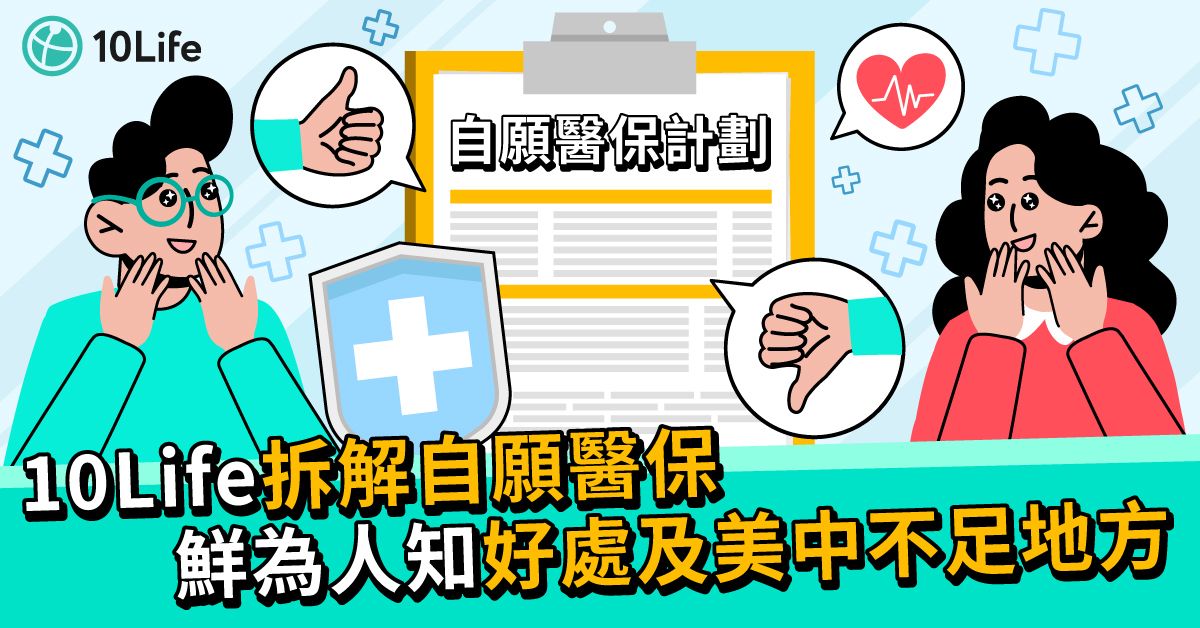
The Voluntary Health Insurance Scheme (VHIS) has been very popular in the market. Since its launch in 2019, nearly 1.13 million policies have been sold as of September 30, 2022 (see Note 1). Is the VHIS any good? The VHIS has pros and cons for consumers. Most people know that one advantage is the tax relief (see Note 2), or that VHIS Standard Plans feature standardized terms and basic protections — for example, guaranteed renewability up to age 100 and coverage for pre-existing conditions that were unknown prior to enrollment. However, the benefits of VHIS plans don't stop there. Some provisions go unnoticed by consumers but are, from an actuarial perspective, quite "valuable" to policyholders and also create a certain cost burden for insurers. Today, 10Life will explore these little-known benefits and the shortcomings so we can objectively evaluate whether the VHIS is any good.
Although the Voluntary Health Insurance Scheme (VHIS) policy terms are complex, some details do protect consumers — for example, guaranteed renewal. At first glance this may not seem special, because many traditional medical insurance products in the Hong Kong market also state guaranteed renewal. However, the VHIS renewal clause (note 3) explicitly states:
If, at renewal, the Company will have or has ceased to be registered with the Government as a VHIS product provider but remains authorized under the Insurance Ordinance to underwrite this policy and benefits, the renewal will be handled as follows: this policy and benefits shall be renewed on terms no less favourable than the latest version of the standard plan terms and benefits published by the Government at the time the Company ceases to be a Government-registered VHIS product provider (excluding Part I, Section 7; Part VI, Sections 1(b) and 5; and other exemptions approved by the Government from time to time) and shall be automatically renewed. (see note 4)
And
Under the renewal situations described in paragraphs (a)–(c) above, any other amendment to the terms and benefits shall apply to all policies of the same category, and shall not conflict with paragraphs (a), (b) or (c) above (as applicable) nor result, compared with pre-renewal, in a reduction of the benefit limits (reducing the benefit limits) applicable to this policy and benefits or an increase in co-insurance or co-payments. (see note 5)
Compared with guaranteed renewal in ordinary medical insurance, the above VHIS plan terms highlight two advantages:
1. Even if in the future an insurer withdraws a product for any reason — poor sales, mispriced risk, losses, etc. — the insurer still has the responsibility to renew coverage for customers who previously purchased a VHIS policy. By contrast, although ordinary medical insurance may advertise guaranteed renewal up to a specified age, once the product is withdrawn the customer cannot renew; at that point, if the customer is older or in poorer health, attempting to purchase another medical insurance policy may result in refusal to insure or additional premium loadings.
2. At renewal the insurer cannot arbitrarily delete or reduce VHIS benefits or benefit limits. In other words, if an insurer’s earlier offering of high benefit limits or features caused a large increase in costs, the insurer cannot worsen those items in the future. By contrast, with ordinary medical insurance, when a benefit item leads to higher-than-expected claims the insurer has the right to change that benefit item at renewal.
When the price of a hamburger goes up, the media will report it and people can easily notice — but what about health insurance? Many people know that the older you get, the higher your health insurance premiums, but you actually cannot forecast the future from the "current" premium schedule, because the "current" premiums do not reflect medical inflation, and insurers often raise prices citing medical inflation.
First, about the Voluntary Health Insurance Scheme (VHIS): insurers are required to publish VHIS premiums on their websites. Also, if you go to the official VHIS website, log in to the "Consumer Information" section's "Recognised Plans" page, and then select the list of Standard Plans or the list of Flexible Plans, you can look up past plan premiums and immediately see whether they have gone up or down. By contrast, for ordinary medical insurance, insurers can quietly raise premiums that are hard to detect, because consumers find it difficult to obtain the information through public channels, let alone calculate the rate of increase.
In the past, insurance companies denied claims on the grounds that the insured failed to disclose important facts at the time of application. However, ordinary consumers find it difficult to distinguish what constitutes an important fact that must be disclosed (material fact).
The terms of the Voluntary Health Insurance Scheme (see note 6) state that both the policyholder and the insured have a duty to answer the underwriting questionnaire and disclose material facts. However, if the underwriting questionnaire does not include relevant questions, the insurer will be exempted from the policyholder’s and the insured’s responsibility to disclose such information. In other words, if the questions set by the insurer are themselves ambiguous and fail to guide the policyholder and the insured to disclose material facts, that is the insurer’s responsibility, not the policyholder’s or the insured’s.
As for general medical insurance, regardless of whether the wording of the underwriting questionnaire is unclear, it remains the responsibility of the policyholder and the insured to disclose material facts to the insurer.
In 2020, 10Life discovered that the coverage for "specified non-surgical cancer treatments" under the Voluntary Health Insurance Scheme applied to eligible expenses "during hospitalisation, or under facilities providing medical services for day patients," and whether oral targeted drugs taken at home were covered fell into a gray area of interpretation. 10Life then consulted the Food and Health Bureau about the meaning of the clause. It is understood that the Food and Health Bureau had made inquiries with several insurers about the incident and subsequently issued a notice to insurers stating that such treatments would be covered as long as they were prescribed by a registered doctor based on medical need. The incident shows the FHB acting as a gatekeeper for the VHIS, clarifying terms and reducing potential disputes in future claims.
Besides the clauses discussed here, the VHIS also safeguards consumers regarding the key terms in claims disputes — 醫療必需 (medically necessary) and 合理及慣常 (reasonable and customary). Due to space constraints, we will explore these in the future; you won't want to miss it.
Finally, we would also like to talk about the shortcomings of the VHIS. Below are two disadvantages of the scheme.
Actuaries at 10Life calculated the expected coverage rates of the Voluntary Health Insurance (VHIS) using multiple illness and injury cases (including cancer, heart disease, stroke, etc.). However, we found that standard plans have an estimated average coverage of only 37.2%. On the other hand, nearly half of the flexible plans on the market have estimated coverage rates exceeding 99.5%. Therefore, before buying a policy you should shop around and understand the product features.
As mentioned in “Benefit 1,” even if claims exceed expectations, coverage under the Voluntary Health Insurance Scheme (VHIS) cannot be arbitrarily reduced. Therefore, insurers may choose to offer relatively conservative coverage when designing VHIS products, especially for “full indemnity” plans. For some insurers, the annual benefit limits of their VHIS products are lower than those of their traditional medical insurance products — this is a drawback of VHIS plans that should not be overlooked.
After analyzing the advantages and disadvantages of VHIS plans above, we hope everyone can make a well-informed judgement on whether VHIS is suitable. To help consumers better understand the coverage of VHIS products, 10Life actuaries calculated the expected coverage rates of VHIS using multiple illness cases (including cancer, heart disease, stroke, etc.). You are welcome to visit 10Life’s “Insurance Decoder” to compare the pros and cons of various VHIS plans in the market one by one the pros and cons of various VHIS plans in the market.
Notes
The above information is provided by 10Life, updated to 28 August 2023, for reference only and does not constitute an offer for sale.

This English version of this article has been generated by machine translation powered by AI. It is provided solely for reference purposes. In the event of any discrepancy or inconsistency between this translation and the original Chinese version, the Chinese version shall prevail.
身為10Life編輯團隊的一員,主力研究各種保險產品比較、拆解保單條款及索償細節,並與10Life持牌顧問緊密合作,致力將複雜術語轉化為易明分析,讓大眾更了解各種保險產品。
身為10Life編輯團隊的一員,主力研究各種保險產品比較、拆解保單條款及索償細節,並與10Life持牌顧問緊密合作,致力將複雜術語轉化為易明分析,讓大眾更了解各種保險產品。
10Life Product Comparison and 10Life Insurance Ratings are developed by 10Life Financial Limited, an authorised insurance broker company licensed with the Insurance Authority under License Number FB1526. 10Life Product Comparison and 10Life Insurance Ratings are developed for generic customer segments using mathematical calculations based on product information, facts and data, and are not influenced by any partnerships with or fees received from insurance companies. Any information on 10Life Platform ("10Life Information"), including but not limited to Product Comparison, Product Ratings, Blog Articles are intended for general education purpose and reference only. None of the 10Life Information is intended, nor should they be considered or relied upon, as regulated advice, insurance, financial, investment or professional advice, recommendation, approval, endorsement, invitation or solicitation in respect of any insurance, financial or investment products. 10Life Information does not take into account your individual needs. Reading 10Life Information should not be considered as conducting a suitability assessment, and is not sufficient to form the basis of any decisions to purchase any insurance products. You should rely on information authorised by insurance companies, carry out your own research and/or seek independent advice from licensed intermediaries before purchasing any insurance products or making any insurance decisions. While reasonable effort is used when collecting, validating and updating 10Life Information from various channels, none of 10Life Group and its subsidiaries, affiliates, agents, directors, officers and employees will be responsible for any liability, claim or loss arising from or associated with you using 10Life Information. No warranty, representation or guarantee is given by 10Life Group and its subsidiaries on the accuracy, completeness and timeliness of the information. If you have any questions on 10Life Product Comparison and 10Life Insurance Ratings, please email us at enquiries@10life.com




 Talk to 10Life on WeChat
