









10Life Financial Limited
Enquiries: enquiries@10life.com
Hotline: (852) 3705 1599
Address: 16/F Greatmany Centre, 109-115 Queen’s Road East, Wan Chai, Hong Kong


2. Cancer compensation
3. Cognitive Impairment Cover
4. Maternity and childhood illness cover
5. Value for money of premiums and the “guaranteed premium unchanged” clause


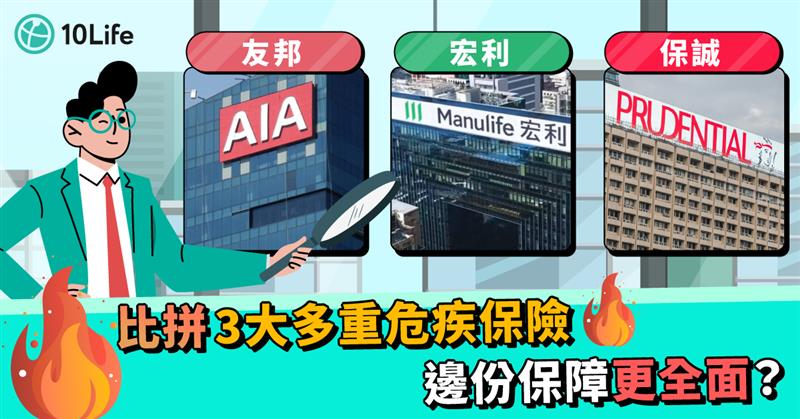
At different stages of life, people face varying levels of critical illness risk. However, with so many multi-pay critical illness insurance products on the market, choosing one that suits your needs is not easy. At present, agents of three major insurance companies are actively promoting their latest multi-pay critical illness insurance products, namely AIA’s On Your Side Insurance Plan 2, ManulifeIncomeGuard Critical Illness Protector and Prudential’s PRUHealth Guardian Critical Illness Plan.
These three popular critical illness insurance products are engaged in fierce competition in terms of their coverage, as insurers seek to stand out in the market and attract customers. This time, we have selected five “selling points” for a focused comparison and analysis. Before taking out a policy, consumers should also clearly understand their own needs.
The first step in analysing critical illness insurance is to pay attention to several figures, including the maximum payout percentage and the maximum number of claims for individual critical illnesses. Only by understanding the claims mechanism clearly can you choose critical illness insurance that suits your needs. In addition, multi-claim critical illness insurance has become increasingly popular in recent years, typically providing multiple payouts for major critical illnesses. For example, if you purchase critical illness insurance with a sum assured of HK$1 million, the total payout could ultimately be several times higher.
Product | Maximum payout as a percentage of the sum insured | Maximum number of claims for individual critical illnesses |
1100% | Cancer: up to 6 times | |
1000% | Cancer: up to 9 times | |
1000% | Cancer: up to 3 times | |
| Notes: 1. Last updated on 21 October 2025 2. Also referred to as dementia in the policy documents, defined as Alzheimer's disease or an irreversible organic degenerative brain disease; for ease of comparison, the relevant condition is uniformly referred to as “cognitive impairment”. 3. The insured person may only receive a “subsequent cognitive impairment” payout if they have not previously received an insurance payout for cognitive impairment. | ||
Critical illness insurance with multiple-claim benefits is becoming increasingly important because cancer can spread or recur, while advances in medical care have significantly prolonged patients’ survival, resulting in higher medical expenses. Under traditional single-claim critical illness insurance, the policy terminates after the insured makes the first claim. Given today’s longer life expectancy, this level of protection may be insufficient. Multiple-claim benefits can provide more comprehensive protection, offering the insured continuous coverage throughout their long journey in life and greater peace of mind.
Of the three products above, AIA On Your Side Insurance Plan 2 offers the highest maximum claim percentage, at 1,100% of the insured amount, making it the highest among the products compared in this review.
2. Cancer compensation
Cancer is one of the major killers of urban residents. When choosing critical illness insurance, you should also review the various payout options. After all, different payout methods each have their own advantages and disadvantages depending on the illness, while a wider range of options naturally provides greater flexibility; a shorter waiting period can also enable the insured person to receive compensation sooner.
| Product | Traditional Multiple Cancer Claim Option^ | Ongoing Cancer Cash Allowance Option after First Cancer | Waiting Period1 | Proof of Active Treatment Required2 |
| AIA On Your Side Insurance Plan 2 | 6 times, up to 600% of the sum assured | 5% of the sum assured paid monthly; up to 100 months | 3 / 3 / 3 | Provided every 6 months |
| ManulifeManulife IncomeGuard Critical Illness Protector | 9 times, up to 900% of the sum assured | Not applicable | 1 / 1 / 1 | The insured must notify the insurer within 30 days after receiving active treatment each year |
| Prudential PRUHealth Guardian Critical Illness Plan | 3 times, up to 300% of the sum assured; | Not applicable | 3 / 3 / 3 | N/A |
| Note: ^Each cancer claim is capped at 100% of the sum assured. 1. The waiting period between the diagnosis date of the previous cancer and that of the subsequent cancer. These are the waiting periods for recurrent cancer / new cancer / ongoing cancer respectively. 2. “Active treatment” refers to any interventional treatment for cancer (including but not limited to surgery, radiotherapy, chemotherapy, targeted therapy, bone marrow transplant, proton therapy, immunotherapy, CyberKnife, Gamma Knife or any combination of the above treatments), and must be medically necessary. Applicable to claims received in the form of ongoing cash payments or additional cash payments. | ||||
In terms of cancer claims, the total cancer benefit under ManulifeIncomeGuard Critical Illness Protector can reach up to 900% of the sum insured, the highest among the three products. AIA On Your Side Insurance Plan 2 and Prudential PRUHealth Guardian Critical Illness Plan offer 600% and 300%, respectively.
Does the ability to claim for cancer more times mean better coverage? The insurers impose a waiting period for each claim, during which no benefit will be paid if cancer occurs again. The waiting periods are categorised into recurrent cancer, new cancer and continuous cancer. ManulifeIncomeGuard Critical Illness Protector has a waiting period of one year for all three categories, the shortest among the products compared, allowing the insured to receive another benefit sooner.
As cancer patients are living longer, some critical illness insurance plans provide a continuous cancer cash allowance, using monthly cash payments instead of a lump-sum benefit to cover long-term expenses. Assuming a sum insured of HK$1 million, if the insured unfortunately develops cancer again after making the first cancer claim, the multiple claims option allows the insured to choose either a lump-sum benefit of HK$1 million or a monthly benefit of 5% of the sum insured, equivalent to HK$50,000, paid monthly. However, once this option is selected, the multiple claims option cannot be reinstated. Taking AIA On Your Side Insurance Plan 2 as an example, its continuous cancer cash allowance is calculated as a monthly benefit of 5% of the sum insured, payable for up to 100 months, giving a total benefit of up to 500% of the sum insured.
3. Cognitive Impairment Cover
Cognitive impairment, such as dementia or Alzheimer’s disease, is a common condition among the elderly and significantly affects patients’ ability to care for themselves. According to Hospital Authority figures, one in six women and one in ten men aged 70 or above suffer from cognitive impairment. Although many critical illness insurance policies on the market cover cognitive impairment, some only provide cover for the first claim. If the insured person first suffers from cancer and develops cognitive impairment in later life, not every critical illness insurance policy will necessarily provide compensation for a second or subsequent claim for cognitive impairment. However, AIA On Your Side Insurance Plan 2 and Prudential PRUHealth Guardian Critical Illness Plan do not impose this restriction. Even if the insured person has previously made a claim for cancer and later develops cognitive impairment in old age, they can still receive compensation.
4. Maternity and childhood illness cover
The scope of critical illness insurance coverage continues to expand, with even unborn babies now eligible for cover. This appeals to many expectant mothers who wish to provide the best possible protection for their children before they are born. Childhood illnesses that may arise as the child grows are also covered, providing adequate protection at different stages of life.
| Product | Versions providing cover for unborn babies | Critical illness cover for newborn babies | Types of illnesses covered for children |
| AIA On Your Side Insurance Plan 2 | ✓ First Care Baby | ✓ Within 90 days of birth, payout is 20% of the sum assured | 13 types |
| ManulifeManulife IncomeGuard Critical Illness Protector | ✗ | ✗ | 17 types |
| Prudential PRUHealth Guardian Critical Illness Plan | ✓ Cherished Baby | ✓ Within 90 days of birth, payout is 20% of the sum assured | 15 types |
To welcome the arrival of a new life, AIA On Your Side Insurance Plan 2 and PRUHealth Guardian Critical Illness Plan both offer versions for unborn babies (namely AIA On Your Side Insurance Plan 2 - First Protect Baby and PRUHealth Guardian Critical Illness Plan - Cherished Baby), allowing pregnant women aged 18 to 45 who are at least 22 weeks pregnant to apply for coverage. The plans cover critical illnesses in newborn babies, paying 20% of the sum assured if the baby is diagnosed within 90 days of birth, and the full benefit amount if the diagnosis is made after 90 days of birth.
As babies grow, certain childhood illnesses should not be overlooked. ManulifeIncomeGuard Critical Illness Protector covers 17 childhood illnesses, including autism, severe epilepsy and intellectual impairment caused by illness or accidental injury. PRUHealth Guardian Critical Illness Plan covers 15 childhood illnesses, while AIA On Your Side Insurance Plan 2 covers 13 childhood illnesses.
5. Value for money of premiums and the “guaranteed premium unchanged” clause
Value for money is also an important consideration when choosing critical illness insurance. In addition to the coverage, consumers should also pay attention to the premiums, particularly whether the policy includes a ‘premium guaranteed to remain unchanged’ clause. Although there have not yet been any cases of insurers increasing the premiums of lifelong critical illness insurance after customers have taken out the policies, insurers are fully entitled to increase premiums. This is especially the case when advances in medical technology make it possible to treat more critical illnesses, or when the risk pool of an individual product is of poorer quality, either of which may lead to premium increases to control risks. However, ManulifeIncomeGuard Critical Illness Protector expressly states that the premiums are ‘guaranteed to remain unchanged’.
| Product | Annual premium (35-year-old non-smoking male, 25-year premium payment term, US$150,000 sum assured) | Baby version premium (35-year-old non-smoking female, 25-year premium payment term, US$150,000 sum assured) | Guaranteed level premium clause |
| AIA友邦 On Your Side Insurance Plan 2 | $4,403 | $1,733 | ✗ |
| ManulifeManulife IncomeGuard Critical Illness Protector | $6,008 | ✗ | ✓ |
| Prudential保誠 PRUHealth Guardian Critical Illness Plan | $4,800 | $1,901 | ✗ |
Finally, critical illness insurance policies from different insurers each have their own features. Readers can decide what kind of critical illness insurance to purchase based on their needs. However, before making a decision, it is necessary to gain an in-depth understanding of the products and compare them, rather than simply believing an agent’s sweet talk. Readers can also contact 10Life’s insurance advisers to find critical illness insurance that suits their needs.
Note:
1. The above premium information was updated on 21 October 2025 and does not include the premium levy collected by the Insurance Authority.
2. The above information is provided by 10Life for reference only and does not constitute a sales offer. Last updated: 21 October 2025.
This English version of this article has been generated by machine translation powered by AI. It is provided solely for reference purposes. In the event of any discrepancy or inconsistency between this translation and the original Chinese version, the Chinese version shall prevail.
Our team of professional content researchers focussing on insurance
Our team of professional content researchers focussing on insurance
10Life Product Comparison and 10Life Insurance Ratings are developed by 10Life Financial Limited, an authorised insurance broker company licensed with the Insurance Authority under License Number FB1526. 10Life Product Comparison and 10Life Insurance Ratings are developed for generic customer segments using mathematical calculations based on product information, facts and data, and are not influenced by any partnerships with or fees received from insurance companies. Any information on 10Life Platform ("10Life Information"), including but not limited to Product Comparison, Product Ratings, Blog Articles are intended for general education purpose and reference only. None of the 10Life Information is intended, nor should they be considered or relied upon, as regulated advice, insurance, financial, investment or professional advice, recommendation, approval, endorsement, invitation or solicitation in respect of any insurance, financial or investment products. 10Life Information does not take into account your individual needs. Reading 10Life Information should not be considered as conducting a suitability assessment, and is not sufficient to form the basis of any decisions to purchase any insurance products. You should rely on information authorised by insurance companies, carry out your own research and/or seek independent advice from licensed intermediaries before purchasing any insurance products or making any insurance decisions. While reasonable effort is used when collecting, validating and updating 10Life Information from various channels, none of 10Life Group and its subsidiaries, affiliates, agents, directors, officers and employees will be responsible for any liability, claim or loss arising from or associated with you using 10Life Information. No warranty, representation or guarantee is given by 10Life Group and its subsidiaries on the accuracy, completeness and timeliness of the information. If you have any questions on 10Life Product Comparison and 10Life Insurance Ratings, please email us at enquiries@10life.com




 Talk to 10Life on WeChat
