









10Life Financial Limited
Enquiries: enquiries@10life.com
Hotline: (852) 3705 1599
Address: 16/F Greatmany Centre, 109-115 Queen’s Road East, Wan Chai, Hong Kong



Which home insurance policies in Hong Kong accept properties over 45 years old?
Why is it more difficult to buy home insurance for buildings over 45 years old?
Insurers are primarily not concerned about damage to household contents, but rather the risk of third-party liability.
How common are older buildings in Hong Kong? 80% of residential buildings are 30 years old or above
Many large housing estates have in fact already entered an advanced age; it is not only old tenement buildings that are considered “old buildings”.
For owners of buildings over 45 years old, 5 things to note before taking out insurance
Which types of older buildings are most likely to face insurance restrictions?
Are insurance premiums for a 45-year-old old building always more expensive?
10Life Viewpoint | When buying home insurance for an older building, you should not look only at the premium
Frequently Asked Questions on Home Insurance for Older Buildings


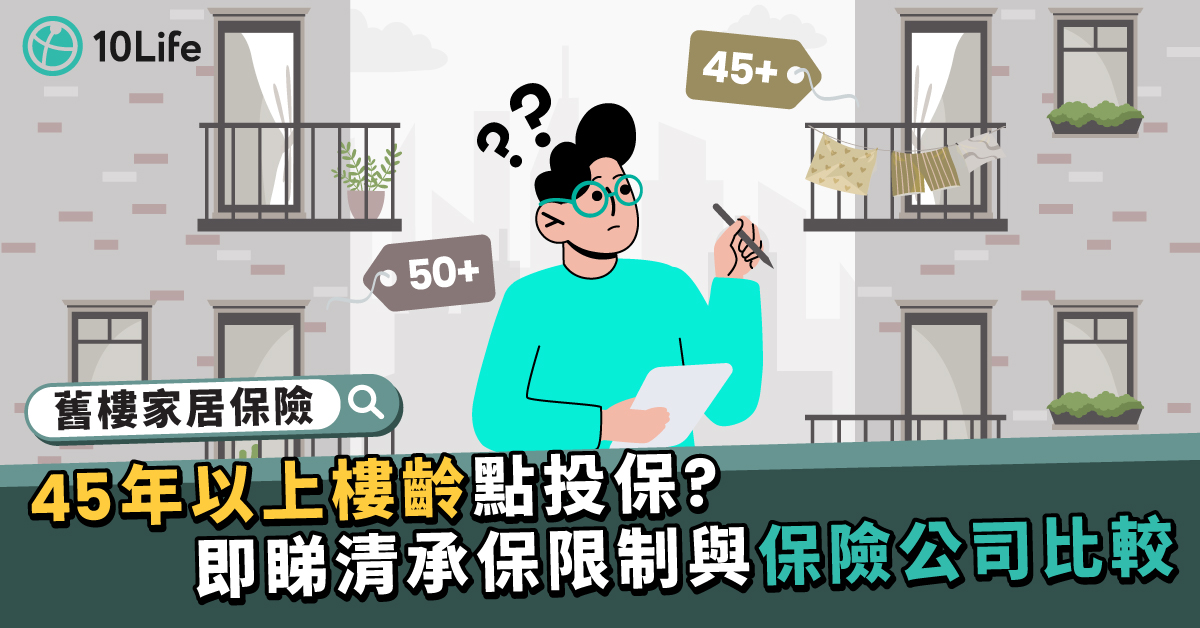
Newly built flats are often attractively renovated and come with luxurious clubhouses, drawing many young residents. However, in recent years, many developers have introduced highly “creative” layouts and designs in order to maximise saleable area. Examples include dining rooms so small that there is barely room for a dining table, windowless bathrooms with narrow shower cubicles or sit-in bathtubs, and balconies with awkward “handshake gaps”, all of which have left many owners of new flats feeling frustrated.
If we turn back the clock 45 years, the living environment for Hong Kong’s middle class was actually quite comfortable. Early large-scale housing estates such as Mei Foo Sun Chuen, Taikoo Shing and other developments generally had practical layouts, ample space, better sound insulation and more comprehensive community facilities. However, these once-admired estates are now gradually becoming older buildings.
When applying for a mortgage, owners of older buildings may face more restrictions. The same applies when taking out home insurance. If a property is more than 45 years old, it may not necessarily be refused cover, but some insurers may impose age limits, require additional underwriting, charge higher premiums or even restrict certain benefits. Therefore, when insuring an older property, owners should pay particular attention to details such as the maximum property age accepted, water pipe leakage, third-party liability and temporary accommodation cover.
10Life has compiled home insurance products available in Hong Kong that accept properties over 45 years old, together with key selection points, to help owners understand the differences in coverage and make a more suitable choice.
Which home insurance policies in Hong Kong accept properties over 45 years old?
The property age requirements vary significantly among insurers. Some companies do not set any property age limit; for example, Prudential (卓爾之家) and Chubb Insurance (Plan B) have no upper limit, while others only accept properties under 50 years old. The following summarises the property age limits and key coverage details of the major home insurance providers, for owners of properties aged 45 years or above:
Assuming the owner-occupier uses the property for self-use, the property is a unit in a multi-storey building aged 45 years, with a saleable area of 300 sq ft.
| Insurer | 10Life Score | First-year premium (HKD) | Maximum covered building age | Home contents cover (HKD) | Legal liability cover (HKD) |
| Ping An 中國平安 家居保險(5層以上) |
7.9 | $610 Enjoy 25% off by purchasing the designated plan online via 10Life →Apply now← |
50 years | $1,000,000 | $10,000,000 |
| BOCG 中銀集團保險 周全家居綜合險保單 計劃3 |
7.9 |
$771 Enjoy 25% off by purchasing the designated plan online via 10Life →Apply now← |
45 years | $1,200,000 | $10,000,000 |
| Dah Sing Insurance 大新保險 樂加家 - 計劃 C |
9.4 | $810 Enjoy 25% off by purchasing via the insurer’s website through 10Life →Apply now← |
60 years |
$1,200,000 |
$1,200,000 |
| OneDegree 家居保險 (加強計劃) |
7.6 | $831 |
50 years | $1,000,000 | $12,000,000 |
| Allianz 安聯 安聯家居保障計劃 - 金計劃 |
7.6 | $883 | 60 years | $1,200,000 | $8,000,000 |
| Prudential 保誠 精選家居寶 卓爾之家 |
9.0 | $860 →Apply now← |
No limit / not specified | $1,500,000 | $1,500,000 |
| QBE 昆士蘭保險 家居綜合保險 卓越 |
9.0 | $950 Enjoy 25% off by purchasing the designated plan online via 10Life →Apply now← |
50 years | $1500,000 | $10,000,000 |
| MSIG iHome 家居保險 計劃 A |
8.7 | $1,006 Enjoy 25% off by purchasing the designated plan online via 10Life →Apply now← |
50 years | $1,000,000 | $8,000,000 |
| Chubb Insurance 安達保險 我的家居保險 計劃 B |
8.3 | $1,058 | No limit / not specified | $500,000 | $10,000,000 |
|
Notes:
|
|||||
As shown in the above table, Prudential and Chubb Insurance do not impose an upper limit on building age, making them suitable for owners of older buildings with a higher building age. MSIG, QBE, Ping An and OneDegree accept buildings up to 50 years old. It is worth noting that even if an insurer states that a particular building age is acceptable, the actual underwriting decision may still be adjusted in terms of premium and cover depending on factors such as the building type and maintenance condition.
Why is it more difficult to buy home insurance for buildings over 45 years old?
When insurance companies assess home insurance, the age of the building is an important consideration. The reason is simple: the older the building, the more likely the property’s structure is to have deteriorated, and the greater the chance of accidents and claims.
Common risks associated with older buildings include:
For example, many Hong Kong tenement buildings or early large housing estates that are over 50 years old still use older water supply or electrical systems. If an accident occurs, it may not only involve repair costs, but could also lead to claims from neighbours or even third parties.
Insurers are primarily not concerned about damage to household contents, but rather the risk of third-party liability.
Many people think home insurance mainly covers household contents, such as damaged electrical appliances and flooding. However, for older buildings, what insurers are most concerned about is actually large third-party liability claims. Common scenarios include:
If any of the above incidents occur, a single case may involve third-party liability claims amounting to hundreds of thousands, or even more than one million dollars. Therefore, the importance of the legal liability cover limit can at times be even greater than that of home contents cover.
How common are older buildings in Hong Kong? 80% of residential buildings are 30 years old or above
According to research data, by the end of 2025, Hong Kong will have approximately 21,355 residential buildings aged 30 years or above, accounting for about 80% of similar residential buildings. Among them, nearly half — 13,125 buildings — are over 50 years old.1
In other words, “older buildings” are actually more common than many people imagine.
Region | 30–49.9 years | 50 years or above | Proportion aged 30 or above |
| Hong Kong Island | 33% | 56% | 89% |
| Kowloon | 21% | 63% | 84% |
| New Territories | 43% | 20% | 63% |
The issue of building age is most pronounced in Kowloon, where 63% of residential buildings are over 50 years old; on Hong Kong Island, 56% of residential buildings are also over 50 years old. By comparison, New Territories properties are generally newer, but 63% of residential buildings are still over 30 years old.
Many large housing estates have in fact already entered an advanced age; it is not only old tenement buildings that are considered “old buildings”.
When people mention “older buildings”, many will immediately think of tenement buildings or single-block old buildings. However, many large housing estates in Hong Kong are already over 30 years old, and some are approaching or even exceeding 40 years in age. In other words, even owners of well-known large housing estates may also face issues with home insurance age restrictions.
| Housing estate | Year of occupation (approx.) | Age of building (in 2026) |
| Taikoo Shing | 1976–1987 | Approx. 39–50 years |
| Whampoa Garden | 1985–1991 | Approx. 35–41 years |
| Parc Oasis | 1992–1995 | Approx. 31–34 years |
| Mei Foo Sun Chuen | 1968–1978 | Approx. 48–58 years |
| Beacon Hill Garden | 1986–1987 | Approx. 39–40 years |
| Laguna City | 1990–1994 | Approx. 32–36 years |
| Kornhill Garden | 1985–1990 | Approx. 36–41 years |
| Telford Gardens | 1980–1982 | Approx. 44–48 years |
| Amoy Gardens | 1981–1987 | Approx. 39–45 years |
| Kornhill | 1985–1988 | Approx. 38–41 years |
| Heng Fa Chuen | 1985–1989 | Approx. 37–41 years |
| Braemar Hill Mansions | 1991–1993 | Approx. 33–37 years |
| Kingswood Villas | 1991–1998 | Approx. 28–35 years |
| City One Shatin | 1980–1987 | Approx. 39–46 years |
Using Mei Foo Sun Chuen, Tak Fook Garden and City One Shatin as examples, some blocks are already over 45 years old, while some phases of Taikoo Shing and Mei Foo Sun Chuen are even approaching 50 years or more. In other words, many homeowners, even if they live in large housing estates, may still encounter building age restrictions when taking out home insurance. 2
For owners of buildings over 45 years old, 5 things to note before taking out insurance
Older buildings do not necessarily mean you cannot buy home insurance, but there are several points that are particularly easy to overlook when taking out cover.
Many property owners assume that if an insurer states it “accepts buildings up to 50 years old”, this means the application will be approved. In reality, building age is only one of the factors considered. Some insurers will also assess the following when underwriting:
In other words, a building that is 50 years old may not necessarily be rejected. It is advisable to check the insurer’s specific underwriting requirements in advance to avoid finding out after submitting an application that you do not meet the criteria.
The greatest risk for older buildings is third-party liability incidents, such as falling concrete injuring someone, a burst pipe flooding a neighbour’s flat, or a falling aluminium window frame. Once an accident occurs, the claim amount can easily run into hundreds of thousands, or even exceed one million dollars. Owners of properties over 45 years old may wish to prioritise policies with higher liability limits, for example:
Prudential (Home Secure): liability cover up to HK$15,000,000
OneDegree (Enhanced Plan): liability cover up to HK$12,000,000
In Hong Kong, about 80% of flushing water is salt water, and the salt-water pipes in older buildings have been used for many years, so the risk of deterioration and bursting is relatively high. If a pipe bursts, it may affect your own unit and even neighbouring flats below, or public facilities, with repair and compensation costs potentially being very substantial.
Therefore, you should check whether the home insurance for older buildings covers burst pipes, flooding or leakage incidents, as well as the insurer’s “water damage excess”.
Assuming the owner-occupier uses the property for self-use, the property is a unit in a multi-storey building with an age of 45 years and a saleable area of 300 square feet.
| Insurer | Maximum building age | Home contents cover | Per-item limit (HK$) | Public liability cover (HK$) | Personal accident cover (HK$) | Water damage excess (41 years or above) (HK$) |
| Ping An 中國平安 家居保險(5層以上) |
50 years | $1,000,000 | $150,000 | $10,000,000 | $200,000 | $3,000 or 10% of loss (whichever is higher) |
| BOCG 中銀集團保險 周全家居綜合險保單 計劃3 |
45 years | $1,200,000 | $100,000 | $10,000,000 | $400,000 | $500 or 10% of loss (whichever is higher) |
| Dah Sing Insurance 大新保險 樂加家 - 計劃 C |
60 years |
$1,200,000 |
120,000 $150,000 |
$1,200,000 | $100,000 | $1,000 |
| OneDegree 家居保險 (加強計劃) |
50 years | $1,000,000 | $75,000 | $12,000,000 | $200,000 | $1,500 or 10% of loss (whichever is higher) |
| Allianz 安聯 安聯家居保障計劃 - 金計劃 |
60 years | $1,200,000 | Home contents: by area; valuables: 24,000; individual items: 240,000 | $8,000,000 | NA |
|
| Prudential 保誠 精選家居寶 卓爾之家 |
No limit / not specified | $1,500,000 | $150,000 (Furniture, household articles or electrical appliances) |
$1,500,000 | $200,000 | $250 or 10% of loss (whichever is higher) |
| QBE 昆士蘭保險 家居綜合保險 卓越 |
50 years | $1500,000 | Not specified | $10,000,000 | $150,000 |
|
| MSIG iHome 家居保險 計劃 A |
50 years | $1,000,000 | $100,000 | $8,000,000 | $100,000 |
|
| Chubb Insurance 安達保險 我的家居保險 計劃 B |
No limit / not specified | $500,000 | $100,000 (specified items: $10,000) | $10,000,000 |
$300,000 |
High-rise: $1,500 or 10% of loss Low-rise: $2,000 or 10% of loss (whichever is higher) |
|
Notes:
|
||||||
As can be seen from the table above, the structure of Prudential is relatively simple. However, as the age of the building increases, the water damage excess for many insurers also rises. For example, for QBE, OneDegree and Allianz, the excess for older properties can reach $10,000 or more.
If a flat has to be vacated temporarily due to fire or serious flooding, temporary accommodation costs can be substantial, especially where repairs take a long time. The maximum temporary accommodation cover varies significantly between insurance plans:
Please note: the scope of compensation under temporary accommodation cover does not include accommodation needs arising from major building repairs or renovation/decorating works carried out by the owner of the flat.
A home contents cover of HK$1 million does not mean that every item will be compensated in full, because each insurance plan sets a per-item compensation limit, and any amount above that must be borne by the policyholder. Taking common market per-item limits as examples:
Dah Sing Insurance | HomePlus - Plan C: HK$120,000 per item
Prudential (Premier Home): HK$150,000 per item for furniture, home contents or electrical appliances
BOCG Insurance | Comprehensive Home Insurance Policy Plan 3 $100,000
Ping An | Home Insurance (5 storeys or above):$150,000
MSIG | iHome Home Insurance - Plan A:$100,000
If you have valuable items at home such as high-end computers, cameras, designer handbags or luxury watches, pay particular attention to whether the per-item limit is sufficient. If necessary, you may consider purchasing separate valuables insurance.
Which types of older buildings are most likely to face insurance restrictions?
Tenement buildings are typically older, with varying structural maintenance. In addition, issues such as unauthorised rooftop structures and alterations to kitchens and bathrooms make insurers more cautious during underwriting. Some insurers may require an on-site inspection or a building condition report before providing cover.
Some insurers treat village houses as a separate detached-house category, with underwriting requirements different from those for urban residential properties. Village houses with a higher age, together with extensive outdoor areas, may face more coverage restrictions.
Public rental housing and Home Ownership Scheme flats are managed by the Housing Authority, and some early estates are already 40 to 50 years old. Although structural maintenance is usually the responsibility of the management body, cover for personal belongings within the unit and third-party liability still needs to be arranged by the owner. Some insurers apply different underwriting criteria to public rental housing and Home Ownership Scheme units.
For older single-block buildings without a management company, maintenance of communal facilities often relies on the owners’ corporation or the initiative of individual owners, resulting in uneven overall maintenance standards. When assessing such properties, insurers generally consider them to present a higher risk than larger managed estates.
For properties aged 50 to 60 years, owners have very limited choice. According to information compiled by 10Life, the companies currently accepting insurance applications for such very old properties in the market are mainly Prudential and Chubb Insurance (both without age restrictions). Owners are advised to contact insurers or intermediaries as early as possible to understand the underwriting requirements.
Are insurance premiums for a 45-year-old old building always more expensive?
Many property owners worry that premiums for older buildings will be significantly higher than those for standard properties, but this is not necessarily the case in practice. Home insurance premiums are affected by a number of factors, including:
As can be seen from the comparison table, taking an owner-occupied unit in a multi-storey building that is 45 years old and has a usable area of 300 sq ft as an example: Ping An Home Insurance (5 storeys or above) starts from as low as HK$610 in the first year after conversion; while Prudential’s selected “Home Treasure” - Chose Home has a first-year premium of HK$860. This shows that, although the policyholder is insuring an older property, both premiums remain affordable. In fact, the key factors influencing home insurance premiums are often the unit size and the level of cover in the plan, rather than building age alone.
Therefore, consumers should avoid “looking only at the premium and not the policy terms” when taking out insurance. It is advisable to compare the total premium with each plan’s scope of cover, excess (deductible) and claim limits in a holistic manner, so as to identify the truly cost-effective protection plan.
10Life Viewpoint | When buying home insurance for an older building, you should not look only at the premium
Many homeowners see that a company is willing to provide cover and immediately take out a policy. However, the real risks for older buildings often come from plumbing, third-party liability and the ageing of the property. If the cover is insufficient, a single water leak or claim arising from an accident could create significant financial pressure.
Taking a flat in a building that is over 45 years old as an example, the key areas of cover that owners should pay closest attention to include:
10Life recommends that owners of older buildings should place primary emphasis on whether the cover is comprehensive when choosing home insurance, rather than simply seeking the lowest premium. Visit 10Life’s Home Insurance Comparison page to compare.
Frequently Asked Questions on Home Insurance for Older Buildings
No. Some insurers, such as Prudential and Chubb Insurance, do not impose an age limit on the building, and may still accept properties aged 50 to 70 years or even older for insurance. However, final acceptance still depends on the property’s condition, type and underwriting requirements. It is advisable to check directly with the insurer.
Not necessarily. The home insurance premiums for owners of old buildings are not necessarily significantly higher than those for new buildings; the main impact is that there are fewer options available. Pricing strategies vary from company to company, so it is advisable to compare carefully and not accept unsuitable coverage simply because the choices are limited.
Some plans can, but the scope of cover and terms may differ from those for owner-occupied flats. Further reading: 【Renter’s Home Insurance】How should you choose tenant insurance? Check out highly rated home insurance now
It depends on where liability lies and the policy terms. If the water leakage is the insured’s responsibility, the third-party liability cover under a typical home insurance policy may cover the relevant compensation. However, please note that different policies vary in how leakage liability is defined and in excess arrangements. It is advisable to read the policy terms carefully before taking out cover, or to consult an insurance adviser. Further reading: 【Home Insurance】What should you do if the upstairs unit leaks? Who is liable if water leaks to the downstairs flat? A guide to seepage liability and insurance cover
Reference Materials
This English version of this article has been generated by machine translation powered by AI. It is provided solely for reference purposes. In the event of any discrepancy or inconsistency between this translation and the original Chinese version, the Chinese version shall prevail.
10+ years in editing & copywriting. I love solving puzzles — now my goal is making insurance jargon simple. Let's decode policies and learn together.
10+ years in editing & copywriting. I love solving puzzles — now my goal is making insurance jargon simple. Let's decode policies and learn together.
10Life Product Comparison and 10Life Insurance Ratings are developed by 10Life Financial Limited, an authorised insurance broker company licensed with the Insurance Authority under License Number FB1526. 10Life Product Comparison and 10Life Insurance Ratings are developed for generic customer segments using mathematical calculations based on product information, facts and data, and are not influenced by any partnerships with or fees received from insurance companies. Any information on 10Life Platform ("10Life Information"), including but not limited to Product Comparison, Product Ratings, Blog Articles are intended for general education purpose and reference only. None of the 10Life Information is intended, nor should they be considered or relied upon, as regulated advice, insurance, financial, investment or professional advice, recommendation, approval, endorsement, invitation or solicitation in respect of any insurance, financial or investment products. 10Life Information does not take into account your individual needs. Reading 10Life Information should not be considered as conducting a suitability assessment, and is not sufficient to form the basis of any decisions to purchase any insurance products. You should rely on information authorised by insurance companies, carry out your own research and/or seek independent advice from licensed intermediaries before purchasing any insurance products or making any insurance decisions. While reasonable effort is used when collecting, validating and updating 10Life Information from various channels, none of 10Life Group and its subsidiaries, affiliates, agents, directors, officers and employees will be responsible for any liability, claim or loss arising from or associated with you using 10Life Information. No warranty, representation or guarantee is given by 10Life Group and its subsidiaries on the accuracy, completeness and timeliness of the information. If you have any questions on 10Life Product Comparison and 10Life Insurance Ratings, please email us at enquiries@10life.com




 Talk to 10Life on WeChat
