









10Life Financial Limited
Enquiries: enquiries@10life.com
Hotline: (852) 3705 1599
Address: 16/F Greatmany Centre, 109-115 Queen’s Road East, Wan Chai, Hong Kong



4 Main Types of Playgroup Courses
How should I choose a playgroup course?
Lay the groundwork for your children early and support important life milestones


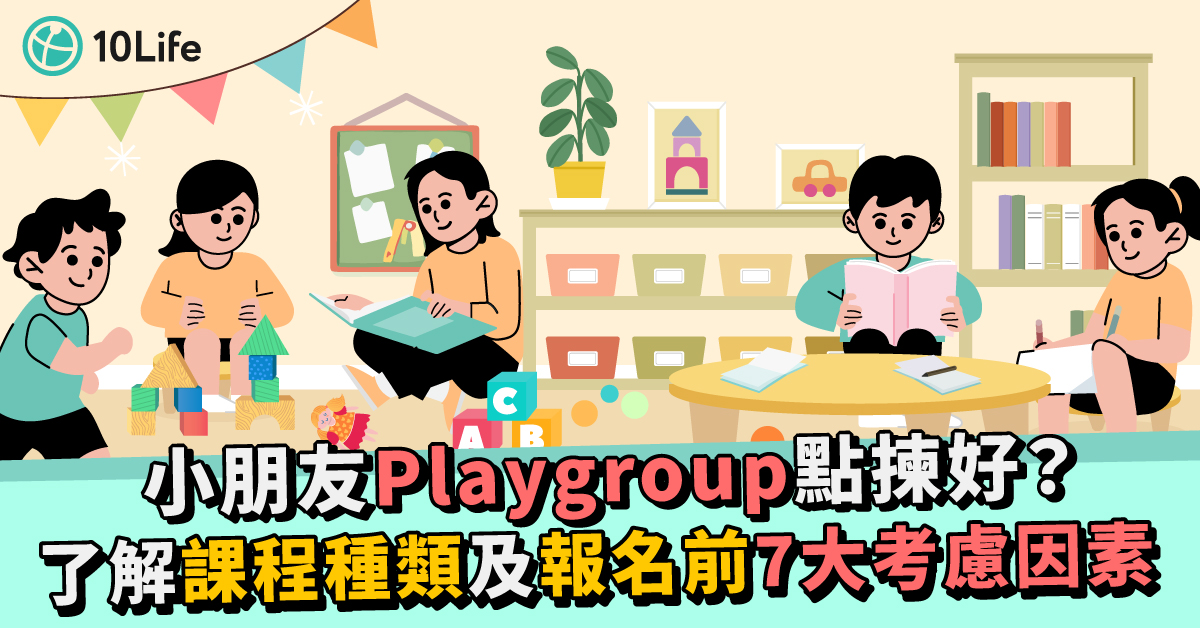
As parents, of course we want our children to get ahead from the very start. Choosing a suitable playgroup for young children can help identify their talents early, nurture their abilities, improve their communication skills, and support their physical and mental development. It can also pave the way for admission to N classes in future. But with so many playgroup courses available, how should parents choose? Should you attend a trial class? Which playgroup has the better instructors? Are playgroup courses very expensive? This time, 10Life has compiled the features of various playgroup courses, as well as the seven key points to consider before enrolling, to help you find the most suitable playgroup course.
4 Main Types of Playgroup Courses
Playgroup is designed for children aged 1 to under 3 years old. It is mainly taught through playgroup-based activities, and many courses allow parents and children to participate together, helping to strengthen parent-child relationships. Children can also learn how to interact appropriately with others through contact and communication with other children. There are many types of playgroups, which can broadly be divided into language learning, arts, physical development, and sensory development:
Playgroups that focus on arts development concentrate on cultivating children’s creativity and artistic awareness. The courses mainly centre on activities such as music, drawing, dance, drama, and DIY, helping children develop their imagination and discover their artistic talents. For example, in music classes, children can improve their auditory and hand-foot coordination through singing, playing musical instruments, and rhythm training. Drawing and DIY activities can stimulate children’s visual development and allow them to express their creativity freely.
Sensory-based courses usually encourage children to get “hands on and feet on”, for example by drawing with their limbs, playing with sand and participating in “messy play”, thereby stimulating the five senses and promoting cognitive ability, while also enhancing observation skills and curiosity.
Playgroups that focus on physical development usually arrange a wide range of physical activities, such as “baby gym”, ball passing, hurdle jumping, competitive games and climbing relays, allowing children to enjoy themselves while building muscle strength, improving fitness, and promoting physical coordination. At the same time, they also learn how to solve problems independently and build self-confidence.
Most playgroups that focus on language development are conducted mainly in English or Putonghua, and are taught by native-speaking teachers. The courses mainly use interactive methods, such as storytelling and games, to help children learn languages in a relaxed environment. In addition, children are encouraged to listen and speak more, thereby improving their language expression skills, increasing their interest in foreign languages, and helping them acquire a second language at an early stage.
How should I choose a playgroup course?
There are all sorts of playgroups on the market, but their quality varies considerably. Parents can observe and assess them based on the following factors to choose the playgroup that best suits their child.
Before choosing a playgroup for their child, parents may wish to spend some time understanding the details of the course, including class times, course content and teaching approach. As each playgroup has a different teaching model and lesson content, parents can gain a better understanding of whether the course meets their child’s interests and developmental needs by attending a trial class. For example, if a child is relatively quiet, a music-based or arts-based playgroup may be suitable; if a child is active and highly curious, a playgroup focused on physical activity or sensory development may be more appropriate.
In addition, class duration is also an important consideration. In general, playgroup sessions last one to two hours; a longer course may tire the child and affect their concentration.
An instructor’s professional knowledge and experience often affect a child’s learning experience. Instructors with professional knowledge and patience can create an enjoyable learning environment, enabling children to acquire new knowledge happily. When choosing a playgroup, parents may wish to enquire about the teachers’ qualifications and teaching experience, and observe their interactions with the children during a trial class to ensure that their child is learning in a safe and professional environment.
Each playgroup has its own fee structure. In addition to basic tuition fees, some playgroups may charge extra fees, such as materials or activity fees, which parents should understand clearly before enrolling. Generally speaking, playgroup fees are charged per session or monthly. Parents are advised to choose instalment payment options to avoid paying too much tuition at once. It is worth noting that price is not the only measure; parents should compare the course content, teacher-to-student ratio and class arrangements of different playgroups to find one that best fits their budget while still offering good quality.
In addition, when considering playgroups, many parents prioritise those that are connected with or affiliated to kindergartens, as a way of paving the way for their child’s future N-class admission (commonly known as “joining the sponsoring body”). However, it should be noted that even if a child successfully enters one of these premium playgroups, this does not guarantee kindergarten admission; it merely increases the chances. Moreover, these playgroups are usually more expensive, so parents should carefully consider their budget when making a choice.
Children are their parents’ precious treasures, so naturally parents want to avoid any accidents during class. Therefore, when choosing a playgroup, parents should visit the venue in person to check whether there are sufficient safety facilities, and whether the space is spacious and hygienic, to ensure that their child can learn in a safe environment.
If the class is too large, the instructor may not be able to take care of each child’s needs, significantly reducing learning effectiveness. Therefore, when making a choice, parents should pay close attention to class size and the teacher-to-student ratio. In addition, some playgroups allow parents to accompany their child in class, helping to enhance the child’s sense of security. If the child is younger and somewhat shy, parents may start with parent-child classes, gradually helping the child adapt to a new learning environment. This not only promotes parent-child interaction, but also makes it easier for parents to meet other parents and share childcare experiences.
Many parents, in order to enrol their child in a renowned playgroup, are willing to travel long distances to attend classes far from home. This not only increases their own burden, but may also leave the child feeling tired and affect their performance in class. Parents may wish to consider playgroups that are conveniently located, close to where they live or work, as this can reduce commuting time and make it easier to pick up and drop off their child or to keep track of class arrangements. In addition, parents can use a trial class to understand the actual commute time and assess whether it is within an acceptable range.
As playgroup courses in Hong Kong are not regulated under the Education Ordinance or the Child Care Services Ordinance, and are mainly run by commercial organisations or non-profit organisations, parents should carefully choose a reliable operator before enrolling. They may also check the playgroup’s reputation online and read other parents’ reviews of the course to avoid making a poor choice.
Lay the groundwork for your children early and support important life milestones
One of the main reasons for enrolling in a Playgroup is to pave the way for future admission to N class. If parents would like to learn more about N class interviews, please refer to N class interview guide: N class admission age, application time and tuition fees. In addition, to give their children a fulfilling life, many parents consider purchasing medical insurance and savings insurance for their children. You may refer to 10Life’s comparisons of different insurance products, with detailed coverage and premiums presented clearly, together with dedicated actuary ratings. If you are interested in learning more, you are also welcome to enquire with 10Life’s professional insurance consultants.
Further reading:
N class interview guide: N class admission age, application time and tuition fees
[Direct Subsidy Primary Schools] Higher rankings? How expensive is the tuition? A one-stop guide to what to note when applying for a DSS primary school
[International Schools] Annual tuition fees can differ by HK$100,000? A comparison of tuition fees at popular international schools
[IB International Baccalaureate] Why is it so popular? Breaking down the features and benefits of the IB curriculum (with a comparison to IGCSE and the Canadian education system)
Article last updated on: 18 October 2024
This English version of this article has been generated by machine translation powered by AI. It is provided solely for reference purposes. In the event of any discrepancy or inconsistency between this translation and the original Chinese version, the Chinese version shall prevail.
Our team of professional content researchers focussing on insurance
Our team of professional content researchers focussing on insurance
10Life Product Comparison and 10Life Insurance Ratings are developed by 10Life Financial Limited, an authorised insurance broker company licensed with the Insurance Authority under License Number FB1526. 10Life Product Comparison and 10Life Insurance Ratings are developed for generic customer segments using mathematical calculations based on product information, facts and data, and are not influenced by any partnerships with or fees received from insurance companies. Any information on 10Life Platform ("10Life Information"), including but not limited to Product Comparison, Product Ratings, Blog Articles are intended for general education purpose and reference only. None of the 10Life Information is intended, nor should they be considered or relied upon, as regulated advice, insurance, financial, investment or professional advice, recommendation, approval, endorsement, invitation or solicitation in respect of any insurance, financial or investment products. 10Life Information does not take into account your individual needs. Reading 10Life Information should not be considered as conducting a suitability assessment, and is not sufficient to form the basis of any decisions to purchase any insurance products. You should rely on information authorised by insurance companies, carry out your own research and/or seek independent advice from licensed intermediaries before purchasing any insurance products or making any insurance decisions. While reasonable effort is used when collecting, validating and updating 10Life Information from various channels, none of 10Life Group and its subsidiaries, affiliates, agents, directors, officers and employees will be responsible for any liability, claim or loss arising from or associated with you using 10Life Information. No warranty, representation or guarantee is given by 10Life Group and its subsidiaries on the accuracy, completeness and timeliness of the information. If you have any questions on 10Life Product Comparison and 10Life Insurance Ratings, please email us at enquiries@10life.com




 Talk to 10Life on WeChat
