









10Life Financial Limited
Enquiries: enquiries@10life.com
Hotline: (852) 3705 1599
Address: 16/F Greatmany Centre, 109-115 Queen’s Road East, Wan Chai, Hong Kong



What is an estate?
What formalities and procedures are involved in inheriting an estate in Hong Kong?
Hong Kong inheritance law: with a will VS without a will
Is there a time limit for applying for probate? What else should I be aware of?
How long does it take for heirs to receive the inheritance?
How can inheritance disputes be reduced?


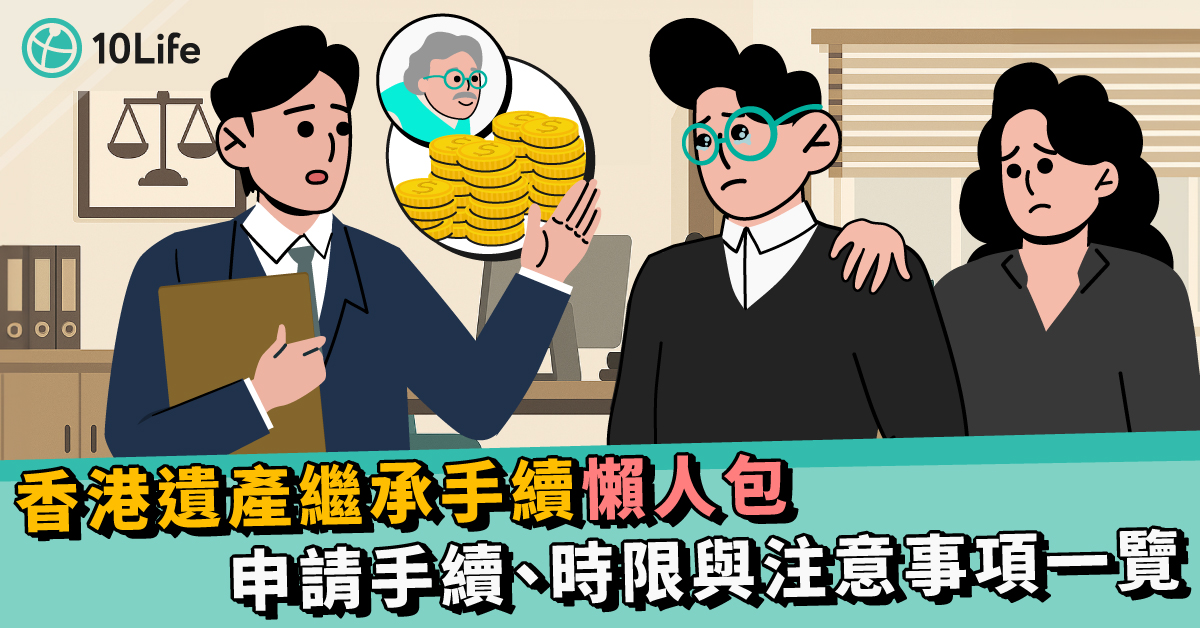
Life is unpredictable, and estate planning is not just for the wealthy. Regardless of the size of your assets, if you own property, you will need to address the distribution of your estate. Prepare a clear plan for your family to avoid disputes over inheritance or financial difficulties in the future. This article brings together the essential knowledge of Hong Kong’s inheritance law, including the probate process, key legal considerations, processing timelines, and how life insurance, trusts and other methods can simplify arrangements and reduce disputes.
What is an estate?
An estate refers to the assets left by a person after their death, including cash, property, shares and bank deposits. These assets are distributed according to the contents of the will or Hong Kong’s Probate and Administration Ordinance, and inherited by the lawful beneficiaries.
Lawful beneficiaries generally include the spouse, children, parents and other statutory relatives. If the deceased did not leave a will, the estate will be distributed according to the statutory order of priority. In addition, since 1993, children born outside marriage and adopted children have enjoyed the same inheritance rights as legitimate children under the law, ensuring fairness in inheritance arrangements.
Common types of estate:
Items not forming part of an estate:
What formalities and procedures are involved in inheriting an estate in Hong Kong?
In Hong Kong, whether or not there is a will, estate administration and inheritance must be handled in accordance with the procedures prescribed by Hong Kong inheritance law. The entire process includes verifying the will, applying for court authorisation, submitting documents and ultimately distributing the assets.
Before handling the procedures, all of the deceased’s assets and liabilities should first be organised, including bank accounts, properties, shares, insurance policies, debts and personal belongings, with a detailed inventory prepared. This inventory will subsequently serve as important supporting documentation for the application.
It is first necessary to ascertain whether the deceased made a will, as this will directly affect the subsequent application procedure. Private documents and safe deposit boxes may be checked, or a solicitor may be engaged to assist with an enquiry to The Law Society of Hong Kong as to whether a will has been registered.
If there is a will, its legal validity must be confirmed before applying for probate. Under the Wills Ordinance, a valid will must satisfy all of the following conditions:
▸ Basic formal requirements
▸ Legal capacity and testamentary intention
▸ Points to note and special circumstances
If there is a valid will, the executor named in it should apply to the court for a grant of probate. If there is no will, the beneficiaries entitled under the law should apply, in order of priority, for letters of administration. If there are several applicants of the same priority, the court will consider who is the most appropriate person to administer the estate.
If the estate is straightforward, such as involving only a small amount of money or no dispute, assistance may be sought from the Home Affairs Department or the Probate Registry. However, in more complex circumstances, such as where property, cross-border assets or inheritance disputes are involved,assistance may be sought from a solicitor to ensure that the procedures are lawful and proceed smoothly.
If the deceased or the applicant is not a Hong Kong resident, supplementary documents or a legal opinion issued by a local solicitor may also be required.
After receiving all the application materials, the court will review the documents. If the information is complete and there is no dispute, a grant of probate or letters of administration will generally be issued within 5 to 7 weeks. If there are errors in the application materials, a dispute is involved or the matter is cross-border, the approval process may take longer.
Once the grant has been issued, the executor or administrator may deal with the estate, including:
The entire process involves multiple legal procedures and the preparation of documents. If there is any uncertainty regarding the estate, it is advisable to consult the Probate Registry or seek professional advice at an early stage to avoid affecting the inheritance arrangements.
Hong Kong inheritance law: with a will VS without a will
In Hong Kong, how a deceased person’s estate is distributed depends on whether they left a will.
If there is a valid will, the estate will be distributed according to its contents. The executor named in the will is responsible for handling the relevant matters, such as settling debts and arranging the transfer of ownership, before distributing the remaining estate to the beneficiaries named in the will. A will can clearly specify who is to inherit which assets, such as property, cash or other assets. This helps ensure that the estate is distributed according to the deceased’s wishes and can also help reduce disputes among family members.
If there is no will, the estate will be dealt with under the Intestates’ Estates Ordinance. In this case, the estate will be distributed according to the order prescribed by law, usually to relatives such as the spouse, children, parents, and siblings. For example:
It is worth noting that Hong Kong abolished estate duty in 2006, so no tax is payable when inheriting an estate. However, some legal or application fees may still be payable when dealing with an estate, so it is advisable to understand the procedures clearly in advance.
Is there a time limit for applying for probate? What else should I be aware of?
Dealing with inheritance in Hong Kong involves not only legal procedures, but also various matters that require attention. The following are common legal points and matters to note when applying for a grant of representation:
In Hong Kong, an application for a grant of representation must be made in accordance with the Probate and Administration Ordinance (Chapter 10). Regardless of whether the deceased left a will, the applicant must apply to the Probate Registry of the High Court and obtain a grant issued by the court:
Only a person who has been issued a grant has the legal authority to deal with the deceased’s assets in Hong Kong, including bank accounts, properties and shares. It is important to note that Hong Kong courts only deal with local estates. If the deceased held assets overseas, such as properties in Mainland China or deposits in foreign banks, separate arrangements must be made in accordance with the laws of the relevant jurisdiction.
Where there is a will, the executor named in the will has priority to make the application. Where there is no will, the persons entitled under the law of intestacy should apply in the order of priority set out in the Intestates’ Estates Ordinance, such as the spouse, children, parents and siblings.
The following restrictions should also be noted:
Although Hong Kong law does not prescribe a time limit for applying for a grant of representation, it is generally advisable to deal with the relevant procedures as soon as possible to avoid unnecessary risks arising later. For example, if an application is not made promptly, the deceased’s assets may be frozen due to there being no one to manage them, or may even be misappropriated. In addition, important documents, such as asset information or proof of family relationships, may be lost over time, affecting the progress of the application.
Furthermore, if disagreements arise among the beneficiaries and disputes are not resolved at an early stage, the entire estate distribution process may become more complicated, resulting in longer processing times. To ensure that the estate can be administered and distributed smoothly, it is advisable to take action promptly and prepare the required information.
When applying for a grant of representation, the following key points should be noted:
How long does it take for heirs to receive the inheritance?
As mentioned above, where there are relatively few types of assets, all documents are in order and there are no disputes, the court will usually issue the Grant (that is, the Grant of Probate) within approximately 5 to 7 weeks after the documents are filed. Only then can the executor distribute the estate to the beneficiaries. Where the assets are diverse, the documents are incomplete, overseas assets are involved or there are disputes, the process may take as long as six months or even a year.
How can inheritance disputes be reduced?
If inheritance matters are not handled properly, they can often lead to family disputes and even delay the distribution of assets. If you wish to ensure that your loved ones are fully protected after your death, it is very important to make arrangements early. The following measures can effectively prevent disputes and make estate planning clearer.
Making a will is the most fundamental and important step in succession planning. Through a will, you can clearly specify the beneficiaries and method of asset distribution, avoiding disputes among family members caused by unclear arrangements. At the same time, remember to appoint an executor and ensure that the entire will-making process, including the signing method, complies with Hong Kong's inheritance laws and regulations, to avoid its validity being challenged in the future.
Preparing a list of your assets and liabilities in advance helps your family quickly understand your financial situation when necessary, and can also prevent misunderstandings caused by unclear information. In addition to making a will, the following financial tools are also worth considering:
The earlier and clearer your estate arrangements are, the greater the protection for your family. Whether making a will, taking out life insurance or establishing a trust, each step is an important measure for reducing future disputes and safeguarding family harmony. To learn more about life insurance, please refer to 【Whole-life insurance comparison】Is life insurance not intended for savings returns? Compare death benefits at a glance and Is the coverage sufficient? Term life VS whole life — how should you choose?
Further reading:
【Trust funds】An overview of the eligibility thresholds, types and fee standards for trust funds in Hong Kong
References:
1. Probate Registry
2. Community Legal Information Centre (CLIC). What are the requirements for a valid will?
3. Manulife. A simple guide to inheritance: 7 common questions answered one by one — probate procedures, estate tax, estate distribution, the Intestates' Estates Ordinance and more
4. Probate - six steps for applying for a grant of probate or letters of administration
本文最後更新日期:29 August 2025
This English version of this article has been generated by machine translation powered by AI. It is provided solely for reference purposes. In the event of any discrepancy or inconsistency between this translation and the original Chinese version, the Chinese version shall prevail.
Our team of professional content researchers focussing on insurance
Our team of professional content researchers focussing on insurance
10Life Product Comparison and 10Life Insurance Ratings are developed by 10Life Financial Limited, an authorised insurance broker company licensed with the Insurance Authority under License Number FB1526. 10Life Product Comparison and 10Life Insurance Ratings are developed for generic customer segments using mathematical calculations based on product information, facts and data, and are not influenced by any partnerships with or fees received from insurance companies. Any information on 10Life Platform ("10Life Information"), including but not limited to Product Comparison, Product Ratings, Blog Articles are intended for general education purpose and reference only. None of the 10Life Information is intended, nor should they be considered or relied upon, as regulated advice, insurance, financial, investment or professional advice, recommendation, approval, endorsement, invitation or solicitation in respect of any insurance, financial or investment products. 10Life Information does not take into account your individual needs. Reading 10Life Information should not be considered as conducting a suitability assessment, and is not sufficient to form the basis of any decisions to purchase any insurance products. You should rely on information authorised by insurance companies, carry out your own research and/or seek independent advice from licensed intermediaries before purchasing any insurance products or making any insurance decisions. While reasonable effort is used when collecting, validating and updating 10Life Information from various channels, none of 10Life Group and its subsidiaries, affiliates, agents, directors, officers and employees will be responsible for any liability, claim or loss arising from or associated with you using 10Life Information. No warranty, representation or guarantee is given by 10Life Group and its subsidiaries on the accuracy, completeness and timeliness of the information. If you have any questions on 10Life Product Comparison and 10Life Insurance Ratings, please email us at enquiries@10life.com




 Talk to 10Life on WeChat
