









10Life Financial Limited
Enquiries: enquiries@10life.com
Hotline: (852) 3705 1599
Address: 16/F Greatmany Centre, 109-115 Queen’s Road East, Wan Chai, Hong Kong



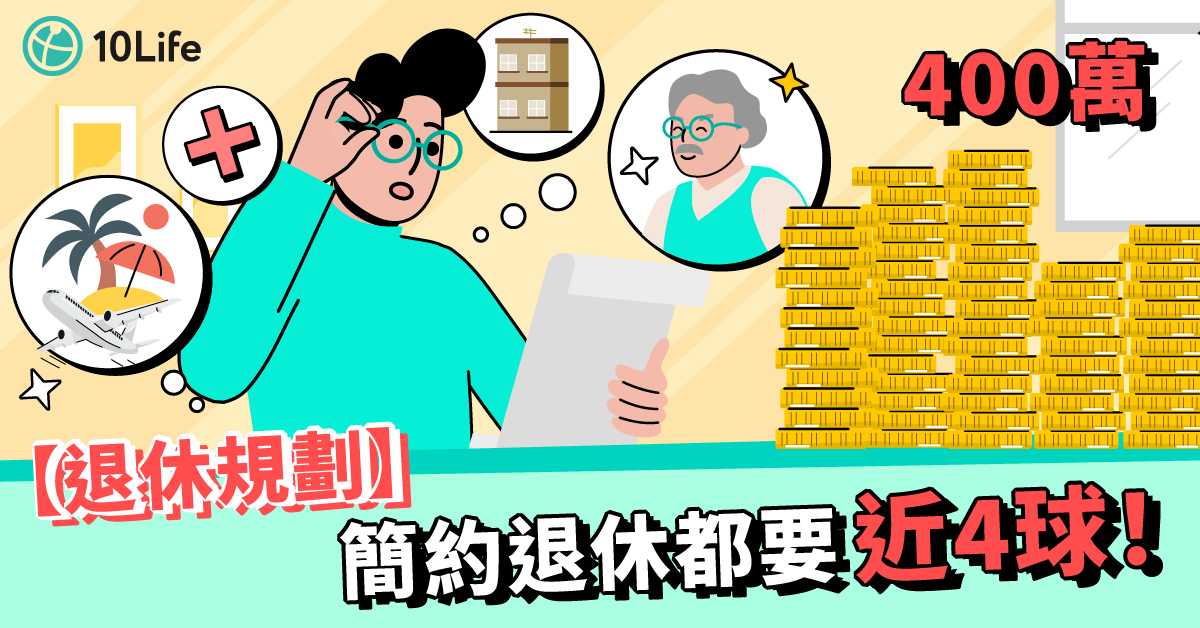
How much money do you need for retirement? Different people have different answers. Some want to enjoy life after retirement and travel the world, while others are content with an ordinary life and enjoy shopping for bargains across the border. Clearly, how much you need for retirement depends on the lifestyle you want. HSBC has released the HSBC Retirement Planning Indicator (Q4 2023), which defines retirement life as basic, modest, comfortable and affluent, with the required retirement funds for an individual at HK$2.34 million, HK$3.96 million, HK$7.16 million and HK$11.89 million respectively (assuming a retirement period from age 65 to 90). An affluent retirement requires more than HK$10 million, which many may feel is far out of reach. Even if you opt for something in between and simply aim for a modest retirement, you would still need nearly HK$3.96 million. For the average office worker, that still sounds unattainable. In fact, with early planning and disciplined saving, building up HK$4 million for retirement is not a dream!
According to HSBC’s estimates, under a modest retirement lifestyle, a single retiree (living in a private property with the mortgage fully repaid) would spend HK$12,825 per month between the ages of 65 and 79, and HK$13,940 per month from age 80 onwards. Over the entire retirement period (from 65 to 90), living a modest lifestyle would cost around HK$3.96 million in total.
Most employees may not be able to produce HK$3.96 million at short notice, so saving for retirement should not be overlooked. In addition, a survey shows that Hong Kong people save an average of HK$9,000 per month. If this money is not invested in any way, it may take nearly 37 years to save enough for retirement. If the target retirement age is 65, saving would need to start from age 28.
Of course, nobody stores their savings under the bed; instead, people look for ways to grow their assets and make their savings work more efficiently. For those who prefer a stable approach, they may consider placing their money in a fixed deposit at a bank to earn interest. However, a high-interest environment may not last indefinitely, so what other ways are there to increase assets? In fact, savings insurance is also a common financial planning tool. Through guaranteed returns and bonuses, wealth can grow over time in a more defensive environment, helping to achieve retirement goals.
By comparison, fixed deposits are a relatively short-term investment, whereas savings insurance is a long-term investment. Through the power of compounding, it can accumulate a higher cash value. In general, the longer the policy term of a savings insurance plan, the higher the internal rate of return (IRR) tends to be. For people who want to achieve long-term goals but are not inclined to spend time on active investing, it can be quite attractive. However, if you can plan ahead and start saving earlier, reaching retirement can be much easier!
As shown in the chart below, if an employee plans to retire at 65, the savings target is HK$3.96 million. Assuming the internal rate of return (IRR) of the savings insurance is 5%, with the same 10-year premium payment period, the monthly premium required will vary depending on the age at which the policyholder starts the policy.
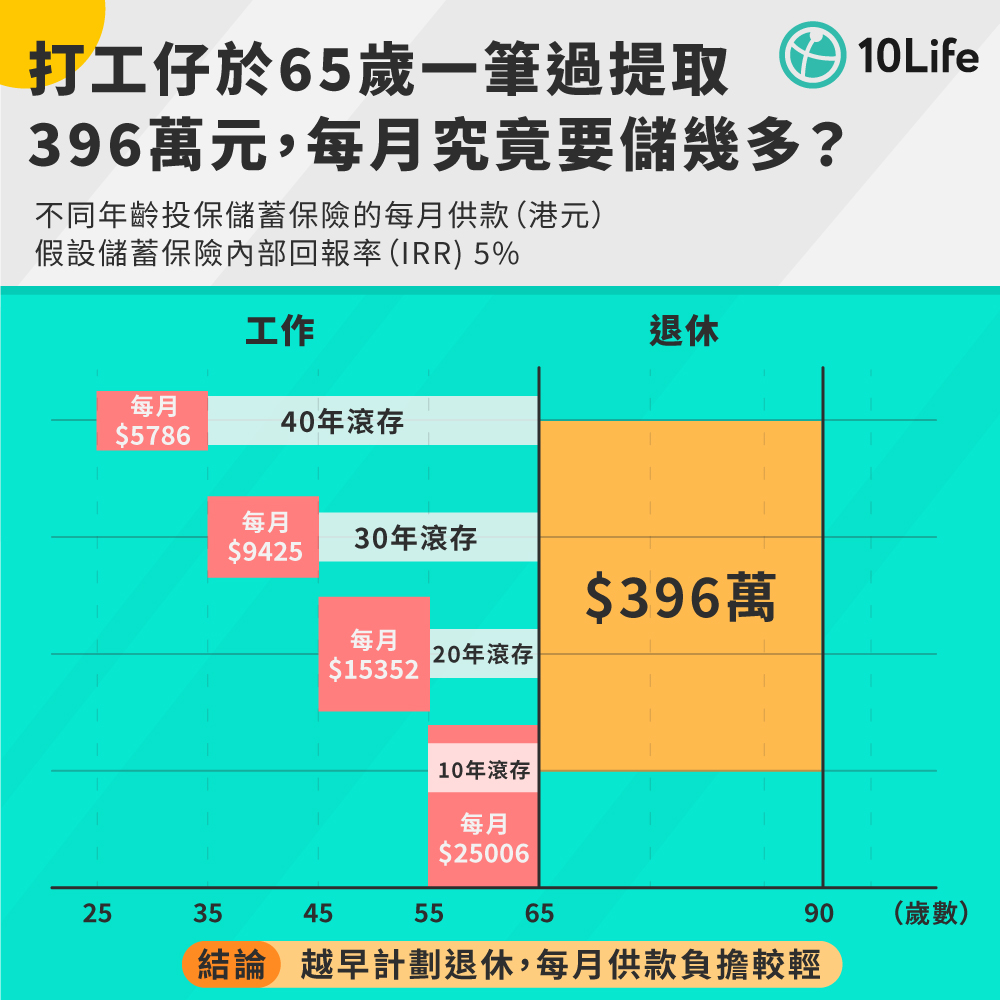
This shows that if a policyholder starts paying for a 10-year savings insurance plan from the age of 25, with a monthly premium of HK$5,786, after 40 years of accumulation, the policyholder can receive a lump sum of HK$3.96 million at the age of 65. In contrast, as the policyholder’s age at the time of purchase increases, the premium required to achieve the same goal also rises. A policyholder who starts at 55 would need to pay as much as HK$25,006 per month, which is 332% higher than the monthly premium for someone who purchased at 25. This shows that the earlier retirement planning begins, the lighter the premium burden.
If policyholders would like to learn more about how to plan for retirement in the future, they are welcome to enquire with 10Life’s insurance advisers.
· Savings insurance is a medium- to long-term financial planning tool. If policyholders surrender the policy in the early years, they may do so at a loss.
· The projected returns of savings insurance include non-guaranteed elements. Policyholders may review the company’s bonus payout ratio to understand whether the bonuses can be realised.
Last updated on: 15 April 2024.

This English version of this article has been generated by machine translation powered by AI. It is provided solely for reference purposes. In the event of any discrepancy or inconsistency between this translation and the original Chinese version, the Chinese version shall prevail.
Our team of professional content researchers focussing on insurance
Our team of professional content researchers focussing on insurance
10Life Product Comparison and 10Life Insurance Ratings are developed by 10Life Financial Limited, an authorised insurance broker company licensed with the Insurance Authority under License Number FB1526. 10Life Product Comparison and 10Life Insurance Ratings are developed for generic customer segments using mathematical calculations based on product information, facts and data, and are not influenced by any partnerships with or fees received from insurance companies. Any information on 10Life Platform ("10Life Information"), including but not limited to Product Comparison, Product Ratings, Blog Articles are intended for general education purpose and reference only. None of the 10Life Information is intended, nor should they be considered or relied upon, as regulated advice, insurance, financial, investment or professional advice, recommendation, approval, endorsement, invitation or solicitation in respect of any insurance, financial or investment products. 10Life Information does not take into account your individual needs. Reading 10Life Information should not be considered as conducting a suitability assessment, and is not sufficient to form the basis of any decisions to purchase any insurance products. You should rely on information authorised by insurance companies, carry out your own research and/or seek independent advice from licensed intermediaries before purchasing any insurance products or making any insurance decisions. While reasonable effort is used when collecting, validating and updating 10Life Information from various channels, none of 10Life Group and its subsidiaries, affiliates, agents, directors, officers and employees will be responsible for any liability, claim or loss arising from or associated with you using 10Life Information. No warranty, representation or guarantee is given by 10Life Group and its subsidiaries on the accuracy, completeness and timeliness of the information. If you have any questions on 10Life Product Comparison and 10Life Insurance Ratings, please email us at enquiries@10life.com




 Talk to 10Life on WeChat
