









10Life Financial Limited
Enquiries: enquiries@10life.com
Hotline: (852) 3705 1599
Address: 16/F Greatmany Centre, 109-115 Queen’s Road East, Wan Chai, Hong Kong



Canadian school education system
Differences Between the Canadian and Hong Kong Education Systems1
Canadian Secondary Schools: Public vs Private2
Pathways to university in Canada4
How much does it cost to study in Canada?
Reference monthly budget for accommodation and living expenses7
Canada Student Visa8
Study abroad expenses can be substantial. Is there any way to ease the pressure?


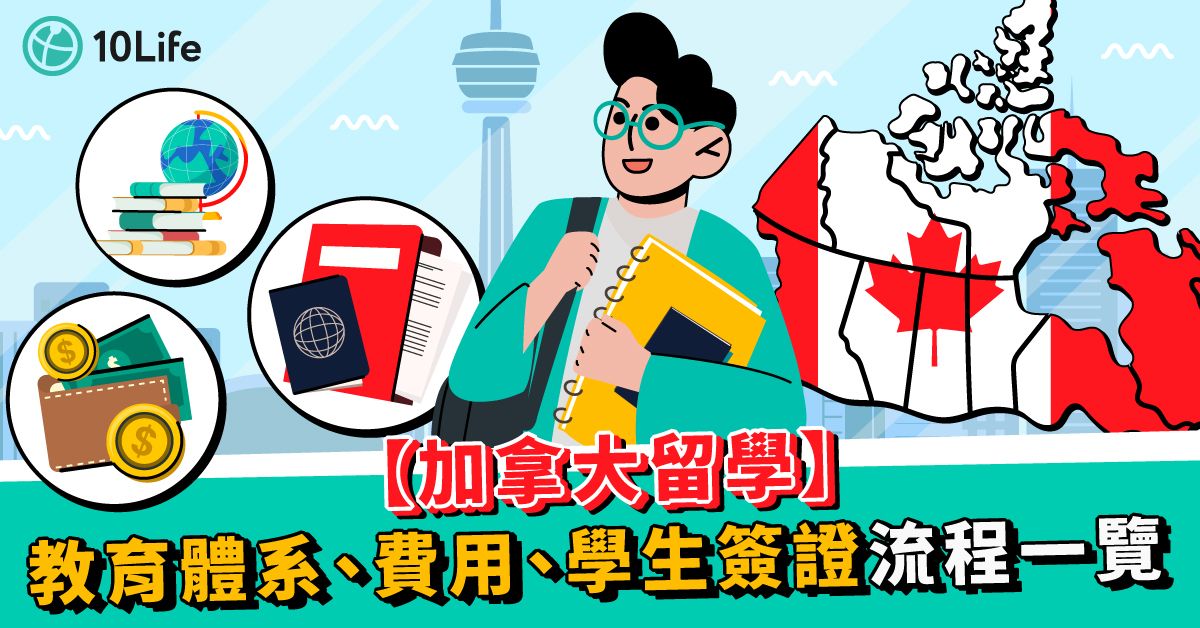
As the Hong Kong DSE examination results are about to be released, many parents and students are actively planning overseas study options. Canada, with its world-class universities, safe and stable social environment, multicultural atmosphere, and relatively reasonable tuition fees, has become a popular first choice for Hong Kong people pursuing overseas education. In recent years, the Canadian government has also introduced a number of favourable immigration policies, prompting many parents to send their children to study in Canada, and even to immigrate with the entire family. Whether you are a parent planning to send your child to study in Canada, or a student preparing to pursue further studies abroad, this guide will provide a detailed explanation of relevant information about studying in Canada, covering study costs, application procedures, living expenses, and admission requirements, answering each one in turn to help everyone plan a smooth study journey.
Canadian school education system
Canada’s education system is administered by each province individually. Every province has its own education authority responsible for teaching and curriculum content. There is no unified national teaching standard, and educational arrangements also vary from province to province. Canada has two official languages, English and French, so the school system is also divided into English- and French-language streams. Schools in Quebec mainly teach in French and have an independent education system (Quebec education system), though overseas students may apply to study in English. (Please refer to the table below for details.)
In general, children in Canada may start kindergarten at the age of 4 to 5, and this stage usually lasts for 1 to 2 years. By around the age of 6, all children will begin Primary 1. However, the age at which compulsory education begins also varies across administrative regions, as follows1:
| Compulsory education age | Province |
| 5 to 16 | Nova Scotia, Prince Edward Island |
| 5 to 18 | New Brunswick, Northwest Territories |
| 6 to 15 | Nunavut |
| 6 to 16 | Alberta, British Columbia, Newfoundland and Labrador, Quebec, Yukon |
| 6 to 18 | Ontario |
| 7 to 16 | Saskatchewan |
| 7 to 18 | Manitoba |
Differences Between the Canadian and Hong Kong Education Systems1
School System | Age | Hong Kong Education System | Canadian Education System | Quebec Education System |
Kindergarten | 5 | K3 | Kindergarten | Kindergarten |
Primary School | 6 | Primary 1 | Grade 1 | Grade 1 |
7 | Primary 2 | Grade 2 | Grade 2 | |
8 | Primary 3 | Grade 3 | Grade 3 | |
9 | Primary 4 | Grade 4 | Grade 4 | |
10 | Primary 5 | Grade 5 | Grade 5 | |
11 | Primary 6 | Grade 6 | Grade 6 | |
Secondary School | 12 | Secondary 1 | Grade 7 | Grade 7 |
13 | Secondary 2 | Grade 8 | Grade 8 | |
14 | Secondary 3 | Grade 9 | Grade 9 | |
15 | Secondary 4 | Grade 10 | Grade 10 | |
16 | Secondary 5 | Grade 11 | Grade 11 | |
17 | Secondary 6 | Grade 12 | CEGEP Year 1 | |
University | 18+ | 4 years’ university | 3 - 4 years’ university | CEGEP Year 2+ 3 years’ university |
Canadian Secondary Schools: Public vs Private2
For students who have not yet reached university entrance age, or who wish to adapt to a new environment first, it may be worth considering secondary school in Canada. In Canada, secondary schools are mainly divided into public and private schools, each with different education models and resource allocations.
Public schools in Canada are funded by the provincial and federal governments and administered by local school boards. They mainly enrol local students, but also accept international students, although an application and tuition fees are required. If the parents hold Canadian citizenship or permanent resident status, their children may attend school free of charge within the designated school district. Public school curricula are centrally planned by the provincial education authorities to ensure consistency in educational quality. Although most public schools do not offer boarding, some schools work with local families to provide homestay programmes for international students, helping them adapt to life and culture in Canada, and the school or the host family will act as the child’s guardian.
Private schools in Canada include independent schools, international schools and religious schools. Independent schools are known for their rigorous preparatory programmes and low student-to-teacher ratios; international schools are designed specifically for overseas students; and religious schools integrate religious teachings and mostly provide boarding facilities. Although their curricula are similar to those of public schools, private schools have their own teaching models and generally offer a higher standard of education. However, tuition fees are relatively higher and admission requirements are more stringent. Parents should note that not all private schools accept international students. It is therefore recommended that parents first check the school’s DLI list.
Public schools will usually carry out an initial assessment based on the student’s past academic performance, and admission requirements may vary from school to school. An average grade ranging from A to C may be sufficient to meet the application criteria. Generally speaking, public secondary schools do not require students to provide proof of English fluency, but they will offer free English (ESL) or French classes after international students arrive. In addition, some schools may require a recommendation letter from the student’s current teacher. By contrast, competition for private schools is more intense; without outstanding academic performance and good English ability, admission is more difficult.
The academic year for public schools usually starts in September and ends in June of the following year. School intakes are in September (autumn term) and January (spring term). When applying to schools, the quickest route is to contact the school board, so that the committee can assess the new student’s educational background. In addition, it is recommended to plan six months to a year in advance before applying, and to align with each school’s term schedule to ensure a smooth application process.
By contrast, private schools offer much more flexible intake dates, usually providing four to five different entry points, including February, May, July and September, allowing students to choose the most suitable intake according to their own study progress and schedule. Taking Hong Kong students as an example, most finish their studies in Hong Kong between June and July each year, so it is recommended that they begin in Canada in July or September, so that they can adapt more quickly to the new learning environment and complete their studies and graduate successfully in the shortest possible time.
If you are considering studying in Canada, the first thing to understand is Canada’s Designated Learning Institutions (DLI). These are institutions authorised by the government to handle matters relating to foreign students, and all public schools are DLI-recognised institutions, with the number of international students admitted also regulated by the government. Once a DLI school has been confirmed, the next step is to understand each school’s different application requirements. Although requirements vary from school to school, the following supporting documents are generally needed to assess a child’s eligibility for admission and suitable age:
• Passport and birth certificate
• Application form
• School reports for the past two years
• Statement from parents and guardian
• Child immunisation records
• Certified guardianship form
• Recommendation letter
The application process for private schools is similar to that for public schools. Once admission is approved, applicants will receive an offer of admission and can then apply for a study visa in accordance with the relevant procedures.
Pathways to university in Canada4
DSE graduates may choose one of the following three main pathways to pursue university studies in Canada, depending on their results and personal plans.
First, after completing Secondary 6, students may apply directly to a four-year university. Hong Kong students are generally required to have Level 4 in five DSE subjects or Grade C or above in three A Level subjects, together with English results of TOEFL iBT 85 or IELTS 6.0 or above. Unlike the UK, Australia and other education systems, Canadian universities do not focus solely on DSE results, but assess secondary school performance comprehensively, with particular emphasis on Secondary 4 and Secondary 5 results. In addition, applicants are usually required to submit a personal profile and attend a video interview.
Students may choose to study at a two-year College. After completing an associate degree programme, they may either transfer into the third year of university or graduate with an associate degree. Tuition is relatively affordable. The entry requirement is DSE 3322, along with English results of IELTS 6.0 or above. Colleges in British Columbia (BC) have a relatively well-established transfer system, allowing associate degree credits to be transferred to universities.
UTP programmes are similar to foundation courses in the UK and allow students from Secondary 5 and above to enrol directly without DSE results, with progression to the first or second year of university. Unlike associate degree programmes, which require completion of the first two years before progressing to university, UTP is divided into Stage 1 and Stage 2. Completion of Stage 1 is equivalent to graduating from secondary school and allows students to enter the first year of university or continue to Stage 2; completion of Stage 2 allows entry to the second year of university. The IELTS requirement for UTP is 6.0. The programmes cover areas such as business, media, arts, education, engineering and science, and are administered by institutions in partnership with universities.
Below is the 2026 QS World University Rankings table for Canadian universities5:
University name | 2025 QS World University Ranking |
McGill University | 27 |
University of Toronto | 29 |
University of British Columbia | 40 |
University of Alberta | 94 |
University of Waterloo | 119 |
Western University | 151 |
University of Montreal | 168 |
McMaster University | 173 |
Queen's University, Ontario | 191 |
University of Calgary | 211 |
University of Ottawa | 219 |
How much does it cost to study in Canada?
Below are the costs of studying in Canada (annual tuition fees), with amounts also provided in Hong Kong dollars for reference:
In Canada, many colleges and universities offer scholarships, and students can study in Canada by applying for scholarships, bursaries or financial assistance. For details, please refer to the school website.
Please refer to the school website for the specific fees above, calculated at an exchange rate of CAD 1.00 to HKD 5.73; the above figures are for reference only.
Reference monthly budget for accommodation and living expenses7
International students studying in Canada will find that monthly accommodation and living expenses vary by city. The following figures are for reference:
The average monthly living expenses for international students studying in Canada are approximately CAD $600 to CAD $800 (HK$3,440–HK$4,586), excluding accommodation costs. The cost of living mainly depends on lifestyle and spending habits. The following breakdown lists various costs in Canada for reference, to help you prepare thoroughly for studying abroad. (Average calculation):
Calculated at an exchange rate of CAD 1.00 : HKD 5.73; the above figures are for reference only.
Canada Student Visa8
The application process for a student visa is relatively straightforward. Once the student has received the school’s offer letter, parents may begin applying for a student visa for children under the age of 17. The required documents are as follows:
1. School offer letter
2. Proof of identity (valid passport or travel document, two passport-sized photographs)
3. Notarised guardian declaration (the guardian must be a Canadian citizen or permanent resident, or the school’s designated guardian)
4. Proof of financial support (for proof of financial support, parents must show that they or the child are able to cover all expenses during the period of study abroad, such as by providing bank statements for the past four months or a bank draft convertible into Canadian dollars.)
5. Explanation letter (e.g. the reason for studying abroad)
6. Provincial attestation letter or territorial attestation letter
7. Medical examination report
8. Quebec Acceptance Certificate (CAQ), if the study destination is in Quebec.
Study abroad expenses can be substantial. Is there any way to ease the pressure?
Although studying in Canada is attractive, tuition fees are much higher than those for local higher education. Preparing an education fund early through a savings plan can help ease future financial pressure. Earlier, 10Life compared the potential returns and risks of common insurance plans used to set up education funds. Parents who are interested may read the article to gain a basic understanding, or WhatsApp 3705 1599 to enquire with a 10Life insurance consultant.
Further reading:
【Overseas Study Insurance 2025】Compare coverage and premiums of 12 products — essential reading for studying abroad!
【Studying in the UK 2025】Understand UK university tuition fees and the student visa application process in one article!
【Australia Study Guide 2025】A comprehensive look at Australia’s study costs, procedures and living expenses!
【IB Diploma】Why is it so popular? A breakdown of the features and benefits of the IB curriculum (with a comparison to IGCSE and the Canadian system)
Notes:
1. Man Wai Education. Canadian secondary school system
2. Oh Study Overseas Study and Education Centre. Public schools vs private schools
3. Woori Education Group. YORK Region District School Board | Guide to applications for Canadian primary and secondary schools | Must-read for Stream A parents
4. EF. Studying in Canada
5. QS World University Rankings 2026: Top global universities
6. EduCanada. Study costs for international students in Canada
7. Studying in Canada. Cost of Studying in Canada for International Students
8. EduCanada. Study permits and visas
This article was compiled by 10Life from market information gathered through various sources and is for general reference only. It does not take into account any individual needs or suitability, and should not be regarded as sales advice. Before taking out insurance, you should discuss an appropriate insurance solution with a licensed insurance consultant, and rely on the information provided by the insurer.
Last updated: 15 July 2025.
This English version of this article has been generated by machine translation powered by AI. It is provided solely for reference purposes. In the event of any discrepancy or inconsistency between this translation and the original Chinese version, the Chinese version shall prevail.
Our team of professional content researchers focussing on insurance
Our team of professional content researchers focussing on insurance
10Life Product Comparison and 10Life Insurance Ratings are developed by 10Life Financial Limited, an authorised insurance broker company licensed with the Insurance Authority under License Number FB1526. 10Life Product Comparison and 10Life Insurance Ratings are developed for generic customer segments using mathematical calculations based on product information, facts and data, and are not influenced by any partnerships with or fees received from insurance companies. Any information on 10Life Platform ("10Life Information"), including but not limited to Product Comparison, Product Ratings, Blog Articles are intended for general education purpose and reference only. None of the 10Life Information is intended, nor should they be considered or relied upon, as regulated advice, insurance, financial, investment or professional advice, recommendation, approval, endorsement, invitation or solicitation in respect of any insurance, financial or investment products. 10Life Information does not take into account your individual needs. Reading 10Life Information should not be considered as conducting a suitability assessment, and is not sufficient to form the basis of any decisions to purchase any insurance products. You should rely on information authorised by insurance companies, carry out your own research and/or seek independent advice from licensed intermediaries before purchasing any insurance products or making any insurance decisions. While reasonable effort is used when collecting, validating and updating 10Life Information from various channels, none of 10Life Group and its subsidiaries, affiliates, agents, directors, officers and employees will be responsible for any liability, claim or loss arising from or associated with you using 10Life Information. No warranty, representation or guarantee is given by 10Life Group and its subsidiaries on the accuracy, completeness and timeliness of the information. If you have any questions on 10Life Product Comparison and 10Life Insurance Ratings, please email us at enquiries@10life.com




 Talk to 10Life on WeChat
