









10Life Financial Limited
Enquiries: enquiries@10life.com
Hotline: (852) 3705 1599
Address: 16/F Greatmany Centre, 109-115 Queen’s Road East, Wan Chai, Hong Kong





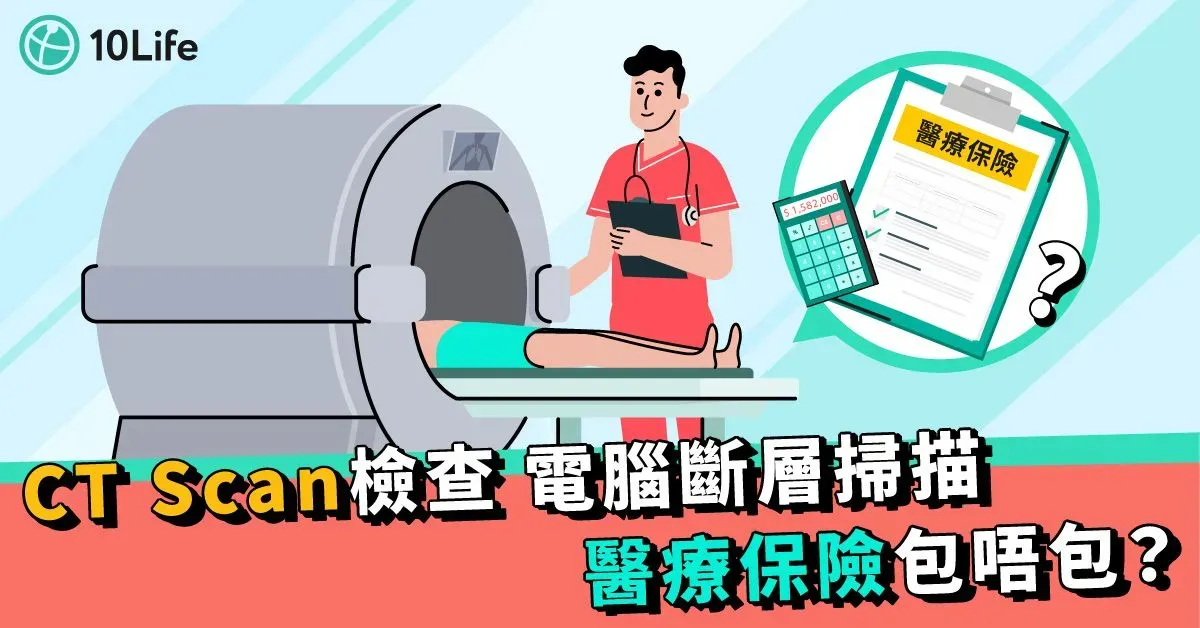
A CT scan uses X-rays together with computer processing to capture cross-sectional images of the body. It usually takes 10 to 20 minutes and is commonly used to diagnose conditions of the brain, heart, lungs and abdomen. Fees depend on the body area, whether a contrast agent is used and the medical institution; charges at private and public hospitals can differ widely. Below, 10Life explains the uses of CT scans, hospital fees, contrast-agent side effects, radiation risks and the scope of VHIS cover.
What is a CT scan? What is it used for?
A CT scan is computed tomography — in English, a CT Scan — and is commonly referred to as “having a CT”. All three names refer to the same examination. During the scan, an X-ray tube rotates around the body and a computer reconstructs images from multiple angles into cross-sections, showing bones, organs and blood vessels. The patient only needs to lie on the scanner bed. The actual time spent on site depends on the arrangements and can range from about an hour to half a day.
Common scan areas include:
CT scans are relatively fast and are often used in emergencies such as head trauma, suspected stroke or acute abdominal pain, so doctors can judge from the images whether surgery is needed.
Coronary CT angiography (CTCA) uses a contrast agent to show whether the coronary arteries are narrowed, blocked or calcified. Before the scan, the patient may need to control their heart rate as instructed; the actual arrangements are decided by clinical staff.
Low-dose lung CT (LDCT) uses a lower radiation dose than a conventional chest scan and is used for lung cancer screening. LDCT is not a routine check suitable for everyone. People at higher risk, such as long-term smokers, should first have a doctor assess the risks and benefits.

How much does a CT scan cost? Comparing private and public hospital fees
Fees depend on the body area scanned, the contrast agent, whether the scan is done as an outpatient or inpatient, and the institution. Charges for the same body area can differ by more than two times among private hospitals.
Comparison of private hospital and clinic CT Scan fees
| Medical institution | Brain | Heart | Lungs | Abdomen |
| Hong Kong Specialist | $1,700 / $3,1001 | $6,4001 | $2,500 / $4,0001 | $2,800 to $6,6001, 2 |
| Evangel Hospital | $2,000 / $3,5001 | $10,1001 | $3,100 / $5,5001 | $3,100 to $7,5001, 2 |
| St. Teresa’s Hospital (French Hospital)3 | $2,100 / $3,9001 | $8,0001 | $3,180 / $5,9001 | $3,180 to $5,9001, 2 |
| Precious Blood Hospital (Caritas) | $2,205 | $7,2451 | $5,5651 | $5,145 to $7,6651, 2 |
| Hong Kong Baptist Hospital4 | $2,380 / $4,4501 | $8,2201 | $4,110 / $7,3201 | $3,530 to $9,7301, 2 |
| CUHK Medical Centre | $2,380 / $4,4901 | $6,540 / $8,0001 | $4,030 / $6,9901 | $3,350 to $6,4901, 2 |
| Union Hospital | $2,400 / $4,5001 | $8,6001 | $4,200 / $7,0001 | $3,500 to $9,7001, 2 |
| St. Paul’s Hospital | $2,400 / $4,3001 | $7,4101 | $6,2001 | $3,150 to $9,8201, 2 |
| Hong Kong Adventist Hospital (Stubbs Road) | $2,833 / $5,0991 | $8,1581 | $7,2511 | $7,0251 |
| Gleneagles Hospital Hong Kong | $2,970 / $5,2201 | $7,6501 | $4,050 / $7,2001 | $3,690 to $11,7001, 2 |
1 With contrast agent. Figures before and after the slash are fees without and with contrast agent. Prices updated to October 2026; all fees are subject to the medical institution’s latest published rates. Figures generally exclude consultation, medication and report fees — patients should confirm the total charge with the institution. | ||||

From 1 January 2026, the Hospital Authority has implemented three-tier charges for non-emergency radiology services. CT imaging is a high-end item: eligible persons pay HK$500 per item, intermediate items cost HK$250, and basic items are free. Emergency radiology services for inpatients and accident-and-emergency patients remain free, and hospital charges already include tests during the stay.
Non-emergency cases require a doctor’s referral. Patients must settle the fee at least 14 calendar days before the appointment date; unpaid appointments are cancelled automatically. Fees can be refunded if the patient cancels at least 14 days in advance. Waiting times depend on the hospital cluster, the body area being scanned and clinical priority. The Hospital Authority also diverts some demand through public-private partnership programmes; details follow the Hospital Authority’s announcements.
What is a contrast agent? What side effects can it have in a CT scan?
A contrast agent (also called contrast medium) makes blood vessels, organs and lesions clearer on the images. It can be taken by mouth, injected intravenously or given as an enema. Some scans require an injection; not every CT scan uses contrast agent.
During an injection, patients may feel a brief flush of heat, a metallic taste, nausea or itchy skin, which usually fades quickly. Clinical staff may ask the patient to stay in the imaging department for a short observation. Severe allergic reactions such as breathing difficulty, a drop in blood pressure or even shock are very rare, but can be life-threatening. Patients must tell clinical staff about any history of allergies, asthma or kidney disease before the scan.
Patients with weaker kidney function are at higher risk. Clinical staff will assess whether medication needs to be adjusted according to kidney function and the scan arrangements. Whether patients with diabetes who take metformin need to pause the medicine and when they may resume is likewise decided by clinical staff according to kidney function — not every patient needs to stop it for 48 hours.
Does a CT scan involve radiation? What are the risks?
CT scans use X-rays and involve a higher radiation dose than a single ordinary X-ray. The dose depends on the area scanned, the coverage and the protocol, and may also differ between machines for the same body area.
Radiation risk is related to dose. The risk from a single scan is generally very low, but it is not zero, and no single percentage can summarise every examination. Pregnant women and children are more sensitive to radiation. Patients who are pregnant or may be pregnant should tell clinical staff before the scan. When children are scanned, staff adjust the settings according to body weight and clinical need, and avoid unnecessary repeat scans.
CT scan process: what to note before, during and after the examination
If a contrast agent injection is required, patients generally need to fast for several hours; the actual requirements are set by the institution. Patients should remove metal items and tell clinical staff about any history of allergies, asthma, kidney disease, diabetes or thyroid disease, and whether they are pregnant or breastfeeding. Abdominal scans may require an oral contrast agent, which patients should drink at the instructed time.
The patient lies on the scanner bed and passes through the ring-shaped scanner. They must stay still and follow instructions to breathe in and hold their breath, because movement can blur the images and require a repeat scan. The radiographer can speak with the patient through an intercom.
After the scan, patients can eat and move about as usual. Those who received a contrast agent injection should drink more water. If a rash, breathing difficulty or persistent discomfort appears, notify clinical staff immediately. Report times depend on the complexity of the scan and the institution’s arrangements; patients should confirm this with the institution.
How does a CT Scan differ from MRI, X-ray and ultrasound?
The four examinations differ in principle, radiation and uses; doctors choose according to the condition.
| Item | CT scan | MRI | X-ray | Ultrasound |
| Principle | X-rays combined with computer reconstruction of cross-sections | Magnetic fields and radio waves | Single-direction X-rays | High-frequency sound waves |
| Radiation | Yes | None | Very low | None |
| Scan time | Usually about 10 to 20 minutes | Usually longer | Very short | Shorter |
| Common uses | Bones, lungs, acute bleeding and trauma | Soft tissue, the brain and the nervous system | Initial screening, fractures | Abdomen, gynaecology and soft tissue |
CT scans are fast and suitable for emergencies and for examining bones and the lungs. MRI is better for soft tissue and the nervous system, but takes longer, and may not suit patients with metal implants. Each examination has its own uses; none is better than the others in every respect. 10Life also has dedicated explainers on MRI and positron emission tomography (PET Scan).
Can I claim CT scan costs from VHIS?
VHIS cover for prescribed diagnostic imaging tests includes CT scans, MRI and PET scans. Taking the Standard Plan as an example, the benefit limit is HK$20,000 per policy year, with 30% co-insurance, meaning the insured person must bear 30% of eligible expenses. The test must be recommended in writing by the attending registered doctor and performed during a hospital stay or in a day-case facility; a scan in a purely outpatient clinic may not fall within the scope of cover.
Benefit limits and co-insurance ratios vary among Flexi Plans, but prescribed diagnostic imaging tests are likewise limited to examinations performed during a hospital stay or in a day-case facility. VHIS does not automatically cover every CT scan. Medical need, the doctor’s recommendation and where the scan is done all affect the claim outcome. Policyholders should check the benefit schedule and exclusions, and keep the referral letter, receipts and report.
Visit the 10Life VHIS comparison page to compare prescribed diagnostic imaging benefit limits and co-insurance across plans, then choose according to your needs.
CT scan FAQs
Non-emergency CT scans in public hospitals require a doctor’s referral. Appointment arrangements at private hospitals and imaging centres vary: some require a referral letter, while others accept self-funded bookings. Patients should check with the institution first. Prescribed diagnostic imaging tests under VHIS must be recommended in writing by the attending registered doctor, and the insurer may require written proof such as a referral letter.
Not every CT scan requires fasting. For scans that need an injection of contrast agent, institutions generally require several hours of fasting; those that do not need contrast agent can usually eat and drink as normal. People with diabetes should follow instructions on medication arrangements in particular.
There is no uniform standard for report times. They depend on the complexity of the scan and the institution’s workflow. Patients should ask when booking and collect the results according to the doctor’s follow-up arrangements.
CT scans do not use magnetic fields, so metal implants are generally not an absolute contraindication. However, metal can cause artefacts that affect nearby areas. Patients should tell clinical staff the type and location of any implant before the scan.
According to guidance updated by the American College of Radiology (ACR) in 2024, there is generally no need to stop breastfeeding or discard breast milk after using an iodinated contrast agent. If a breastfeeding mother still has concerns, a doctor can provide further advice.
Disclaimer
This article is for general reference only and is not medical or insurance advice. Whether a scan is appropriate, as well as fees, radiation dose and insurance cover, should follow a doctor’s assessment and the institution’s latest information.

This English version of this article has been generated by machine translation powered by AI. It is provided solely for reference purposes. In the event of any discrepancy or inconsistency between this translation and the original Chinese version, the Chinese version shall prevail.

Our team of professional content researchers focussing on insurance
Our team of professional content researchers focussing on insurance
10Life Product Comparison and 10Life Insurance Ratings are developed by 10Life Financial Limited, an authorised insurance broker company licensed with the Insurance Authority under License Number FB1526. 10Life Product Comparison and 10Life Insurance Ratings are developed for generic customer segments using mathematical calculations based on product information, facts and data, and are not influenced by any partnerships with or fees received from insurance companies. Any information on 10Life Platform ("10Life Information"), including but not limited to Product Comparison, Product Ratings, Blog Articles are intended for general education purpose and reference only. None of the 10Life Information is intended, nor should they be considered or relied upon, as regulated advice, insurance, financial, investment or professional advice, recommendation, approval, endorsement, invitation or solicitation in respect of any insurance, financial or investment products. 10Life Information does not take into account your individual needs. Reading 10Life Information should not be considered as conducting a suitability assessment, and is not sufficient to form the basis of any decisions to purchase any insurance products. You should rely on information authorised by insurance companies, carry out your own research and/or seek independent advice from licensed intermediaries before purchasing any insurance products or making any insurance decisions. While reasonable effort is used when collecting, validating and updating 10Life Information from various channels, none of 10Life Group and its subsidiaries, affiliates, agents, directors, officers and employees will be responsible for any liability, claim or loss arising from or associated with you using 10Life Information. No warranty, representation or guarantee is given by 10Life Group and its subsidiaries on the accuracy, completeness and timeliness of the information. If you have any questions on 10Life Product Comparison and 10Life Insurance Ratings, please email us at enquiries@10life.com




 Talk to 10Life on WeChat

