









10Life Financial Limited
Enquiries: enquiries@10life.com
Hotline: (852) 3705 1599
Address: 16/F Greatmany Centre, 109-115 Queen’s Road East, Wan Chai, Hong Kong





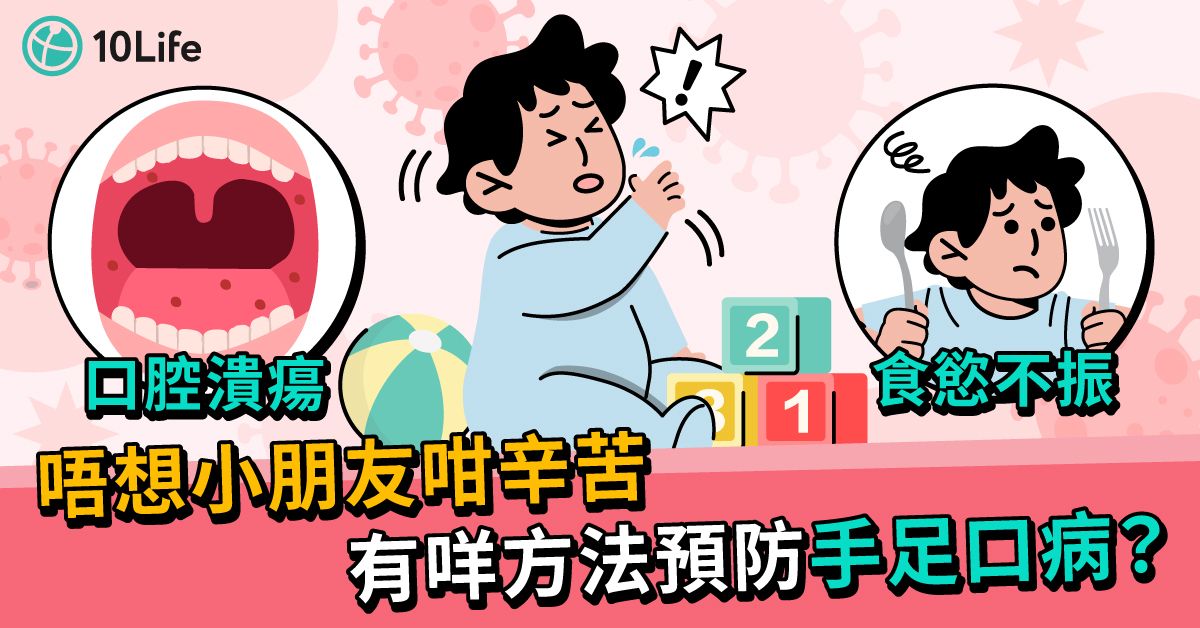
Following the lifting of the “mask mandate”, people have started to get used to not wearing masks, and many common infectious diseases are expected to make a comeback. One such disease is hand, foot and mouth disease, which mainly affects young children. Due to its high contagiousness, it can easily trigger outbreaks in kindergartens and childcare centres. Hand, foot and mouth disease can cause mouth ulcers, and children often lose weight because they are in pain and discomfort and do not want to eat. In severe cases, it may even lead to serious complications, so parents should not let their guard down. 10Life has compiled information on the causes, symptoms, treatment and prevention of hand, foot and mouth disease to help everyone protect against viral infection.
According to the Department of Health, hand, foot and mouth disease can be caused by various enteroviruses, such as Coxsackievirus and Enterovirus 71 (EV71). It mainly affects young children under the age of five. Symptoms often include a continuous fever for several days, blisters or a rash on the hands and feet, and painful ulcers inside the mouth and beside the tongue, which may affect appetite.
Most patients with hand, foot and mouth disease experience mild symptoms. The blisters and rash usually subside within 7 to 10 days. However, hand, foot and mouth disease may also lead to serious complications, such as viral meningitis and encephalitis.
In addition, a specialist in family medicine has pointed out that adults can also contract hand, foot and mouth disease, and the symptoms after infection may be more severe than in children. Some adult patients may need to take antiviral medication.
According to the Department of Health, hand, foot and mouth disease is mainly spread through direct contact with an infected person’s respiratory secretions, saliva, excreta, ruptured blisters, or contaminated objects. The incubation period is about 3 to 7 days. Hand, foot and mouth disease is highly contagious, and is especially most infectious during the first week after onset.
In the past, the peak season for hand, foot and mouth disease has been from May to July, while smaller peaks may also occur from October to December. Once diagnosed with hand, foot and mouth disease, children should avoid going to school or taking part in group activities until they have fully recovered, that is, after the fever and rash have subsided, and the ulcers and blisters in the mouth, hands and feet have scabbed over. They should then rest at home for a further two weeks before returning to school.
There is currently no targeted medication for hand, foot and mouth disease, but medicine may be used to relieve discomfort, such as fever and the pain caused by mouth ulcers. In addition, patients should drink plenty of water and get adequate rest, which can help them recover.
Furthermore, to help prevent complications, parents should monitor their children’s condition. If they develop a persistent high fever, appear lethargic, or their condition worsens, they should be taken to see a doctor as soon as possible.
After a patient has recovered from hand, foot and mouth disease, they will develop antibodies against the virus that caused that particular infection. However, they may still be infected again in the future by hand, foot and mouth disease caused by other enteroviruses.
There is currently no vaccine specifically for hand, foot and mouth disease. If you want to prevent hand, foot and mouth disease, the most important thing is to pay attention to personal and environmental hygiene, for example:
Amid the COVID-19 pandemic, people have become more aware of hygiene. Coupled with long-term mask-wearing and online classes, both adults and children have had less contact with various bacteria and viruses. A family medicine specialist has pointed out that the number of confirmed cases of some common infectious diseases, such as influenza and hand, foot and mouth disease, has indeed declined in recent years. However, mask-wearing is no longer compulsory, and children are generally more vulnerable with weaker immunity, making them more susceptible to illness. Extra caution is needed to prevent viruses from invading.
At the same time, taking out medical insurance early can help children receive suitable treatment more flexibly. If needed, you may refer to 10Life’s earlier articles comparing different voluntary health insurance plans for children: Voluntary health insurance for kindergarten children, Voluntary health insurance comparison for primary school children, or learn more through 10Life’s Insurance Decoder.
Note:
1. Source: Department of Health, Centre for Health Protection, media reports
2. Last updated on: 30 August 2023.

This English version of this article has been generated by machine translation powered by AI. It is provided solely for reference purposes. In the event of any discrepancy or inconsistency between this translation and the original Chinese version, the Chinese version shall prevail.

Our team of professional content researchers focussing on insurance
Our team of professional content researchers focussing on insurance
10Life Product Comparison and 10Life Insurance Ratings are developed by 10Life Financial Limited, an authorised insurance broker company licensed with the Insurance Authority under License Number FB1526. 10Life Product Comparison and 10Life Insurance Ratings are developed for generic customer segments using mathematical calculations based on product information, facts and data, and are not influenced by any partnerships with or fees received from insurance companies. Any information on 10Life Platform ("10Life Information"), including but not limited to Product Comparison, Product Ratings, Blog Articles are intended for general education purpose and reference only. None of the 10Life Information is intended, nor should they be considered or relied upon, as regulated advice, insurance, financial, investment or professional advice, recommendation, approval, endorsement, invitation or solicitation in respect of any insurance, financial or investment products. 10Life Information does not take into account your individual needs. Reading 10Life Information should not be considered as conducting a suitability assessment, and is not sufficient to form the basis of any decisions to purchase any insurance products. You should rely on information authorised by insurance companies, carry out your own research and/or seek independent advice from licensed intermediaries before purchasing any insurance products or making any insurance decisions. While reasonable effort is used when collecting, validating and updating 10Life Information from various channels, none of 10Life Group and its subsidiaries, affiliates, agents, directors, officers and employees will be responsible for any liability, claim or loss arising from or associated with you using 10Life Information. No warranty, representation or guarantee is given by 10Life Group and its subsidiaries on the accuracy, completeness and timeliness of the information. If you have any questions on 10Life Product Comparison and 10Life Insurance Ratings, please email us at enquiries@10life.com




 Talk to 10Life on WeChat
