









10Life Financial Limited
Enquiries: enquiries@10life.com
Hotline: (852) 3705 1599
Address: 16/F Greatmany Centre, 109-115 Queen’s Road East, Wan Chai, Hong Kong





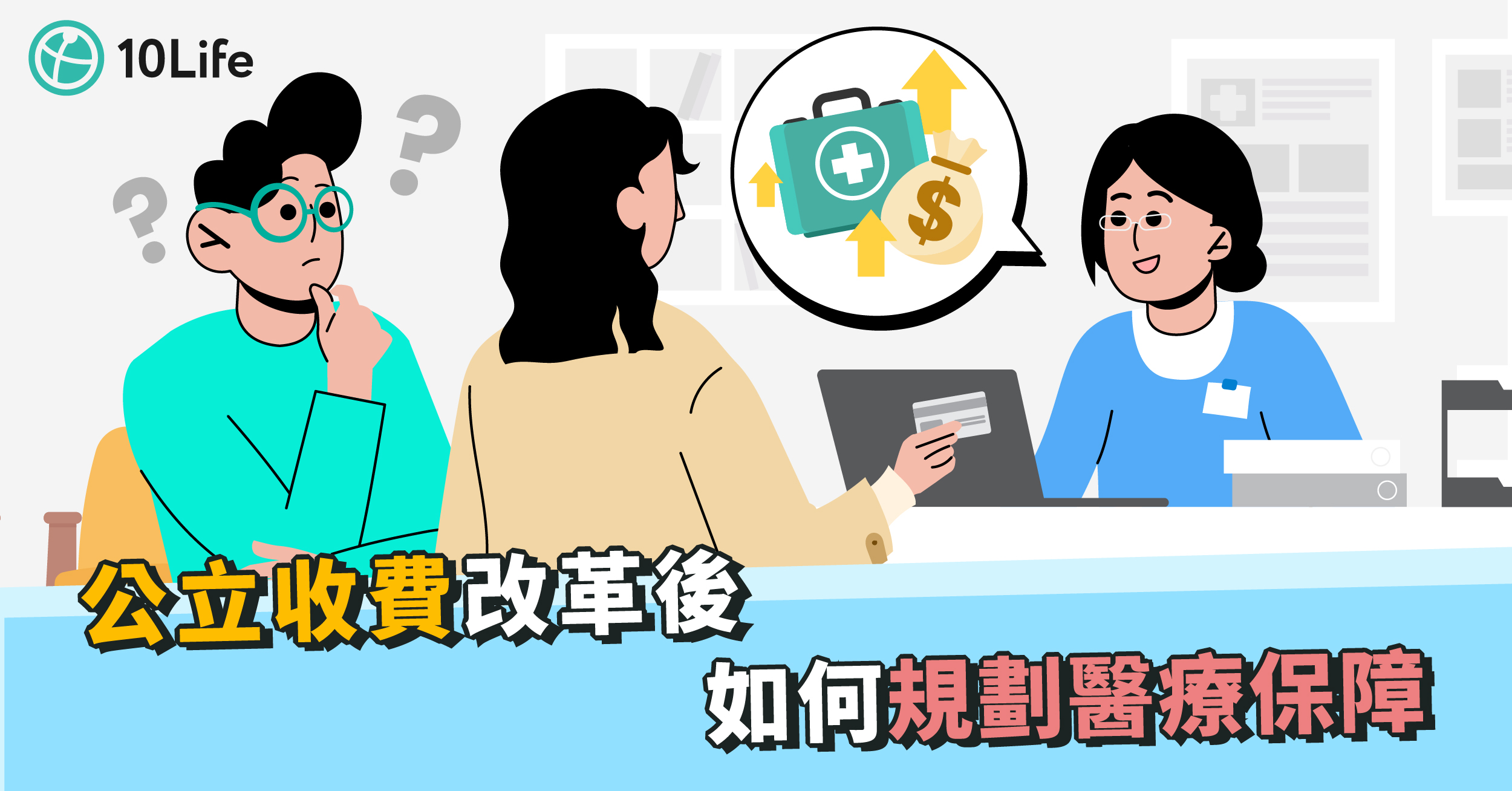
From 1 January 2026, the healthcare charging reform will be formally implemented for public healthcare services. Many people’s first impression is simply that accident and emergency charges have increased, but if one thinks about it more carefully, in this period of economic downturn and employment difficulties, public services generally would not raise prices aggressively. Yet this time, the increase in public healthcare charges is quite significant. Contrary to handing out sweeteners, ordinary people do not like price rises, so why is the Government still taking this step? What difficulties is public healthcare facing? And how should the public respond more strategically?
Overview of Public Hospital Fee Increases
This public hospital fee increase covers multiple services, including not only accident and emergency departments, but also inpatient care, outpatient services and medicines. The Hospital Authority hopes to expand the concept of “co-payment” in some areas to handle non-emergency cases, so that resources can be more focused on those most in need.
Table 1: Changes in public healthcare fees before and after the reform
Service category (eligible persons) | Old charges before the reform | New charges from 1/1/2026 |
Accident and Emergency (A&E) | $180 | $400 |
Inpatient care (acute beds) | $120/day | $300/day |
Inpatient care (convalescent/rehabilitation) | $100/day | $200/day |
Family medicine out-patient clinic | First consultation $135; follow-up consultation $80 | $150 |
Specialist out-patient clinic | First consultation $135; follow-up consultation $80 | $250 |
Specialist out-patient clinic medication (per item) | $15 (up to 16 weeks) | $20 (up to 4 weeks) |
| Note: The actual details and charges for individual services are subject to the latest announcement by the HA/Government. | ||
Why is the government promoting public healthcare reform?
When announcing the reforms, the Government explicitly stated that the goal was to focus limited resources more on supporting patients who are “poor, urgent, serious and critical”, reduce waste and misuse, and use charges to guide the public towards more appropriate use of services at different levels.
Hong Kong is undergoing a clear trend of population ageing. Government statistical publications show that over the past two decades, the population age structure has continued to shift towards older age groups, and Hong Kong’s median age in 2024 was 47.9. A greyer city means more chronic conditions, more tests and more rehabilitation. The healthcare system is facing a long haul, with healthcare demand and the pressure of long-term disease management rising in tandem.
Table 2: Hong Kong population ageing over 20 years (2024 vs 2004)
Indicator | 2004 | 2024 |
Median age of population (years) | 38.6 | 47.9 |
Aged 60 or above (number / share) | 1.08 million / 15.9% | 2.436 million / 32.5% |
Aged 65 or above (number / share) | 843,000 / 12.4% | 1.785 million / 23.8% |
| Note: The Census and Statistics Department of Hong Kong calculates the statistical table using year-end (December) data. | ||
What does public healthcare reform mean for the general public? Public healthcare is more like a safety net, while private healthcare choices become more important.
Based on the extremely high utilisation of public healthcare, Hong Kong’s ageing population trend and the government’s fiscal pressure, it can be inferred that the government intends to promote a division of roles between public and private healthcare. Public healthcare will become more focused on the “poor, urgent, serious and critical”, serving as a universal safety net; genuine emergency patients will still be eligible for fee waiver arrangements. As for private healthcare, it will handle more non-urgent medical needs, especially illnesses affecting the middle class, which will be steered by policy towards private or primary healthcare (family doctors), such as milder conditions, cases requiring faster checks but where the severity is still uncertain, and treatment options where patients seek greater comfort and autonomy.
From now on, Hong Kong people need to know where to seek medical consultation and which channels to use in order to obtain diagnosis and appropriate treatment more quickly and accurately, without being financially ruined by illness and treatment. Therefore, everyone needs a personal healthcare strategy that balances public and private care.
Table 3: Government healthcare expenditure: 2024/25 vs 2004/05
| Indicator | 2004/05 | 2024/25 |
| Public healthcare expenditure (HK$) | Approx. HK$37.5 billion (estimated) | HK$127.9 billion (budgeted) |
| Share of total government expenditure | 14.5% | 16.5% |
How should the public prepare? Reassessing public vs private healthcare options
Before choosing which type of medical plan to take, everyone should first understand their own situation and needs.
If you have chest pain suggestive of a heart attack, stroke symptoms, severe breathing difficulties, heavy bleeding, changes in consciousness, etc., the Accident and Emergency Department of a public hospital remains the preferred option for saving lives and handling critical incidents. Under the reform of public healthcare charges, the critical/serious categories are eligible for fee waivers, and a refund mechanism linked to triage is also in place.
What the public need to prepare is not just $400, but also:
This type of situation is very common. The symptoms may not be critical, but there may be concern that something more serious is going on, for example persistent fever, abdominal pain, headache, or sudden swelling and pain in a part of the body with an unknown cause. In such cases, patients need quicker examinations and diagnosis, which may involve laboratory tests, imaging, and so on. Under the direction of the reform, the public sector will focus more on dealing with critical and serious cases, while for this kind of rapid assessment many middle-class patients will want a private option, such as private clinics and diagnostic tests.
What you can prepare:
These situations are very relatable. Although they may not be critical, they can significantly affect a patient’s quality of life. In the public system, you may face a long waiting time; pain and loss of function may persist for a long period, quality of life may decline, and the pressure on work and family may increase. If you want to shorten the waiting time and improve function and pain more quickly, private healthcare becomes more important. Of course, the premise is that you know how to find a specialist, or that you have medical protection.
For many middle-class people, so-called freedom of medical choice is never just about treating an illness. Rather, it is about wanting a more comfortable inpatient environment, more flexible visiting arrangements, the ability to choose one’s attending doctor, and a long-term doctor-patient relationship, with a doctor who understands your medical history, medication responses, and lifestyle habits taking care of your health. This need is about a service experience that is agreeable and predictable. Clearly, private healthcare is the way forward, but the problem is that it comes at a high cost.
Voluntary Health Insurance: Making private healthcare options more affordable and predictable
When illness strikes, having a choice matters. Voluntary health insurance is a tool that helps people move towards private healthcare with greater peace of mind, making private healthcare expenses more manageable. In the Government’s healthcare reform narrative, promoting Voluntary Health Insurance is also regarded as part of the overall healthcare reform, alongside public fee reforms and enhanced transparency in private healthcare charges.
When considering Voluntary Health Insurance, you should first understand your own needs (such as rapid diagnosis, comfort during hospitalisation, and which minor or major illnesses you want treatment for). Then choose the deductible, compare the policy’s coverage, insured amount and claims mechanism, so that private healthcare options can become more affordable and more predictable.
Last updated: 9 January 2026

This English version of this article has been generated by machine translation powered by AI. It is provided solely for reference purposes. In the event of any discrepancy or inconsistency between this translation and the original Chinese version, the Chinese version shall prevail.
Our team of professional content researchers focussing on insurance
Our team of professional content researchers focussing on insurance
10Life Product Comparison and 10Life Insurance Ratings are developed by 10Life Financial Limited, an authorised insurance broker company licensed with the Insurance Authority under License Number FB1526. 10Life Product Comparison and 10Life Insurance Ratings are developed for generic customer segments using mathematical calculations based on product information, facts and data, and are not influenced by any partnerships with or fees received from insurance companies. Any information on 10Life Platform ("10Life Information"), including but not limited to Product Comparison, Product Ratings, Blog Articles are intended for general education purpose and reference only. None of the 10Life Information is intended, nor should they be considered or relied upon, as regulated advice, insurance, financial, investment or professional advice, recommendation, approval, endorsement, invitation or solicitation in respect of any insurance, financial or investment products. 10Life Information does not take into account your individual needs. Reading 10Life Information should not be considered as conducting a suitability assessment, and is not sufficient to form the basis of any decisions to purchase any insurance products. You should rely on information authorised by insurance companies, carry out your own research and/or seek independent advice from licensed intermediaries before purchasing any insurance products or making any insurance decisions. While reasonable effort is used when collecting, validating and updating 10Life Information from various channels, none of 10Life Group and its subsidiaries, affiliates, agents, directors, officers and employees will be responsible for any liability, claim or loss arising from or associated with you using 10Life Information. No warranty, representation or guarantee is given by 10Life Group and its subsidiaries on the accuracy, completeness and timeliness of the information. If you have any questions on 10Life Product Comparison and 10Life Insurance Ratings, please email us at enquiries@10life.com




 Talk to 10Life on WeChat
