









10Life Financial Limited
Enquiries: enquiries@10life.com
Hotline: (852) 3705 1599
Address: 16/F Greatmany Centre, 109-115 Queen’s Road East, Wan Chai, Hong Kong


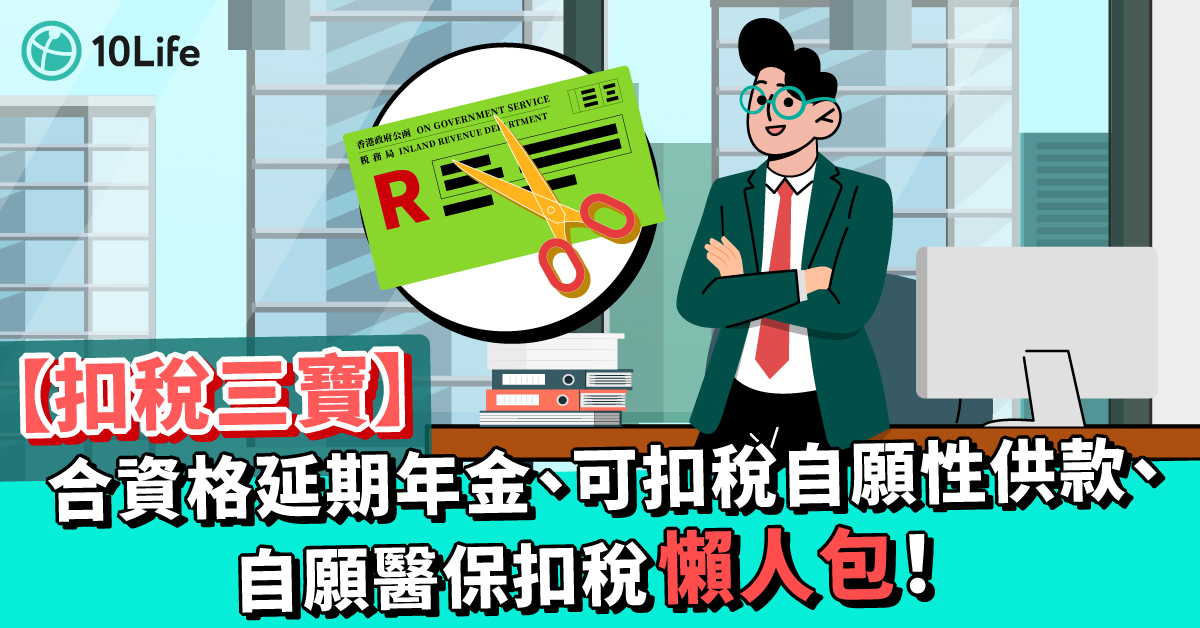
Every tax season, many taxpayers find themselves scratching their heads when they see their tax bills. If taxpayers want to save on taxes, they can consider the so‑called "three tax-deduction essentials" commonly available, which not only provide an extra layer of protection but also reduce the tax burden.
The "three tax-deduction essentials" are Qualified Deferred Annuity Policies (QDAP), tax-deductible voluntary MPF contributions (TVC), and Voluntary Health Insurance Scheme (VHIS) plans. The "three tax-deduction essentials" can provide each taxpayer with tax deductions of HK$68,000 or more per year. Calculated at the current highest salaries tax rate (i.e., 17%), taxpayers can save HK$11,560 or more annually. Below is a quick guide to the "three tax-deduction essentials" to help readers understand these tax-saving tools.
An annuity is a long-term insurance product that helps consumers convert funds into a long-term, stable cash income—essentially creating their own long-term income stream. As for deferred annuities, the policyholder usually pays premiums in instalments while working, allowing the insurer to accumulate interest; later, at a specified term or age, they can begin to receive annuity payments from the insurer in instalments until the policy’s stated termination date.
Deferred annuities must meet specific conditions to qualify as a qualifying deferred annuity (also known as a tax-deductible annuity) in order for the policyholder to receive a tax deduction. The annual tax deduction limit for a qualifying deferred annuity is HK$60,000; at the current highest tax rate (17%), an individual can save up to HK$10,200 in tax per year.
Conditions for a qualifying deferred annuity include:
1. Total premiums must be at least HK$180,000
2. Contribution period must be at least 5 years
3. Annuity payment period must be at least 10 years
4. The annuitant must be aged 50 or above to receive the annuity (i.e., the income period must begin when the policyholder is over 50)
5. The policy must disclose the product’s internal rate of return (IRR) and clearly set out guaranteed and non-guaranteed amounts
6. Premiums for additional benefits, such as critical illness cover or hospital cash, must be clearly separated from the annuity premiums
The annual policy summary of qualifying products will bear the following mark, and a list of qualifying deferred annuity products can be found on the Insurance Authority’s website.
Tax-deductible MPF voluntary contributions are one type of contribution under the MPF system. Such contributions can be used to apply for a deduction against individual income tax, with an annual tax deduction limit of HK$60,000. It is worth noting that the tax deduction for tax-deductible MPF voluntary contributions and for qualifying deferred annuities is shared — that is, if a taxpayer uses up the HK$60,000 tax deduction on voluntary contributions, no tax deduction will be available for deferred annuities, and vice versa.
Meanwhile, the balances in all voluntary contribution accounts, whether or not a tax deduction is claimed, must be preserved until retirement at age 65 before they can be withdrawn (except in specific circumstances prescribed by law).
The Voluntary Health Insurance Scheme (VHIS) is a measure introduced by the Food and Health Bureau to regulate inpatient insurance and encourage the public to plan for medical protection. The VHIS is divided into standard plans and flexible plans. Standard plans are fixed products designed in accordance with the VHIS minimum compliance requirements, while flexible plans offer greater product-design flexibility and provide cover beyond the standard plans, including higher benefit limits and broader coverage.
The VHIS standard plans set minimum standards for inpatient insurance, harmonise most policy terms and coverage, ensure insured persons can be renewed up to age 100, and expand coverage to include pre-existing conditions, day surgery, non-surgical cancer treatment and psychiatric treatment.
VHIS premiums are also tax-deductible. The tax-deductible premium ceiling for each insured person is HK$8,000; at the current highest tax rate (i.e., 17%), a taxpayer can save HK$1,360 in tax.
The three tax-deductible items (qualifying deferred annuities, tax-deductible MPF voluntary contributions, and Voluntary Health Insurance) can provide up to a total of HK$68,000 in tax deductions per taxpayer each year. At the current highest tax rate (i.e., 17%), an individual can save up to HK$11,560 in tax per year.
If both spouses are taxpayers, they can flexibly allocate premiums for qualifying deferred annuities between them to enjoy a combined maximum tax deduction of HK$120,000, provided that the deduction claimed by each person does not exceed HK$60,000.
In addition, taxpayers can, besides taking out Voluntary Health Insurance for themselves, also insure designated relatives and thereby obtain a tax deduction of up to HK$8,000 per insured person, with no limit on the number of policies eligible for deduction. Designated relatives include children, spouses, the taxpayer's or their spouse's parents, grandparents (both paternal and maternal), and siblings.
For tax deductions under the Voluntary Health Insurance Scheme, taxpayers should complete the tax return under "Qualifying premiums paid under a Voluntary Health Insurance Scheme policy". Part 9(1) can be used to enter the taxpayer's own qualifying premiums, while Part 9(2) should record the designated relative's personal particulars and the qualifying premiums.
For tax deductions for voluntary contributions and annuities, taxpayers should complete the tax return under "Qualifying annuity premiums and tax-deductible Mandatory Provident Fund (MPF) voluntary contributions". Part 10(1) is for entering tax-deductible MPF voluntary contributions; Part 10(2a) is for qualifying annuity premiums paid for oneself, and (2b) is for qualifying annuity premiums paid for a spouse.
Among the "three tax-deductible treasures," tax-deductible annuity products are particularly complex, so policyholders need to choose more carefully to avoid future regret. Below are the items readers should pay attention to when selecting a tax-deductible annuity.
When purchasing tax-deductible annuities, you should understand your purchase purpose, such as saving, creating your own retirement income, or hedging longevity risk, and then choose the appropriate product according to your personal needs and financial situation. If readers want to learn more and choose a suitable annuity product, feel free to contact 10Life's insurance advisers.
Further reading:
[2025 Tax-Deductible Annuity Complete Guide] Analysis of tax-deductible annuity products (10-year annuity term) — see how annuities save tax and which provider offers higher returns!
[Tax-Deduction Tool] How soon can tax-deductible annuities break even? How can you maximize tax deductions?
How to choose tax-deductible annuities 2025
Note: Last updated November 21, 2025.

This English version of this article has been generated by machine translation powered by AI. It is provided solely for reference purposes. In the event of any discrepancy or inconsistency between this translation and the original Chinese version, the Chinese version shall prevail.
Our team of professional content researchers focussing on insurance
Our team of professional content researchers focussing on insurance
10Life Product Comparison and 10Life Insurance Ratings are developed by 10Life Financial Limited, an authorised insurance broker company licensed with the Insurance Authority under License Number FB1526. 10Life Product Comparison and 10Life Insurance Ratings are developed for generic customer segments using mathematical calculations based on product information, facts and data, and are not influenced by any partnerships with or fees received from insurance companies. Any information on 10Life Platform ("10Life Information"), including but not limited to Product Comparison, Product Ratings, Blog Articles are intended for general education purpose and reference only. None of the 10Life Information is intended, nor should they be considered or relied upon, as regulated advice, insurance, financial, investment or professional advice, recommendation, approval, endorsement, invitation or solicitation in respect of any insurance, financial or investment products. 10Life Information does not take into account your individual needs. Reading 10Life Information should not be considered as conducting a suitability assessment, and is not sufficient to form the basis of any decisions to purchase any insurance products. You should rely on information authorised by insurance companies, carry out your own research and/or seek independent advice from licensed intermediaries before purchasing any insurance products or making any insurance decisions. While reasonable effort is used when collecting, validating and updating 10Life Information from various channels, none of 10Life Group and its subsidiaries, affiliates, agents, directors, officers and employees will be responsible for any liability, claim or loss arising from or associated with you using 10Life Information. No warranty, representation or guarantee is given by 10Life Group and its subsidiaries on the accuracy, completeness and timeliness of the information. If you have any questions on 10Life Product Comparison and 10Life Insurance Ratings, please email us at enquiries@10life.com




 Talk to 10Life on WeChat
