









10Life Financial Limited
Enquiries: enquiries@10life.com
Hotline: (852) 3705 1599
Address: 16/F Greatmany Centre, 109-115 Queen’s Road East, Wan Chai, Hong Kong


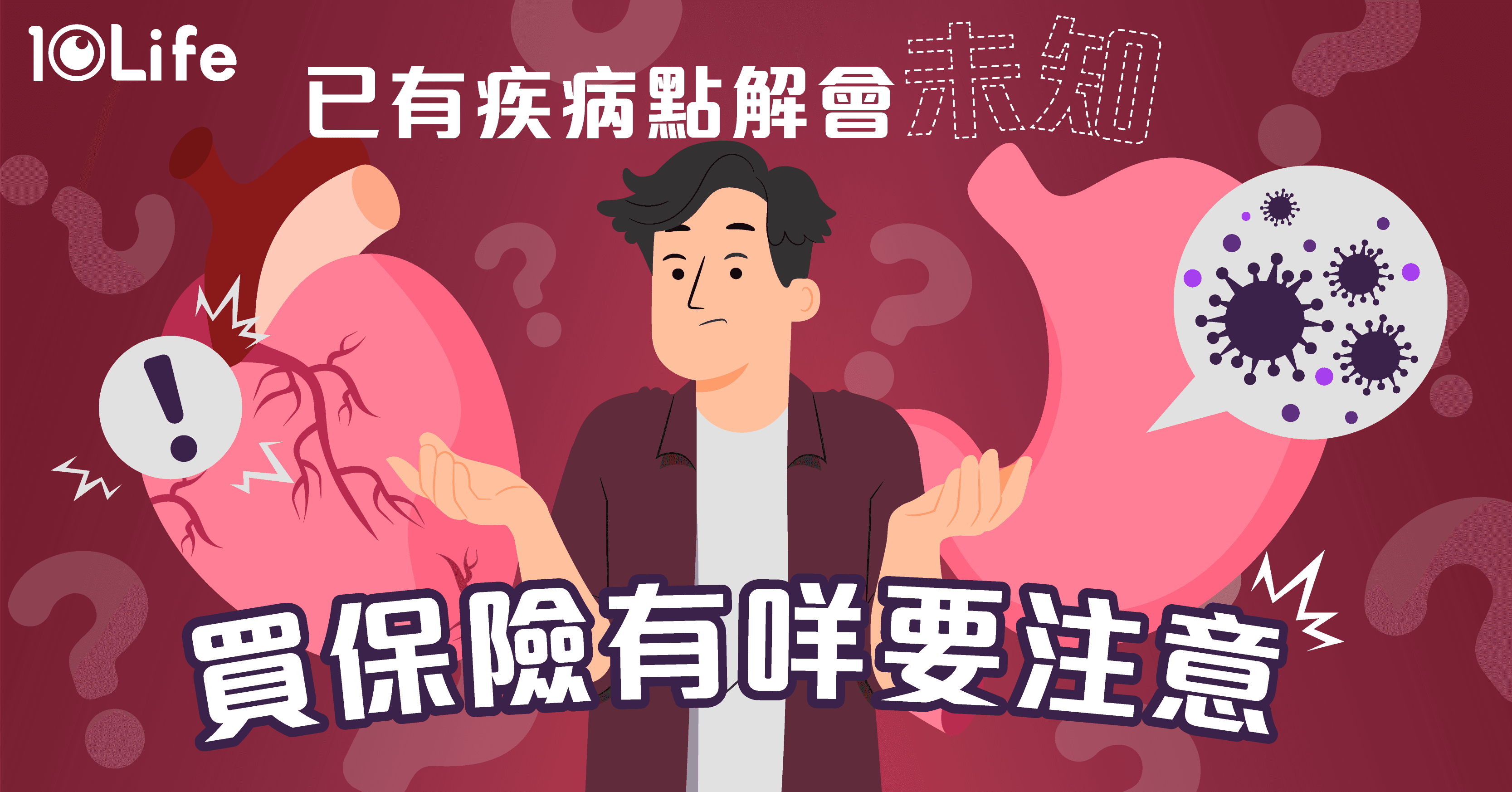
The Voluntary Health Insurance Scheme (VHIS) has been introduced for over three years, with one of its key selling points being the coverage of "pre-existing conditions unknown at the time of application." This term might sound somewhat complex, but what does it actually mean? And what significance does it hold when comparing insurance products?
In simple terms, "pre-existing conditions unknown at the time of application" refers to health conditions that show no apparent symptoms at the time of application and of which the policyholder is unaware, such as a long-existing cerebral aneurysm.
| Pre-existing Conditions | Unknown Pre-existing Conditions at Application |
Already diagnosed, or | Unaware and reasonably should be unaware of the condition at the time of submitting the insurance application |
These types of conditions, medically determined to have existed for some time, are often not compensated under many traditional medical insurance plans, even if the policyholder claims to have been unaware of them at the time of application. However, under the rules of VHIS, even if an insurance company does not provide compensation for "unknown pre-existing conditions at application" in the first year, partial compensation of 25% is available in the second year upon diagnosis, 50% in the third year, and 100% from the fourth year onwards.
| Traditional Medical Insurance | Voluntary Health Insurance Scheme |
Listed as excluded items or subject to additional premiums | Under VHIS, after the policy effective date: |
"Pre-existing conditions unknown at the time of application" can easily lead to disputes. Taking a case from the Insurance Complaints Bureau's 2020/21 annual report as an example, as detailed in this case, the complainant was admitted to a private hospital for a sleep test and was ultimately diagnosed with mild sleep apnea. The insurance company learned that the complainant had a snoring issue (a symptom of sleep apnea) which existed prior to the application, but this was not disclosed in the insurance application form. Consequently, the insurance company rejected the hospitalisation claim on the grounds that the complainant failed to disclose material facts.
The complainant lodged a complaint with the Insurance Complaints Bureau, and the Complaints Panel noted that the attending doctor stated the symptoms related to the complainant's sleep apnea only appeared after the policy came into effect. Since snoring during sleep is a common phenomenon, and the complainant had never sought medical attention for snoring issues before the policy was effective, the Complaints Panel did not consider the snoring to be an undiagnosed symptom that needed to be declared in the application form. Therefore, the panel ruled in favour of the complainant, and the insurance company was required to provide compensation.
However, the general public is required to disclose material facts with the utmost good faith. Under the Voluntary Health Insurance Scheme, there are underwriting questionnaire clauses (Note 1) which state that "each policyholder and insured person has the responsibility to answer questions and disclose material facts as required by the questions." However, if the insurance application documents do not include any relevant questions, it will be deemed that the company has waived the policyholder's and insured person's responsibility to disclose the required information. In other words, if the questions set by the insurance company are ambiguous and fail to guide the policyholder and insured person to disclose material facts, the responsibility lies with the insurance company.
It is worth noting that many high-end voluntary health insurance plans have now raised their standards to the highest level, with the waiting period for "pre-existing conditions unknown at the time of application" mostly reduced to 30 days or even shorter. However, some mid-to-low-end voluntary health insurance plans still adhere to the most basic terms set by the Voluntary Health Insurance Scheme. Policyholders are advised to carefully read the policy terms and conditions to minimise potential disputes.
This article only discusses one of the clauses of Voluntary Health Insurance. In fact, Voluntary Health Insurance products offer a wide range of coverage, including different ward categories and coverage areas. Before purchasing, readers are advised to compare options from multiple providers based on their personal needs. You are welcome to use 10Life's Insurance Decoder for a deeper understanding.
Further Reading: Insurance Intermediary Oversight: Customer Fails to Disclose "Material Facts", Medical Insurance Claim Unsuccessful
Note:
1. Clause 8 of the Policy Terms and Conditions in the "Voluntary Health Insurance Scheme Certified Product Policy Template (Revised July 2020)".
2. The above information is provided by 10Life, updated as of 4 July 2022, and is for reference only. It is not a sales proposal.
This English version of this article has been generated by machine translation powered by AI. It is provided solely for reference purposes. In the event of any discrepancy or inconsistency between this translation and the original Chinese version, the Chinese version shall prevail.
Our team of professional content researchers focussing on insurance
Our team of professional content researchers focussing on insurance
10Life Product Comparison and 10Life Insurance Ratings are developed by 10Life Financial Limited, an authorised insurance broker company licensed with the Insurance Authority under License Number FB1526. 10Life Product Comparison and 10Life Insurance Ratings are developed for generic customer segments using mathematical calculations based on product information, facts and data, and are not influenced by any partnerships with or fees received from insurance companies. Any information on 10Life Platform ("10Life Information"), including but not limited to Product Comparison, Product Ratings, Blog Articles are intended for general education purpose and reference only. None of the 10Life Information is intended, nor should they be considered or relied upon, as regulated advice, insurance, financial, investment or professional advice, recommendation, approval, endorsement, invitation or solicitation in respect of any insurance, financial or investment products. 10Life Information does not take into account your individual needs. Reading 10Life Information should not be considered as conducting a suitability assessment, and is not sufficient to form the basis of any decisions to purchase any insurance products. You should rely on information authorised by insurance companies, carry out your own research and/or seek independent advice from licensed intermediaries before purchasing any insurance products or making any insurance decisions. While reasonable effort is used when collecting, validating and updating 10Life Information from various channels, none of 10Life Group and its subsidiaries, affiliates, agents, directors, officers and employees will be responsible for any liability, claim or loss arising from or associated with you using 10Life Information. No warranty, representation or guarantee is given by 10Life Group and its subsidiaries on the accuracy, completeness and timeliness of the information. If you have any questions on 10Life Product Comparison and 10Life Insurance Ratings, please email us at enquiries@10life.com




 Talk to 10Life on WeChat
