









10Life Financial Limited
Enquiries: enquiries@10life.com
Hotline: (852) 3705 1599
Address: 16/F Greatmany Centre, 109-115 Queen’s Road East, Wan Chai, Hong Kong



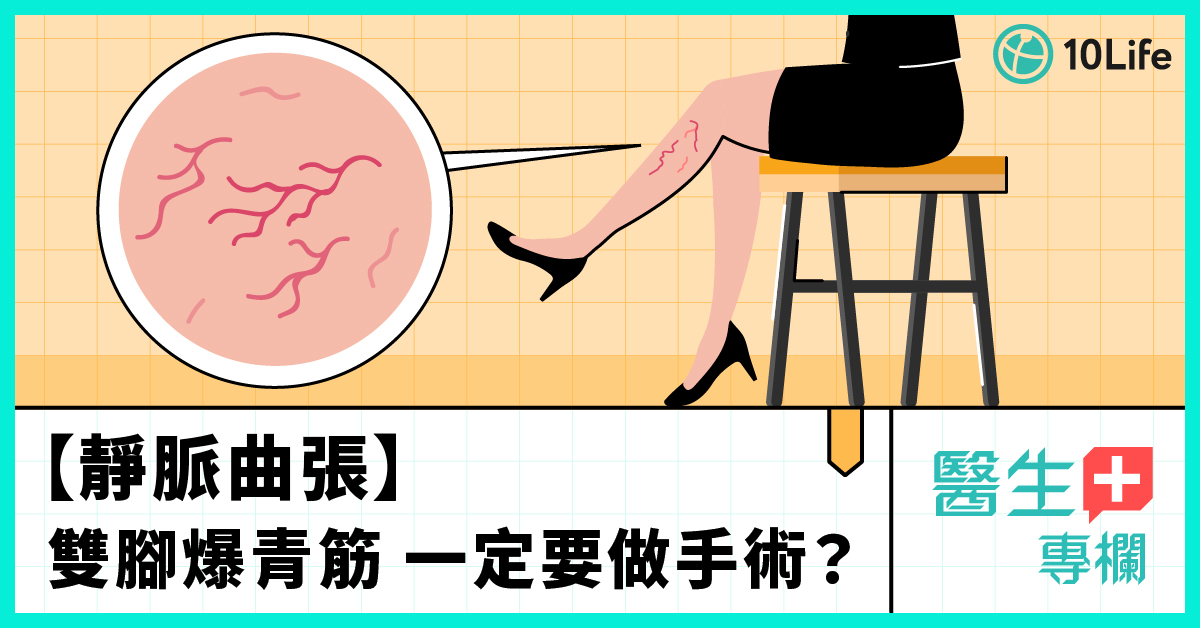
Raised “veins” on the legs are often a sign of varicose veins. If left untreated, severe cases may lead to swelling in the legs, darkening of the skin, and even ulcers.
The function of veins is to carry blood back to the heart. Normal leg veins have valves to prevent blood from flowing backwards under the influence of gravity. If these valves become faulty and cannot close properly, blood flows back and pools in the leg veins. Over time, this causes the veins to become distorted and progressively thicker, forming twisted and enlarged veins in the lower limbs, which is known as varicose veins.
If varicose veins are only grade 1 or mild grade 2, you can start by adjusting your lifestyle: avoid sitting or standing for long periods, and exercise more, such as running and swimming, to help the muscles drive venous blood in the lower limbs back to the heart. In addition, wearing compression stockings can also help blood flow back. There are different styles of compression stockings on the market; please note that you should choose a graduated type with stronger pressure at the foot and weaker pressure at the thigh to relieve symptoms.
Those with a family history of varicose veins, older adults, people who are overweight, and women are all more likely to develop varicose veins. Prolonged standing or sitting is also a major cause of varicose veins in the legs, so people working in the catering industry, sales assistants and healthcare workers are more likely to be affected. Physical labourers may also place greater pressure on the lower limbs and therefore face a higher risk. In addition, pregnant women, and people with ascites or abdominal tumours, are also more prone to venous reflux as increased intra-abdominal pressure affects venous blood flow.
Varicose veins are classified into six stages (see figure below). Doctors will carry out a clinical examination to determine the stage, and use ultrasound imaging to observe the extent and distribution of blood reflux before planning a treatment approach.

Patients with symptoms in stages 2 to 6 may consider surgical treatment. Traditional surgery involves ligating the affected vein at a higher point before stripping it out. The risk of recurrence is low, but bruising may occur in the leg after the operation.

Minimally invasive surgery uses a catheter to enter the diseased vein, then employs laser or radiofrequency to ablate the blood vessel and cause it to contract, preventing blood from flowing into that vessel. Compared with traditional surgery, minimally invasive procedures generally offer a quicker recovery time and smaller wounds, and some can even be performed in a day surgery centre.
| Minimally invasive surgery | Traditional surgery |
| Less invasive | More invasive |
| Smaller wound | Larger wound |
| Surgery duration: less than 1 hour | Surgery duration: 1 to 2 hours |
| Faster recovery | Recovery time: 1 to 2 days |
If the affected vessel is closer to the end of the vein and the affected area is relatively small, injecting sclerosant to glue and seal the vessel may be sufficient. After surgery, it is recommended to wear compression stockings for two weeks to prevent the veins from dilating again during the recovery period.
Specialist in Surgery
Dr Kong Wai Chung
|
This English version of this article has been generated by machine translation powered by AI. It is provided solely for reference purposes. In the event of any discrepancy or inconsistency between this translation and the original Chinese version, the Chinese version shall prevail.

10Life Product Comparison and 10Life Insurance Ratings are developed by 10Life Financial Limited, an authorised insurance broker company licensed with the Insurance Authority under License Number FB1526. 10Life Product Comparison and 10Life Insurance Ratings are developed for generic customer segments using mathematical calculations based on product information, facts and data, and are not influenced by any partnerships with or fees received from insurance companies. Any information on 10Life Platform ("10Life Information"), including but not limited to Product Comparison, Product Ratings, Blog Articles are intended for general education purpose and reference only. None of the 10Life Information is intended, nor should they be considered or relied upon, as regulated advice, insurance, financial, investment or professional advice, recommendation, approval, endorsement, invitation or solicitation in respect of any insurance, financial or investment products. 10Life Information does not take into account your individual needs. Reading 10Life Information should not be considered as conducting a suitability assessment, and is not sufficient to form the basis of any decisions to purchase any insurance products. You should rely on information authorised by insurance companies, carry out your own research and/or seek independent advice from licensed intermediaries before purchasing any insurance products or making any insurance decisions. While reasonable effort is used when collecting, validating and updating 10Life Information from various channels, none of 10Life Group and its subsidiaries, affiliates, agents, directors, officers and employees will be responsible for any liability, claim or loss arising from or associated with you using 10Life Information. No warranty, representation or guarantee is given by 10Life Group and its subsidiaries on the accuracy, completeness and timeliness of the information. If you have any questions on 10Life Product Comparison and 10Life Insurance Ratings, please email us at enquiries@10life.com




 Talk to 10Life on WeChat
