









10Life Financial Limited
Enquiries: enquiries@10life.com
Hotline: (852) 3705 1599
Address: 16/F Greatmany Centre, 109-115 Queen’s Road East, Wan Chai, Hong Kong



Hard to guard against! Understand common critical illnesses in children early
Comprehensive preparation for children’s critical illness lifelong protection
Take action early to provide your child with comprehensive protection


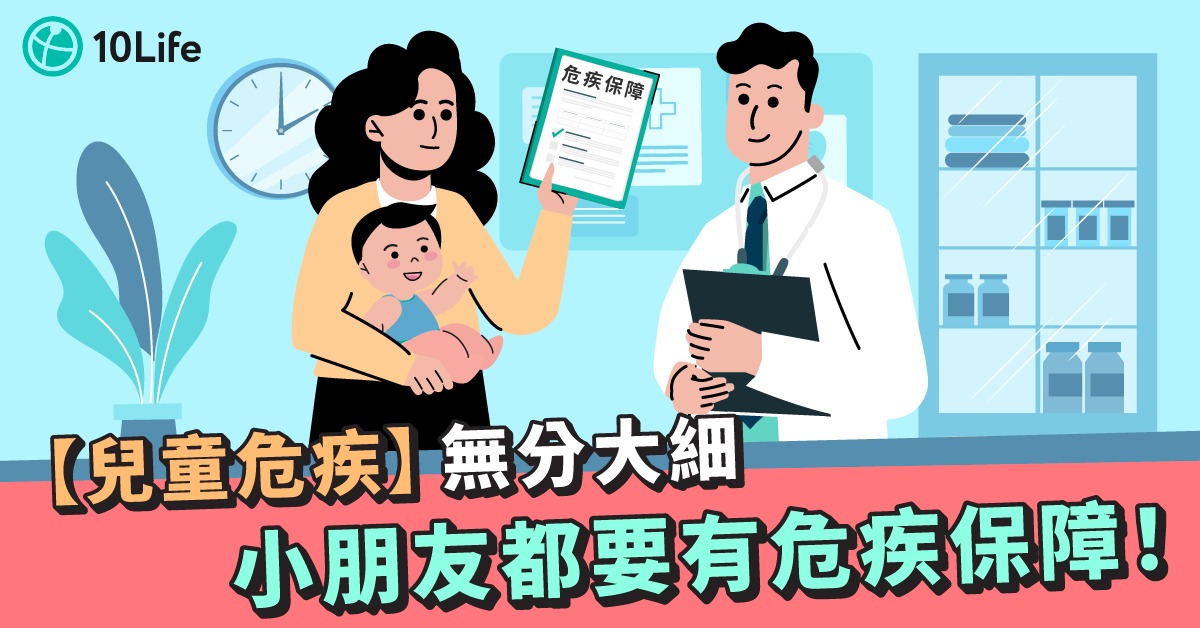
A new life brings joy to the whole family. Parents always hope to do their best to make the finest preparations for their children, from comprehensive antenatal check-ups to a range of childcare support tools. However, life is full of uncertainties, and some parents may choose to make contingency plans: holding on to the greatest hope while also building a safety net against potential concerns. Although the likelihood of children contracting serious critical illnesses is low, there are still many conditions affecting children that are worth parents’ attention.
Hard to guard against! Understand common critical illnesses in children early
Many people think that critical illnesses mainly affect adults, but in fact critical illnesses in children are not uncommon. Below are three common types of childhood critical illness:
According to the Hong Kong Cancer Registry of the Hospital Authority, between 2017 and 2021 there were nearly 131 average annual cancer cases among children aged 0 to 14 over the five-year period, with cases involving children under 5 accounting for nearly 40%1.
Ranking | Cancer type | Age 0 | Ages 1-4 | Ages 5-9 | Ages 10-14 | Total | Percentage of all new cases (%) |
1 | Leukaemia | 16 | 91 | 71 | 57 | 235 | 35.9 |
2 | Primary brain tumour | 8 | 22 | 40 | 24 | 94 | 14.4 |
3 | Lymphoma | 2 | 12 | 24 | 38 | 76 | 11.6 |
4 | Germ cell and gonadal tumours | 7 | 5 | 12 | 30 | 54 | 8.3 |
5 | Neuroblastoma | 9 | 32 | 5 | 1 | 47 | 7.2 |
| Notes: 1. Data on cancer incidence cases among 0- to 14-year-olds from 2017 to 2021 combined Source: Hong Kong Cancer Registry | |||||||
Over 90% of childhood cancers occur spontaneously, with no known cause, so preventive measures are extremely limited. Fortunately, most childhood cancers are curable, but treatment may involve chemotherapy, surgery and radiotherapy, all of which can lead to substantial medical expenses, with the course of treatment often lasting years.
Taking leukaemia as an example, 4 out of every 100,000 children in Hong Kong are diagnosed with the disease. Acute lymphoblastic leukaemia is mainly treated with chemotherapy, and some patients may also require radiotherapy. The entire treatment process may take 2 to 3 years, and the associated medical costs can inevitably place a financial burden on families.
Most heart conditions detected during childhood are congenital. Among every 1,000 newborn babies, 6 to 8 are affected by congenital heart disease of varying severity, with heart defects being the most common.
Some heart defects may close naturally within a few years after birth, but some may require surgical repair. Operations on structurally complex hearts are also more costly, and surgery at private hospitals generally costs hundreds of thousands of dollars.
Further reading: 【Heart Defect】What are the symptoms? Can it be cured? Is congenital heart disease covered by insurance?
Rare diseases are conditions with an extremely low prevalence and a very small number of patients. There are more than 8,000 such diseases worldwide, including spinal muscular atrophy. Many rare diseases are caused by gene mutations or inherited genetic defects, and can affect patients from birth to old age. According to a 2018 study by the University of Hong Kong, one in every 67 people in Hong Kong has a rare disease.
As cases are few and far between, if a child is unfortunately diagnosed with a rare disease, the child and their family often face a longer diagnostic period and expensive treatment costs. They also often need to devote more additional resources to caring for the child, creating a heavy financial burden.
Comprehensive preparation for children’s critical illness lifelong protection
As the treatment process for critical illnesses in children can be lengthy, parents need to spend extra time caring for their children, which may affect work and household income. A lump-sum payout from critical illness insurance can provide flexible support for the family. Taking out critical illness insurance for your child as early as possible means they can enjoy protection sooner, while premiums are also more cost-effective. For example, with whole-of-life critical illness insurance, it can not only cover critical illnesses in children (depending on the product), but also prepare for common adult conditions such as cancer, heart disease or stroke, allowing protection to accompany them through different stages of life.
It is worth noting that the scope of cover varies between different critical illness insurance plans. Some critical illness insurance policies can be applied for from as early as 18 weeks of pregnancy, allowing the child to be protected from birth. As the recurrence rate of critical illnesses is high nowadays, it is also important to understand how multiple claims are handled before taking out a policy.
Take action early to provide your child with comprehensive protection
Every parent, upon learning of a pregnancy, is naturally full of anticipation and eager to make the best plans for their child. Whole-life critical illness protection can provide the best support should the child unfortunately face the worst in future, and is a “lifelong gift” for the child.
Note:
Last updated: 4 October 2024
This English version of this article has been generated by machine translation powered by AI. It is provided solely for reference purposes. In the event of any discrepancy or inconsistency between this translation and the original Chinese version, the Chinese version shall prevail.
Our team of professional content researchers focussing on insurance
Our team of professional content researchers focussing on insurance




 Talk to 10Life on WeChat
