









10Life Financial Limited
Enquiries: enquiries@10life.com
Hotline: (852) 3705 1599
Address: 16/F Greatmany Centre, 109-115 Queen’s Road East, Wan Chai, Hong Kong



What does home insurance cover? Three common core cover types
Additional coverage available only with some home insurance plans
3 common scenarios: is home insurance covered?
Easily compare home insurance in one place: choose the most comprehensive protection for your home through 10Life
What is usually not covered by home insurance?
What should owner-occupiers, landlords and tenants pay attention to?
Home insurance coverage FAQs


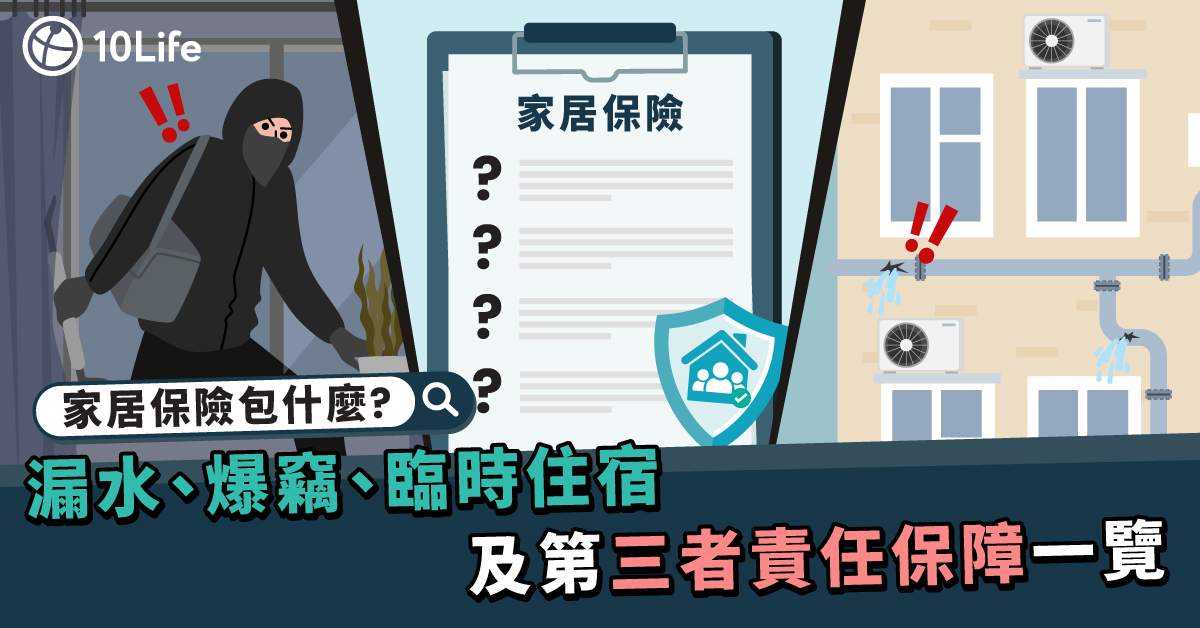
Home emergencies often happen without warning. From windows shattered by typhoons and flooding caused by burst pipes, to ceiling leaks affecting neighbours downstairs, they can all lead to a heavy financial burden. A comprehensive home insurance policy can provide protection for household contents and third-party legal liability. This article will take an in-depth look at the core cover, optional benefits, common claims questions and exclusions of home insurance, and also include fire insurance comparisons and guidance for policyholders of different profiles, helping you choose the most suitable protection plan wisely.
What does home insurance cover? Three common core cover types
There is a wide range of home insurance products available on the market, but their coverage structures generally revolve around three core areas.
Home contents protection mainly covers tangible belongings inside the home, ensuring reasonable compensation if the living environment is damaged by specified accidents. Policyholders should pay attention to the relevant compensation terms and coverage conditions:
It is worth noting that wear and tear arising from normal use, natural ageing of items, poor repair and maintenance, and damage caused by long-term minor seepage are not covered under home contents protection.
Third-party legal liability protection is one of the most important coverages in home insurance, primarily to address legal compensation liability arising from negligence that causes injury, death or property damage to others:
Some insurance plans also include pet owner liability coverage, for example if a dog at home accidentally bites a visitor within the insured area. However, this is not a standard feature, and insurers impose strict restrictions on pet breeds and the location of the accident.
In addition to property and liability cover, some more comprehensive home insurance plans also extend protection to personal safety, providing basic home personal accident benefits:
When selecting a plan, policyholders should first review their existing medical and accident insurance for themselves and their family, and assess whether additional personal protection through home insurance is necessary.
Additional coverage available only with some home insurance plans
In addition to the three core cover items, many insurers add various optional benefits to enhance product appeal. These benefits provide additional support for specific life situations, meeting the diverse needs of different residential occupants and homeowners.
When a residential unit suffers a major incident and becomes uninhabitable, temporary accommodation and rental loss cover can provide practical financial support:
It is important to distinguish clearly that a landlord’s “rental loss cover” refers to losses arising from the unit being damaged and unavailable for letting, which is entirely different from the risk of a tenant’s unjustified rent arrears.
Unexpected home emergencies can often leave people at a loss. The 24-hour emergency home assistance service is designed to provide an immediate channel for urgent help:
Traditional home insurance only covers indoor spaces, but modern residential design often includes outdoor extension areas, so some plans broaden the geographical scope of cover:
Designated plans or optional benefits specifically designed for landlords can provide more comprehensive protection against common risks during the tenancy process:
3 common scenarios: is home insurance covered?
In everyday life, home accidents often involve complex questions of liability and responsibility. The following examines the actual claims process and key approval factors for home insurance through four of the most common accident scenarios.
If an indoor water pipe suddenly bursts, it may not only cause damage to your own household belongings, but also leak into the flat below, resulting in double losses:
When making a claim, you must prove that the burst pipe was a sudden accident rather than the result of long-term poor maintenance; otherwise, the insurer has the right to رفض the claim.
Hong Kong is often hit by typhoons in summer. Strong winds and heavy rain can easily cause windows to break or rainwater to seep in. The key to a claim is whether the incident was sudden and accidental:
When a fire in a nearby unit affects the renovation or belongings in your own unit, the claims route depends on the policy cover and third-party liability:
Easily compare home insurance in one place: choose the most comprehensive protection for your home through 10Life
Want to compare the coverage and premium discounts of different insurers at a glance? Why not use the 10Life Home Insurance Comparison Platform immediately, where you can easily compare various home insurance plans in one place, receive objective analysis from professional actuaries, and complete online application, giving you the most comprehensive protection for you and your loved ones’ home life!

What is usually not covered by home insurance?
Understanding exclusions is just as important as understanding the scope of cover. Insurers will clearly set out the excluded circumstances in the policy terms, and policyholders should pay particular attention to the following eight common exclusions to protect their own interests.
What should owner-occupiers, landlords and tenants pay attention to?
Risks faced by owner-occupiers, landlords and tenants are entirely different. When taking out insurance, you should prioritise different areas of cover according to your own needs. Below is an analysis of the key insurance priorities for the three main groups:
| Owner-occupier | Landlord | Tenant |
Key cover: Ensure the sum insured is sufficient to cover the total value of all home furnishings and appliances, with particular attention to cover for flooding and falling objects. | Key cover: Choose a dedicated landlord plan to cover the unit structure and included fixtures, while also guarding against tenancy disputes. | Key cover: There is no need to insure the landlord’s fixed fittings; focus instead on personal possessions and liability for accidental damage to the landlord’s property. |
Home insurance coverage FAQs
Home insurance may cover valuable belongings such as jewellery, watches, precious metals and antiques, but this depends on the policy definition, insured perils and the individual sub-limits. Policies usually set indemnity limits for each item/group of items, as well as for all valuables in total. If you own high-value items, you should declare the item details and value to the insurer before taking out the policy, and keep receipts, valuation reports or photos. If the basic cover limit is insufficient, you may list individual items under the policy, increase the sum insured, or purchase optional cover. Whether an additional premium is required depends on the product terms.
Standard home insurance does not cover tenants’ rent arrears. Only specific plans or optional covers designed for landlords letting out their properties may cover losses arising from a tenant’s unjustified non-payment of rent. Policyholders should clearly distinguish between “rent loss because the unit is damaged and cannot be let” and “a tenant deliberately failing to pay rent”; these are entirely different items under policy terms.
Whether outdoor contents are covered depends on the policy wording. Standard plans usually only cover contents within enclosed indoor spaces. If the flat has a balcony, rooftop or private garden, the policyholder should check whether the policy includes “outdoor contents cover” and note any special restrictions relating to weather damage and anti-theft measures.
Older buildings can also take out home insurance, but insurers will assess the property based on its age, maintenance condition and whether any unauthorised structures are present. Some insurers set a higher excess for properties of an older age, or require a building condition inspection first. Owners of older buildings are advised to consider dedicated home insurance plans for older buildings to obtain suitable cover.
This English version of this article has been generated by machine translation powered by AI. It is provided solely for reference purposes. In the event of any discrepancy or inconsistency between this translation and the original Chinese version, the Chinese version shall prevail.
I’m delighted to be part of 10Life in building a one stop insurance platform.
10Life Product Comparison and 10Life Insurance Ratings are developed by 10Life Financial Limited, an authorised insurance broker company licensed with the Insurance Authority under License Number FB1526. 10Life Product Comparison and 10Life Insurance Ratings are developed for generic customer segments using mathematical calculations based on product information, facts and data, and are not influenced by any partnerships with or fees received from insurance companies. Any information on 10Life Platform ("10Life Information"), including but not limited to Product Comparison, Product Ratings, Blog Articles are intended for general education purpose and reference only. None of the 10Life Information is intended, nor should they be considered or relied upon, as regulated advice, insurance, financial, investment or professional advice, recommendation, approval, endorsement, invitation or solicitation in respect of any insurance, financial or investment products. 10Life Information does not take into account your individual needs. Reading 10Life Information should not be considered as conducting a suitability assessment, and is not sufficient to form the basis of any decisions to purchase any insurance products. You should rely on information authorised by insurance companies, carry out your own research and/or seek independent advice from licensed intermediaries before purchasing any insurance products or making any insurance decisions. While reasonable effort is used when collecting, validating and updating 10Life Information from various channels, none of 10Life Group and its subsidiaries, affiliates, agents, directors, officers and employees will be responsible for any liability, claim or loss arising from or associated with you using 10Life Information. No warranty, representation or guarantee is given by 10Life Group and its subsidiaries on the accuracy, completeness and timeliness of the information. If you have any questions on 10Life Product Comparison and 10Life Insurance Ratings, please email us at enquiries@10life.com




 Talk to 10Life on WeChat
