









10Life Financial Limited
Enquiries: enquiries@10life.com
Hotline: (852) 3705 1599
Address: 16/F Greatmany Centre, 109-115 Queen’s Road East, Wan Chai, Hong Kong





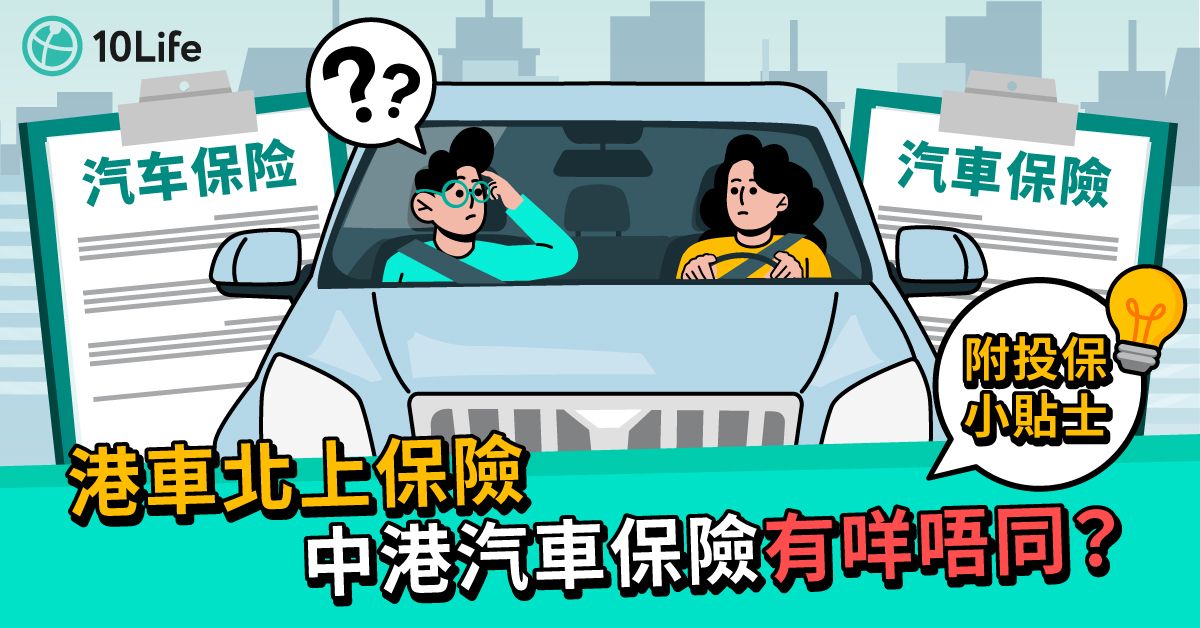
The Hong Kong-Zhuhai-Macao Bridge Macao licence plate scheme has been implemented since July. Eligible Hong Kong private cars may travel between Hong Kong and Guangdong Province via the Hong Kong-Zhuhai-Macao Bridge. Before applying, owners or drivers must first meet a series of conditions, and then register for the computer ballot on the “Hong Kong vehicles heading north” website. Successful applicants must arrange a vehicle inspection and purchase a qualifying statutory motor insurance policy before they can make a customs clearance appointment. However, mainland motor insurance differs significantly from the third-party liability insurance required under Hong Kong law. Is buying just one policy enough to provide adequate protection?
How to apply for Hong Kong vehicles to travel northbound
Owners or drivers wishing to apply for the Hong Kong vehicles northbound scheme must be Hong Kong residents holding a Hong Kong Identity Card and a Home Visit Permit, and must hold driving licences or driving permits issued in Hong Kong and Mainland China, as well as be the registered owner of the private car applying for the scheme. The vehicle taking part in the northbound scheme must also meet certain conditions:
Vehicle requirements |
|
|
|
|
|
Application procedure:
The authorities require applicants to take out statutory motor insurance, namely the Mainland Compulsory Traffic Accident Liability Insurance for Hong Kong cross-boundary vehicles of the Hong Kong-Zhuhai-Macao Bridge (Compulsory Insurance) or “equivalent first recognition” insurance, to provide compensation for death, bodily injury or property damage caused by traffic accidents involving the insured vehicle (excluding passengers and the policyholder on board).
Can the Hong Kong vehicle northbound insurance be purchased separately?
Following the Mainland and Hong Kong authorities reaching a consensus to implement the “equivalence recognition first” policy, Hong Kong insurance companies may offer “equivalence recognition first” policies, i.e. Mainland motor insurance can be added to a Hong Kong motor insurance policy. The entire policy is issued by a Hong Kong insurer, so there is no need to purchase separate policies, and coverage in Mainland China can be obtained under the same arrangement.
If you have just bought a new car, or your existing policy is about to expire and you want to switch insurers, the car owner or driver may consider purchasing an “equivalence recognition first” policy. However, if the existing motor insurance has not yet expired, the car owner or driver may also purchase the Compulsory Traffic Insurance through their current motor insurer as an add-on cover.
At present, 16 insurers in Hong Kong are preparing to launch “equivalence recognition first” products, and some products are already available. Policyholders may choose either an annual plan or a short-term 30-day plan.
On the face of it, motor insurance in Mainland China and Hong Kong both provide compensation for third-party bodily injury and property damage, but what are the differences in scope of cover and limits of liability?
Table: Compare Hong Kong third-party liability insurance, Hong Kong–Zhuhai–Macao Bridge cross-border vehicle compulsory and commercial insurance coverages
| Benefit limits (per accident) | Hong Kong third-party liability insurance | Mainland Compulsory Traffic Accident Liability Insurance | Mainland commercial insurance | |
At-fault compensation | No-fault compensation | |||
| Death and disability benefit limit | HK$100 million | RMB180,000 | RMB18,000 | RMB1 million to RMB10 million |
| Medical expense benefit limit | RMB18,000 | RMB1,800 | ||
| Property damage benefit limit | Typically HK$2 million | RMB2,000 | RMB100 | |
| Passenger liability benefit limit | × | × | × | RMB10,000 to RMB100,000 |
| Policyholder vehicle cover | × | × | × | × |
| Source: Insurance Authority, China Pacific Insurance | ||||
Is third-party insurance cover too low? Do you need to buy multiple commercial policies to have enough cover?
Compared with the compulsory third-party insurance, the sum insured under compulsory motor insurance is relatively low (the maximum compensation for an accident is only RMB 180,000), so the cover may not be sufficient. As a result, some drivers purchase an additional Hong Kong-Zhuhai-Macao Bridge Hong Kong Cross-border Vehicle Commercial Insurance (commercial insurance) policy on top of the compulsory motor insurance.
The commercial insurance offers two insurance options: Third Party Liability Insurance and Occupant Liability Insurance. These cover liability to third parties arising from traffic accidents and liability for persons in the vehicle respectively. Policyholders may choose to purchase both options or only one of them.
Third Party Liability Insurance covers the same scope as compulsory motor insurance, primarily providing additional cover above the compulsory motor insurance. The minimum sum insured is RMB 2 million, with four other sum insured options available.
Occupant Liability Insurance mainly covers the driver and passengers in the vehicle. It provides cover for liability arising from death or bodily injury to persons in the insured vehicle, as well as persons boarding or alighting from the vehicle, when a traffic accident occurs in the insured vehicle. For example, if a passenger is knocked down by a vehicle behind while boarding and suffers injury from a fall, a claim may be made.
Bonus topic: Do traffic accidents still require compensation even when there is no liability?
In Hong Kong, third-party motor insurance covers damage to third-party property, bodily injury and death, related legal proceedings, and other expenses arising from an accident. On the Mainland, compulsory motor insurance is divided into liability and no-fault compensation. The former is broadly similar to Hong Kong’s third-party motor insurance, while the latter is quite different. Under the Mainland’s Road Traffic Safety Law, once a traffic accident occurs, even if the vehicle owner bears no responsibility, the insurer must compensate the losses of the party at fault within the compulsory motor insurance coverage limits.
For example, if Driver A and Driver B are involved in a traffic accident, with Driver A fully at fault and injured, while Driver B is not at fault. Driver A will of course have to pay compensation, but if Driver B has purchased compulsory motor insurance, their insurer must also make no-fault compensation to Driver A. As Driver B, even though they are the victim and the non-liable party and do not have to bear any actual compensation liability, they still need to cooperate when Driver A claims no-fault compensation.
Finally, the Hong Kong Vehicle Mainland Travel Scheme has only been in place for a short time, so the relevant eligibility criteria or requirements may still change. Vehicle owners should pay attention to the latest announcements from the governments of both places. Given that driving northwards involves unfamiliar roads and conditions, choosing an appropriate protection plan is even more important. In particular, insurance coverage differs slightly between the two places, so it is advisable to compare carefully before purchasing.
Further reading: 【Three-party cover online quote comparison】Motor insurance premiums can differ by more than 1.7 times — do vehicle owners know which is the cheapest?
Note: This article was last updated on 24 August 2023.
Source: China Pacific Insurance, ZA Insurance, media reports
This English version of this article has been generated by machine translation powered by AI. It is provided solely for reference purposes. In the event of any discrepancy or inconsistency between this translation and the original Chinese version, the Chinese version shall prevail.
Our team of professional content researchers focussing on insurance
Our team of professional content researchers focussing on insurance
10Life Product Comparison and 10Life Insurance Ratings are developed by 10Life Financial Limited, an authorised insurance broker company licensed with the Insurance Authority under License Number FB1526. 10Life Product Comparison and 10Life Insurance Ratings are developed for generic customer segments using mathematical calculations based on product information, facts and data, and are not influenced by any partnerships with or fees received from insurance companies. Any information on 10Life Platform ("10Life Information"), including but not limited to Product Comparison, Product Ratings, Blog Articles are intended for general education purpose and reference only. None of the 10Life Information is intended, nor should they be considered or relied upon, as regulated advice, insurance, financial, investment or professional advice, recommendation, approval, endorsement, invitation or solicitation in respect of any insurance, financial or investment products. 10Life Information does not take into account your individual needs. Reading 10Life Information should not be considered as conducting a suitability assessment, and is not sufficient to form the basis of any decisions to purchase any insurance products. You should rely on information authorised by insurance companies, carry out your own research and/or seek independent advice from licensed intermediaries before purchasing any insurance products or making any insurance decisions. While reasonable effort is used when collecting, validating and updating 10Life Information from various channels, none of 10Life Group and its subsidiaries, affiliates, agents, directors, officers and employees will be responsible for any liability, claim or loss arising from or associated with you using 10Life Information. No warranty, representation or guarantee is given by 10Life Group and its subsidiaries on the accuracy, completeness and timeliness of the information. If you have any questions on 10Life Product Comparison and 10Life Insurance Ratings, please email us at enquiries@10life.com




 Talk to 10Life on WeChat
