









10Life Financial Limited
Enquiries: enquiries@10life.com
Hotline: (852) 3705 1599
Address: 16/F Greatmany Centre, 109-115 Queen’s Road East, Wan Chai, Hong Kong



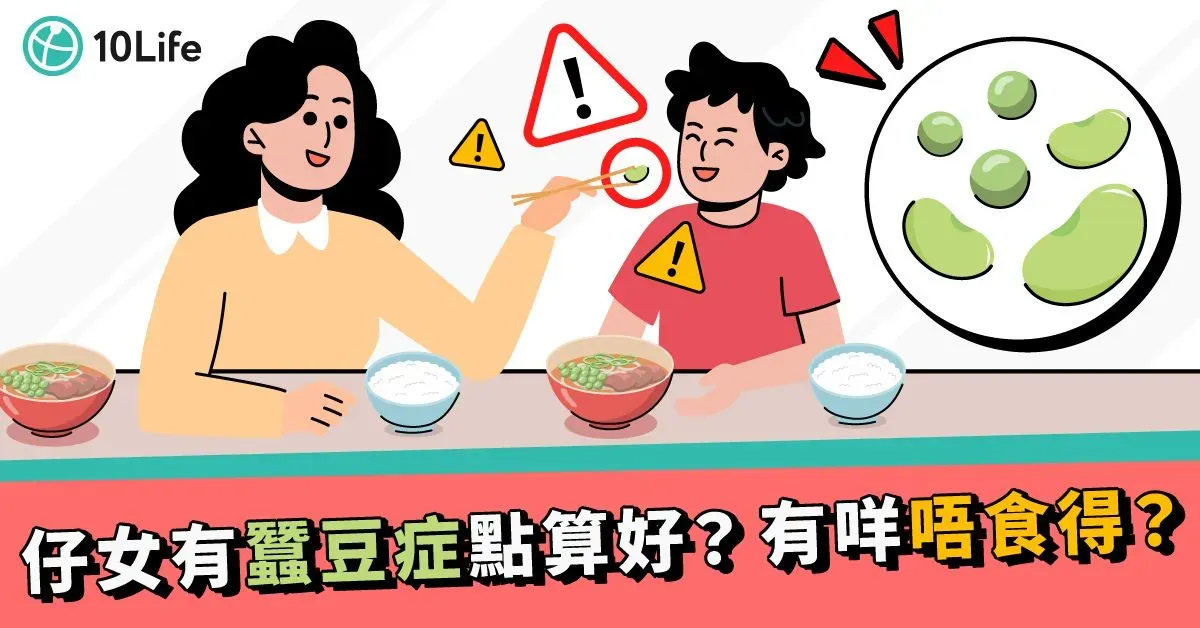
Children have weaker immune systems, so parents are often especially concerned about their health and worry when they seem unwell. However, some conditions have not-so-obvious symptoms. For example, G6PD deficiency, commonly known as favism, requires careful observation by parents or genetic testing for early detection. Children with favism can grow up healthily and develop normally like other children, as long as they avoid forbidden foods or substances. However, if they accidentally consume forbidden foods, it may become life-threatening. So, what are the restrictions for favism? What are the symptoms? Does it go away when they grow up? 10Life has compiled information about favism to give parents a basic understanding.
G6PD deficiency (also known as favism) is the most common inherited metabolic disorder in Hong Kong. According to the Department of Health, 4.5 out of every 100 baby boys in Hong Kong have favism, while the figure for baby girls is 5 in every 1,000.
There are more male than female patients. This is mainly because the gene controlling G6PD production is located on the X chromosome. If a boy’s only X chromosome has a faulty G6PD gene, he will develop favism; a girl must have faulty G6PD genes on both X chromosomes in order to be affected.
People with favism are deficient in the G6PD enzyme, which helps stabilise red blood cells and makes them less susceptible to damage. Patients usually have no symptoms in daily life, but once they come into contact with certain external triggers, such as broad beans or mothballs, their red blood cells may be damaged and break down rapidly, leading to acute haemolysis.
G6PD deficiency is called favism because broad beans are one of the prohibited foods that can trigger an attack.
When a patient with G6PD deficiency has a crisis and develops acute haemolysis, a large amount of haemoglobin is released from the red blood cells, placing an excessive burden on the liver and causing an overproduction of bilirubin, which leads to jaundice.
If a newborn develops severe jaundice and is not treated promptly, excess bilirubin can accumulate in the baby’s brain, potentially causing permanent damage to brain cells, hearing impairment, intellectual developmental problems, muscle spasms and even death. Therefore, parents of babies with G6PD deficiency should pay particular attention to whether their child has jaundice.
In addition to jaundice, during acute haemolysis the rate at which red blood cells are destroyed is faster than the body’s ability to produce new ones. As a result, the body may not be able to replenish enough red blood cells in time, and the following symptoms may also occur:
If a patient with G6PD deficiency suddenly develops these symptoms, medical attention must be sought immediately.
In addition, if G6PD deficiency is diagnosed early, it can help patients and their families avoid foods or items that are contraindicated. Newborns born in public hospitals can undergo free cord blood screening to determine whether they have G6PD deficiency. As for babies born in private hospitals, parents may enquire with the hospital, obstetrician or paediatrician about testing arrangements.
G6PD deficiency cannot be cured, but parents need not worry too much. As long as certain foods, medicines, or items are avoided, the patient’s health is no different from that of a person without the condition.
| Food | Fava beans, and foods containing fava bean ingredients, such as mixed beans, mung bean vermicelli, etc. |
| Chinese medicine | Honeysuckle, coptis, wintersweet flower, bezoar, pearl powder, etc. |
| Western medicine | Some antibiotics, anti-malarial drugs, or painkillers and fever reducers with excessive dosages or containing aspirin, etc. |
| Household products | Mothballs or insect repellent tablets containing naphthalene |
| Note: The above table is for reference only and does not cover all medicines that should be avoided. For details, please consult a doctor. Source: Hospital Authority, Department of Health | |
G6PD deficiency is a congenital condition, so parents may worry about whether their child can get medical insurance.
Each G6PD deficiency patient’s situation is different, and each insurer also has different underwriting terms, so it cannot be generalised. Some insurers will accept applications from people with G6PD deficiency, and the premiums they need to pay will be the same as those for applicants of the same age and gender who do not have the condition. However, exclusions may apply. If hospitalisation is due to symptoms caused by G6PD deficiency, claims are generally not payable; but if medical treatment is sought for other reasons, claims will be handled as normal.
If you would like to learn more about children’s medical insurance, please feel free to contact 10Life’s professional insurance advisers.
Note:
Source: Hospital Authority, Department of Health, Consumer Council, insurance companies
Last updated on 4 December 2023
This English version of this article has been generated by machine translation powered by AI. It is provided solely for reference purposes. In the event of any discrepancy or inconsistency between this translation and the original Chinese version, the Chinese version shall prevail.
Our team of professional content researchers focussing on insurance
Our team of professional content researchers focussing on insurance
10Life Product Comparison and 10Life Insurance Ratings are developed by 10Life Financial Limited, an authorised insurance broker company licensed with the Insurance Authority under License Number FB1526. 10Life Product Comparison and 10Life Insurance Ratings are developed for generic customer segments using mathematical calculations based on product information, facts and data, and are not influenced by any partnerships with or fees received from insurance companies. Any information on 10Life Platform ("10Life Information"), including but not limited to Product Comparison, Product Ratings, Blog Articles are intended for general education purpose and reference only. None of the 10Life Information is intended, nor should they be considered or relied upon, as regulated advice, insurance, financial, investment or professional advice, recommendation, approval, endorsement, invitation or solicitation in respect of any insurance, financial or investment products. 10Life Information does not take into account your individual needs. Reading 10Life Information should not be considered as conducting a suitability assessment, and is not sufficient to form the basis of any decisions to purchase any insurance products. You should rely on information authorised by insurance companies, carry out your own research and/or seek independent advice from licensed intermediaries before purchasing any insurance products or making any insurance decisions. While reasonable effort is used when collecting, validating and updating 10Life Information from various channels, none of 10Life Group and its subsidiaries, affiliates, agents, directors, officers and employees will be responsible for any liability, claim or loss arising from or associated with you using 10Life Information. No warranty, representation or guarantee is given by 10Life Group and its subsidiaries on the accuracy, completeness and timeliness of the information. If you have any questions on 10Life Product Comparison and 10Life Insurance Ratings, please email us at enquiries@10life.com




 Talk to 10Life on WeChat
