









10Life Financial Limited
Enquiries: enquiries@10life.com
Hotline: (852) 3705 1599
Address: 16/F Greatmany Centre, 109-115 Queen’s Road East, Wan Chai, Hong Kong





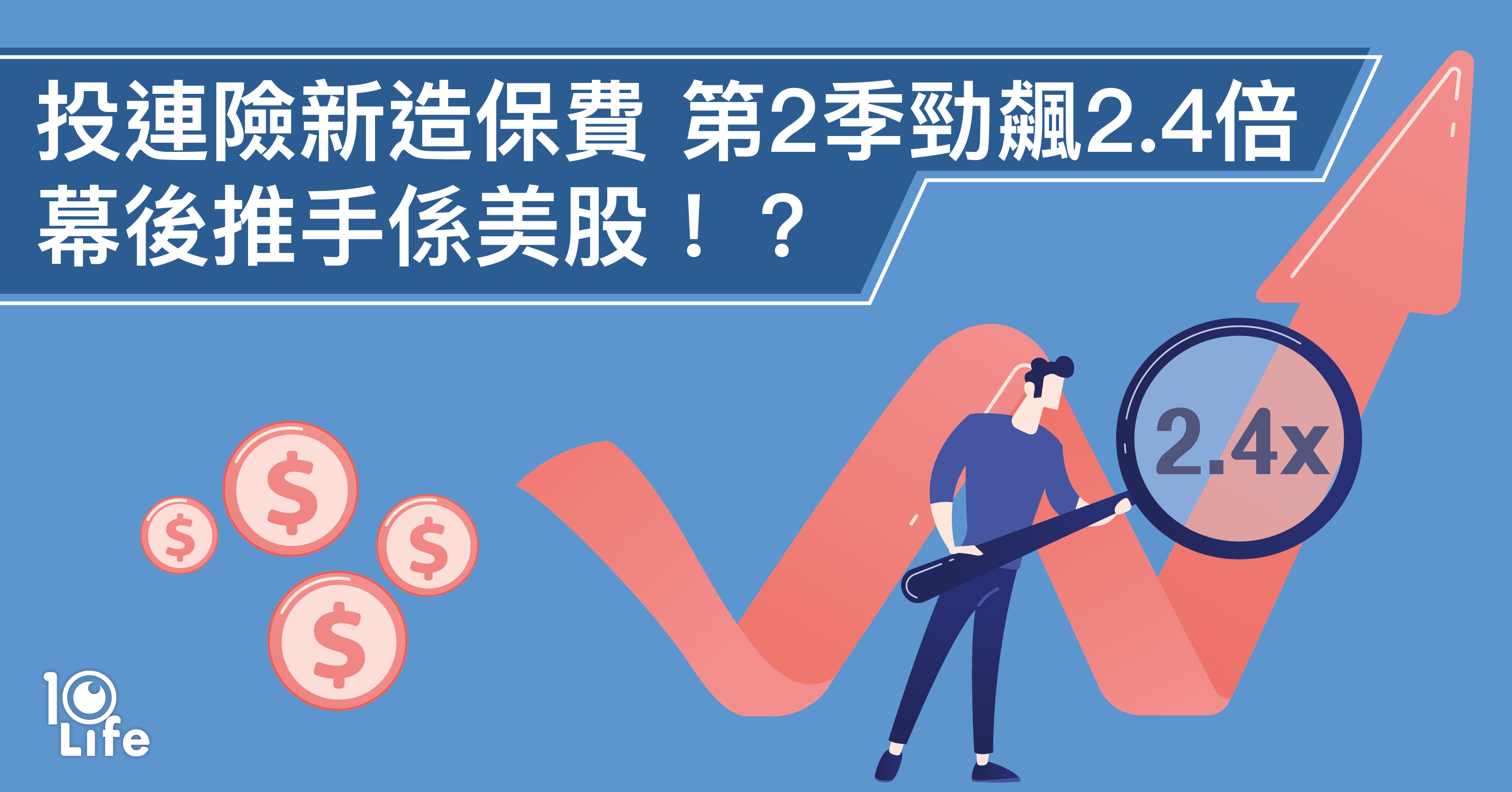
Amid the COVID-19 pandemic, the US Federal Reserve injected liquidity to stimulate the economy, while the three major US stock market indices repeatedly hit new highs. Coincidentally, sales of investment-linked assurance schemes (ILAS, commonly known as investment-linked insurance) also surged, with new premiums reaching HK$7.07 billion in the second quarter of 2021, up nearly 2.38 times year on year. To what extent did US equities influence the sales of investment-linked insurance?
Investment-linked insurance is a hybrid of funds and life insurance. Unlike ordinary savings life insurance, policyholders of investment-linked insurance can choose funds for investment. Asset classes include equities and bonds from different countries, as well as specific sectors such as healthcare and technology. However, policyholders do not directly own the relevant funds or assets; they only own the policy.
Investment-linked insurance usually does not charge fund-switching fees, has a relatively low entry threshold and allows policyholders to invest in multiple funds simultaneously, making it popular among some investors. However, as this type of insurance product is long-term in nature, early surrender will result in losses.
Strong US equity performance stimulates investment-linked insurance sales
At the end of 2019, the first case of COVID-19 was recorded globally. In the first quarter of 2020, the virus spread to countries around the world, severely affecting global stock markets. Governments subsequently introduced various economic rescue measures, such as unprecedentedly loose monetary policies and extensive fiscal policies. Together with progress in vaccine development and hopes of economic reopening, these measures helped stock markets begin to rebound from their lows in the second quarter of 2020.
After the three major US stock market indices fell sharply in the second quarter of 2020, they attracted many Hong Kong investors. US equities also had a low entry threshold, a wide range of investment options and a generally upward yet volatile trend, making them almost as popular as Hong Kong equities.
When stock markets perform strongly, many investors become more aggressive (risk on). Insurance advisers also capitalised on the strong performance of US equities, technology stocks and healthcare stocks, packaging investment-linked insurance as fund products to sell to clients.
Figure 1: Relationship between investment-linked insurance sales, the Hang Seng Index and the Dow Jones Industrial Average

Looking back at quarterly investment-linked insurance data from the first quarter of 2017 to the second quarter of 2021, it is clear that investment-linked insurance sales were closely connected to stock markets during the pandemic. When the Hang Seng Index and the Dow Jones Industrial Average were at relatively low daily closing averages in the second quarter of 2020, new investment-linked insurance premiums for the quarter amounted to only HK$2.089 billion, a new quarterly low in recent years.
However, as global liquidity surged, vaccine development progressed and hopes of economic reopening grew, the Hang Seng Index and the Dow Jones Industrial Average gradually recovered. From the third quarter of 2020 onwards, their performance was positively correlated with investment-linked insurance sales. When the Hang Seng Index regained the 30,000 level in the first quarter of this year and the Dow Jones Industrial Average broke above 33,000 to reach a record high, new investment-linked insurance premiums also reached HK$6.283 billion, up nearly 1.5 times year on year.
However, owing to changes in the regulatory environment in mainland China, the Hang Seng Index performed significantly worse in the second quarter of this year than in the first quarter. The factors supporting US equities remained unchanged, and the Dow Jones Industrial Average continued its strong performance. Notably, new investment-linked insurance premiums still rose by 12.6% quarter on quarter in the second quarter of this year, remaining strongly positively correlated with the performance of US equities, while beginning to diverge from the trend in Hong Kong equities.
Based on the above trends, US equities appear highly likely to be an important factor driving investment-linked insurance sales. It is also possible that investment-linked insurance policyholders have been slow to respond to market conditions in Hong Kong.
Investment-linked insurance sales surged in 2007
In fact, investment-linked insurance enjoyed strong sales in 2007. However, after the global financial crisis erupted in 2008, the collapse of global stock markets caused several financial institutions to fail. As investment-linked insurance is linked to fund prices, it was not immune. The prices of some funds plunged at the time, causing the value of investment-linked insurance policies to almost evaporate. The product then remained dormant for nearly 10 years.
Figure 2: Annual relationship between investment-linked insurance and the Hang Seng Index

At the time, insurance advisers sold investment-linked insurance as insurance products. Many policyholders were unaware of the associated risks when they took out their policies. It was only after suffering substantial losses that they discovered their life insurance protection was linked to the policy value and that the administrative charges were extremely high. This led to numerous complaints, with many policyholders pursuing claims against insurance companies and regulators for years.
In response to the unprecedented number of complaints, the Office of the Commissioner of Insurance (the predecessor of the Insurance Authority) introduced guidelines in 2013, imposing various requirements on the sale of investment-linked insurance. These included requiring policyholders to sign multiple forms, such as a Risk Profile Questionnaire, Financial Needs Analysis, and Important Facts Statement and Policyholder’s Declaration, making investment-linked insurance considerably more difficult to sell. In the same year, the Securities and Futures Commission also required insurance companies offering investment-linked insurance to provide a Product Key Facts Statement (Key Facts Statement, KFS), disclosing the product’s features and risks.
Although investment-linked insurance has this dark history, perhaps people have forgotten the lessons of the global financial crisis. For insurance companies, with business from mainland Chinese clients having nearly disappeared and investment-linked insurance involving numerous fee items (see this article for details), there are also incentives to relaunch the product. This time, investment-linked insurance has been repackaged and marketed using exceptionally well-performing US equity funds, technology funds, healthcare funds and “dividend funds”, attracting many consumers to take out policies.
However, US equities have already accumulated substantial gains. If the US Federal Reserve tightens monetary policy, or if the pandemic worsens again, significant volatility is likely to follow. Hong Kong and mainland Chinese stock markets also face mainland regulatory risks, while the global political and economic landscape remains unpredictable, making future market performance difficult to forecast. If global asset prices weaken significantly, investment-linked insurance products may also incur losses. Will history repeat itself?
Note: The above information is provided by 10Life and was updated on 3 September 2021. It is for reference only and does not constitute a sales recommendation.
This English version of this article has been generated by machine translation powered by AI. It is provided solely for reference purposes. In the event of any discrepancy or inconsistency between this translation and the original Chinese version, the Chinese version shall prevail.
Our team of professional content researchers focussing on insurance
Our team of professional content researchers focussing on insurance
10Life Product Comparison and 10Life Insurance Ratings are developed by 10Life Financial Limited, an authorised insurance broker company licensed with the Insurance Authority under License Number FB1526. 10Life Product Comparison and 10Life Insurance Ratings are developed for generic customer segments using mathematical calculations based on product information, facts and data, and are not influenced by any partnerships with or fees received from insurance companies. Any information on 10Life Platform ("10Life Information"), including but not limited to Product Comparison, Product Ratings, Blog Articles are intended for general education purpose and reference only. None of the 10Life Information is intended, nor should they be considered or relied upon, as regulated advice, insurance, financial, investment or professional advice, recommendation, approval, endorsement, invitation or solicitation in respect of any insurance, financial or investment products. 10Life Information does not take into account your individual needs. Reading 10Life Information should not be considered as conducting a suitability assessment, and is not sufficient to form the basis of any decisions to purchase any insurance products. You should rely on information authorised by insurance companies, carry out your own research and/or seek independent advice from licensed intermediaries before purchasing any insurance products or making any insurance decisions. While reasonable effort is used when collecting, validating and updating 10Life Information from various channels, none of 10Life Group and its subsidiaries, affiliates, agents, directors, officers and employees will be responsible for any liability, claim or loss arising from or associated with you using 10Life Information. No warranty, representation or guarantee is given by 10Life Group and its subsidiaries on the accuracy, completeness and timeliness of the information. If you have any questions on 10Life Product Comparison and 10Life Insurance Ratings, please email us at enquiries@10life.com



 Talk to 10Life on WeChat
