









10Life Financial Limited
Enquiries: enquiries@10life.com
Hotline: (852) 3705 1599
Address: 16/F Greatmany Centre, 109-115 Queen’s Road East, Wan Chai, Hong Kong



5 Home Checks to Make Before a Typhoon
What should you do about water leakage by the window? A few immediate emergency measures
Tropical Cyclones Are Coming: Home Insurance Is Your Last Line of Defence
What is a tropical cyclone?
What is a tropical cyclone warning? How are tropical cyclone warning signals classified?
How to interpret a tropical cyclone track chart?
Why are tropical cyclones particularly likely to cause problems at home?


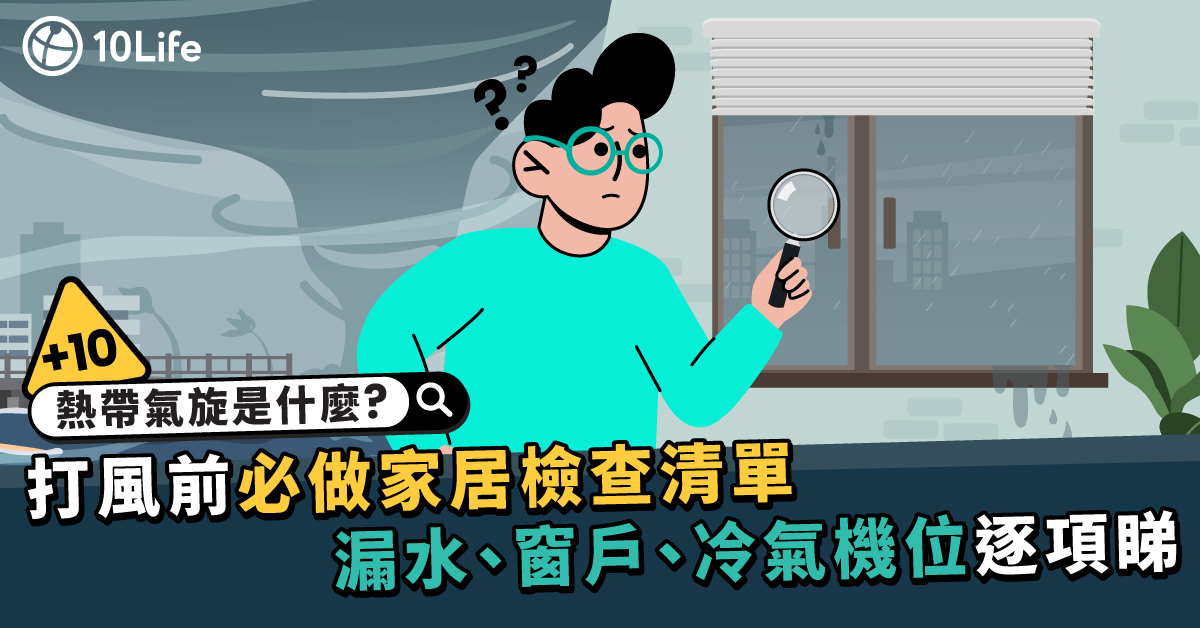
Whenever typhoon season arrives in Hong Kong, people are most concerned not only about whether work and school will be suspended, but also whether their home will turn into a “water performance”.
News reports often say things like “a tropical cyclone is approaching Hong Kong” or “the tropical cyclone has intensified into a severe typhoon”, but what exactly is a tropical cyclone? How is it different from a typhoon? More importantly, when a typhoon really hits, the parts of the home most likely to be affected are often not the ceiling, as you might expect, but water seepage by the windows, leaks at the air-conditioning unit, blocked balcony drains, or even loose window hinges and objects overturned by strong winds.
If you think that all you need to do before a typhoon is stick an “X” pattern of tape on the glass, you may be underestimating the destructive force of wind and rain. This article will use a simple and easy-to-understand approach to explain what a tropical cyclone is, and provide a practical home inspection checklist to help you prepare before a typhoon.
5 Home Checks to Make Before a Typhoon
In addition to checking whether the glass is cracked, also pay attention to whether the window frame and hinges are secure and free from rust. If the waterproof seals around the window have aged or cracked, water can easily seep in during strong winds, so repairs should be carried out as early as possible before a typhoon.
Many people stick “cross-shaped tape” on windows, but in fact this has limited effect in preventing glass from breaking. More importantly, ensure the window structure itself is sound and secure. If you are worried about water ingress, you can place towels around the window or on the windowsill in advance to absorb water and reduce rainwater entering the home.
This is one of the easiest “water ingress hotspots” to overlook! Once the sealing adhesive around a window-type air conditioner has aged and developed gaps, rainwater can seep into the home along the wall at any time. It is advisable to use a plastic bag or waterproof tape to temporarily seal the edges of the air conditioner before a typhoon as basic protection.
If you use a split-type unit, remember to check whether the outdoor unit bracket is loose or rusty to avoid accidents. Beds should also be kept as far away from the air conditioner as possible, so that if water does seep in, the impact can be reduced.
If the drain outlet is blocked by leaves or debris, heavy rain can easily cause water to back up and flow into the home. Be sure to clear the drainage area before a typhoon, and move balcony flower pots, drying racks and similar items indoors to prevent them from being blown away by strong winds.
Bubbling at corners, peeling paint or water stains all indicate potential water seepage problems. Small water marks that are usually unnoticed may quickly worsen under strong winds and heavy rain, so pay particular attention to windowsills and areas close to exterior walls.
If water enters from the window area, nearby extension leads, routers or small electrical appliances can easily short-circuit and be damaged. The safest approach is to move appliances, rugs and important documents away from windows before a typhoon, to prevent problems before they arise.
What should you do about water leakage by the window? A few immediate emergency measures
If water starts leaking by the window during a typhoon, do not focus on continuously mopping it up first. You should carry out a few basic first-aid steps.
Tropical Cyclones Are Coming: Home Insurance Is Your Last Line of Defence
Tropical cyclones are not a distant weather term; they are a real risk affecting Hong Kong every year. The reality is that even if you carry out all the recommended typhoon preparations, damage caused by strong winds and heavy rain, such as water seepage damaging floors, rainwater backflow ruining furniture, or leaks from the air-conditioner unit causing short circuits, can still be difficult to avoid entirely, and repair costs can be astonishingly high.
Therefore, the ideal preparation before a typhoon is not only to close all windows and clear drainage outlets, but also to make sure you have suitable home insurance. Home insurance covers indoor furniture and appliances, as well as accidental losses caused by severe weather. With the storm season just beginning, you may wish to visit 10Life to compare the coverage of different home insurance plans and build the strongest possible defence for your home.
Further reading: 【Home Insurance Comparison 2026】Which home insurance is best? A complete guide for owners and tenants (with exclusive actuary ratings)
What is a tropical cyclone?
Simply put, a tropical cyclone is a low-pressure system formed over warm oceans, and what people commonly refer to as a “typhoon” is actually one of the stronger types of tropical cyclone.
For people in Hong Kong, the most tangible impact of a tropical cyclone is not the terminology, but the strong winds, torrential rain, storm surge and damage to the home that it brings. When a No. 8, No. 9 or even No. 10 signal is hoisted, seemingly ordinary window frames, balconies and air-conditioner openings can suddenly become household hazards.
What is a tropical cyclone warning? How are tropical cyclone warning signals classified?
Many people search for “tropical cyclone warning” or “tropical cyclone warning signal” because what they really want to know is how severe the storm’s actual impact on Hong Kong will be.
In simple terms, when the Observatory’s tropical cyclone-related signal is progressively upgraded, it usually means the likelihood or severity of the storm’s impact on Hong Kong is increasing. For the average household, the higher the warning level, the earlier you should prepare against wind and flooding and carry out home safety checks, rather than waiting until a Number 8 signal is hoisted and then rushing to deal with things at the last minute.
How to interpret a tropical cyclone track chart?
In addition to monitoring tropical cyclone warnings, many people also search for a “tropical cyclone track map” to judge whether the storm will move closer to Hong Kong.
In fact, when looking at a tropical cyclone track map, you can first pay attention to three things: the storm’s current location, its direction of movement, and whether the forecast track is close to the Pearl River Estuary. The closer the track is to Hong Kong, and the stronger the winds become, the more significant the impact of wind and rain on Hong Kong is usually likely to be. As such, home preparations before a typhoon should not be delayed.
Why are tropical cyclones particularly likely to cause problems at home?
Many people think the greatest danger during a typhoon is “shattered glass”, but in reality, the more common problems in Hong Kong homes are seepage, leaks, backflow, and loose items being blown away.
The reason is simple: a tropical cyclone is not just about strong winds, but also driving wind and rain. Small gaps that are usually not obvious can turn into points of water ingress during a typhoon; balconies with slightly slow drainage can become waterlogged and experience backflow during heavy rain; as for air-conditioner openings, ageing window sealant, and small cracks in external walls, these often all show up at once at such times.
So, truly effective typhoon preparedness is not simply waiting until the Observatory issues a signal before rushing to act, but carrying out a full home inspection in advance.
This English version of this article has been generated by machine translation powered by AI. It is provided solely for reference purposes. In the event of any discrepancy or inconsistency between this translation and the original Chinese version, the Chinese version shall prevail.
I’m delighted to be part of 10Life in building a one stop insurance platform.
10Life Product Comparison and 10Life Insurance Ratings are developed by 10Life Financial Limited, an authorised insurance broker company licensed with the Insurance Authority under License Number FB1526. 10Life Product Comparison and 10Life Insurance Ratings are developed for generic customer segments using mathematical calculations based on product information, facts and data, and are not influenced by any partnerships with or fees received from insurance companies. Any information on 10Life Platform ("10Life Information"), including but not limited to Product Comparison, Product Ratings, Blog Articles are intended for general education purpose and reference only. None of the 10Life Information is intended, nor should they be considered or relied upon, as regulated advice, insurance, financial, investment or professional advice, recommendation, approval, endorsement, invitation or solicitation in respect of any insurance, financial or investment products. 10Life Information does not take into account your individual needs. Reading 10Life Information should not be considered as conducting a suitability assessment, and is not sufficient to form the basis of any decisions to purchase any insurance products. You should rely on information authorised by insurance companies, carry out your own research and/or seek independent advice from licensed intermediaries before purchasing any insurance products or making any insurance decisions. While reasonable effort is used when collecting, validating and updating 10Life Information from various channels, none of 10Life Group and its subsidiaries, affiliates, agents, directors, officers and employees will be responsible for any liability, claim or loss arising from or associated with you using 10Life Information. No warranty, representation or guarantee is given by 10Life Group and its subsidiaries on the accuracy, completeness and timeliness of the information. If you have any questions on 10Life Product Comparison and 10Life Insurance Ratings, please email us at enquiries@10life.com




 Talk to 10Life on WeChat
