









10Life Financial Limited
Enquiries: enquiries@10life.com
Hotline: (852) 3705 1599
Address: 16/F Greatmany Centre, 109-115 Queen’s Road East, Wan Chai, Hong Kong





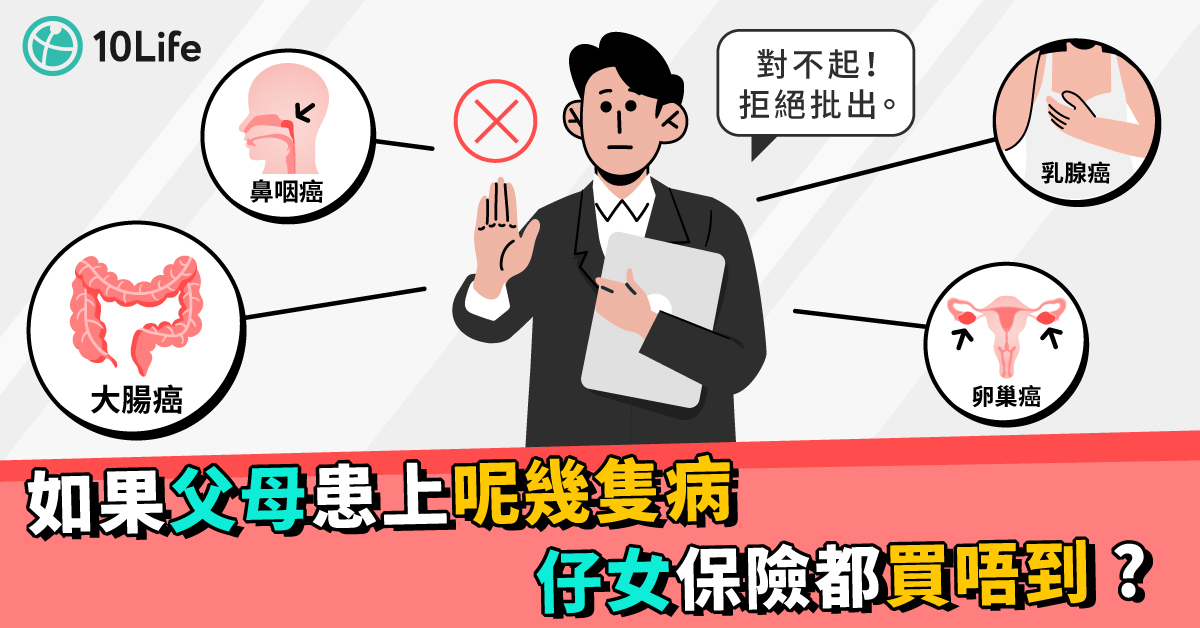
“I was diagnosed with cancer 5 years ago, but I have now recovered. I am planning to buy insurance for my 3-year-old daughter, but the insurance agent said that my daughter may be declined cover or have exclusions added to her policy...”. This user’s case is probably far from uncommon. In fact, when parents buy insurance for their children, insurers will not only ask about the prospective insured person’s health condition, but will also ask about their family medical history, namely the medical history of immediate relatives (parents or siblings). If a parent has previously suffered from cancer, diabetes or other specified illnesses, taking genetic factors into account, in the worst case insurers may reject the child’s application for critical illness or medical insurance. 10Life editors visited insurers’ websites to test this in practice. If, when applying online, parents declare a history of cancer, they generally need to contact the insurer directly to follow up on the application, indicating that it may be more difficult to get cover for certain cancers.
If the insured person’s parents have cancer, insurers will underwrite more cautiously.
Genetic diseases are no longer limited to congenital conditions. Many studies have shown that major illnesses such as cardiovascular disease, diabetes, stroke and various types of cancer are all related to genetics.
Taking cancer, Hong Kong’s number one killer, as an example, around 10% of cancers are associated with inherited cancer-causing genes1. Children may inherit cancer-causing genes from their parents, leading to cancerous changes. Therefore, if a parent unfortunately develops cancer in mid-life (before the age of 60), their children may face stricter underwriting when applying for insurance in the future, with a possibility of additional exclusions, substantially higher premiums, or even rejection of cover. In addition to cancer, insurers will also ask whether any immediate family members have ever been diagnosed before the age of 60 with coronary heart disease, diabetes and various other conditions. Based on the principle of utmost good faith, policyholders should answer truthfully.
Bowtie online insurance application tested:

Practical test of AIA insurance online application:

Certain cancers are more difficult to insure against.
In a recent hands-on test by 10Life, when purchasing critical illness and medical insurance on the online platforms of AIA and Bowtie, declaring that a parent had cancer triggered special handling, and direct application was not always possible.
During the Bowtie application process, if the applicant selected that the proposed insured person’s parent or sibling had been diagnosed with cancer at or before the age of 60, the next page would require further disclosure of the cancer type, such as breast cancer, colorectal cancer, ovarian cancer and nasopharyngeal cancer. After selecting one of these cancers, the process would then move to a page asking the applicant to leave personal details for the insurer to follow up on the application. This also suggests that the above four types of cancer attract greater attention from insurers.
The editor also tested applying for medical or critical illness insurance online with AIA. Once it was selected that the insured person’s parent or sibling had previously had cancer, the process likewise redirected to a page awaiting follow-up by the insurance agent, and the insurer would need to carry out further checks.
Insure early and prepare ahead
If the policyholder declares that their parents have cancer, the insurance company may require the patient to submit a pathology report to understand the nature of the cancer before deciding whether that cancer is an exclusion, whether to increase the premium, or whether the entire policy should be declined. Once declined, parents may need to approach multiple insurance companies to find one that will provide cover, and each time they will also need to go through a complicated declaration process.
Lastly, if you are concerned that developing cancer, other critical illnesses, or having the “three highs” (high blood pressure, high cholesterol and high blood sugar) may affect or limit your children’s cover in future, parents should arrange insurance for their children while both they and their children are healthy, to avoid being declined or facing higher premiums later.
Note:
This English version of this article has been generated by machine translation powered by AI. It is provided solely for reference purposes. In the event of any discrepancy or inconsistency between this translation and the original Chinese version, the Chinese version shall prevail.
Our team of professional content researchers focussing on insurance
Our team of professional content researchers focussing on insurance




 Talk to 10Life on WeChat
