









10Life Financial Limited
Enquiries: enquiries@10life.com
Hotline: (852) 3705 1599
Address: 16/F Greatmany Centre, 109-115 Queen’s Road East, Wan Chai, Hong Kong



How does insurance handle construction defects such as insufficient reinforcement in a new building?
Four scenarios: What does insurance cover, and what does it not cover?
Having identified the issue, what can the property owner do next?
Summary: First distinguish the losses, then check the coverage item by item
Frequently Asked Questions


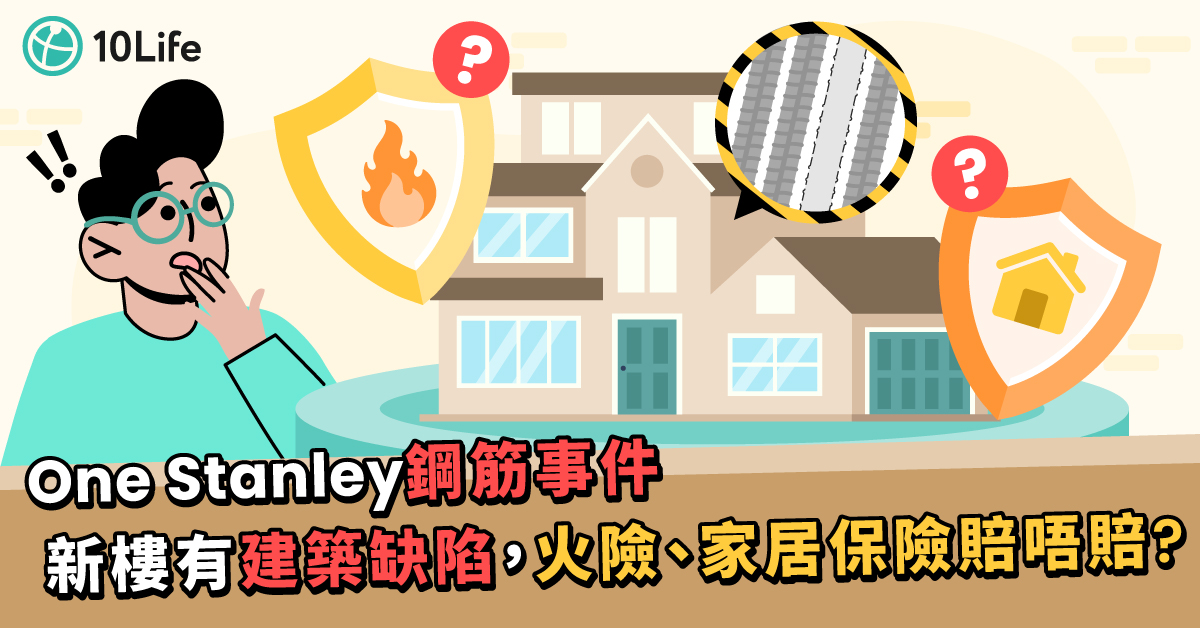
The One Stanley reinforced steel incident has become a city-wide talking point, causing many prospective homeowners to worry about the quality of new developments. According to <《胡‧說樓市》>, the owner of a newly built detached house at One Stanley discovered, while removing the flooring during renovation in August 2025, that the plaster beneath the floor had flaked off. The owner subsequently commissioned a structural engineer to conduct an inspection. After opening up the concrete, the engineer found irregularities in the arrangement and spacing of the reinforcing steel. Based on an analysis of the inspection data, the main reinforcement in some areas was approximately 41% to 75% less than shown in the plans. The owner subsequently sought to hold the developer responsible; the report stated that the two parties disputed whether the problem originated from the original construction or subsequent renovation works.
Regarding the incident, the Buildings Department announced on 3 October that the reinforcement arrangement in parts of the floor slabs did not conform to the plans, and that the protective covering of a ground-floor beam had also not been provided with the wire mesh specified in the plans. Although there is currently no apparent danger, the quality of the construction is a cause for concern. The department is arranging meetings with the authorised person, registered structural engineer, registered contractor and developer. If any breaches are identified, prosecutions and/or disciplinary action may be initiated. The seller responded that, if the investigation establishes any fault, it would carry out remedial works in accordance with the law and pursue the responsibility of the relevant parties.
Detached houses in Stanley costing over HK$100 million may be beyond the reach of most people. However, newly completed residential developments have been handed over in recent years and will continue to be handed over over the next few years, and many people have already bought, or are preparing to buy, their first homes. If construction defects such as insufficient reinforcement, poor workmanship or non-compliant materials are found in a new property, can the fire insurance or Home protection insurance already purchased provide compensation?
How does insurance handle construction defects such as insufficient reinforcement in a new building?
Building cover under fire insurance and Home protection insurance generally does not cover the cost of rectifying original building defects. “Original” means that the defect originated from the design or construction process of the building.
Rectifying a defect itself involves remedying inadequate reinforcement or redoing defective work, which constitutes the cost of rectifying the original works. As this is not the repair of damage caused by an insured event, it is generally not covered under the building cover of Home protection insurance or the cover provided by mortgage fire insurance.
Some policies expressly exclude damage arising from, caused by or connected with inherent defects, defective workmanship, defective materials or design defects. Other policies may contain exceptions that could cover damage caused by the defect to other insured property. The actual position depends on the exclusions and applicable exceptions set out in the individual policy.
The property involved in One Stanley is a detached house. As most people in Hong Kong live in multi-storey buildings, owners of individual flats facing similar issues must, in addition to considering insurance, distinguish whether the affected area is inside their own flat or part of the common areas of the building. Columns, external walls and other areas may constitute common parts. This should be verified by reference to the deed of mutual covenant, and the property management office or owners’ corporation should be notified for coordination. The party responsible for following up on repairs may not necessarily be the same party that ultimately bears responsibility and the costs.
Four scenarios: What does insurance cover, and what does it not cover?
Property owners face different risks and must determine whether the loss was caused by a pre-existing defect, gradual wear and tear, or a sudden accident. The coverage and claims handling procedures for fire insurance and Home protection insurance also differ depending on the circumstances. The following four scenarios illustrate this:
| Scenario | Example | Fire insurance coverage principles | Home protection insurance coverage principles | Who should be contacted first? |
| Sudden insured event | For example, a fire destroys the building and household contents | The building damage must result from an insured risk and comply with other policy terms. | Damage to insured property may be claimed; it must be confirmed that the structural parts are covered under the building insurance. | Notify the insurance company; if common areas are involved, also notify the management office/owners’ corporation. |
| Gradual deterioration | Long-term water seepage, rust or ageing | Deterioration or routine maintenance costs are generally not covered. | Deterioration is generally excluded; not all water leaks are covered. | The owner should arrange an inspection; if common areas are involved, contact the management office/owners’ corporation. |
| Rectification of existing defects | Rectification required due to insufficient reinforcement or poor workmanship | The cost of rectifying the defect itself is generally not covered. | Even where property or building insurance is in place, the cost of rectifying defects is generally not covered. | Notify the seller/developer in writing as soon as possible, and check the sale and purchase agreement for arrangements and notification deadlines relating to defect rectification; if the deadline has passed, evidence should still be preserved and professional or legal advice should be sought. |
| Accidental damage caused by a defect | Suppose a construction defect causes the ceiling to suddenly collapse and damage household contents | If the ceiling collapses purely because of a construction defect, rather than as a result of an insured event specified in the policy, the fire insurance will generally not pay. | If the cause is confirmed to be a defect, the loss of household contents may not be covered due to the defect exclusion; individual policies may provide exceptions. | Notify the insurance company (before the cause is determined, it may not be clear whether an exclusion applies); at the same time, pursue the developer for liability for the defect; if common areas are involved, notify the management office/owners’ corporation. |
Analysis of general terms and hypothetical examples, not One Stanley claims decisions. The actual assessment must be based on the scope of cover, schedule, endorsements, limits and excess; for differences in the coverage limits and excesses of each plan, please refer to the Home protection insurance comparison guide.
Suppose the ceiling suddenly collapses and damages furniture in the home; a subsequent investigation finds that the collapse was caused by defective materials or design. In such circumstances, even though the furniture itself is insured property, the loss may still not be covered because the cause of the damage falls within the exclusions.
This is because some Home protection insurance policies specify the following exclusion: damage caused by, arising from or connected with inherent defects, poor workmanship, defective materials or design defects.
Having identified the issue, what can the property owner do next?
Property owners can follow the five steps below to address repairs and any potential claims concurrently:
1. Confirm safety first: if there is an immediate danger, move away from the affected area and contact the emergency services or relevant authorities.
2. Preserve evidence: take photographs, record the date the issue was discovered, and retain inspection or works reports; where necessary, appoint a qualified professional to conduct an assessment.
3. Review the contract and deed of mutual covenant: notify the developer in writing in accordance with the defect warranty arrangements and time limits under the sale and purchase agreement; if common areas are involved, notify the management office / owners’ corporation at the same time.
4. If there is property damage that may give rise to a claim, or an incident that may lead to a third-party liability claim, notify the insurer as soon as possible in accordance with the policy requirements; provide the policy, schedule and details of the damage; even if the cause has not been established, do not wait until the liability dispute has been resolved before giving notice.
5. Confirm the repair arrangements: apart from emergency safety measures, first co-operate with any inspection required under the policy; if there is a liability dispute, seek legal or engineering advice.
Summary: First distinguish the losses, then check the coverage item by item
The One Stanley incident demonstrates that when construction defects arise in a new building, the costs of rectifying the defects and losses caused by accidents need to be dealt with separately. Property owners can first list the affected building issues, property losses and rectification works, and then follow up on the repair arrangements in accordance with the sale and purchase agreement and deed of mutual covenant.
Although construction defects are generally not covered by Home protection insurance, property owners should not overlook the risks of other unforeseen events. If you would like to learn more about the available cover options, you can compare Home protection insurance through 10Life.

Frequently Asked Questions
Generally, no. The costs of rectifying the defects themselves are generally not covered; if the defects cause accidental damage separately, the insured risks and exclusions under the policy must be checked.
It depends on the cause. If an investigation confirms that the damage was caused by building defects, the claim may still be declined under the defects exclusion, even if the furniture is insured property; some policies provide exceptions for damage to other property caused by defects, so the policy terms must be consulted.
If building defects are discovered, the developer should be notified in writing as soon as possible for follow-up, and the defect rectification arrangements and notification deadlines specified in the sale and purchase agreement should be checked. Building cover under fire insurance and Home protection insurance generally does not cover the costs of rectifying the defects themselves. If the defects cause damage to property that may give rise to a claim (for example, burst pipes damaging furniture), or cause an incident that may give rise to a third-party liability claim, the insurance company should be notified as soon as possible in accordance with the policy requirements. Whether compensation will ultimately be payable depends on the insured scope and exclusions under the policy. If common areas are involved, the management office / owners’ corporation should also be notified.
This article is for general reference only and does not constitute an individual claims decision or legal, engineering or insurance advice. Information as at 6 October 2026; actual cover is subject to the policy, schedule and endorsements. The One Stanley incident remains under investigation, and this article does not determine the liability of any person or the claim outcome for the property concerned.
This English version of this article has been generated by machine translation powered by AI. It is provided solely for reference purposes. In the event of any discrepancy or inconsistency between this translation and the original Chinese version, the Chinese version shall prevail.

身為10Life編輯團隊的一員,主力研究各種保險產品比較、拆解保單條款及索償細節,並與10Life持牌顧問緊密合作,致力將複雜術語轉化為易明分析,讓大眾更了解各種保險產品。
身為10Life編輯團隊的一員,主力研究各種保險產品比較、拆解保單條款及索償細節,並與10Life持牌顧問緊密合作,致力將複雜術語轉化為易明分析,讓大眾更了解各種保險產品。
10Life Product Comparison and 10Life Insurance Ratings are developed by 10Life Financial Limited, an authorised insurance broker company licensed with the Insurance Authority under License Number FB1526. 10Life Product Comparison and 10Life Insurance Ratings are developed for generic customer segments using mathematical calculations based on product information, facts and data, and are not influenced by any partnerships with or fees received from insurance companies. Any information on 10Life Platform ("10Life Information"), including but not limited to Product Comparison, Product Ratings, Blog Articles are intended for general education purpose and reference only. None of the 10Life Information is intended, nor should they be considered or relied upon, as regulated advice, insurance, financial, investment or professional advice, recommendation, approval, endorsement, invitation or solicitation in respect of any insurance, financial or investment products. 10Life Information does not take into account your individual needs. Reading 10Life Information should not be considered as conducting a suitability assessment, and is not sufficient to form the basis of any decisions to purchase any insurance products. You should rely on information authorised by insurance companies, carry out your own research and/or seek independent advice from licensed intermediaries before purchasing any insurance products or making any insurance decisions. While reasonable effort is used when collecting, validating and updating 10Life Information from various channels, none of 10Life Group and its subsidiaries, affiliates, agents, directors, officers and employees will be responsible for any liability, claim or loss arising from or associated with you using 10Life Information. No warranty, representation or guarantee is given by 10Life Group and its subsidiaries on the accuracy, completeness and timeliness of the information. If you have any questions on 10Life Product Comparison and 10Life Insurance Ratings, please email us at enquiries@10life.com




 Talk to 10Life on WeChat
