









10Life Financial Limited
Enquiries: enquiries@10life.com
Hotline: (852) 3705 1599
Address: 16/F Greatmany Centre, 109-115 Queen’s Road East, Wan Chai, Hong Kong



The 4 most common considerations for middle-class families buying VHIS
What is the difference between a semi-private room and a general ward?
Use a deductible plan to reduce premiums while complementing your company medical insurance
Do not only look at the premiums and overall limits; also compare the detailed coverage
How to interpret the coverage details of VHIS?
Which 5-star VHIS plan is right for you? First, look at 3 common scenarios
There are various forms of Voluntary Health Insurance; it is advisable to consult an expert before taking out a policy.


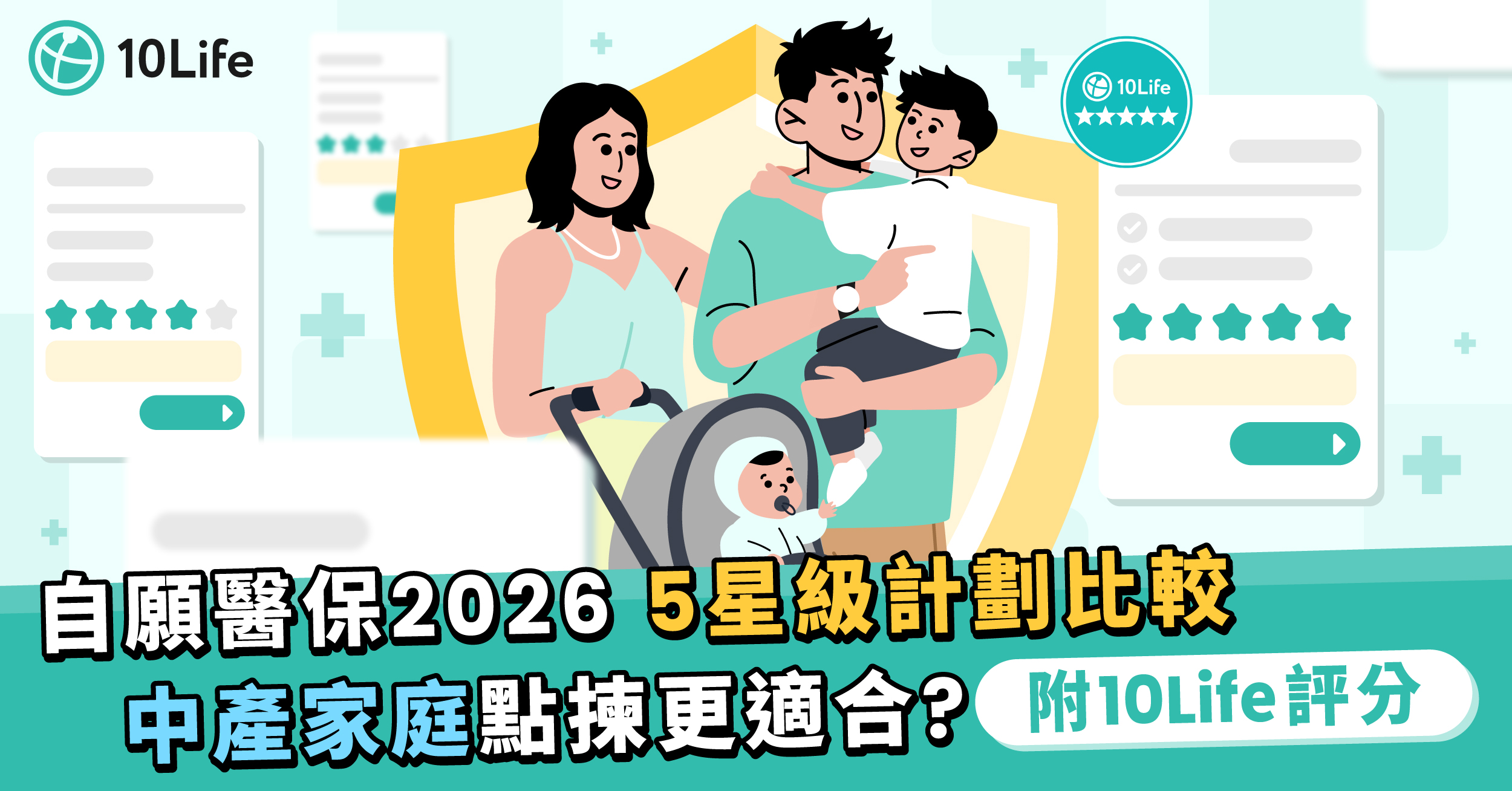
The 4 most common considerations for middle-class families buying VHIS
Medical insurance premiums generally increase with age and rising healthcare costs. Therefore, in addition to comparing the premiums for the first year, it is also worth considering long-term affordability. Some products offer a discount for the first year, making the initial premium particularly attractive. However, premiums will revert to the standard rate thereafter, and increases resulting from medical inflation may place greater pressure on your finances over the long term. To understand the reasons for and trends in rising medical insurance premiums, you can use our Voluntary Health Insurance Scheme VHIS premium increase calculator for an assessment.
Further reading: 10Life insight: Medical insurance premiums are becoming increasingly expensive — medical inflation may not be the only driving force
As your family grows with the arrival of children, your medical protection needs may also change. From initially considering personal protection only, you may later place greater emphasis on family needs, the stability of your coverage and long-term healthcare planning, which may lead to different considerations when taking out a policy.
Many employees already have company medical insurance, but the level of cover may not be sufficient, and coverage will generally end when they leave the company or retire. As a result, many people also consider taking out additional VHIS cover in the hope of obtaining longer-term and more stable medical protection.
In addition to the level of cover, some people also consider the hospital experience, such as the level of privacy in the ward, arrangements for accompanying family members and overall comfort. Therefore, many middle-class families consider semi-private room plans in the hope of striking a balance between protection and budget.
What is the difference between a semi-private room and a general ward?
When choosing VHIS, many middle-income families consider the semi-private room level. Compared with a general ward, a semi-private room usually accommodates fewer patients and offers greater privacy, but room charges, doctors’ fees and operating theatre fees for semi-private rooms are 1.5 to 2 times higher. Therefore, premiums for semi-private rooms are also higher than those for general wards.
For families with children, hospital accommodation arrangements may also be a consideration. For example, semi-private rooms are generally larger, making it more convenient for parents to stay overnight and provide care.
Use a deductible plan to reduce premiums while complementing your company medical insurance
10Life 5-star Voluntary Health Insurance plans can cover the vast majority of medical expenses for 12 common illnesses and injuries, including cancer and vascular diseases. They achieve a rating of 9.5 or above and demonstrate resistance to medical inflation, meaning that the benefit limits can meet continuously rising medical costs. Factors considered include whether the plan provides full coverage and whether it has a high annual policy benefit limit.
In fact, many 5-star products offer very similar levels of coverage, so premium arrangements are also worth comparing in addition to the scope of coverage. Taking premiums for a 35-year-old as an example, plans without a deductible generally cost over $10,000, which may not be an affordable commitment for everyone.
If you wish to balance coverage and budget, or already have company medical insurance, middle-class families may consider 5-star VHIS plans with a deductible. Many people choose deductibles of $20,000 to $25,000 to complement their company medical insurance and obtain ideal medical protection. VHIS plans with a deductible can also significantly reduce premiums.
(Assuming non-smoking males aged 5 and 35, coverage area: Asia, deductible: $20,000–25,000)
| Plan | 10Life Rating | Premium at age 5 | Premium at age 35 | Deductible | Common illnesses claim payout ratio | Cancer coverage ratio | Annual limit | Lifetime limit |
| FWD | FWD vPrime Signature Medical Plan (Standard) | 9.7 | $2,066 $ | $3,163 $ | $25,000 | 98.3% | 97.9% | $15 million | No limit |
| FWD | FWD vPrime Medical Plan | 9.7 | $2,433 $ →Apply now← | $3,727 $ →Apply now← | $25,000 | 98.3% | 97.9% | $16.5 million | No limit |
| AIA | AIA AIA Voluntary Health Insurance Privilege Ultra Scheme | 9.6 | $4,384 | $7,664 | $25,000 | 98.3% | 97.9% | $12 million | $60 million |
| Manulife | Manulife Manulife Supreme VHIS Flexi Plan (Select) | 9.5 | $4,724 | $7,338 | 22,800 | 98.3% | 97.9% | $12 million | $60 million |
| Chubb Life | Chubb Life Chubb VHIS - Prime Plan | 9.5 | $8,456 | $6,390 | 25,000 | 98.3% | 97.9% | $10 million | $40 million |
| AXA | AXA AXA Hong Kong and Macau WiseGuard Pro Medical Insurance Plan (Enhance) | 9.5 | $4,309 | $6,856 | 25,000 | 98.3% | 97.9% | $25 million | No limit |
| Cigna Healthcare | Cigna Healthcare Cigna VHIS Series – Flexi Plan (Superior) | 9.5 | $2,640 50% off first-year premium →Apply now← | $3,284 50% off first-year premium →Apply now← | 25,000 | 98.2% | 97.9% | $30 million | No limit |
| Sun Life | Sun Life WeHealth Prestige | 9.5 | $4,820 | $6,821 | 20,000 | 98.3% | 97.9% | $10 million | $40 million |
| Blue Cross | Blue Cross Blue Cross Dynasty VHIS Plan | 9.4 | $5,319 | $7,799 | 20,000 | 97.9% | 97.5% | $10 million | $48 million |
| China Taiping | China Taiping Taiping Life VHIS Priority Plan | 9.4 | $3,820 | $6,498 | 20,000 | 97.0% | 96.4% | $20 million | No limit |
| PrudentialPrudential PRUHealth VHIS VIP Plan | 9.3 | $4,996 | $6,698 | 20,000 | 97.6% | 97.9% | $12 million | $56 million |
| Note: 1. Ranked by overall rating (highest to lowest). 2. Premium information updated to 29 May 2026. | ||||||||
Do not only look at the premiums and overall limits; also compare the detailed coverage
When comparing VHIS, premiums and annual limits are naturally key considerations, but the factors that truly affect claims are often hidden in the details of individual coverage items. In addition to the overall figures, policyholders can further review the key coverage areas of each plan, including prescribed non-surgical cancer treatments, pre-hospitalisation and post-hospitalisation outpatient care, daytime haemodialysis and home nursing care.

| Plan | Prescribed non-surgical cancer treatment | Pre-hospitalisation outpatient | Post-hospitalisation outpatient | Home nursing care | Daytime haemodialysis coverage | Annual psychiatric limit (hospitalisation only) |
| FWD | FWD vPrime Signature Medical Plan (Standard) | No limit + additional $2 million/year | Up to 32 times | All within 90 days | 196 days | No limit + additional $2 million/year | $40,000 |
| FWD | FWD vPrime Medical Plan | No limit + additional $2.5 million/year | Up to 32 times | All within 90 days | 196 days | No limit + additional $2.5 million/year | No limit |
| AIA | AIA AIA Voluntary Health Insurance Privilege Ultra Scheme | No limit | All within 31 days before hospitalisation | 90 days (365 days for major surgery) | 196 days | No limit | $40,000 |
| Manulife | Manulife Manulife Supreme VHIS Flexi Plan (精選) | No limit | Up to 31 times | 90 times within 90 days | 30 days | No limit | No limit |
| Chubb Life | Chubb Life Chubb VHIS - Prime Plan | No limit | Up to 31 times | 12 times within 90 days | 60 days | No limit | $50,000 |
| AXA | AXA AXA Hong Kong and Macau SmartHealth Medical Protection (Superior) | No limit | 30 days before hospitalisation All | 90 days (180 days for major surgery) | 90 days | No limit | $30,000 |
| Cigna Healthcare | Cigna Healthcare Cigna VHIS Series – Flexi Plan (Superior) | No limit | All within 30 days before hospitalisation | All within 90 days | 90 days | No limit | No limit |
| Sun Life | Sun Life WeHealth Prestige | No limit | Up to 31 times | 90 times within 90 days | 30 days | No limit | $40,000 |
| Blue Cross | Blue Cross Blue Cross Dynasty VHIS Plan | No limit | Up to 2 times | All within 90 days | 196 days | No limit | $60,000 |
| China Taiping | China Taiping Taiping Life VHIS Priority Plan | $2.5 million | 30 days before hospitalisation All | 3 times within 90 days | 200 days | No limit | No limit |
| PrudentialPrudential PRUHealth VHIS VIP Plan | No limit | Up to 31 times | All within 90 days | 30 days | No limit | No limit |
| Note: 1. Ranked by overall score (highest to lowest). 2. Information updated as at 29 May 2026. | ||||||
How to interpret the coverage details of VHIS?
The scope of cover under the Voluntary Health Insurance Scheme varies from product to product. Even among 5-star plans, there may still be differences in the details of the cover. You should review each item carefully to avoid discovering that the cover differs from your expectations only when making a claim.
Prescribed non-surgical cancer treatments generally cover the costs of chemotherapy, radiotherapy, targeted therapy and immunotherapy, which often account for a significant proportion of cancer treatment expenses. Most 5-star plans provide unlimited cover, but some plans still impose annual limits. For example, the cancer treatment cover under the China Taiping 優遇 Plan is capped at HK$2.5 million per year, representing a notable difference compared with plans without an upper limit.
When comparing pre- and post-hospitalisation outpatient cover, you should note whether it covers “all outpatient consultations within a specified number of days” or imposes a “maximum number of visits” limit. As shown in the table, some plans cover all relevant outpatient consultations within 30 to 31 days before hospitalisation, offering greater flexibility, while others limit cover to a maximum of 31 or 32 visits. Blue Cross offers the most limited cover, with a maximum of only 2 visits. For outpatient consultations after discharge, although many plans impose no restriction on consultations within 90 days after discharge, 安達 and China Taiping only impose limits on the number of visits.
In addition, before taking out a policy, policyholders should carefully review the relevant terms, such as whether examinations, physiotherapy or long-term follow-up care are covered, whether a limit applies to each treatment session, and whether a doctor’s referral or pre-authorisation is required. This can help avoid discovering that the cover is insufficient only when making a claim.
Home nursing care generally refers to nursing services received at home after discharge. For example, following a serious illness, severe injury or major surgery, the insured person may require assistance from nursing staff with daily care and rehabilitation. The number of days covered by different plans ranges from 30 days to approximately 200 days, representing a substantial difference.
If the policyholder lives alone or there may be no one at home who can provide care for an extended period, particular attention should be paid to whether the home nursing care cover is sufficient, to avoid having to make additional out-of-pocket arrangements for nursing support after discharge.
Daytime haemodialysis, commonly known as “kidney dialysis” or “blood dialysis”, requires regular and ongoing treatment, and can therefore involve considerable long-term medical expenses. Most 5-star plans provide unlimited cover for daytime haemodialysis, offering a relatively comprehensive level of protection overall. The two FWD plans additionally provide separate annual benefits of HK$2 million and HK$2.5 million respectively.
As haemodialysis is usually a long-term and regular treatment, cumulative medical expenses can be substantial. People at high risk of kidney disease or with a relevant family medical history should still carefully review the relevant terms before taking out a policy, including whether additional designated cover is provided, the limits applicable to each treatment session and the claim requirements.
Psychiatric cover has attracted increasing attention in recent years, but the differences in annual limits between plans are significant. Some plans provide unlimited annual cover, while others impose specified monetary limits ranging from approximately HK$30,000 to HK$60,000.
However, it should be noted that psychiatric cover under the Voluntary Health Insurance Scheme generally applies only to inpatient treatment. If you simply consult a psychiatrist or psychologist at a private clinic, or receive counselling services, these will generally not fall within the scope of cover.
Which 5-star VHIS plan is right for you? First, look at 3 common scenarios
Many employees already have company medical insurance, but the scope of cover is often limited and may not cover all hospitalisation expenses. In this case, you may consider choosing a Voluntary Health Insurance Scheme plan with a deductible (such as $20,000 to $25,000)—the company medical insurance will first cover part of the medical expenses, while the VHIS plan covers the excess. This avoids duplicate cover while effectively reducing premium costs.
It is important to note that if you leave your job or your company cancels its medical benefits in the future, VHIS cover can continue, providing a long-term safety net.
Further reading: 【Voluntary Health Insurance】 Standard ward vs semi-private room plan: which is better? (Comparison of premiums from 8 insurance companies)
Children have weaker immune systems, and influenza viruses spread quickly. Their condition can sometimes deteriorate within a short period, and in serious cases, hospital observation or treatment may be required. For parents, arranging medical cover for their children is not just about meeting medical expenses; it is also about ensuring that their children can receive appropriate treatment and hospital arrangements more quickly when needed.
During the peak influenza season, demand for private hospital beds increases, and a standard ward may not have an available bed immediately. If parents would like their children to be admitted to a semi-private room, which is quieter and more spacious, depending on their condition and bed availability, they should pay attention to whether the insurance plan's room-level cover and benefit limits are sufficient to meet the relevant hospitalisation expenses.
When young children are admitted to hospital, parents generally hope to stay by their side to provide care, such as comforting them, helping with meals, attending to them during the night and communicating with medical staff. However, space in a standard ward is limited, and arrangements for parents to stay overnight may also be restricted by hospital policies and safety considerations. In comparison, semi-private rooms are more spacious, which may be more convenient for parents who need to accompany their children for extended periods.
Therefore, many parents take out insurance early while their children are still young. If hospitalisation becomes necessary, parents can choose more suitable treatment and hospital arrangements based on their child's condition, bed availability and the family's needs. When choosing children's medical insurance, in addition to the sum insured, the following points are also worth noting:
VHIS premiums increase with age. Some plans offer attractive premiums when you are young, but the increases become more significant after the age of 50. When choosing a plan, in addition to comparing the first-year premium, it is also advisable to consider the average premium over 10 years and assess whether the long-term financial commitment is sustainable.
In terms of cover, you may wish to focus on comparing the annual benefit limit and lifetime benefit limit. The higher the limits, the more comprehensive the cover will be in the event of a serious illness or long-term treatment.
Would you like to understand the premium increases in advance? You can use the VHIS premium calculator to simulate premium changes at different ages before making a decision.
There are various forms of Voluntary Health Insurance; it is advisable to consult an expert before taking out a policy.
VHIS involves various factors, including room type, deductibles, co-insurance, geographical coverage and long-term premium arrangements. Even among 5-star products, different combinations may suit different needs. Different companies may have different underwriting requirements, so customers with pre-existing medical conditions should take particular care to understand the details.
If you would like to compare 5-star VHIS combinations that suit your needs, you can use the 10Life product comparison tool, or WhatsApp contact a 10Life insurance adviser for enquiries.
Note:
The maximum tax deduction per insured person for each year of assessment is HK$8,000.
10Life calculates the estimated average coverage based on medical expenses under general circumstances for multiple common cases of illnesses and injuries involving different levels of severity and medical services, and by comparing these with the benefit limits of medical products through analysis by 10Life actuaries. For details, please refer to 《Medical Insurance Rating Methodology》. The estimated coverage ratios for the above cases of illnesses and injuries are calculated based on the estimated medical expenses for the relevant illness or injury under general circumstances. They are intended to indicate the estimated medical expenses that medical insurance and consumers may have to bear, are for reference only, and have not been confirmed by the relevant insurance companies.
“Full coverage” means that the insurance company will pay in full the eligible medical expenses and other expenses after deducting the balance of the deductible (if any), subject to the coverage limit per policy year (if applicable), lifetime coverage limit (if applicable), coverage limit per illness or injury per policy year (if applicable) and/or other relevant conditions. Full coverage applies only to specified benefit items, while other benefit items are subject to the benefit limits applicable to the relevant items. Claims must meet the requirement of being “medically necessary”, and the expenses must be “reasonable and customary”.
This English version of this article has been generated by machine translation powered by AI. It is provided solely for reference purposes. In the event of any discrepancy or inconsistency between this translation and the original Chinese version, the Chinese version shall prevail.
10+ years in editing & copywriting. I love solving puzzles — now my goal is making insurance jargon simple. Let's decode policies and learn together.
10+ years in editing & copywriting. I love solving puzzles — now my goal is making insurance jargon simple. Let's decode policies and learn together.
10Life Product Comparison and 10Life Insurance Ratings are developed by 10Life Financial Limited, an authorised insurance broker company licensed with the Insurance Authority under License Number FB1526. 10Life Product Comparison and 10Life Insurance Ratings are developed for generic customer segments using mathematical calculations based on product information, facts and data, and are not influenced by any partnerships with or fees received from insurance companies. Any information on 10Life Platform ("10Life Information"), including but not limited to Product Comparison, Product Ratings, Blog Articles are intended for general education purpose and reference only. None of the 10Life Information is intended, nor should they be considered or relied upon, as regulated advice, insurance, financial, investment or professional advice, recommendation, approval, endorsement, invitation or solicitation in respect of any insurance, financial or investment products. 10Life Information does not take into account your individual needs. Reading 10Life Information should not be considered as conducting a suitability assessment, and is not sufficient to form the basis of any decisions to purchase any insurance products. You should rely on information authorised by insurance companies, carry out your own research and/or seek independent advice from licensed intermediaries before purchasing any insurance products or making any insurance decisions. While reasonable effort is used when collecting, validating and updating 10Life Information from various channels, none of 10Life Group and its subsidiaries, affiliates, agents, directors, officers and employees will be responsible for any liability, claim or loss arising from or associated with you using 10Life Information. No warranty, representation or guarantee is given by 10Life Group and its subsidiaries on the accuracy, completeness and timeliness of the information. If you have any questions on 10Life Product Comparison and 10Life Insurance Ratings, please email us at enquiries@10life.com




 Talk to 10Life on WeChat
